

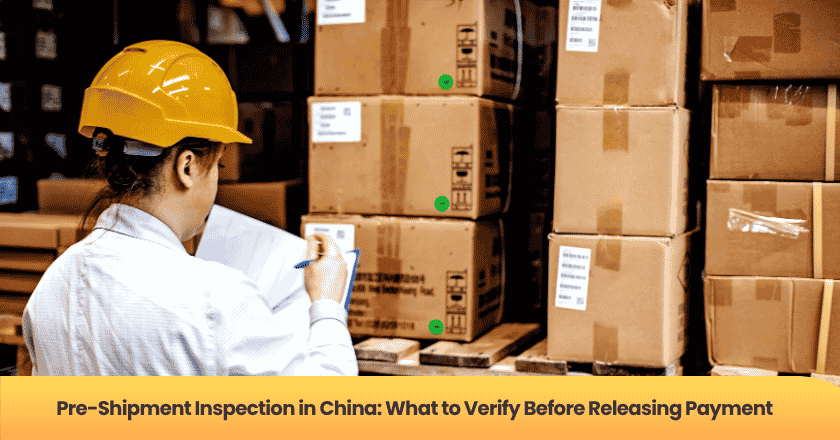
A pre-shipment inspection is the last point at which quality issues can be caught before goods leave China. The right checklist turns inspection from a vague "look at the goods" exercise into a structured verification of contractual specifications. Here's what should be on it.
Key Takeaways
- Pre-shipment inspection (PSI) is conducted when production is 80–100% complete and goods are packed for shipment. The inspection verifies that production matches PO specifications before goods leave the factory.
- AQL (Acceptable Quality Limit) sampling is the industry standard. AQL 2.5 / 4.0 (Major / Minor) per ISO 2859-1 means specific sample sizes drawn from the production lot, with defined accept/reject thresholds.
- A complete PSI covers: quantity verification, product-against-spec verification, function testing (where applicable), packaging and labeling, carton markings, dimensions and weight, defect classification per AQL, and final accept/reject recommendation.
- Inspection cost: USD 250–550 per inspector-day, typically 1 day for orders up to 5,000 units, 2 days for larger orders. Cheap relative to the cost of receiving rejected or returned goods.
- A complete PSI checklist should include: an AQL sampling chart per ISO 2859-1, a general inspection checklist, packaging and labeling verification, function test forms specific to the product, and a structured inspector summary report. The framework is standardized; product-specific customization is what makes it actually useful.
- Common PSI failures: defect rate exceeds AQL, packaging differs from spec, labeling errors, missing certifications/test reports, product specifications changed from approved sample.
- Inspection scheduling needs 5–7 days advance notice. Most major inspection firms (SGS, QIMA, BV, AsiaInspection) offer same-day reporting after inspection.
For US importers buying from Chinese suppliers, pre-shipment inspection (PSI) is the operational checkpoint that determines whether you receive what you ordered or what the supplier decided to send. Done well, PSI catches quality issues, packaging errors, quantity discrepancies, and specification deviations before goods leave China — when the supplier still has incentive to fix problems and before the goods are halfway across the Pacific.
Done poorly, PSI is a checkbox exercise: an inspector visits the factory, takes some photos, signs a form, and declares the goods "OK." The buyer feels protected but isn't. Quality problems still surface at the destination warehouse, by which point the supplier has been paid, the goods have crossed the ocean, and recovery options are limited and expensive.
This guide walks through what a meaningful PSI actually verifies — the elements an inspector should cover on every pre-shipment visit, regardless of who's running the inspection. Use this framework as the basis for your own inspection brief, customize for your specific products, and require inspectors to complete every element as part of their written report.
Why Most PSIs Don't Catch What They Should
Three patterns we see when reviewing PSI processes from new clients.
Pattern 1: Vague inspection scope. The inspector is told "inspect the goods" without specific criteria. They fall back to default checks (visible defects, count verification) but miss specification-level issues that require comparing against the actual PO and approved sample.
Pattern 2: No AQL framework. Inspectors look at "quality" subjectively. Without statistical sampling and defined accept/reject thresholds, the assessment is impressionistic. A 2% defect rate and a 6% defect rate look similar to a tired inspector at the end of a long day.
Pattern 3: Pressure from supplier and tight timelines. Inspector arrives, factory is in a hurry to ship, supplier representative is friendly and helpful. Inspector signs off on goods that should have been flagged because the alternative is delaying shipment and creating supplier conflict.
The framework below addresses all three: structured scope, AQL-based sampling, and clear accept/reject decision framework that an inspector can defend.
The Six Elements of a Complete PSI
1. Quantity verification
The simplest check, often skipped or rushed. Verify the total carton count matches PO quantity. Random sample of cartons opened to verify carton contents match labeling (e.g., a carton labeled "100 units" actually contains 100 units, not 96 or 104).
For mixed-SKU shipments: verify SKU mix matches PO. A common supplier shortcut is shipping more of the easy-to-produce SKUs and fewer of the difficult ones.
2. AQL sampling and defect classification
ISO 2859-1 specifies sample sizes by lot size and inspection level. Common parameters: General Inspection Level II (default), AQL 2.5 for Major defects, AQL 4.0 for Minor defects.
For a lot of 1,200 units at General Inspection Level II:
Sample size: 80 units
Major defect acceptance: 5 (reject if 6+ major defects found)
Minor defect acceptance: 7 (reject if 8+ minor defects found)
Critical defects: 0 (any critical defect rejects the lot)
Defect classifications:
- Critical defects: Safety hazards, regulatory non-compliance, completely non-functional. Zero tolerance.
- Major defects: Product affects normal use, significantly reduces marketability, or is highly visible. AQL 2.5.
- Minor defects: Visible imperfections that don't affect use or significantly reduce marketability. AQL 4.0.
Each inspection checklist should have product-specific examples of each defect class. Generic AQL without product-specific defect examples produces inconsistent inspections.
3. Specification verification
Inspector compares sample units against the approved production sample (which the supplier should have on file at the factory) and against PO specifications.
Verify:
Dimensions within tolerance
Materials match specification (visual + sometimes touch confirmation; not chemical testing at PSI stage)
Color matches specified Pantone
Function operates correctly (for functional products)
Branding, labels, decorations match approved sample
This is where supplier substitution gets caught — the production sample matched spec, but production batch shows material differences.
4. Function testing
For functional products: power-on testing, operating verification, simple performance checks. The PSI test isn't a full lab evaluation but does verify "does it work?"
For electronics: power on, basic functions, wireless connectivity, battery charging. For toys: motion, sound, mechanical components. For appliances: power, primary function, basic settings.
The number of units tested for function depends on product type: 100% for high-value electronics, statistical sample for consumer goods.
5. Packaging and labeling verification
Inner packaging matches spec (color, material, branding). Outer carton dimensions, weight, markings. Country of origin marking. Tracking labels for children's products. Barcodes scan correctly. Carton drop test for fragile items.
This is where shipping-related quality issues get caught — products that pass production QC but have packaging issues that cause damage in transit.
6. Documentation verification
Test reports for regulatory compliance (CPSIA, FCC, CE, RoHS as applicable). Certificate of origin if required. Material certifications (E1 formaldehyde, food grade, etc.). Carton labels include all required information.
Some PSI scopes don't include documentation review — that's a gap. The buyer needs assurance that compliance documentation exists before shipment, not after CBP raises questions.
What to Specify in Your Inspection Brief
Before the inspection, the buyer (or their sourcing agent) should provide the inspection firm with:
1. PO copy with detailed product specifications.
2. Approved production sample (or detailed photos and dimensions of the approved sample).
3. Defect classification list — what counts as critical vs major vs minor for this specific product. Generic defect lists miss product-specific issues.
4. AQL sampling parameters. Standard AQL 2.5/4.0 unless your product justifies different thresholds.
5. Specific tests to perform — function tests, packaging tests, any product-specific verification.
6. Documentation requirements — what compliance certifications must be present.
7. Lot size so inspector knows sampling requirements.
8. Inspection date and access arrangements — production must be 80%+ complete and goods packed.
The detailed brief is the difference between a checklist exercise and a meaningful verification.
Common Mistake: Buyers schedule PSI without providing detailed inspection briefs. The inspection firm uses generic checklists, the inspector spends 2 hours doing visual quality assessment, and signs off on goods that meet generic standards but don't meet the specific buyer requirements. The PSI happens, the buyer paid for it, but it didn't catch what it should have. The fix is investing 30 minutes in detailed inspection briefing for each unique product.
PSI Cost and Scheduling
Inspector cost: USD 250–550 per inspector-day. Major firms (SGS, QIMA, BV, AsiaInspection, TÜV) operate at the higher end. Smaller specialized firms at the lower end. Quality differential exists but isn't always proportional to price.
Inspection duration: 1 day for orders up to ~5,000 units. 2 days for larger orders. 3+ days for very large orders or complex products.
Scheduling lead time: 5–7 days advance notice for most firms. Same-week scheduling sometimes available at premium pricing. Peak season (pre-Chinese New Year, pre-Christmas) requires longer lead times.
Reporting: Most firms provide same-day or next-day reporting after inspection. Reports include photos of defects found, AQL calculations, accept/reject recommendation, and any specific issues noted.
Re-inspection: If goods fail PSI and supplier reworks, re-inspection is required. Cost is similar to original PSI; timeline impact is significant (typically 1–2 weeks delay).
Function-Specific PSI Considerations by Category
PSI scope varies by product category. Function-specific checklist considerations include:
General consumer goods: standard quality, function, packaging checks.
Electronics: power-on testing, wireless connectivity, battery, charging port, electromagnetic interference visible signs.
Toys / children's products: small parts (16 CFR 1501), tracking labels, age-grading consistency, choking hazard verification, sharp edges.
Apparel: stitching quality, color consistency, sizing, shrinkage indicators, label accuracy.
Furniture: structural integrity, finish quality, hardware function, packaging for shipping damage prevention.
Cosmetics / personal care: packaging integrity (no leakage), label accuracy, batch coding present, primary container function (pumps, dispensers).
Each section is a starting point. Customize for your specific products.
Expert Tip: When choosing an inspection firm, prioritize their specific category experience over price. A firm with 100 inspections of similar products in your category will catch things a generalist firm with broader but shallower experience won't. Ask the firm specifically: "How many [product type] inspections has your team done in the past 12 months? Can you provide a sample inspection report from a similar product?" Specific answers separate experienced firms from generalists. Commission-free sourcing agents typically include in-house inspection coordination as standard practice and have established relationships with category-specialized inspection firms — saving the buyer the work of vetting inspection firms separately.
What to Do When PSI Fails
A failed PSI (defect rate exceeds AQL, specification deviations, packaging issues) creates a decision point with three options:
Option A: Reject the lot. Most protective. Supplier must rework or remake. Significant timeline impact (typically 2–4 weeks for rework + re-inspection). Use when defects are critical or when accepting would damage brand quality.
Option B: Accept with rework. Supplier sorts and reworks defective units before shipment. Faster than full rejection (typically 1–2 weeks delay). Use when defects are correctable and production is largely acceptable.
Option C: Accept with negotiated discount. Buyer accepts goods at reduced price reflecting quality issues. Fastest resolution (no shipping delay). Use only for minor issues; sets bad precedent if used for major quality problems.
The right response depends on defect severity, timeline pressure, and supplier relationship. Document the decision in writing — "we accepted this lot with X% discount due to Y issues" — to maintain enforcement leverage on future orders.
The Bottom Line
Pre-shipment inspection is the operational checkpoint that determines whether you receive what you ordered. The cost is small (USD 250–550 per day) relative to the cost of receiving substandard goods (cross-Pacific shipping, customer complaints, returns, brand damage).
A meaningful PSI requires three things: AQL-based sampling with defined accept/reject thresholds, product-specific defect classification, and a detailed inspection brief that gives the inspector clear scope. Generic "look at the goods" inspections rarely catch what they should.
The framework above is a working starting point. Build a checklist from it, customize for your specific products, provide it to your inspection firm as part of the brief, and require inspectors to complete every element as part of their report. The 30 minutes invested in inspection brief preparation is among the highest-ROI work in any sourcing program.
For brands running ongoing sourcing programs, integrating PSI into standard process — not as an afterthought — is the difference between a quality-managed supply chain and a quality-by-luck supply chain.
FAQ
When should the PSI happen?
When production is 80–100% complete and goods are packed for shipment. Earlier inspections (during production) catch issues earlier but don't verify final packed goods. The standard PSI happens at the very end, immediately before shipment. Some buyers run both — in-process inspection at 50% complete + final PSI at 100% complete — for high-stakes orders.
What's the difference between AQL 2.5 and AQL 4.0?
The AQL number specifies the maximum acceptable defect rate as a percentage. AQL 2.5 means up to 2.5% defective is acceptable for that defect class. AQL 4.0 allows up to 4.0%. Standard practice: AQL 2.5 for Major defects (more strict), AQL 4.0 for Minor defects (less strict). For premium products, some buyers use AQL 1.0/2.5 (stricter); for commodity products, AQL 4.0/6.5.
Can I do the inspection myself if I'm in China?
Yes for buyers actively in China during production. Self-inspection is fine technically but loses the third-party verification value. For PO contracts that specify "inspection by Buyer's designated third-party inspection agency," self-inspection doesn't satisfy the contract. The third-party inspection report has more enforcement value if disputes arise.
What if my supplier resists allowing inspection?
Major red flag. Reputable suppliers welcome PSI because it validates their work. Suppliers who resist inspection typically have something to hide — quality issues they don't want surfaced, or documentation gaps. The PO contract should specify inspection rights; suppliers who resist may be violating the contract terms. Persistent resistance is grounds for relationship review.
Can I just trust the supplier's own quality control?
Self-inspection by suppliers is necessary but not sufficient. The supplier has a financial interest in passing their own goods. Independent inspection — by you, your sourcing agent, or a third-party firm — adds the verification that protects your interests. For low-stakes commodity orders with established suppliers, supplier self-inspection may be acceptable; for higher-stakes orders, independent PSI is cheap insurance.
How quickly can I get an inspection report after the inspection?
Most major firms: same-day or next-day. Specialized firms with detailed reporting: 2–3 days. Reports typically include photos of defects, AQL calculations, specific issues, and accept/reject recommendation. Negotiate report timing with your inspection firm if speed is critical for your decision-making.
Should I attend the inspection in person?
For first orders with new suppliers: highly recommended if logistically feasible. The first PSI sets quality precedent for ongoing orders, and being present clarifies expectations. For ongoing orders with established suppliers: not necessary; competent third-party inspection plus written reporting is sufficient.
NewBuyingAgent
Related Resources


Commencer aujourd'hui
Transformons vos objectifs d'approvisionnement en réalitéWeChat:+86 15157124615
WhatsApp:+86 15157124615
Adresse : Bâtiment 10 #39 Xiangyuan Road, Hangzhou, Chine
