

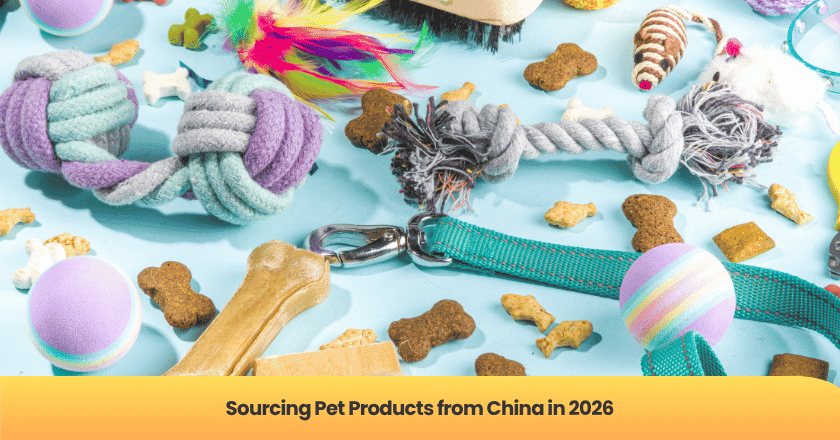
Pet products is one of the fastest-growing China sourcing categories — and one of the most diverse. A single brand might need silicone food bowls, electronic smart feeders, fabric carriers, and stainless steel water fountains, each from a different cluster, each with different compliance requirements.
Key Takeaways
- The global pet care market exceeded $260B in 2024 with consistent 5–7% annual growth. China dominates global pet product manufacturing across most categories — toys, accessories, electronic devices, basic food and treat packaging, grooming tools.
- Pet products break into five sourcing-distinct categories: silicone/rubber items (food bowls, toys), fabric goods (carriers, beds, apparel), electronics (smart feeders, cameras, automated litter boxes), metal products (cages, fountains, leashes), and consumables (treats, supplements — heavily regulated).
- Food-grade silicone certification (FDA 21 CFR 177.2600) is essential for any silicone product that contacts pet food or water. Quality varies sharply between Chinese suppliers; specifying and verifying is critical.
- Smart pet electronics (cameras, automated feeders, GPS trackers) require FCC certification for US market and CE for EU. Battery-powered devices need UL certification for safety. Quality factories handle this; trading-company sourcing often produces incomplete documentation.
- Major pet product clusters: Yiwu and Ningbo (general accessories and small goods), Dongguan and Shenzhen (electronics and smart devices), Qingdao and Tianjin (metal cages, larger items), Hangzhou (silicone specialty manufacturers).
The global pet care market is one of the most consistent growth stories in consumer goods. US household pet ownership reached 70%+ in 2024, with millennial and Gen Z owners spending dramatically more per pet than previous generations. Premium pet products — orthopedic beds, smart feeders, ventilated carriers, ergonomic harnesses, GPS trackers — have created entire new product subcategories that didn't exist a decade ago.
China dominates the manufacturing side of this market across most non-food categories. Silicone bowls, fabric carriers, stainless steel water fountains, smart feeding stations, automated litter boxes, training devices, leashes, harnesses, toys, grooming tools, and accessories are predominantly Chinese-made and shipped globally. The major Western pet retail brands (Chewy, Petco, PetSmart, plus Amazon's growing pet category) source the vast majority of their non-food private label and branded products from Chinese factories.
For US importers building pet product brands or expanding pet category offerings, China remains the structural default despite the 2026 tariff environment. This guide walks through the sourcing-relevant subcategories of pet products, what each requires, where the major clusters are, and what the realistic sourcing process looks like for a brand entering this market.
Part 1: The Five Sourcing-Distinct Pet Product Categories
Pet products are not a single sourcing category — they're five distinct categories, each with different supplier types, different compliance requirements, and different cluster geography.
Category 1: Silicone and rubber products
Food bowls, water bowls, lick mats, slow feeders, chew toys, mat pads, collapsible bowls, freeze molds. Increasingly important as silicone has become the dominant material for premium pet feeding products.
Suppliers: specialized silicone factories (Hangzhou, Shenzhen, Dongguan have major clusters). Many factories run injection molding for both human-grade kitchenware and pet products on the same equipment; spec discipline is critical.
Critical compliance: FDA 21 CFR 177.2600 food-grade silicone certification for any product contacting food or water. LFGB (German food contact standard) for EU markets. The cost differential between food-grade and industrial-grade silicone is real — industrial silicone factories will quote dramatically lower prices but the products fail compliance testing.
MOQ profile: 500–2,000 units typical for OEM with custom molds. Stock products available at 100–500 units from Yiwu trading companies.
Category 2: Fabric and textile pet products
Carriers, beds, blankets, apparel, harnesses, leashes (textile portions), cleaning cloths, toys with textile components.
Suppliers: textile factories in Zhejiang (Yiwu, Ningbo, Hangzhou), Guangdong (Dongguan area), and Jiangsu. Many serve both pet and home textile markets.
Critical compliance: REACH (EU) for chemical safety; CPSIA (US) for products with components reachable by children; flammability testing for beds and pads. Pet apparel has additional considerations around comfort, safety (no choking hazards), and sometimes thermal regulation claims.
MOQ profile: 500–1,500 units for OEM with custom designs. Pattern complexity affects MOQ significantly.
Category 3: Smart pet electronics
Automated feeders, water fountains with pumps, smart cameras, GPS trackers, automated litter boxes, interactive toys, training collars (electronic), pet door openers, treat-dispensing cameras.
Suppliers: Shenzhen and Dongguan electronics manufacturers. Most are general consumer electronics OEMs with growing pet product specialization. Tier 1 electronics manufacturers (Foxconn-scale) don't typically engage in pet electronics; the work concentrates in mid-size Bao'an and Dongguan factories.
Critical compliance: FCC certification for any wireless device (Wi-Fi, Bluetooth, cellular for GPS trackers). UL certification for products with batteries or AC power. CE for EU. Privacy compliance for cameras (especially in EU under GDPR).
MOQ profile: 1,000–3,000 units typical for OEM. Complex devices with custom firmware can require 3,000+.
Category 4: Metal products
Cages, crates, water fountains (metal/glass), fixed feeders, pens, gates, leashes (metal portions), grooming tools, food storage containers.
Suppliers: Qingdao, Tianjin, Hebei region (large metal goods); Yongkang for hardware; Jiangsu for stainless steel kitchenware-equivalent products.
Critical compliance: lead and heavy metal testing for water-contact products. FDA food contact for stainless steel feeding products. Sharp edge testing for cages. Powder coating durability for outdoor products.
MOQ profile: 500–2,000 units depending on product size. Large metal products (large cages, gates) have lower MOQs because per-unit cost is higher.
Category 5: Pet treats, food, and supplements
Pet jerky, dental chews, supplements, treats. Note: this category is heavily regulated in US (FDA, AAFCO requirements) and is generally not advisable as a starting point for new China-sourcing programs. Many brands sourcing pet food/treats from China have faced recalls and import alerts. Most premium US pet brands manufacture food domestically.
If sourcing pet consumables from China is required:
- AAFCO compliance for nutritional content claims
- FDA registration for facility (similar to MoCRA but under different statute)
- AFFL (Association of American Feed Control Officials) labeling requirements
- Heavy metal and contaminant testing
We don't generally recommend this category for new buyers without specific regulatory expertise.
Part 2: Major Pet Product Clusters in China
Five geographic clusters dominate Chinese pet product manufacturing.
Yiwu (Zhejiang) — small accessories and trading hub
Yiwu's massive small commodities market is the global trading hub for pet accessories at small-batch volumes. The market includes thousands of pet product vendors selling everything from collars and leashes to small toys to silicone bowls. Best for buyers needing variety across many SKUs at moderate volumes.
What to source from Yiwu: small accessories, trial orders across multiple SKUs, products where consolidation across suppliers matters more than per-SKU specialization.
What not to source: complex electronics, large products, regulated compliance categories.
Ningbo (Zhejiang) — kitchen-adjacent and consumer goods
Ningbo is a major consumer goods manufacturing hub with significant pet product capability — food bowls, feeders, water containers, basic accessories. Many factories also produce home kitchenware and apply similar manufacturing capability to pet products.
What to source from Ningbo: feeding products (bowls, feeders, water fountains), basic accessories, mid-volume general pet products.
Dongguan and Shenzhen (Guangdong) — electronics and smart devices
The major Chinese electronics manufacturing region. Smart pet electronics — automated feeders, cameras, GPS trackers, electronic training devices — concentrate here. Higher unit costs than other clusters but better engineering and certification capability.
What to source from Dongguan/Shenzhen: smart pet electronics, products with significant electronic components, products requiring FCC/CE certification depth.
Hangzhou and Wenzhou (Zhejiang) — silicone specialists
Several silicone-specialized factory clusters around Hangzhou and Wenzhou produce high-quality food-grade silicone products. Many serve both human kitchenware and pet markets.
What to source from Hangzhou/Wenzhou: premium silicone feeding products, custom silicone molds, food-grade compliance work.
Qingdao and Tianjin (North China) — metal and large goods
Major metal manufacturing regions. Pet cages, large gates, metal feeders, stainless steel products.
What to source from North China: large metal pet products, stainless steel feeding products, durable outdoor pet equipment.
Part 3: Compliance Requirements by Product Type
Pet product compliance varies significantly by product type. Five categories of regulatory requirements.
Food-contact materials (silicone, plastic, stainless steel, ceramic)
US: FDA 21 CFR Part 175–178 covers food contact materials. For pet feeding products, the same standards apply as for human food contact (FDA's position is that pet food contact materials should meet human food contact standards because of cross-contamination potential).
EU: Regulation EC 1935/2004 framework + specific regulations for plastics (10/2011) and other materials. LFGB testing typical.
Critical to verify: food-grade silicone test certificates from accredited labs (not factory-internal claims). Migration testing for plastics. Heavy metal testing for ceramic glazes.
Electronics
US: FCC certification for wireless devices (mandatory). UL certification for safety with batteries or AC power (recommended; sometimes required by retailers). DOE energy efficiency for plugged devices.
EU: CE marking covering applicable directives (Low Voltage, EMC, RED for radio).
Critical: real test reports from accredited labs, not 5-page summary "certificates." Review test reports for completeness.
Children-reachable products
If a pet product could reasonably be reached or used by children under 12 (e.g., pet products in households with kids), CPSIA testing applies. Requires lead, phthalate, and other chemical safety testing.
Cost: USD 500–2,000 per product.
Chemical safety
US: California Proposition 65 for products sold in California (chemical warning labels for listed chemicals).
EU: REACH compliance for chemicals in materials.
Critical for pet products containing: any synthetic dyes (textile products), rubber/latex components, PVC plastics, certain treated metals.
Apparel and textile
Flammability standards (varies by jurisdiction). Care labeling. Country of origin labeling.
For pet apparel specifically: choking hazard testing on small detachable components.
Common Mistake: Buyers source pet products through Yiwu trading companies without verifying compliance documentation. The trading company's own marketing materials show "FDA approved" or "FCC certified" claims, but the underlying test reports are either nonexistent, from non-accredited labs, or for different products than what's actually shipped. When CBP or a major retailer audits, the documentation gaps surface and orders get blocked. The remedy: require copies of underlying test reports (not summary certificates) from accredited international labs (UL, SGS, TÜV, BV) for any product in a regulated category. If the supplier can't provide them, treat the compliance claims as unsupported.
Part 4: Smart Pet Electronics — Specific Sourcing Considerations
Smart pet electronics is the fastest-growing pet product subcategory and the most operationally complex to source.
Common smart pet electronics product types
Automated feeders: Programmable food dispensers with portion control, scheduling, and often smartphone connectivity. Battery + AC powered options.
Water fountains: Filtered water dispensers with pumps. Some with smartphone app integration for filter replacement reminders, water level monitoring.
Pet cameras: Wi-Fi cameras with treat dispensing, two-way audio, sometimes laser pointers. Privacy and data security increasingly important.
GPS trackers: Cellular or Wi-Fi connected trackers worn on collars. Subscription model often integrated.
Automated litter boxes: Self-cleaning litter systems with sensors and motors.
Interactive toys: Battery-powered toys with motion sensors, treat dispensing, or app control.
Smart pet doors: Microchip or RFID-activated pet doors.
Sourcing considerations specific to smart pet electronics
Component sourcing depth: Most smart pet electronics use commodity components (Wi-Fi modules, motor drivers, battery management ICs) sourced from the broader Shenzhen electronics ecosystem. Factories that have established component supplier relationships produce more reliable products than those assembling from spot-purchased components.
Firmware quality: Smart pet electronics include firmware. Firmware quality varies dramatically and significantly affects product reliability. Look for factories with internal firmware development capability rather than outsourced firmware.
App development: Many smart pet products require companion apps. Some Chinese factories develop apps in-house; others use white-label apps that the brand customizes. The app quality often becomes a customer support issue post-launch.
Connectivity standards: Wi-Fi (most common), Bluetooth, Zigbee, Z-Wave, LTE-M (for GPS trackers). Factory capabilities vary by connectivity type.
Privacy and data security: Cameras and connected devices process personal data. EU GDPR has strict requirements; California CCPA equivalent. Buyers should verify factory data handling practices and ensure privacy policies match what factories actually do.
Subscription integration: GPS trackers and some other smart products require ongoing connectivity (cellular). Subscription billing infrastructure is the brand's responsibility but should be considered in product economics.
MOQ and tooling for smart pet electronics
Typical MOQ for a custom OEM smart pet device: 1,000–3,000 units. Tooling investment for new product: USD 5,000–25,000 for moderate complexity, more for products with custom electronics.
Development timeline: 4–8 months from spec to first production-ready samples.
Expert Tip: When sourcing smart pet electronics, request demonstration of working prototypes — not renderings or prototype-only-photos — before committing tooling investment. Functional prototypes reveal manufacturability, firmware quality, and design issues that don't show in visual mockups. Budget USD 500–2,000 for working prototypes per design iteration. Commission-free sourcing agents who can navigate the engineering review process — checking firmware code, evaluating component selections, identifying durability issues — add significant value here. The cost of catching engineering issues during prototype review is much smaller than catching them in field returns.
Part 5: How to Build a Pet Product Line from Scratch
Five-step framework for new pet product brands building a China sourcing program.
Step 1: Define the product category mix
A starter pet brand typically launches 5–15 SKUs. The mix usually spans 2–3 of the five categories. Common starter combinations:
- Premium feeding line (silicone + stainless steel + a small electronic feeder)
- Travel essentials (carriers + portable bowls + leashes)
- Smart device + accessories (one anchor electronic product + companion non-electronic accessories)
The category mix determines the supplier strategy. Single-category brands can work with one specialist supplier per product; multi-category brands typically need either trading-company sourcing or sourcing-agent coordination across multiple specialist suppliers.
Step 2: Map suppliers to categories
For each category in the launch mix, identify 3–5 candidate suppliers. Use a mix of trade shows (Pet Fair Asia in Shanghai is the major industry show), Alibaba/1688 search, and sourcing agent recommendations. Visit the most promising candidates if possible.
Step 3: Sample and verify compliance early
Order samples and run independent compliance testing on regulated items (food-grade silicone, smart electronics) before committing to large orders. The cost of upfront compliance testing (USD 1,500–5,000 per category) is much smaller than the cost of recall or border holds on production orders.
Step 4: Place trial orders before scaling
For each supplier, a 100–500 unit trial order tests production quality, communication during real production pressure, and packaging/shipping reliability. Many suppliers pass sample-stage evaluation but reveal weaknesses only in actual production.
Expert Tip: When launching a pet product line, prioritize supplier consolidation over per-supplier price optimization. A single sourcing agent or trading company managing 10 SKUs across 3 supplier categories is operationally much simpler than 10 direct factory relationships, even if per-SKU pricing is 5–10% higher with the consolidated approach. Time saved on operational coordination is time available for marketing and product development. The right time to disaggregate to direct factory relationships is after 12–24 months of stable operation, not at launch. Commission-free sourcing agents who handle multi-category coordination as standard practice make this consolidation path practical without hidden margin layers.
The Bottom Line
Pet products is a structurally attractive China sourcing category — large global market, consistent growth, dense Chinese supplier ecosystem across multiple subcategories. Most US pet product brands source the majority of their non-food private label and branded products from China.
The category breaks into five sourcing-distinct subcategories: silicone/rubber, fabric, smart electronics, metal products, and consumables. Each has different supplier specialization, different compliance requirements, and different MOQ profiles. Successful sourcing strategies match supplier choice to product category rather than treating pet products as a single sourcing class.
The 2026 tariff environment puts Chinese pet products at 35–52% effective duty depending on category. Vietnam offers a 25-point advantage for fabric and basic accessory categories where Vietnamese capability has matured; China retains structural advantages in silicone specialty, smart electronics, and metal products. Most successful programs run dual-source by category.
Compliance is a more meaningful issue in pet products than many sourcing buyers expect — food-grade certification for silicone, FCC/UL for electronics, CPSIA for products reachable by children, and chemical safety across categories. Working with suppliers who have established compliance infrastructure (and verifying their documentation independently) is essential.
FAQ
Should I source pet food or treats from China?
Generally not, unless you have specific regulatory expertise. Pet food and treats from China face strict FDA oversight, frequent recall risk, and import alert exposure. Most premium US pet brands manufacture food domestically. Non-consumable pet products are a very different sourcing question — China dominates that market and is the right structural answer for most categories.
How do I verify food-grade silicone is actually food-grade?
Request copies of FDA 21 CFR 177.2600 test reports from accredited labs (UL, SGS, TÜV, BV — not factory-internal labs). Read the reports for completeness. For high-stakes orders, arrange independent verification through your own lab (USD 200–500 per sample). The cost differential between food-grade and industrial silicone is meaningful enough that suppliers sometimes substitute lower grades; testing is the only verification.
What's the realistic timeline to launch a custom OEM pet product?
For non-electronic products (silicone, fabric, metal): 4–6 months from spec to first production-ready samples. For smart pet electronics: 6–10 months due to firmware and certification requirements. Add 1–2 months for first production run beyond samples.
Are smart pet electronics from China actually reliable?
Variable. Tier 1 and Tier 2 Shenzhen/Dongguan electronics manufacturers produce reliable products comparable to other consumer electronics. Trading company-sourced smart pet products often have firmware issues, app reliability problems, and shorter functional lifespans. For brand-defining smart products, work with established electronics manufacturers; for accessory smart products, mid-tier suppliers can be acceptable.
How does pet apparel sourcing compare to human apparel?
Generally similar suppliers and processes, often the same factories. Pet apparel has additional considerations: choking hazards from small detachable components, size variability across breeds, comfort and safety in motion, sometimes thermal regulation claims. Most pet apparel comes from Zhejiang and Guangdong textile clusters that also produce human apparel.
What's the right MOQ to start with for a pet product brand?
For initial launch testing: 200–500 units per SKU across 5–15 SKUs. This volume tests market response without excessive inventory commitment. Once SKU performance data is in, scale winning SKUs to 1,000–3,000 unit reorders and discontinue underperformers. Most successful pet brands run this iterative model rather than committing to large initial orders across the full SKU set.
Are Pet Fair Asia and other trade shows worth attending?
Yes, particularly Pet Fair Asia (Shanghai, annually). The show concentrates the major Chinese pet product manufacturers in one location, and in-person factory representative meetings are dramatically more efficient than online supplier discovery. Plan 3–5 days for a productive visit. Pre-arrange meetings with shortlisted suppliers in advance rather than wandering booth-to-booth.
NewBuyingAgent
Related Resources

Commencer aujourd'hui
Transformons vos objectifs d'approvisionnement en réalitéWeChat:+86 15157124615
WhatsApp:+86 15157124615
Adresse : Bâtiment 10 #39 Xiangyuan Road, Hangzhou, Chine
