

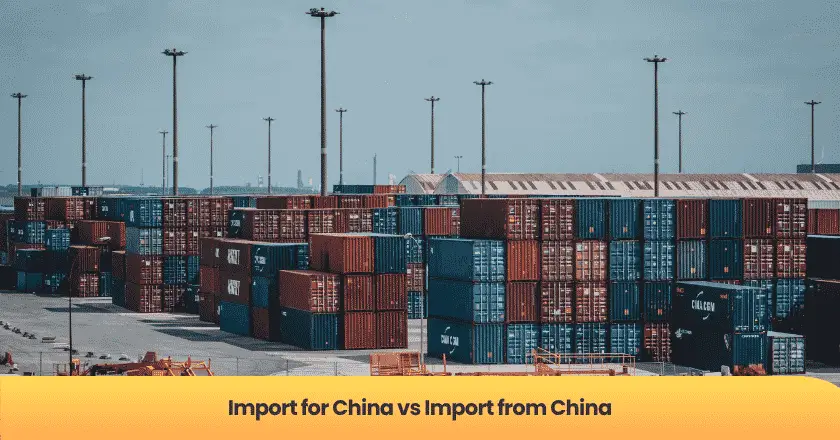
A European food producer writes to a consultancy asking for help with import for China. The reply that comes back explains factory vetting, quality control and sea freight from Ningbo, and the producer reads it twice before realising nobody has understood the question. She is not buying from China. She wants to sell into it, and the work she needs has almost nothing in common with the work she was offered.
One preposition separates two businesses that share a country and very little else. Which direction you are travelling determines who can legally be the importer, what has to be registered before goods move, and which regulator you answer to.
Key Takeaways
• Importing from China means sourcing goods for your own market, which is a supplier and logistics problem.
• Importing into China means market entry, which is a licensing, registration and labelling problem.
• The consignee for goods entering China must be a Chinese entity that has completed customs record filing.
• Several product categories require registration with Chinese authorities before any shipment can be declared.
• Cross-border e-commerce offers a lighter route into China for some consumer goods, with its own rules and limits.
Two Businesses That Share a Preposition
The phrase import for China gets used by non-native speakers to mean either direction, which is why clarifying it early saves weeks. The two activities barely overlap in skills, counterparties or risk.
Importing From China
This is sourcing. You find a factory, agree a specification, control quality, arrange freight and clear goods into your own market. Your regulators are at home, your compliance obligations follow your destination country, and your Chinese counterparty is a supplier.
Most published guidance about China trade describes this direction, which is why buyers searching for help with the other one so often receive answers to a question they did not ask.
The skills involved are industrial and commercial. Reading a specification, judging a factory, setting an inspection standard, calculating landed cost. None of them requires knowledge of Chinese consumer regulation, because your goods leave China rather than staying in it.
Importing Into China
This is market entry. Your customer is Chinese, your regulator is Chinese, and your product has to satisfy Chinese standards before it can be sold. The Chinese party in the transaction is a buyer, distributor or platform rather than a supplier, and the work is legal and administrative rather than industrial.
Classification still governs duty in both directions, since the Harmonized System is used by more than 200 countries including China. Almost everything else about the two processes differs.
Expert Tip: Settle the direction in your first message when approaching any service provider. One sentence does it: state that you manufacture in Italy and want to sell in China, or that you sell in Germany and want to buy from Chinese factories. I've watched enquiries run three exchanges deep before both sides realised they were discussing opposite businesses. Providers rarely ask, because the from-China direction is so dominant that they assume it.
Who Can Legally Be the Importer in China
The most consequential difference appears immediately. A foreign company cannot simply ship goods into China in its own name and clear them.
The Consignee Must Be Filed With Customs
Goods entering China are declared by a consignee, and that party must be a market entity within Chinese customs territory that has completed record filing with customs. The regulations on record filing of customs declaration entities, issued by the General Administration of Customs and in force since the start of 2022, replaced the older registration system with a filing procedure, and customs completes filing within three working days where materials are in order.
In practice this means a foreign exporter needs a Chinese entity on the other side: a distributor, an importer of record, a joint venture, or its own subsidiary. Choosing which of these you use is a market entry decision rather than a logistics one, and it shapes your pricing, your control over the brand and your ability to change partners later.
The record filing itself was simplified some years ago. Companies registering with the market regulator can complete customs filing as part of the same process, and separate application remains available through the single window or the online customs portal. What has not changed is the underlying requirement that a domestic entity stands behind every import declaration.
Import Agents and the Cross-Border Route
Import agents act as consignee for goods they do not own, handling declaration, duty payment and delivery to your Chinese customer. This suits testing a market before committing to a subsidiary, and it leaves the commercial relationship with the end buyer at arm's length from you.
Cross-border e-commerce is the other common route, with goods sold to Chinese consumers through approved platforms under a separate customs regime. Categories are limited and quantities per consumer are capped, so it works for consumer goods and not for industrial supply. It is best understood as a market test channel rather than a substitute for a full import structure.
Common Mistake to Avoid: Assuming your Chinese distributor's registrations cover your product is the error that strands shipments at the border. Record filing makes a company able to import in general, and it says nothing about whether your specific product category is approved, whether your manufacturing site is registered where that is required, or whether your labelling meets Chinese standards. Ask the distributor which registrations exist in your product's name rather than in theirs, and confirm before the first container leaves rather than while it sits in a bonded warehouse.
What China Requires of the Product
The second major difference is that many categories need approval before goods move, not after they arrive.
Category Registration Before Shipment
Food is the clearest example. Under the regulations on registration of overseas producers of imported food, overseas enterprises producing, processing or storing food for export to China must be registered with the General Administration of Customs, with registration either recommended by the competent authority in the producer's own country or applied for directly depending on the category.
The registration number then has to appear on the customs declaration, and goods without one are not accepted for import declaration. Similar principles apply in other regulated areas, including compulsory product certification for certain electrical and consumer goods. Confirm what applies to your category before you plan a launch, since registration timelines are measured in months rather than weeks.
Registration attaches to product categories rather than to companies in general. A producer registered for one category cannot ship a different one under the same approval, and adding categories means a further application. Plan the full product range at the point of first registration where you can, because sequencing them one at a time stretches a launch across quarters.
Labelling and Documents in Chinese
Chinese labelling requirements are specific and enforced at inspection. Prepackaged consumer goods generally need Chinese-language labelling covering the required particulars for the category, and for registered food producers the registration number must appear on inner and outer packaging.
Plan labelling as a production decision rather than a shipping one. Applying compliant labels at the factory is straightforward. Applying them in a Chinese bonded warehouse after goods have arrived is possible, slower and considerably more expensive, and it is a common reason first shipments miss their launch date.
Expert Tip: Ask your prospective Chinese partner to send you a photograph of a competing product's Chinese label before you finalise your own artwork. It shows you what the market actually accepts in your category, which is more informative than a summary of the rules. Where a partner cannot produce one, that tells you something about how much of this work they have done before, which is worth knowing while you still have other options.
Working Out Which Direction You Are In
Most businesses are in one direction only. A few end up in both, and those need to keep the two workstreams separate.
Diagnosing the Question
Three questions settle it. Where is your paying customer. Whose regulator approves your product. Is the Chinese company in your plan selling to you or buying from you. Answer those and the direction is unambiguous, along with which kind of help you should be looking for.
The advice you need differs accordingly. From-China buyers need supplier verification, quality control and freight. Into-China sellers need entity structure, category registration, labelling and distribution. A provider strong in one is not automatically useful in the other, and few are genuinely strong in both.
Timelines differ enough to matter for planning. A from-China sourcing project moves at the speed of samples and production, so a first order commonly lands within a few months. An into-China launch moves at the speed of registration and approval, and categories requiring pre-market registration routinely need considerably longer before a single unit can be sold.
Where the Two Directions Touch
Some businesses run both, typically manufacturers who buy components from China and also sell finished goods there. The two flows share a language and a time zone and nothing else operationally, so keeping separate documentation, separate partners and separate compliance calendars avoids a great deal of confusion.
One thing genuinely transfers: understanding how Chinese business is structured and how counterparties present themselves. Reading a business licence, checking a registered scope and knowing what a company name signals are useful whether the Chinese party is selling to you or buying from you.
Expert Tip: If you are in both directions, write down which partner belongs to which flow and keep the lists physically separate. I've seen a buyer's supplier list and its distributor list merge in a shared spreadsheet, and six months later nobody could remember which Chinese company was owed money and which owed it. The two relationships run on opposite commercial logic, and treating them as one supplier base creates errors that are tedious to unpick.
Where NewBuyingAgent Operates in This Picture
NewBuyingAgent operates on the import-from-China side of the equation. It is designed for buyers who want to source products from China for their own markets, rather than for companies looking to sell products into China.
The difference is important. NewBuyingAgent does not simply help buyers identify a factory and then leave them to manage the purchase themselves. Buyers tell NewBuyingAgent what products they need, including specifications, quantities and other requirements. NewBuyingAgent then sources the products through its extensive factory network across China and supplies them to the buyer.
Its broad factory network gives buyers access to more sourcing options across product categories, helping NewBuyingAgent identify competitive suppliers based on the buyer's requirements. Depending on the product and order, this can help reduce purchasing costs by around 5%–10%.
The sourcing process also extends beyond finding a supplier. NewBuyingAgent's 20,000+ product development and QC experts across China provide product and quality support, helping ensure that products are developed and produced according to the buyer's requirements.
This makes NewBuyingAgent particularly relevant to buyers sourcing multiple products or categories from China. Instead of building a separate supplier network and managing every factory independently, buyers can use one sourcing partner to access products across China.
In simple terms:
| If you want to… | NewBuyingAgent can… |
|---|---|
| Buy products from China | Source and supply products based on your requirements |
| Access more Chinese suppliers | Search across its extensive factory network |
| Improve purchasing costs | Identify competitive suppliers and negotiate based on requirements |
| Source across multiple categories | Provide products from different supplier networks through one purchasing relationship |
| Reduce supplier-management work | Handle communication and purchasing coordination with factories |
| Maintain product quality | Support product development and QC through its China-based expert network |
So while importing into China is primarily a market-entry and regulatory process, importing from China is about finding the right products and suppliers, controlling purchasing and quality, and getting the goods to your market.
For buyers on the import-from-China side, NewBuyingAgent provides an alternative to managing multiple Chinese suppliers independently—giving them access to China's manufacturing supply base without having to build that network themselves.
Frequently Asked Questions
Can a foreign company import goods into China in its own name?
Not directly. Goods are declared by a consignee that must be a market entity in Chinese customs territory with completed record filing. Foreign exporters work through a Chinese distributor, an import agent acting as consignee, a joint venture or their own Chinese subsidiary, and the choice affects pricing and brand control.
What does GACC registration mean for food exporters?
Overseas enterprises producing, processing or storing food destined for China must be registered with the General Administration of Customs, either through recommendation by their home authority or by direct application depending on category. The registration number must appear on the customs declaration and on packaging, and unregistered goods are not accepted for import declaration.
Is cross-border e-commerce a simpler way into China?
For some consumer goods, yes. Goods sold to Chinese consumers through approved platforms fall under a separate customs regime with lighter requirements than general trade. Categories are limited and per-transaction quantities are capped, so treat it as a way to test demand rather than as a full distribution channel.
Do I need Chinese labelling before shipping?
For prepackaged consumer goods, plan on it. Chinese-language labelling covering the required particulars is checked at inspection, and applying labels at the factory is far cheaper and faster than relabelling in a bonded warehouse after arrival. Treat it as part of production planning rather than as a shipping task.
Does my Chinese supplier help if I also want to sell in China?
Usually not, and it is worth asking rather than assuming. A factory that exports for you has no particular expertise in Chinese consumer regulation, distribution or retail. Some larger firms have a domestic sales arm and can introduce you, though the registration and labelling work still sits with specialists rather than with the production side.
Conclusion
Decide which direction you are in before you buy any advice, because the two businesses share a country and almost no methodology. Selling into China is an entity, registration and labelling problem solved months before goods move. Buying from China is a supplier and quality problem solved through factory selection and control. Confusing them costs a launch window. For the from-China direction, NewBuyingAgent handles factory selection, quality control and delivery from China.
Partial Sources
1. General Administration of Customs of the People's Republic of China, via the State Council — Regulations on Record Filing of Customs Declaration Entities (GACC Order No. 253), in force from 1 January 2022 — https://www.gov.cn/zhengce/zhengceku/2021-11/23/content_5652669.htm — accessed 6 August 2026
2. General Administration of Customs of the People's Republic of China, via the State Council Gazette — Regulations on Registration and Administration of Overseas Producers of Imported Food (GACC Order No. 248) — https://www.gov.cn/gongbao/content/2021/content_5616161.htm — accessed 6 August 2026
3. World Customs Organization — What is the Harmonized System (HS)? — https://www.wcoomd.org/en/topics/nomenclature/overview/what-is-the-harmonized-system.aspx — accessed 6 August 2026
NewBuyingAgent
Related Resources
Commencer aujourd'hui
Transformons vos objectifs d'approvisionnement en réalitéWeChat:+86 15157124615
WhatsApp:+86 15157124615
Adresse : Bâtiment 10 #39 Xiangyuan Road, Hangzhou, Chine
