

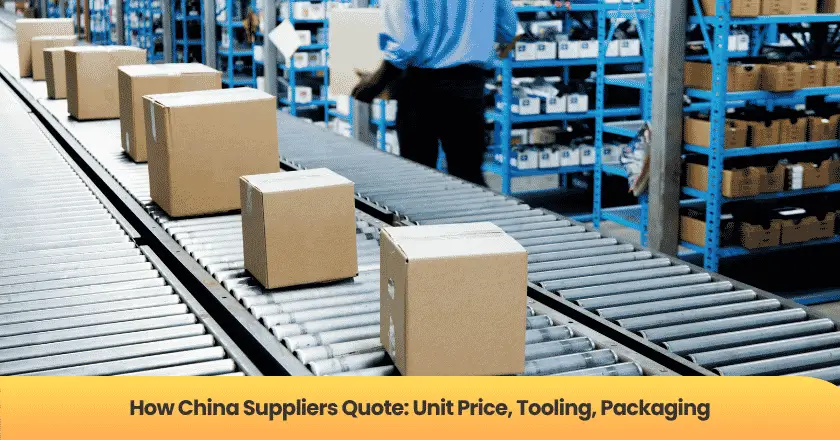
Three quotes arrive for the same storage crate. The first says $4.20. The second says $3.95 with tooling at $2,800. The third says $4.60 including a printed retail box. A buyer ranking these by the first number picks the cheapest and discovers later that it excluded the box entirely, that the crate ships in a plain brown carton nobody can sell from, and that retail packaging quoted separately costs $0.55 a unit.
Chinese quotations follow a recognisable pattern once you know what to look for. The lines that appear are straightforward. The lines that are absent by convention are where buyers lose money, and there are more of them than most first-time importers expect.
Key Takeaways
- A quotation covers goods to a defined point in the journey, and the trade term decides where that point sits.
- Tooling is an asset purchase rather than a service fee, so it should always be quoted as a separate line.
- Packaging is priced independently and affects freight cost through carton dimensions as well as through its own price.
- Quotes carry a validity period because material prices move, and an expired quote is a starting point rather than a commitment.
- Comparison only works after every quote is rebuilt to the same specification, quantity, term and currency.
What a Quotation Contains and What It Omits
Most Chinese quotations arrive as a short table or a proforma invoice. The format is consistent enough that gaps are easy to spot once you know the full set.
The Lines You Should See
A complete quotation states the product with a specification reference, the quantity it is priced against, the unit price, the trade term, the currency, the lead time, the payment terms, the minimum order quantity, and carton dimensions with units per carton. Tooling and packaging appear as separate lines where relevant.
Two of those matter more than their prominence suggests. Carton dimensions determine how many units fit a container and therefore your freight cost per unit. The quantity the price is based on determines whether the number survives when you order something different.
The Lines That Are Absent by Default
Quotes describe goods, not journeys. Freight beyond the stated term, destination charges, duty, inspection, sample costs and certification testing are all normally excluded unless you asked for them. None of this is concealment. It is simply that a supplier quotes what it controls.
The trade term is where the boundary sits, and Incoterms define exactly which costs and risks belong to each side. A quote without a stated term is incomplete rather than cheap, and the first reply to any such quote should be a request to restate it on a named term.
Certification is the omission that catches buyers latest. Testing to a market standard is a real cost with a real lead time, and suppliers quote it only when asked because they cannot know which market you sell into. State your destination market in the enquiry and ask explicitly whether testing and certification are included, quoted separately, or not covered at all.
Expert Tip: Ask for the quote to be issued as a proforma invoice rather than an email body, even at enquiry stage. The proforma format forces the supplier to state quantity, term, currency, validity and payment terms in fields rather than leaving them implied. I've had suppliers discover their own omissions in the act of filling one in. It also gives you a document that can be attached to an order rather than a message thread nobody can find in six months.
Reading the Unit Price
The headline number is an aggregate of several things, and knowing its composition tells you which parts can move.
What Sits Inside the Number
A manufacturer builds a unit price from material cost, processing time, labour, scrap allowance, overhead recovery and margin. Material is usually the largest single component on simple products, and it is the component neither of you controls, since it follows commodity markets.
Ask what proportion of the price is material. A supplier that answers has told you where negotiation can realistically go, and a supplier that cannot answer is probably reselling rather than producing. That one question does more than several rounds of pushing on the total.
Why the Same Product Gets Five Different Prices
Price dispersion across suppliers usually reflects real differences rather than dishonesty. A different material grade, a different wall thickness, a different surface finish, a different quantity assumption or a different trade term will each move a number substantially.
The dangerous version is specification drift, where a supplier quotes a slightly cheaper build without saying so. Send a written specification with every enquiry and require suppliers to confirm they are quoting to it. Quotes that come back materially below the group are then worth investigating rather than celebrating.
Quantity assumptions deserve a second look as well. A price quoted against 5,000 units tells you nothing about what 1,200 costs, and suppliers rarely volunteer the difference. Ask for a quantity break table alongside the quote so you can see the shape of the curve rather than a single point on it.
Common Mistake to Avoid: Ranking quotes by unit price before checking what each one includes is the error that produces most bad supplier choices. One number covers the goods to a port, another covers them to your door, a third includes retail packaging and a fourth assumes a quantity you never intend to order. Rebuild every quote to the same specification, quantity, trade term and packaging standard before comparing anything. The ranking frequently reverses, and the supplier that looked expensive was often quoting honestly against a fuller scope.
Tooling and Packaging as Separate Decisions
These two lines behave differently from the unit price, and buyers who treat them as add-ons rather than decisions tend to regret it.
Tooling Is an Asset Purchase
Tooling covers the moulds or dies that produce your part, and paying for it does not automatically mean owning it. Ownership, storage, maintenance, retention period and the right to transfer the tool to another factory all need to be written down, because the mould physically lives at the factory regardless of what the invoice says.
Ask for tooling quoted separately from the unit price rather than amortised into it. Amortised tooling looks convenient and obscures both the true unit cost and what you have actually bought. Standard provisions for this kind of arrangement appear in the model contracts published by the International Chamber of Commerce.
Sample and development charges belong in the same conversation. Most factories charge for samples and many credit the cost against a subsequent order, which is worth confirming rather than assuming. Where a product needs several rounds, ask what each additional round costs, since three revisions at full sample price is a meaningful sum on a modest first order.
Packaging Is Priced Independently and Moves Freight
Packaging quotes have two components: the cost of the packaging itself, and the effect of its dimensions on how many units fit a container. The second is frequently larger than the first and almost never discussed.
Ask for two packaging options with carton dimensions for each, then calculate units per container yourself. Freight is sold by volume, and container rates move enough that a reference such as Drewry's World Container Index is worth checking before you decide a carton redesign is not worth the trouble.
Expert Tip: Request the tooling quote broken into cavities, material and lead time rather than as a single figure. A four-cavity mould costs more than a single cavity and produces four times the output per cycle, which changes your unit price and your capacity ceiling at the same time. Buyers who accept one tooling number never learn which trade-off they bought. I ask what a two-cavity version would cost against a four, and the answer usually reframes the whole quantity discussion.
Making Quotes Comparable
The work of comparison happens after the quotes arrive and before any decision. It is mechanical rather than clever, and skipping it is what makes supplier selection feel like guesswork.
Building the Comparison Sheet
Put suppliers down the side and these across the top: unit price, quantity quoted, trade term, tooling, packaging cost, carton dimensions, units per carton, units per container, lead time, payment terms, validity and currency. Fill every cell, chasing the gaps rather than estimating them.
Then add a calculated row for landed cost per unit, adding freight, duty and destination charges to whichever quotes exclude them. Duty follows the HS classification of the goods, so confirm the code with a broker rather than assuming it, since an assumed rate can move the ranking on its own.
Keep the sheet after the decision. Six months later, when a supplier proposes an increase, the original comparison shows what was quoted, on what basis and at what quantity, which turns a vague conversation about rising costs into a specific one about which line moved. Buyers who discard the sheet renegotiate from memory and generally lose.
Validity, Currency and Payment Terms
Quotes carry validity periods, commonly 15 to 30 days, because material prices move. An expired quote is a starting point rather than a commitment, and requoting after a delay is normal rather than a supplier tactic.
Currency matters more than buyers expect. A quote in yuan and a quote in dollars carry different exchange exposure, and on a large order a modest currency movement outweighs most negotiated discounts. Payment terms belong in the comparison too, since 30% deposit with balance before shipment and full payment in advance are materially different prices once the cost of money is counted.
Expert Tip: Ask every supplier to requote in the same currency, even where it is not their preference. Suppliers accept this routinely and it removes a variable that otherwise sits invisibly inside your comparison. Where a supplier insists on quoting in yuan, note the rate you used and the date, because a comparison built on three different implied exchange rates is not a comparison at all. This costs one line in an email and prevents a decision made on noise.
Where NewBuyingAgent Changes What the Quote Says
Reading and comparing supplier quotations is essential when buying directly from Chinese factories. But for many buyers, the bigger question is whether they need to manage that process themselves for every product.
NewBuyingAgent offers a different way to source from China. Buyers simply tell NewBuyingAgent what products they need, including specifications, quantities and other requirements. NewBuyingAgent then sources the products through its extensive factory network across China and supplies them to the buyer.
Its broad supplier network gives NewBuyingAgent more options to identify competitive, cooperative suppliers rather than relying on a single factory or a limited supplier base. Depending on the product and order, this can help reduce purchasing costs by around 5%–10%.
The advantage becomes more significant when a buyer needs products across multiple categories. Instead of contacting different factories, comparing quotations and handling separate supplier communications for every product, the buyer can work with NewBuyingAgent through one purchasing relationship.
| Buying directly from factories | Buying through NewBuyingAgent |
|---|---|
| Find and contact factories yourself | NewBuyingAgent sources suitable suppliers |
| Compare quotations from individual suppliers | NewBuyingAgent handles the sourcing and quotation process |
| Negotiate and communicate with multiple factories | One communication channel with NewBuyingAgent |
| Manage different suppliers for different products | Source products across categories through one partner |
| Spend internal time on supplier research and follow-up | Free up time to focus on sales and business growth |
The value, therefore, is not simply the difference between a factory price and a sourcing price. It is the combination of supplier access, purchasing costs and the time required to manage the sourcing process.
For buyers who want to purchase products from China across multiple categories without dealing with every factory directly, NewBuyingAgent provides a more efficient way to access China’s supply base. Contact now.
Frequently Asked Questions
What should I ask a supplier to include in a quotation?
Specification reference, quantity quoted, unit price, trade term, currency, lead time, payment terms, minimum order quantity, carton dimensions and units per carton, plus tooling and packaging as separate lines. Requesting a proforma invoice rather than an email price usually produces all of this without further prompting.
Why does one supplier quote so much lower than the others?
Most often because it is quoting a different specification, a different quantity, a different trade term or a thinner packaging standard. Occasionally it reflects genuinely better factory economics. Ask the low supplier to confirm in writing that it is quoting to your written specification, and the gap frequently explains itself.
Should tooling be included in the unit price?
Better quoted separately. Amortised tooling hides your real unit cost, makes future quantity comparisons unreliable, and obscures what you have bought. Separate tooling also forces a conversation about ownership, storage and transfer rights, which is the conversation that matters if you ever change factories.
How long is a Chinese supplier quotation valid?
Commonly 15 to 30 days, and shorter where material prices are volatile. Treat an expired quote as an indication rather than an offer. When requoting after a delay, send the original quote back with your enquiry so the supplier updates a known basis rather than rebuilding the number from scratch.
Is it rude to ask a supplier to break down its price?
Not at all, and experienced exporters expect it. Asking what proportion is material, what tooling covers and what packaging costs separately is ordinary commercial practice rather than a challenge. What suppliers do resist, reasonably, is a demand for their full cost structure and margin, which no business discloses to a customer.
Conclusion
A quotation is a scoped document rather than a price, and most comparison errors come from treating it as the latter. Fix the specification before you ask, require a stated trade term, keep tooling and packaging on their own lines, and rebuild everything to a common basis before ranking anyone. The supplier that wins that comparison is usually a different one from the supplier that won the inbox. For buyers who would rather receive quotes already normalised, NewBuyingAgent handles factory selection, quality control and delivery from China.
Partial Sources
1. International Chamber of Commerce — Incoterms rules, the international standard for allocating cost and risk between buyer and seller — https://iccwbo.org/business-solutions/incoterms-rules/ — accessed 6 August 2026
2. International Chamber of Commerce — ICC Model Contracts and Clauses, standard provisions for international commercial agreements — https://iccwbo.org/business-solutions/model-contracts-clauses/ — accessed 6 August 2026
3. Drewry Supply Chain Advisors — World Container Index, weekly composite spot rate per 40ft container across major east-west trade lanes — https://www.drewry.co.uk/supply-chain-advisors/supply-chain-expertise/world-container-index-assessed-by-drewry — accessed 6 August 2026
NewBuyingAgent
Related Resources

Commencer aujourd'hui
Transformons vos objectifs d'approvisionnement en réalitéWeChat:+86 15157124615
WhatsApp:+86 15157124615
Adresse : Bâtiment 10 #39 Xiangyuan Road, Hangzhou, Chine
