

Floor loading is packing shipping cartons directly into a container without grouping them on pallets. Palletizing is grouping cartons into pallet loads that can be handled together; this unitization changes both the occupied space and the work needed at receiving.
For China exports, the useful comparison runs from the actual factory pack to the agreed receiving endpoint. Floor loading can avoid origin pallet costs, but the cartons still need a workable unloading method. Pallets add materials and a footprint; their value depends on whether the destination can use the resulting load without costly rebuilding or an additional container.
Choose an accepted unloading method before comparing cost
Choose only from loading methods the receiving site accepts and the packer can make suitable for transport and unloading. Compare the complete cost on the same order, including container count, work at both ends and any additional palletization. A lower factory-loading price does not settle the decision when the warehouse cannot receive the load or the protection assumptions remain unresolved.
- Decision: Confirm the receiver’s method and equipment before approving the factory pack.
- Cost comparison: Include container count, materials and receiving work on the same basis.
- Timeline: Validate the unloading plan against the booked appointment and available staff.
- Risk: Compare carton support, restraint and actual loss evidence; pallets are not a damage guarantee.
What changes when cartons travel on pallets?
Floor loading and palletizing change how cartons occupy the container and how they are handled at the destination. A floor-loaded shipment arrives as individual shipping cartons, while an origin-palletized shipment arrives in grouped loads that require compatible handling equipment. Floor loading followed by destination palletization is a third configuration: it preserves the floor-loaded ocean arrangement but adds a receiving operation that needs its own agreement and price.
The choice also reaches back into the product pack: an insert, a carton’s compression strength or an exposed finish can change what handling is acceptable. NewBuyingAgent combines product-development and quality-control capability with local China factory resources. Those strengths are relevant when recurring purchases need product protection and export packing to work together.
The IMO/ILO/UNECE CTU Code provides non-mandatory global guidance on packing and securing across sea and land transport, including receiving and unpacking. It supports checking the whole chain; it does not declare either loading method safe merely because of its name.
The comparison below covers the same China-origin product order through the same receiving endpoint. It compares handling configurations and the questions needed to validate them, rather than measured unloading speeds or claimed damage rates.
| Method | Cost scope | Receiving | Risk check |
|---|---|---|---|
| Floor load | Load + loose unload | Carton handling | Stack + restraint |
| Origin pallets | Pallets + handling | Matched lift gear | Unit + load secure |
| Floor + local pallets | Unload + new pallets | Agreed extra work | Extra touch points |
Based on this comparison, floor loading is a candidate when the receiver accepts carton handling and the full shipment cost is lower under a feasible protection plan. Origin pallets are a candidate when compatible unit-load handling provides enough receiving value to justify their complete cost. Destination palletization requires an explicit handoff; it should not appear as an unpriced assumption.
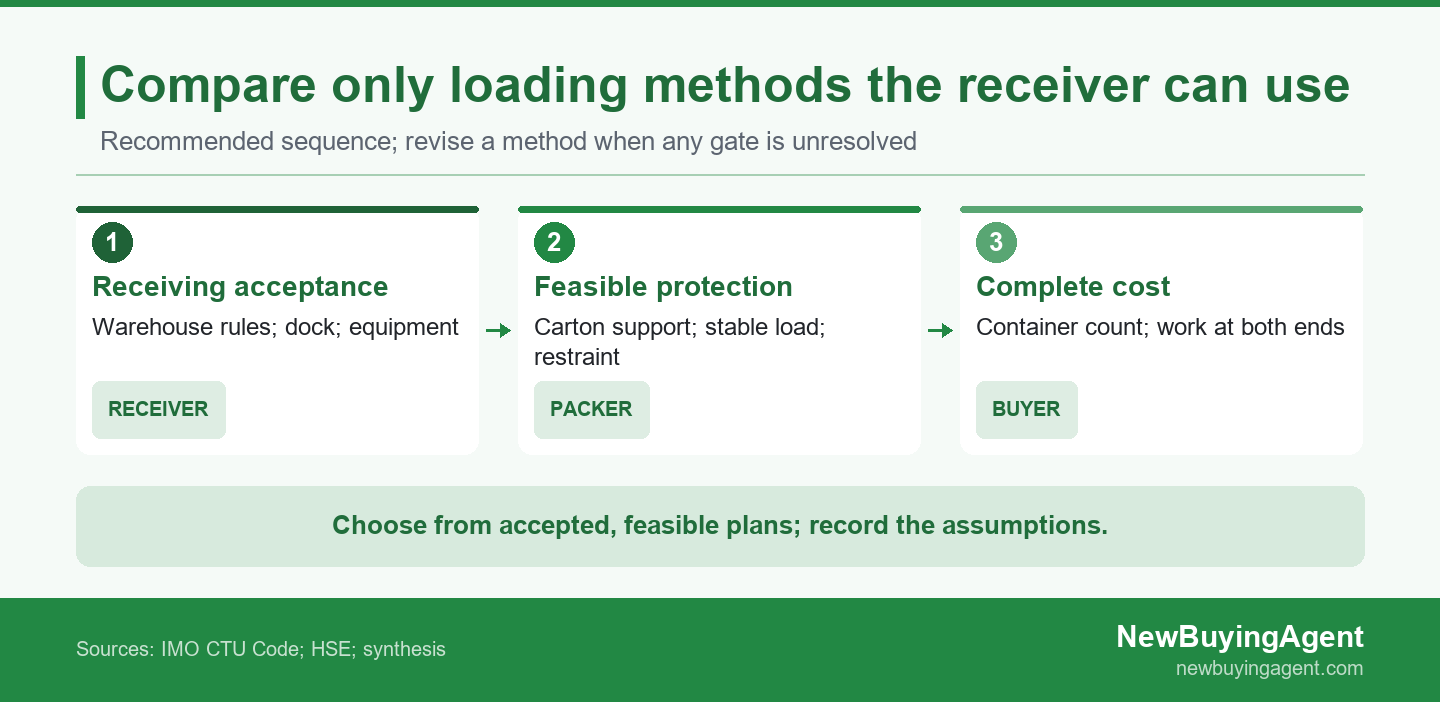
Confirm receiving acceptance and safe packing before comparing the full cost of feasible loading methods.
Compare the cost through receipt, not only factory loading
Compare each loading method through the same agreed receiving endpoint, using the same products, quantity, route and service inclusions. Separate costs that both plans share from the materials, labor and handling steps that change with the method. Keep unresolved charges visible so that an apparently cheaper quote does not win by leaving work for another company to price later.
Check actual container count before pricing the difference
Determine the feasible carton quantity for each proposed arrangement before comparing freight totals. A pallet occupies space and adds weight, but its effect depends on the carton footprint, pallet build, permitted layers, equipment and route. A general percentage allowance cannot establish whether the order needs the same number of containers.
Ask the packer to show the actual arrangement, including access needed for handling, permitted stack loads and the materials used to prevent movement. Check door access and the load’s weight distribution as well as total volume. The receiving method can restrict the arrangement even when the arithmetic fits inside the container.
Treat container count as a discrete result. A small quantity increase can cross a packing threshold and require another container for one method while the other still fits. Request an updated arrangement and price when that happens; do not assume that a previous per-carton difference will scale smoothly with the new order.
Price labor and extra handling at both ends
List the method-dependent work at origin and destination: pallet purchase or rental, suitable protection and restraint, loading, unloading, sorting and any later palletization. State whether disposal, returns or pallet exchange apply. Name the party performing each task, the quote unit and what is excluded before combining the figures.
For a floor-loaded option, ask whether the receiving charge includes carton handling and movement to the agreed endpoint. For origin pallets, ask whether the load is accepted as delivered or must be broken down and rebuilt. If a destination facility creates pallets before onward delivery, include its handling, materials, transfer and timing conditions; a cheaper factory task can simply move the cost elsewhere.
On continuing orders, these assumptions need to stay aligned with the product and factory packing instructions. NewBuyingAgent’s existing-factory management includes supplier communication, production progress, quality management and logistics coordination within the agreed scope. That broader support matters when a change in packing affects the supplied products, order cost and delivery arrangement together.
Test receiving speed against the actual dock and labor
A useful receiving-speed comparison specifies the site, equipment, staffing and point at which unloading is considered complete. Moving pallets off a container and placing loose cartons into storage are different work scopes, so their times cannot be compared without adjustment. Confirm the appointment conditions and the actual handling sequence before treating a faster unloading estimate as a purchasing advantage.
Confirm warehouse acceptance and the unloading arrangement
Obtain the warehouse’s current receiving instructions in writing. Confirm accepted load types, pallet footprint and height where relevant, identification requirements, dock access and who provides equipment and labor. Check whether the site accepts floor-loaded containers directly or requires delivery through a facility that unloads and palletizes first.
UK HSE loading guidance says loading should allow safe unloading and involved companies should agree the arrangements in advance. Its examples include instructions, equipment and cooperation when drivers unload. Use that as a practical planning prompt while checking the actual local rules and site responsibilities; do not assume the driver will perform unagreed unloading work.
Ask the receiver to describe the sequence for this shipment: gaining safe access, removing goods, checking quantities and handing the load to the next operation. A requirement to rebuild pallets or sort mixed SKUs can change both the charge and appointment duration. Record the accepted process before the factory locks the method.
Check the work, equipment and staffing behind a time estimate
Compare the actual work rather than a generic claim that pallets always unload faster. A matched pallet load may reduce individual carton touches, but unsuitable forks, access limits or rebuilding can remove that benefit. Floor loading needs a workable way to reach and move cartons without relying on unsafe lifting or makeshift access.
The UK HSE manual-handling guidance prioritizes avoiding hazardous manual handling where reasonably practicable, assessing what cannot be avoided and reducing injury risk. It also explains that its law does not set specific weight limits. Do not replace a task assessment with a universal “safe carton weight”; repetition, reach, grip, posture and the surrounding work still matter.
Request the time estimate’s staffing and equipment assumptions, including breaks and sorting or rebuilding work. Use a representative observed operation when available. Without comparable timing evidence, keep the speed benefit conditional rather than adding an invented number of saved hours.
Compare damage mechanisms and destination requirements
Compare damage through the mechanisms that could harm the actual product: carton compression, unsupported edges, abrasion, handling impacts and movement during transport. Both floor loads and pallet loads need protection and restraint suited to their arrangement, and neither method supplies a universal damage-rate advantage. Add destination material requirements to the comparison because a physically useful pallet can still create an import or receiving problem.
Match carton support and restraint to the product
Start with the packed product and the expected handling chain. Check the carton condition, permitted orientation and stack limits; examine how the arrangement supports the product and avoids vulnerable overhang or concentrated pressure. A floor-loaded plan may use more individual carton handling, while a pallet load can introduce fork contact, overhang or instability if the build is unsuitable.
UK DVSA’s road-load guidance for palletized goods distinguishes securing goods to the pallet as one unit from securing the resulting unit on the vehicle. That road guidance does not provide a complete ocean-container design. The practical distinction remains useful: wrapping cartons together does not by itself establish that the load is adequately restrained for the whole route.
Ask the responsible packer to confirm the intended protection, stable arrangement and securing method, including how unloading will remain safe after transit. Keep photographs, pack specifications and any relevant test or trial results linked to the actual version. Evidence from a different carton, product or handling route is a reason to investigate, not proof that the current method will perform equally well.
Check the pallet material and importing-market rules
Identify the pallet and dunnage materials before treating compliance cost as a fixed pallet surcharge. Destination requirements can apply to regulated wood supports used with either method. A floor-loaded shipment may still contain wood blocks or other dunnage, so removing the pallets does not automatically remove the relevant wood-packaging checks.
For shipments entering or transiting the United States, APHIS wood-packaging import guidance describes requirements for regulated wood packaging, including pallets and dunnage, covering treatment, marking and pest conditions. Confirm the actual material and applicable requirements with the responsible parties. A pallet invoice or a supplier’s general assurance does not establish that every wood component in the shipment meets the required conditions.
Australia’s DAFF ISPM 15 guidance lists packaging made wholly from processed wood, such as plywood, among exemptions from that standard, while directing importers to the applicable Australian import conditions. Check the complete construction: a plywood deck does not establish that a pallet with solid-wood components is wholly processed wood. Nor does an ISPM 15 exemption remove every possible destination requirement.
Record the material specification, required marks or documents and who checks them before dispatch. Keep biosecurity treatment separate from structural suitability: an appropriately treated pallet can still be unsuitable for the intended load, equipment or receiving site. Price only the configuration that satisfies both sets of needs.
A worked comparison can reverse the apparent saving
The following hypothetical example compares one order through an identical receiving endpoint, assuming both methods are accepted and their arrangements are feasible. It separates common container costs from the loading-method costs so that a receiving charge cannot disappear from one option. The figures are invented for arithmetic, not current market prices, tested capacities, a customer result or an approved loading plan.
Compare two accepted plans on the same order basis
Assume an order of 1,560 identical cartons. For this example only, the checked floor-loaded arrangement holds 900 cartons per container and the checked palletized arrangement holds 780; both therefore need two containers. These assumed capacities already represent feasible arrangements for the hypothetical pack, rather than a formula based only on empty container volume.
Assume the common transport and service cost is USD 3,000 per container, with all method-dependent handling excluded. The floor-loaded option adds USD 240 at origin and USD 420 for destination unloading, totaling USD 660. The palletized option adds USD 360 for pallets and protection, USD 160 for origin handling and USD 100 for destination unloading, totaling USD 620. All these method charges are per order, not per container.
The complete compared totals are therefore USD 6,660 for floor loading and USD 6,620 for origin pallets. Pallets add material cost, yet the assumed receiving difference makes that option USD 40 cheaper. The margin is small enough that an omitted rebuilding charge could change the decision; the buyer should confirm inclusions before selecting it.
Now increase the order to 1,680 cartons while keeping the hypothetical per-container capacities unchanged. Floor loading still needs two containers, because 1,680 is below 1,800; palletizing needs three, because two carry only 1,560. The additional container adds USD 3,000 of common transport cost under the assumed rate, before any changed method charges. The original USD 40 advantage no longer supports a decision: obtain new complete quotes for the larger order.
Damage loss has not been assigned a zero value or invented percentage in either total. If comparable evidence supports an expected loss or rework allowance, add it on the same basis; otherwise show the uncertainty and test how much difference would change the choice. A receiving rejection or an unresolved protection problem excludes that plan before this cost comparison, regardless of the apparent saving.
Put the agreed method into the purchasing brief
Record the chosen method and the assumptions that made it acceptable. Use the checklist below to request missing information and release a dated version to the factory, packer, logistics provider and receiver. A changed carton, order quantity or receiving site should trigger review of the affected arrangement and costs before dispatch.
- Product and pack: SKU mix, carton revision, contents, measurements, gross weight and protection limits.
- Receiving acceptance: Named site, current instructions, equipment, staffing and unloading endpoint.
- Load basis: Feasible arrangement, container count, pallet build and restraint responsibility.
- Complete quote: Materials, handling at both ends, extra transfers and explicit exclusions.
- Change control: Decision owner, approval date, recipients and the fact that would require a new comparison.
For recurring China procurement, bring these constraints into the product brief alongside specifications, quantity, target price, destination, timing and the current sourcing situation. To discuss complete product supply or agreed management of existing factories around the actual quality, packing and delivery needs, send the purchasing brief to NewBuyingAgent.
Frequently Asked Questions
Can slip sheets replace pallets without changing receiving equipment?
Slip sheets require compatible handling equipment and an agreed process at the relevant handling points. Do not substitute them merely because they occupy less space than a pallet. Confirm how the load will be picked up, transferred and unloaded, including any intermediate facility. If the receiving equipment or service is unavailable, the proposed substitution needs a different agreed plan rather than an assumed saving.
Can one container combine palletized goods and floor-loaded cartons?
A container can use a mixed method only with an agreed stable arrangement and a receiving sequence that preserves safe access. Identify which goods need pallets and where each part will be positioned. Check support, restraint, weight distribution and how the receiver reaches each load without unsafe rebuilding. Do not add a mixed configuration to an accepted plan without obtaining the packer’s and receiver’s agreement.
Who should pay for palletizing after the container arrives?
The commercial agreement should identify who performs and pays for destination palletization and the related unloading work. State the facility, materials, handling endpoint, price basis and any onward-delivery responsibility. Do not assume the cost is included because a quote mentions delivery to a warehouse. Resolve exclusions before dispatch, and have the relevant provider confirm any change to its contracted scope.
How should buyers compare damage costs without reliable loss data?
Keep damage loss as an unresolved comparison input when there is no comparable evidence for the product and route. Record known failure mechanisms and the available packing or trial evidence, then test how a plausible additional cost would affect the result without presenting it as a measured rate. A small quoted saving warrants closer investigation when one option introduces an untested handling step.
NewBuyingAgent
Ressources associées



Commencer aujourd'hui
Transformons vos objectifs d'approvisionnement en réalitéWeChat:+86 15157124615
WhatsApp:+86 15157124615
Adresse : Bâtiment 10 #39 Xiangyuan Road, Hangzhou, Chine
