

A mixed-SKU container loading plan is a record linking each stock-keeping unit, or product variant, to its shipping quantities, handling units, container zones and receiving sequence. It combines an identification plan with physical access requirements; a list of products alone does not show which goods the receiver can reach first.
For recurring China import orders, start with what the destination needs to do when the container arrives. Agree the receiving priorities and current warehouse instructions, then ask the packer to confirm a workable arrangement. The aim is to avoid searching, sorting and repeated moves caused by an unsuitable sequence, without treating speed as permission to compromise product protection or safe unloading.
Make the first receiving task physically reachable
Make the first receiving task physically reachable by linking priority groups to recognizable shipping units and a feasible access path. Confirm the carton definitions, receiving equipment and packing constraints before turning that priority into a position. Release the actual loaded contents and zone record together, so the receiver does not work from an attractive diagram that describes goods left behind at the factory.
- Decision: Define the first receiving action before choosing the loading sequence.
- How it works: Connect SKU quantities, handling-unit IDs, zones and receiving steps.
- Risk: Reverse order works only within an accepted, stable packing and unloading arrangement.
- Timeline: Reconcile actual loaded goods and send current information before arrival.
Start with the receiver’s sequence, then test access
A useful loading sequence begins with the receiver’s next actions, then tests whether the required goods can be identified and reached safely. A priority group belongs near the access point only if its position also fits the actual support, restraint and handling arrangement. Keep these conditions together in the plan rather than treating a commercial priority as approval to place any product beside the doors.
Ask which goods need immediate use, which move to reserve storage and which require separate checking. Confirm whether the warehouse wants complete SKU groups, purchase-order groups or another agreed unit of receipt. The same product mix can need a different sequence at a different site, even when the total carton quantity is unchanged.
Those groups may also need different export cartons, inserts or handling limits. NewBuyingAgent combines product-development and quality-control capability with local China factory resources. That capability is relevant when a recurring mixed-product order needs packing choices that protect the goods while supporting the buyer’s receiving requirements.
The IMO/ILO/UNECE CTU Code provides non-mandatory global packing and securing guidance across sea and land transport, including receiving and unpacking. Its whole-chain scope supports checking access alongside protection; a zone map alone does not establish safe stowage.
In the schematic example, A is a bulk group, B goes to reserve and C is needed first. Placing C nearest the doors can support that receiving order only after the actual arrangement is confirmed. The equal-sized regions show access sequence, not proportional quantities, measured space or an approved packing design.
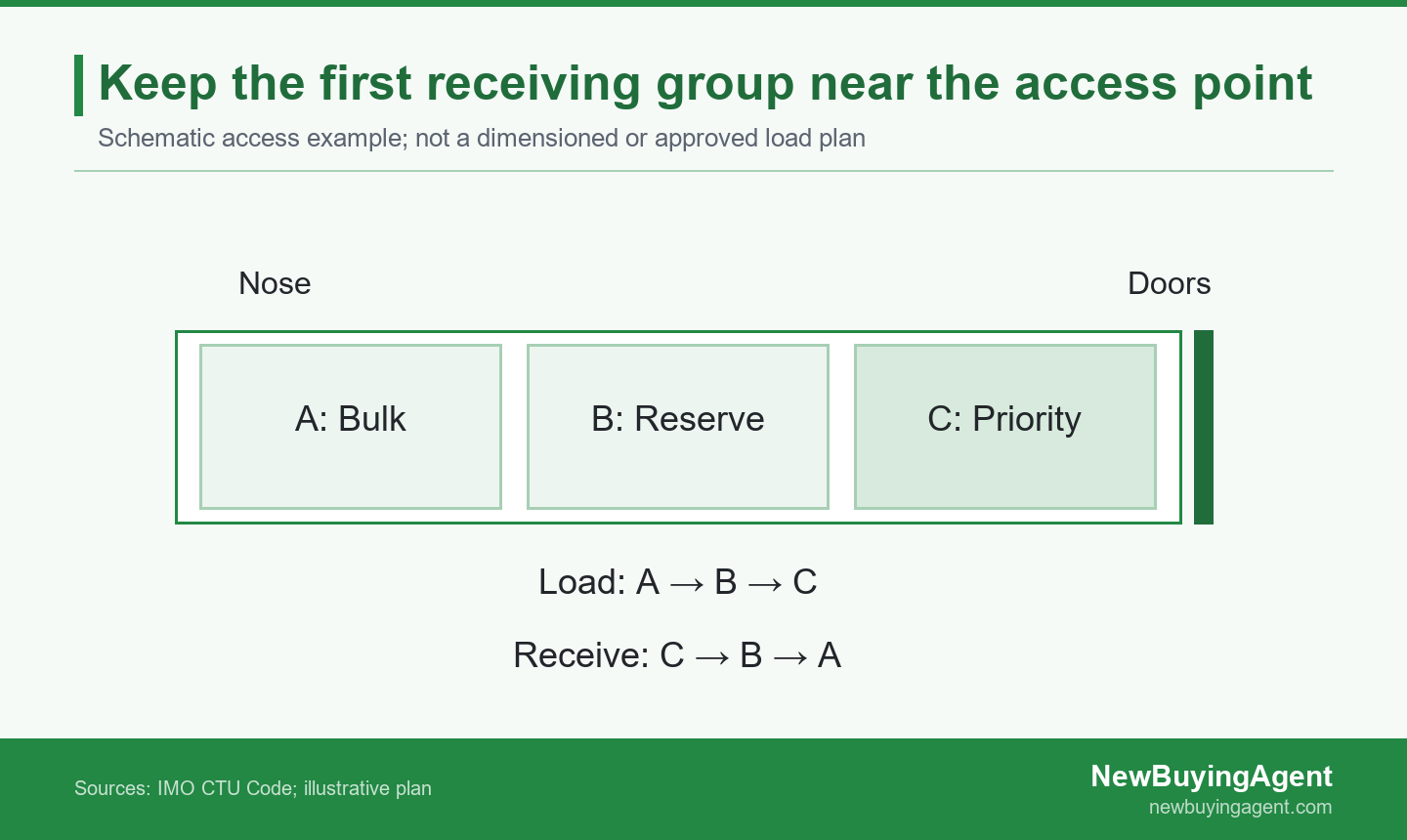
Schematic access example: priority C is nearest the doors; actual support, restraint and safe unloading still require confirmation.
Build one record that links contents, units and zones
Use one current record to connect each shipping pack with its contents, identifying marks, handling-unit reference and container zone. Keep carton counts distinct from product-piece counts and from pallet or other handling-unit totals. The receiver should be able to follow that record from a recognizable arriving group to the expected contents and the next receiving action without reconstructing the factory’s assumptions.
Define each shipping pack before assigning a position
Identify the SKU and pack revision, units per carton, carton quantity, outside dimensions, gross weight and relevant handling limits. Separate full cartons, mixed cartons and partial cartons instead of averaging them into a nominal pack. State which values belong to one carton and which belong to a loaded pallet or other grouped unit.
The U.S. International Trade Administration’s packing-list explanation describes a document that itemizes package contents and includes weights and measurements. That helps establish what is being shipped, but it does not prescribe a physical loading position. Use the package-level information as an input to the zone and access plan rather than expecting the packing list to perform both jobs.
Add the receiving priority and intended lane or checking area beside the pack information. For an exception such as a mixed carton, identify its actual contents and where the receiver will open or sort it. An unexplained “miscellaneous” group may occupy space correctly while forcing the destination to stop and investigate what it contains.
Keep handling-unit identity linked to its actual contents
Give the receiver an agreed way to recognize each handling unit and retrieve its contents. A zone reference tells people where a group is positioned; it should not replace the unit’s identity or its SKU-level content record. Keep the identifier readable at the agreed checking point, and test that a sample scan or lookup returns the expected current record.
Within the GS1 system, the GS1 Logistic Label Guideline uses the SSCC to identify a logistic unit and links that unit to its contained trade items in the despatch advice. Its shipping process also connects loaded units and actual goods with the despatch data. These requirements describe the GS1 logistic-label system, not a universal instruction to put an SSCC on every loose export carton.
GS1 Sweden’s label guidance explains that when an electronic despatch advice supplies the contents, the receiver can scan the SSCC to retrieve that information. The trading parties still need an agreed, functioning exchange. A successful lookup identifies the declared unit; it does not physically confirm every product and quantity inside it.
If the receiver does not use that system, agree a suitable content list and readable marks instead of assuming an unsupported barcode will speed receipt. Avoid adding a new label that obscures an existing identifier. When contents change, update the corresponding records and apply the relevant identification rules for the actual handling unit.
Turn receiving priorities into a feasible loading sequence
Translate receiving priorities into a loading sequence only after checking the actual access path, carton support and unloading method. For a simple single-door sequence, goods needed first may be loaded later so they remain reachable at the doors. That is a conditional planning approach, and the packer may need a different arrangement when weight distribution, stability, product compatibility or equipment prevents the proposed order.
Check safe access before applying reverse order
Keep the desired receiving order and the physical packing decision visible as separate inputs. The receiver states what should be handled first; the responsible packer confirms which arrangement supports the load and permits suitable restraint and unloading. A priority request cannot override stack limits or justify a position that makes other cargo unstable.
UK HSE loading guidance says loading should allow safe unloading and that companies should agree arrangements in advance. It also calls for checks that loads have not shifted and will not move or fall when restraints are removed. Use those points to frame the discussion while confirming the actual local requirements and the site’s responsibilities.
Confirm the method for reaching each group, the equipment involved and how the remaining goods stay stable as unloading progresses. If the first-needed SKU cannot be made safely accessible in the proposed layout, change the arrangement or the receiving plan. Do not promise the warehouse that it can extract a buried group without the packer’s and receiver’s agreement.
Stage the groups and rehearse the receiving handoff
Stage the approved groups in a way that makes the intended sequence and identities clear to the loading team. Match the carton or handling-unit references to the current zone record before movement begins. Keep held goods physically distinguishable from goods cleared for the shipment so that staging proximity is not mistaken for permission to load.
Walk through the plan with the receiving owner: which group appears first, how it is identified, where it moves and which quantity is checked. Test a representative label or record lookup and identify any sorting or rebuilding step. If that step requires space, labor or equipment that will not be available, correct the receiving arrangement before approving the load.
Photos can help show recognizable groups and the final accessible face, provided they are tied to the current shipment. They do not replace a count record or prove that hidden cartons match the declared contents. Assign someone to record actual deviations during loading, rather than relying on a staged photo that may no longer describe the finished container.
Control changes before the container is sealed
Confirm what actually entered the container before releasing the final quantity and receiving records. A held batch, substitute carton or changed pallet build can affect the contents, occupied space and sequence even when the booking reference stays the same. Keep the old plan recoverable, identify the current version and tell every affected party which assumptions have changed before they act on superseded information.
Reconcile planned, loaded and held quantities
Track planned, staged, loaded and held quantities separately until the shipment is reconciled. For each affected SKU, record the actual carton count, contents and handling-unit reference, along with its zone. Investigate any difference before confirming the shipment as complete; a carton sitting beside the loading area is not evidence that it was loaded.
If goods remain on hold, resolve the product-order decision as well as the worksheet. The buyer may require approved replacement goods, a delayed shipment or an expressly amended quantity. The packer must then check the affected arrangement, including any space or support assumptions changed by removing the held cartons.
NewBuyingAgent’s existing-factory management includes supplier communication, production progress, quality management and logistics coordination within the agreed scope. That broader support is relevant when a held production lot changes the products available for a recurring order and the buyer needs the packing and delivery decision aligned with the actual supply.
Send the actual shipment data to the right recipients
Send the receiver the current SKU and quantity record, handling-unit references, zone map, receiving sequence and known exceptions. Confirm that the information has reached the person or system that will use it, rather than only an email contact outside the warehouse operation. Identify the version and the owner who can resolve a mismatch when the goods arrive.
The DCSA booking and bill-of-lading implementation guide distinguishes data originating in bookings, shipping instructions and carrier records, with corresponding amendment processes. Updating an internal loading worksheet therefore does not by itself update a carrier record. Ask the responsible provider or document owner which information needs amendment, follow the applicable process and obtain the required confirmation.
Reconcile the actual packing list and any agreed advance shipment information with the loaded goods. A warehouse map, a package-content document and a carrier instruction have different purposes, but their shared quantities and identities must stay consistent. Send a specific change notice when an earlier receiving file has already been distributed.
Work through a three-SKU receiving plan
The following hypothetical example shows how a zone record becomes a receiving sequence and how a shortage changes the release decision. It assumes one receiving site, one door-access path and a compatible arrangement already confirmed by the responsible packer and receiver. The quantities and positions are illustrative, with no dimensional scale, capacity approval, customer result or measured unloading-time saving.
Use a zone record to walk the shipment through receipt
Assume a shipment has 120 cartons: 60 of SKU A for bulk storage, 40 of SKU B for reserve and 20 of SKU C for immediate receiving priority. The agreed schematic arrangement places A toward the nose, B in the middle and C nearest the doors. The record below links each group to its receiving task; it does not determine the physical arrangement’s dimensions or support requirements.
| Zone | Group / cartons | Receive | Check |
|---|---|---|---|
| Nose | A / 60 | Third: bulk | A marks; 60 |
| Middle | B / 40 | Second: reserve | B marks; 40 |
| Doors | C / 20 | First: priority | C marks; 20 |
The loader follows A, then B, then C within the confirmed arrangement. At receipt, the team first checks the current records and the condition of the load using the agreed safe process. It identifies C, checks its 20 cartons and moves them to the priority lane; B’s 40 cartons then go to reserve, followed by A’s 60 to bulk storage. The checked groups reconcile to the declared 120 cartons.
The useful observation is whether the team can identify and move the intended group without an unplanned search or repeated move of other cargo. Record actual waiting, sorting, extra handling and any identity mismatch. Those observations can guide the next order’s sequence; the example does not establish a fixed number of minutes saved.
Now suppose 10 cartons of A are held before loading. Available goods become A 50, B 40 and C 20, totaling 110 cartons. Do not release the original 120-carton record: obtain approved replacement goods or an authorized amended shipment decision, then recheck the affected packing arrangement and quantities. If the amended quantity is accepted, update the zone record and downstream information before releasing that version; otherwise keep the shipment release pending.
Release the plan with the complete purchasing requirement
Use the checklist below to make the receiving plan reviewable before dispatch. Assign an owner to each missing item, keep the approved version dated and identify the people who must receive a change. The completed record should connect the actual products and quantities with the way the factory, packer and destination will handle them.
- Product and pack: SKU mix, pack revisions, contents, carton quantities, measurements and handling limits.
- Receiving: Site instructions, priority groups, equipment, staging lanes and checking responsibilities.
- Arrangement: Agreed zones, recognizable unit references, access sequence and packing confirmation.
- Actual shipment: Loaded and held quantities, content exceptions, current documents and receiving data.
- Release: Decision owner, date, recipients and the changes that require the plan to be checked again.
For recurring China procurement, include these receiving needs with the product specifications, SKU quantities, target price, destination, timing and current sourcing situation. To discuss complete product supply or agreed management of existing factories around the actual quality, packing and delivery requirements, send the product requirements to NewBuyingAgent.
Frequently Asked Questions
Should the first SKU needed always be loaded last?
The first SKU needed should be loaded last only where that creates safe, usable access within the agreed packing arrangement. Weight distribution, carton support, restraint, equipment and other products may require a different layout. Ask the packer and receiver to resolve the conflict before dispatch. If the physical arrangement cannot meet the desired priority, revise the receiving task rather than presenting reverse order as an unconditional rule.
Does every mixed-SKU export carton need a GS1 SSCC?
An SSCC is not a universal requirement for every loose export carton. It identifies a logistic unit within the GS1 logistic-label system, and the agreed unit may be a pallet or another grouped shipment unit. Confirm the buyer’s and receiver’s identification requirements for the actual goods. Keep SKU and quantity records linked to those identifiers instead of assuming that one barcode proves every contained item is correct.
Can the same plan cover deliveries to multiple receiving sites?
Multiple receiving sites require a separately agreed route and unloading sequence rather than automatic reuse of a single-site plan. Confirm the actual transport arrangement and whether goods are transferred or rebuilt at an intermediate facility. Partial unloading can change access and the stability of the remaining load. Have the responsible providers and receivers agree the arrangement and information needed at each handoff before approving it.
How much receiving time should a loading sequence save?
A loading sequence has no defensible fixed time saving without comparable evidence from the actual receiving operation. Measure the same completion point with similar products, quantities, equipment and staffing, and separate unloading from checking, sorting and put-away. Record unplanned searches, extra moves and waiting to locate the problem. Use those observations to improve the next plan without presenting an illustrative sequence as a timed result.
NewBuyingAgent
موارد ذات صلة



ابدأ اليوم
دعنا نحول أهداف التوريد الخاصة بك إلى واقعWeChat:+86 15157124615
WhatsApp:+86 15157124615
العنوان: مبنى 10 #39 طريق شيانغيوان، هانغتشو، الصين
