


Sea-air shipping is a planned multimodal movement in which the same shipment travels by ocean to a transfer hub and then by air toward its destination. The complete service includes the work needed to move cargo from the vessel into an accepted air shipment and onward to the receiving point.
Sea-air can make sense when an executable hub connection meets the buyer’s stock deadline at a justified cost. Compare it with full air and all-sea offers using the same cargo and warehouse endpoint. Check the transfer process, product acceptance and next-flight consequences before relying on the proposed delivery date.
Choose sea-air only when the whole connection fits
Start with the latest useful warehouse receipt and the product’s actual ready date. A sea-air proposal needs an accepted cargo plan, a workable handoff at the hub and a complete quotation. Check what happens if the intended flight is missed. The route’s value depends on whether the goods still arrive in time for the purchasing need.
- Best for. Sea-air may serve a delivery window between the available ocean and full-air options.
- How it works. Include port release, transfer, handling and air acceptance.
- Cost comparison. Confirm the air billing basis and all hub charges.
- Decision. Test the next feasible flight against the real stock deadline.
Find the delivery window that sea-air can actually serve
Evaluate sea-air when the available ocean service misses a meaningful stock date and a complete air movement costs more than the buyer can justify. Confirm that the hybrid service actually improves the warehouse outcome for the same goods. The route needs enough time for the hub work and onward flight, with a credible response if the intended connection changes. Cargo suitability and current capacity remain part of that assessment.
The first question is how the shipment will be used. A seasonal retail order, a replenishment gap or a product launch can create a genuine delivery constraint. Define the affected quantity and the date it is needed, then request complete offers. If ordinary sea freight already meets demand, identify what additional benefit would justify the hybrid route’s extra cost and handling.
DHL Global Forwarding’s multimodal service description includes a planned SeaAir product from Asia through a transfer hub to onward markets. That illustrates a coordinated transport option with defined service arrangements. Obtain the current origin, hub and destination plan for the actual shipment. Headline service descriptions alone do not establish an available departure or final delivery commitment.
The choice between sea, air and sea-air shipping ultimately depends on the specific requirements of each order, including product characteristics, shipment volume and delivery timelines. For buyers sourcing from China, these considerations are closely tied to the purchasing process. NewBuyingAgent helps global buyers source products across multiple categories from China, drawing on its extensive manufacturing network and industry experience to support their purchasing needs from product sourcing through order fulfillment. This gives buyers a more complete picture of their orders when planning transportation and choosing a shipping solution that fits their requirements.
Keep port availability, hub transfer, air acceptance and warehouse receipt visible as separate checks. Each check should identify the next required fact and the person able to confirm it.
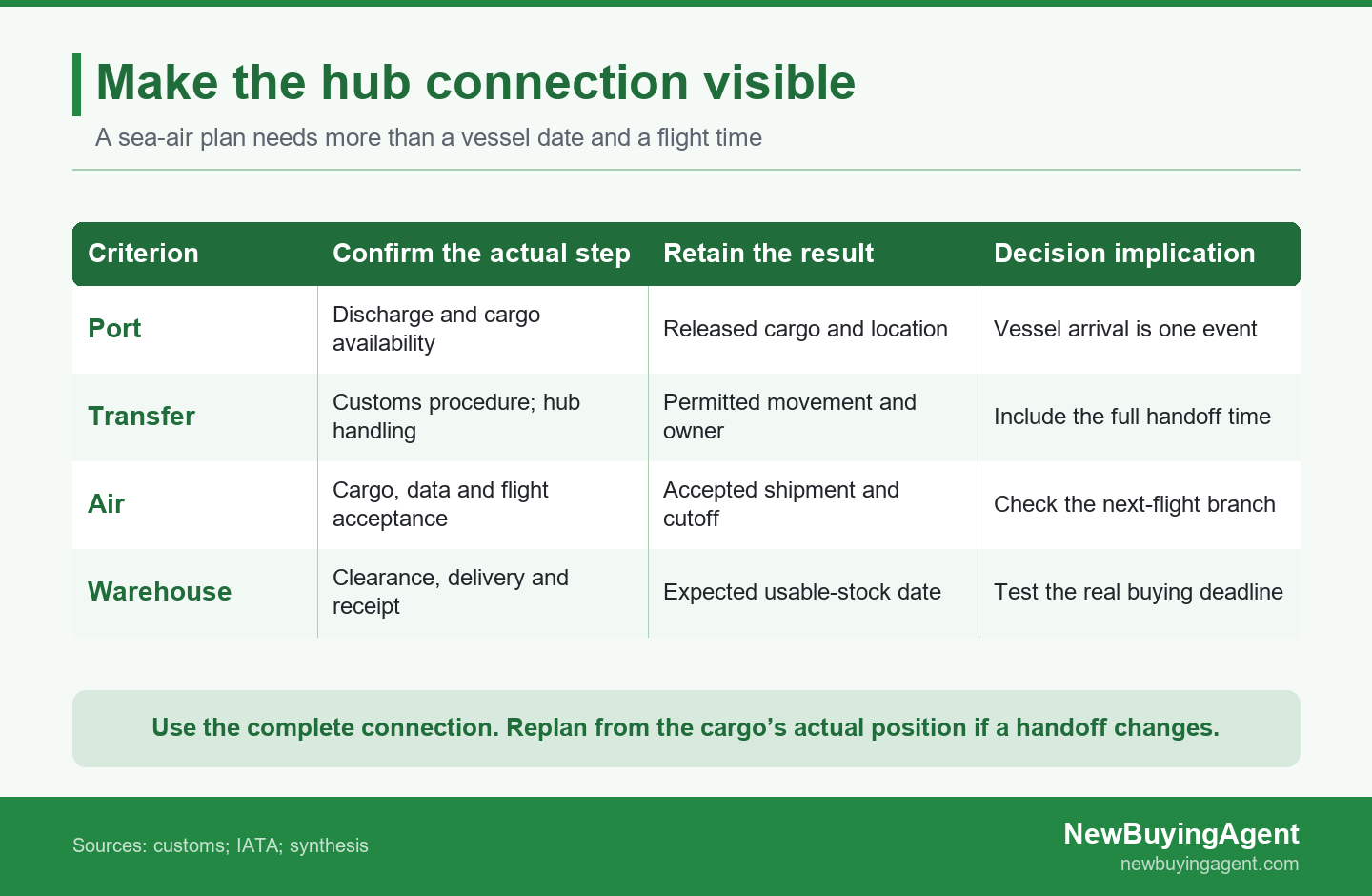
Confirm port release, hub transfer, air acceptance and warehouse delivery as separate sea-air handoffs.
Build the route around the hub handoff
Ask for a stage-by-stage plan from the China pickup point to the receiving warehouse, including the work between sea and air. Record the goods location, required documents, responsible party and expected completion of each handoff. The planned flight becomes meaningful only when cargo can reach its acceptance cutoff in the required condition. Retain the assumptions behind that connection in the booking record.
Use the checklist below in the quotation discussion. Replace each confirmation field with the actual reference, date and named party. Keep an unresolved point open until the provider has answered it. A published vessel arrival or flight time cannot fill a missing customs, handling or cargo-acceptance step.
| Handoff question | Record the actual answer | Confirmation to retain |
|---|---|---|
| When is cargo available? | Vessel, discharge and release status | Location and available date |
| Who moves it through the hub? | Handler, customs route and transfer | Named owner and permitted movement |
| What makes it air-ready? | Packing, data, security and cutoff | Acceptance conditions and timing |
| Which flight can it catch? | Booked service and next feasible option | Capacity status and late-case date |
| When can stock be used? | Clearance, delivery and warehouse checks | Expected receipt and stock date |
Confirm the China departure and hub cargo availability
Confirm when the factory can hand over finished, checked and packed goods with the agreed records. Match collection and origin receiving arrangements to the actual vessel cutoff. If the goods are late for that departure, rebuild the downstream connection from the next workable service. The onward air booking needs to reflect the revised cargo-availability date at the hub.
DSV’s sea-air service via Dubai describes shipping cargo from Greater China by container ship and transferring it to an aircraft for onward markets. The hub is therefore part of the actual route, with a physical change of transport mode. Have the provider identify the port, handling location, departure airport and onward service used in its offer.
Separate vessel arrival from discharge, release and availability for transfer. Ask whether the shipment is consolidated with other cargo and what must happen before the affected cartons can be collected. Record how an arrival change will be communicated to the air-handling team. The connection should follow the cargo’s usable availability, rather than a vessel date copied into a spreadsheet.
Make customs transfer and air acceptance explicit
Identify the hub procedure and the party responsible for it before accepting the service. Ask whether cargo moves under customs control, where deconsolidation occurs and which documents authorize the next movement. Confirm who pays for handling, storage and any approved repacking. Keep those answers connected to the cargo and transport references so the sea and air teams work on the same shipment.
Dubai Customs lists declaration and cargo-transfer services covering different customs regimes and movement to customs-controlled premises for deconsolidation and subsequent clearance. This illustrates why the hub procedure needs a specific answer. For a Dubai movement, have the representative confirm the applicable process. For another hub, obtain its own procedure and responsible contact.
IATA’s air cargo handling guidance describes acceptance as a process establishing readiness for carriage against operator requirements and relevant country rules. A shipment released from the port still needs the required air-side checks. Ask the provider which acceptance steps apply, what information is needed in advance and when the cargo must be available to complete them.
Check the goods against the air leg before loading the vessel
Resolve product and packing eligibility for the proposed air service before the ocean departure. Provide an accurate product description and relevant characteristics, including batteries, liquids, aerosols or unusual dimensions where present. Obtain the carrier’s acceptance conditions and required records. This avoids reaching the transfer hub with goods that need a different preparation, approval or service before they can continue by air.
Use the actual product and pack configuration in the acceptance request. Identify accessories, included components and any change from the sample or previous order. A general description such as household products can conceal information the carrier needs. If eligibility remains unresolved, keep the route decision conditional and establish who will obtain the missing answer.
Resolve product, packing and carrier restrictions early
Ask whether the proposed packaging and shipment size are suitable for the booked aircraft and handling plan. Confirm any pallet changes, carton opening, protective packing or dimensional limits that affect acceptance. Agree who may carry out that work and how the updated package count, marks, dimensions and weight will be recorded. Keep the original shipment identity traceable through the change.
For movements within the scope of U.S. hazardous-materials rules, FAA guidance on shipping dangerous goods addresses classification, packaging, marking and labeling and notes that carriers may impose additional restrictions. The general planning lesson is to obtain the applicable product and carrier acceptance before dispatch. Have a qualified party confirm the actual requirements for the proposed route and goods.
For buyers retaining Chinese suppliers, NewBuyingAgent’s existing-factory management can support supplier communication, production and quality follow-up, and logistics coordination within the agreed scope. That is relevant when the transport provider needs reliable product and packing facts from the factory. The provider and applicable specialists still confirm the air-service acceptance and procedural requirements.
Align shipment identity and advance cargo data
Check that the invoice, packing information and sea and air transport references describe the same goods. Assign responsibility for supplying and submitting each required data set. If packages are split, consolidated or repacked, preserve a record linking the original cartons to the air shipment. Resolve inconsistent descriptions or missing party details before the relevant filing and loading deadlines.
The European Commission’s ICS2 guidance explains safety and security information requirements for goods entering or transiting the EU, including a pre-loading stage for air transport. For a relevant shipment, confirm who files the required information and handles any referral. The ocean movement’s documents alone do not answer every air-leg data obligation. Other destinations require their own checks.
Give the response owner a clear route for corrections. A revised invoice or package count needs to reach the relevant submitter and handler in time. Record which version was used and whether an open data query affects loading. This keeps the physical cargo plan and the information used for its onward movement aligned.
Price the complete movement and its fallback
Compare the full sea-air quotation with complete all-sea and full-air offers for the same shipment and receiving point. Include origin work, ocean transport, hub charges, the air leg and final delivery, while showing excluded or conditional charges separately. Then test the cost and arrival consequences of a missed connection. A nominal saving against full air has value only when the hybrid service still fulfills the buyer’s delivery need.
Ask which amounts are fixed, estimated or charged after handling. Confirm the quote’s validity and the currency used for each component. Treat an unquoted transfer, storage or repacking charge as unknown until it is priced. Keep duties and recoverable taxes on a consistent basis across the options, separate from the transport-service comparison.
Check air-leg billing and every hub charge
Provide packed dimensions, package count and gross weight for the cargo that will actually enter the air leg. Ask how palletization or repacking would change the billed dimensions and quote. Obtain the applicable volumetric conversion, rounding and any minimum charge from the provider. A sea quotation based on a container or cargo volume cannot establish the onward air price by itself.
Flexport’s chargeable-weight explanation describes air-freight billing using the greater of gross weight and volumetric weight, which converts cargo volume into a weight equivalent. The gross figure includes packing and pallets. Confirm the actual quoted calculation and use the final packing configuration. Light, bulky retail goods can therefore need a different cost assessment from dense products with similar actual weight.
List port and terminal handling, deconsolidation, customs services, transfer transport, air handling, security-related work, storage and delivery where applicable. Identify who authorizes additional work and how the cost is confirmed. Review the terms of carriage and any insurance arrangement across the complete movement, including the hub, with the relevant provider or adviser.
Test a replenishment plan against a missed flight
Consider a hypothetical replenishment of 1,200 cartons of ordinary kitchenware, accepted on all proposed services, with usable warehouse stock required by day 26. Assume equal-scope offers of USD8,500 for sea-air, USD14,000 for full air and USD5,000 for all sea. The hybrid calendar is 3 days at origin, 11 at sea, 3 at the hub, 2 in air movement and 3 for destination processing, totaling 22 days. Full air takes 8 days and all sea takes 38. Sea-air saves USD5,500 against full air, costs USD3,500 more than sea and leaves 4 days before the deadline. A missed flight adding 5 days produces a 27-day result and misses the deadline. All figures are teaching assumptions, not current rates, schedules or a standard buffer.
Under the planned calendar, the hybrid service meets the stated requirement while all sea arrives too late. Full air also meets it, at a higher assumed transport cost. The buyer now has a specific question for the provider about the likelihood and consequences of losing the intended connection. Confirm the next feasible departure and complete warehouse date rather than relying on the planned saving alone.
If the later-flight branch is credible and the stock date is firm, the hybrid proposal needs further justification before booking. The buyer can evaluate a confirmed full-air service, a different connection or a separately priced urgent quantity. Use the actual demand gap to size any split. If the receiving date can move, record the revised requirement and its commercial consequence before accepting the later arrival.
Once cargo is already at the hub, a recovery estimate starts from that location and current status. The original China-to-warehouse full-air estimate no longer describes the job. Obtain the remaining release, acceptance, flight and delivery steps and their charges. Confirm the resulting stock date before deciding whether an acceleration still helps. This separates the original mode choice from a later recovery decision.
Agree who acts when the connection changes
Name a response owner and the parties responsible for origin readiness, hub handling, air booking and final delivery. Agree which change triggers an update and what decision the buyer needs to make. A useful exception message identifies the current cargo position, unresolved step, next feasible movement, revised warehouse date and additional cost. This allows the buyer to choose an actionable response while time remains.
Before dispatch, ask how the provider handles a late vessel, failed acceptance, missing data or unavailable flight capacity. Establish who can authorize storage, repacking, a revised air service or a cargo split. Keep the approval and cost basis in the booking record. When an estimate changes, update the complete remaining route and tell the receiving team what the new date means.
The International Trade Administration’s common export document guidance distinguishes the commercial invoice from the packing list containing package, quantity, weight and mark details. Those records help preserve shipment identity when handling units or transport references change. Retain the version history and match the physical cartons to the relevant documents. A revised routing instruction should remain traceable to the goods actually moving.
Close an exception after the agreed movement or corrective action has been confirmed, then record the actual receipt and charges. Use the result to improve the next order’s packing, data preparation or connection plan. Keep a provider’s estimate, the buyer’s approval and the observed outcome distinct in the record so future decisions use the appropriate evidence.
Prepare the next purchase around the required stock date
Bring the stock deadline into the purchase brief before production and packing choices are locked. Explain the destination warehouse, required quantity, delivery window and relevant product characteristics. Ask the sourcing and logistics parties to identify the information and preparation each needs. Confirm what will happen if factory readiness slips, since that can change every downstream transport option.
For recurring China purchasing, share your purchasing requirements with NewBuyingAgent, including product specifications, quantity, target price, destination, timing and current sourcing situation. Add pack dimensions and any product characteristics affecting the proposed air leg. This supports a scoped discussion of China product supply or agreed existing-factory management, using local factory resources and product/QC capability to prepare an order around the buyer’s actual requirements.
Frequently Asked Questions
Can a buyer arrange the sea and air legs separately?
Separate bookings can work only when the hub handoff, cargo acceptance, documents and responsibility for delays are explicitly arranged between the parties. Identify who receives the sea cargo, prepares it for air carriage and books the onward movement. Check the contract and coverage for the gap between services. Compare the complete charges and exception arrangements before choosing that structure.
Can a shipment already at sea switch to an air connection?
A shipment already at sea needs a new feasible plan from its actual location, including release, handling, customs and confirmed onward capacity. Ask whether the cargo can be accessed at the proposed port and what authorization or contract changes are needed. Obtain a complete revised cost and warehouse date. The original departure estimate cannot establish the remaining recovery time.
Does one tracking reference mean the whole route is guaranteed?
One tracking reference can improve visibility, while any delivery commitment still depends on the agreed contract, service scope and conditions. Check which milestones are reported and who handles an exception at the hub. Ask how a missed flight changes the quoted service and who confirms the revised plan. Retain the actual commitment separately from an estimated tracking milestone.
Should only the urgently needed cartons use sea-air?
A partial sea-air movement can fit when its defined quantity closes a real replenishment gap and its separate charges and handling remain justified. Confirm package identification, document treatment and the physical ability to split the cargo. Quote the urgent and remaining portions separately. Give the warehouse a receiving plan for both so the accelerated cartons solve the intended stock problem.
NewBuyingAgent
موارد ذات صلة


ابدأ اليوم
دعنا نحول أهداف التوريد الخاصة بك إلى واقعWeChat:+86 15157124615
WhatsApp:+86 15157124615
العنوان: مبنى 10 #39 طريق شيانغيوان، هانغتشو، الصين
