


A China–Europe transport lane is the complete shipment path from the named Chinese pickup point to the named European receiving point. A rail-versus-sea decision compares that same cargo, ready date, delivery requirement and cost scope using each mode’s actual route.
Choose sea when its executable warehouse arrival meets demand and the rail premium creates insufficient benefit. Choose rail when an accepted, workable route makes stock available soon enough to avoid a credible loss that exceeds the extra cost. Confirm the departure, delivery scope and cargo acceptance before treating either offer as a usable option.
Choose the route that meets the stock deadline at justified cost
Begin with the required warehouse date and work back to factory readiness. Compare complete offers for the same shipment, then value the difference in usable-stock timing. Keep unquoted charges and unconfirmed dates visible until the logistics provider answers them. The economical choice depends on the buyer’s replenishment need and the route that can actually be booked.
- Timeline. Include pickup, departure waiting, main transport, clearance and receipt.
- Cost comparison. Compare equal service inclusions before calculating the premium.
- Risk. Count only a supported benefit from earlier usable stock.
- Decision. Confirm the product, route and documents for the actual shipment.
Compare the same factory-to-warehouse shipment
Define the lane using the factory address, receiving warehouse, cargo details and realistic ready date. Ask both providers to quote that same movement and identify every excluded leg. This gives rail freight and sea freight a common comparison basis. A shorter terminal journey creates value only if the complete route changes when the buyer can use the goods at an acceptable total cost.
A coastal factory delivering to a warehouse close to a seaport can produce a different result from an inland factory replenishing an inland European warehouse. List the actual Chinese collection point, departure terminal or port, European arrival point and final delivery address. Where a quote ends at a terminal, obtain the missing onward service before comparing its price with a delivered offer.
Bahnoperator’s China–Europe rail service information distinguishes rail timing from pre- and on-carriage and describes routing as shipment-specific. That makes the endpoint of a published time important. Ask whether the estimate starts when the cargo reaches the origin terminal, when the train leaves or when the factory hands over the goods. Record the corresponding end event as well.
When a recurring order is nearly ready but carton sizes or product checks remain open, NewBuyingAgent’s local factory resources and product/QC capability are relevant to confirming the actual order condition. Establishing specifications, pack details and production readiness gives the transport comparison reliable inputs. That sourcing work helps purchasing set a workable handover date.
Use the same quantity, packed dimensions, gross weight, stackability and product description in both requests. State the latest usable-stock date and any receiving restrictions. If one provider proposes a different cargo split or delivery point, show it as a separate option with its own assumptions so the difference remains visible.
Keep shipment identity, calendar, cost scope and route acceptance aligned throughout the comparison. These inputs explain whether a quoted time advantage reaches the buyer’s inventory.
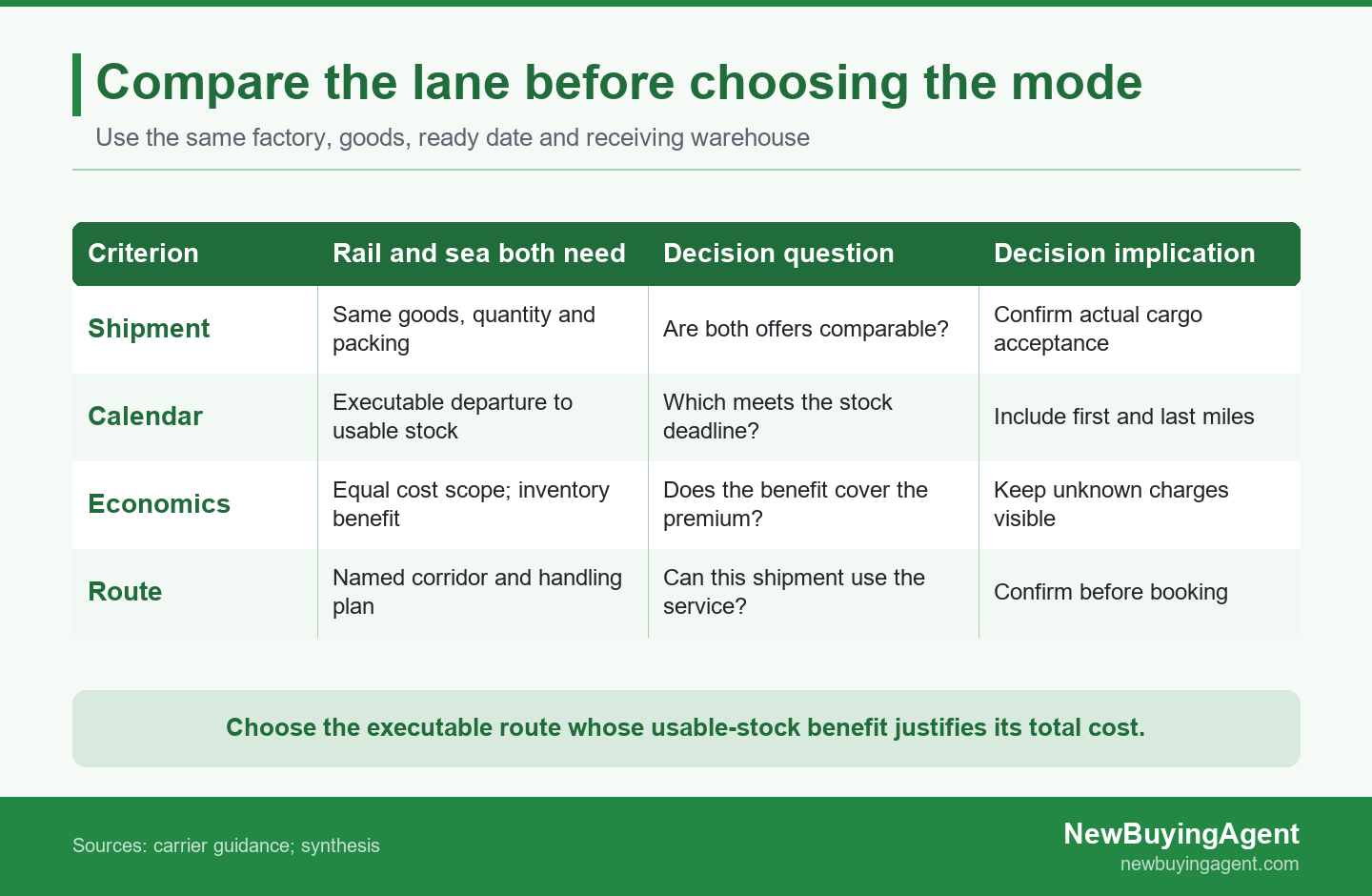
Compare rail and sea using the same shipment, warehouse deadline, cost scope and cargo acceptance.
Where rail and sea change the buying decision
Compare rail and sea against the same delivery requirement, with the inclusions and uncertainties stated before judging price. The matrix below identifies questions to answer for both offers. It describes conditional buying situations rather than current freight rates or guaranteed transit times. Use the written quotation and transport plan to fill in the result for the actual lane.
For consumer goods, the important differences often concern how much stock is needed by a certain date, which departure is usable and what each quote includes. A replenishment shipment can justify paying more when it prevents a documented shortage. Routine stock with enough calendar room can favor the lower comparable cost. Test those conditions against the same receiving event.
| Decision input | Rail option | Sea option | Confirm for this lane |
|---|---|---|---|
| Usable stock date | Can fit a tighter restock window | Can fit planned stock with calendar room | Executable departure and warehouse receipt |
| Transport cost | Premium needs a defined benefit | Lower offer helps only with equal scope | Same services and excluded charges |
| Origin access | Factory-to-rail-terminal leg | Factory-to-port leg | Collection cost and cutoff |
| Destination access | Rail-terminal onward movement | Seaport onward movement | Clearance point and warehouse delivery |
| Small loads | Shared-load service may be available | Shared-load service may be available | Minimum charges and release scope |
| Handling and route | Named corridor and handoffs | Named sailing and any transfer to another ship | Cargo acceptance and packing plan |
Based on this comparison, sea fits when the executable arrival meets demand at the better total economics. Rail fits when its usable-stock advantage has enough verified value to cover the premium. An unknown final-delivery charge or unconfirmed departure leaves the recommendation provisional until the missing input is obtained.
Rail Cargo Group’s China–Vienna consolidated service distinguishes freight-station transit from a door-to-door option with truck first and last miles. The example shows why a small shipment needs its own service description. Confirm consolidation timing, destination handling and delivery inclusions for the chosen offer. Availability on a published connection remains subject to the actual booking.
Build a calendar from cargo readiness to usable stock
Use one ready date and list the elapsed stages to the same warehouse receiving event. Include the next departure the goods can catch, transfer or consolidation time, destination processing and the receiving appointment. Keep a realistic late-arrival case alongside the planned result. This reveals whether the advertised transport advantage survives the handoffs that the actual order requires.
Ask the provider which events are confirmed, estimated or dependent on another party. A departure that is already past the cargo cutoff cannot support the current order plan. Record the next workable service and update the whole arrival estimate. Use the same treatment for a missed train, sailing or onward connection.
Confirm the departure the factory can actually catch
Factory readiness includes finished goods, agreed checks, completed packing and documents available for the booked service. Ask when the shipment can be handed over in the required condition. Compare that with collection arrangements, terminal receiving hours and cargo and document cutoffs. If preparation is incomplete, use the next executable departure when calculating the warehouse date.
Maersk’s schedule guidance separates point-to-point transport plans, port calls and vessel schedules. Select the view that matches the question being answered and check the locations included in the plan. A vessel’s port arrival is only one event in the buyer’s delivery calendar. Confirm how pickup and final delivery connect to it.
Include clearance and the warehouse receiving appointment
Identify where import clearance will occur, who coordinates it and what must be ready beforehand. Then confirm the onward delivery method and the warehouse booking process. A shipment can reach its European transport endpoint while the receiving slot, documents or onward vehicle remain unresolved. Count availability according to the buyer’s actual receiving and stock-entry requirements.
The European Commission explains that customs transit can allow clearance at destination under the applicable procedure, with import duties and taxes temporarily suspended during the movement. Arrival at an EU entry point therefore does not independently establish import clearance. Have the representative confirm the intended procedure and the point at which it is completed for this shipment.
Separate transport arrival from stock available for sale or use. If receiving requires carton counts, product identification or another agreed check, include the planned time for that work consistently in both options. Ask the logistics provider and warehouse how weekends, appointment capacity or a late arrival would change the next available receipt date.
Put the rail premium against a defined inventory benefit
Calculate the extra comparable transport cost first, then assess whether earlier usable stock pays for it. Use actual cargo value and payment timing for any carrying-cost benefit. Evaluate avoided shortage or emergency replenishment cost separately, with evidence for the affected period and quantity. Keep overlapping benefits out of the total so the comparison does not count the same economic effect twice.
Earlier delivery can release capital sooner, prevent a missed replenishment or simply increase stock already sitting in the warehouse. Identify which effect applies. A sales forecast alone does not establish the loss avoided by choosing rail. Check current available stock, expected demand, the replenishment gap and realistic alternatives before assigning a value.
Normalize transport and carrying-cost inputs
List origin collection, handling, main transport, consolidation or deconsolidation, destination handling, clearance service and final delivery. Add applicable shipment-specific surcharges and insurance on the same basis. Show duty and recoverable tax separately from transport and explain their treatment. Confirm currencies, quotation validity and chargeable weight or volume. Leave an unquoted item unknown until it is priced.
The International Trade Administration’s document guidance distinguishes packing information from the commercial invoice. Quantities, package details and weights help define what is being transported, while the invoice states the sold goods and payable amount. Use consistent product and packing data for both providers so a price difference is not caused by different cargo assumptions.
For a simple carrying-cost estimate, multiply the relevant funded cargo value by the annual carrying rate and the days saved, divided by the annual day basis used. Confirm when payment actually ties up funds and when the benefit ends. If a quoted inventory rate already includes a shortage component, separate that component before adding another avoided-loss estimate.
Work through a replenishment decision with explicit assumptions
Consider a hypothetical importer replenishing EUR100,000 of kitchenware. Assume comparable factory-to-warehouse transport of EUR9,000 by rail and EUR5,000 by sea, with usable stock after 25 and 45 days respectively. These are invented teaching inputs, not market quotations. For this calculation, assume earlier receipt advances sale or use and reduces actual funded inventory holding by 20 days across the full cargo value. Use a 12% annual carrying rate and a 365-day basis. Earlier warehouse receipt alone would only relocate inventory, so count no carrying saving until a holding-period reduction is supported. The carrying benefit is EUR100,000 × 12% × 20 ÷ 365, approximately EUR658. The EUR4,000 transport premium leaves about EUR3,342 to justify through a separate benefit. If timely rail delivery avoids a supported EUR6,000 shortage loss, excluding carrying cost, the net benefit is about EUR2,658. If rail is 8 days late, assume the actual funded-holding reduction falls to 12 days, giving a carrying benefit of approximately EUR395. A net benefit of EUR2,395 would then exist only if the same shortage loss were still avoided.
Start with the no-shortage case. If existing stock covers demand through the sea arrival, the carrying benefit alone leaves the rail premium largely unpaid. That carrying-only comparison is conditional on a supported reduction in funded holding. If earlier receipt simply adds warehouse stock, use zero carrying saving. Sea has the better economics in either version of this no-shortage case. The buyer should retain the stock projection supporting that conclusion rather than assuming every earlier delivery generates additional sales.
Next test the shortage claim against the delayed rail arrival. If the late shipment misses the period in which the loss would have been avoided, remove the unsupported benefit and reassess the remaining loss by affected quantity and timing. If the loss is only partly avoided, use that smaller supported amount. The planned rail advantage can disappear even while rail remains faster than sea.
Before applying the result, replace the teaching figures with written offers, the actual payment schedule and a stock projection. Check that the shortage estimate reflects net economic loss rather than gross sales revenue. Where a demand benefit cannot be substantiated, keep it unknown and make a conditional decision, identifying the data needed to resolve it.
Check the corridor and product before accepting the quote
A promising cost-and-time result still requires a route that accepts the actual goods and can be booked. Obtain the named corridor, relevant handoffs, cargo restrictions and document requirements from the provider. Check product and route-specific regulatory questions with the qualified representative. If an alternative corridor is proposed, rebuild the timing and cost comparison around its actual service rather than carrying over the original assumptions.
Send an accurate product description and the information needed for cargo acceptance before comparing firm offers. Flag batteries, liquids, magnets, temperature needs or other relevant characteristics when present. Ask the provider which documents and approvals apply to that product and route, and confirm any unresolved point before relying on the departure date.
Confirm route acceptance and transit requirements
Ask for the countries, border crossings, transfer points and final delivery arrangement used in the quotation. Confirm that the cargo, parties and route have been accepted for the proposed shipment. Record any condition that could change the service. A broad label such as China–Europe rail leaves too much unspecified for a booking decision.
The European Commission publishes specific guidance on transit of listed goods via Russia. Its existence makes product and route applicability a concrete question for qualified review. Confirm the current rules for the actual goods, counterparties and proposed movement. A generic statement that all rail is available, or all rail is prohibited, cannot establish the answer for this shipment.
The World Bank describes the Middle Corridor as a network combining road, rail and sea through Central Asia and the Caucasus. A proposal using that corridor can therefore contain different transfer stages from another rail offer. Request the complete plan and price each relevant leg. Recheck the warehouse date when changing the corridor, even if the sales description continues to emphasize rail.
Match packing and shipment size to the actual service
Check whether the proposed service uses a dedicated container or consolidated cargo, and who handles loading, securing and unloading. Give the provider accurate packed dimensions and weight. For furniture, glassware or mixed retail cartons, consider stability, compression and the handling actually planned. Ask whether the quoted packing arrangement remains suitable across every leg and transfer.
The IMO/ILO/UNECE CTU Code provides packing and securing guidance for the cargo-unit supply chain, including receiving and unpacking. It also retains the role of applicable national and mode-specific regulations. Use it as a reference for discussing the packing plan with the responsible parties, then confirm the requirements for the booked service.
For established China suppliers, NewBuyingAgent’s existing-factory management can connect agreed production and quality follow-up with supplier communication and logistics coordination. That is relevant when the buyer needs reliable pack details and dispatch readiness for repeat orders. The transport provider still needs to confirm the cargo acceptance and quoted service conditions.
Book against a written delivery requirement
Record the selected shipment, comparable charges, executable departure, expected usable-stock date and the conditions supporting the choice. Name the open items that must be confirmed before booking and retain the provider’s answers. If a cutoff, route or receiving date changes, update the affected comparison. This preserves the reason for paying a premium or choosing the lower-cost option as the order moves toward dispatch.
The booking brief should state the factory pickup point, destination warehouse, product description, quantity, packing, weight, ready date and latest useful receipt date. Attach the required document list and receiving constraints. Retain any cost exclusions and validity date, along with the person responsible for confirming that the goods and paperwork are ready.
For recurring consumer-goods sourcing, share your purchasing requirements with NewBuyingAgent, including specifications, quantity, target price, destination, timing and current sourcing situation. Add the warehouse stock deadline and packing constraints behind the rail-versus-sea decision. That supports a scoped discussion of China product supply or agreed existing-factory management, using local factory resources and product/QC capability to align the order with the buyer’s replenishment needs.
Frequently Asked Questions
Should a buyer send only the urgent quantity by rail?
A split shipment can fit when a defined urgent quantity prevents a real shortage and the separately quoted handling and freight still justify it. Calculate that quantity from the stock gap, then obtain a separate offer and receiving plan for each part. Check minimum charges, document work and pack allocation. Keep the remaining replenishment linked to the same demand plan so the split does not create another shortage.
Does a rail quote include import duty and delivery?
A rail quote includes only the services stated in its scope, so import duty, tax, clearance and delivery need explicit confirmation. Ask where the quoted movement starts and ends, which local charges apply and who handles the destination formalities. Treat an unquoted amount as unknown. Use equivalent inclusions and tax treatment before comparing the offer with a delivered sea option.
Is rail always the lower-emission choice for consumer goods?
An emissions comparison needs the actual route, transport legs, load assumptions and calculation method before either mode receives a defensible shipment-level result. Ask the providers for estimates using a consistent boundary and method, including first and last miles where relevant. Keep that environmental comparison separate from the cost calculation until its assumptions are clear.
Can the same comparison be used for every European destination?
Each destination needs its own receiving point, customs procedure, onward connection and delivery calendar because the European terminal alone does not define the lane. A result for an inland EU warehouse may change for another country or a coastal receiving point. Requote the changed legs and confirm the local procedure, then update the usable-stock date and the economic value of any time saved.
NewBuyingAgent
موارد ذات صلة



ابدأ اليوم
دعنا نحول أهداف التوريد الخاصة بك إلى واقعWeChat:+86 15157124615
WhatsApp:+86 15157124615
العنوان: مبنى 10 #39 طريق شيانغيوان، هانغتشو، الصين
