

International express courier is an integrated shipping service that coordinates collection, transport and delivery through a courier network. Air freight is cargo transport by aircraft, with pickup, customs handling and final delivery included only to the extent specified in the booked service.
For a sample or urgent replenishment from China, choose the service that gets the correct goods to the actual receiving point by the useful date. Compare the same packed shipment and complete delivery scope. The decision can change when carton dimensions, destination charges or the next available departure are confirmed.
Choose the service that reaches the actual receiving point
Courier often fits accepted sample cartons and urgent goods needing coordinated delivery. Air freight can fit a larger or specially handled movement when its full destination plan is executable and the complete cost is justified. Obtain the actual service boundaries and receiving date for both options. A cheap airport quote has an unresolved total until the remaining work is priced.
- Best for. Match the service to an approval sample or a defined stock gap.
- Cost comparison. Use packed dimensions, billing rules and complete charges.
- Timeline. Include acceptance, clearance and receiver availability.
- Decision. Select an accepted shipment plan that meets the buying need.
Start with the sample decision or stock gap
A sample shipment should reach the person who can make the required product decision, with the correct version and supporting information. An urgent replenishment should deliver a defined quantity of saleable stock before the business needs it. These different purposes determine how much to send, where it must arrive and what work remains after delivery. Establish those requirements before requesting courier and air-freight offers.
For a product-development manager, a sample arriving before a review meeting has value only when its material, finish and revision match the question being tested. Include the sample reference, requested checks and contact responsible for approval. If the receiving address is a laboratory, confirm its booking and intake requirements. Delivery to an unattended office can consume the time saved in transport.
For a purchasing manager facing a stock gap, identify the affected SKU, existing usable inventory and the quantity needed before the normal replenishment arrives. A full order may contain cartons with very different urgency. Separating the critical quantity can reduce the amount exposed to expensive transport, provided the split remains traceable and both receiving plans are workable.
When the buying requirement is still being translated into a sample or production order, NewBuyingAgent’s local factory resources and product/QC capability are relevant to establishing the actual product, packing and readiness. Those inputs support complete China product sourcing around the buyer’s requirements. They also give the transport provider a defined shipment to assess, instead of a provisional weight and a generic product name.
Carry four facts into the service comparison. Establish cargo acceptance, the usable receiving date, the complete charges and the quantity that genuinely needs acceleration.
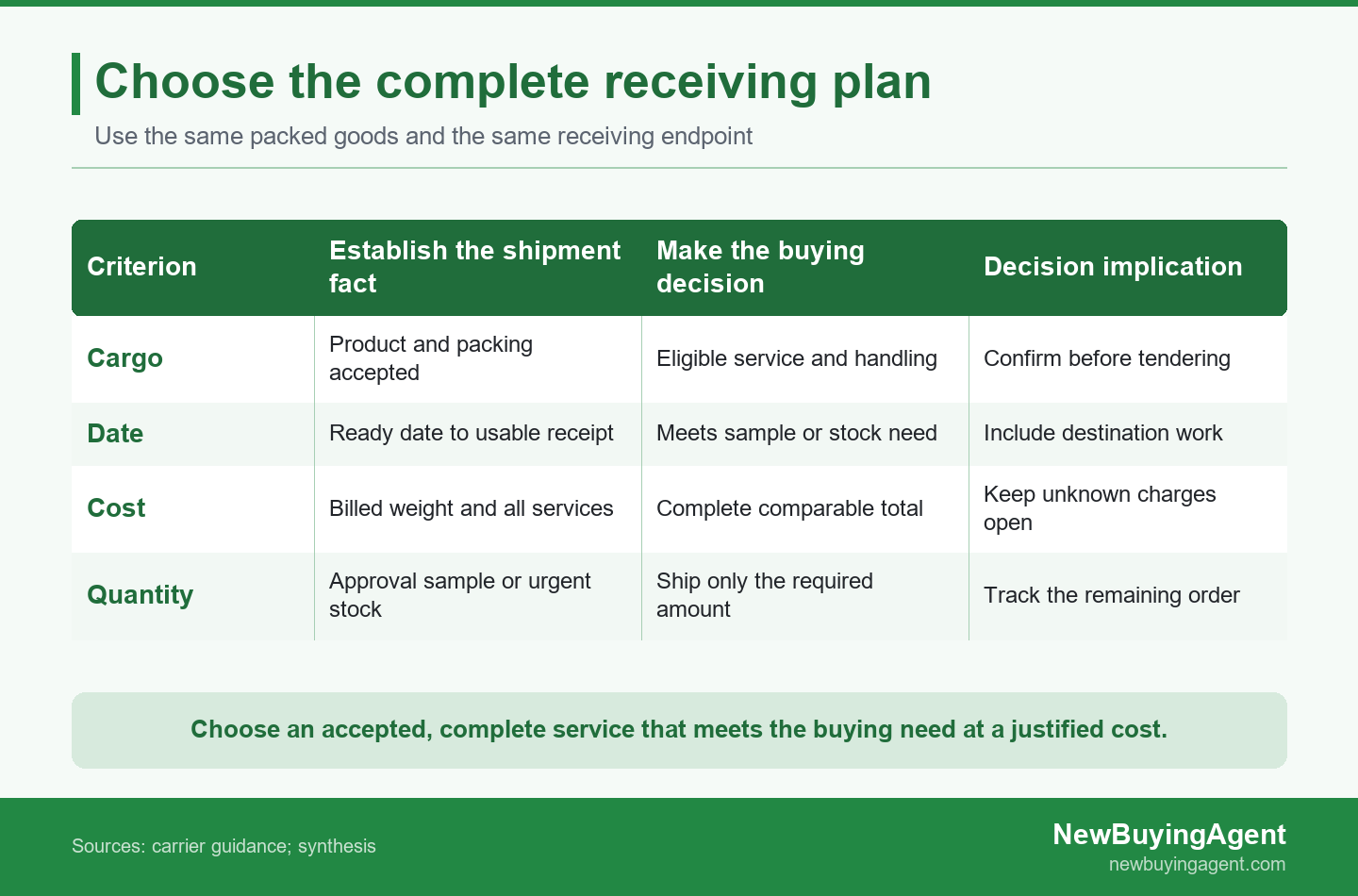
Compare accepted cargo, receiving date, complete cost and urgent quantity before choosing courier or air freight.
Compare the delivery scope before comparing speed
Compare courier and air freight from the same China collection point to the same receiving destination, with the same clearance and delivery responsibilities. Express networks coordinate a delivery chain, while an air-freight offer can cover an airport movement or a more complete door service. Each quotation must identify what its price and transit estimate include. Ask who completes every excluded step before treating the options as interchangeable.
Use the service name as a starting point for questions. A door-to-door label still needs a named payer for import charges, a receiving address and a statement of special handling. An airport service requires an operational plan for retrieving the freight and moving it onward. A buyer with a broker and receiving truck may handle that arrangement comfortably, while another buyer needs those activities quoted together.
Separate integrated express from airport and door services
DHL’s express-network explanation describes coordinated door delivery and shipment tracking within an integrated network. It also discusses large and heavy shipments, which is a reason to check the actual service limits before applying a simple parcel-versus-freight rule. Carrier acceptance, package limits, surcharges and the available destination service still need confirmation for the proposed China shipment.
The U.S. FedEx Airport-to-Airport service page explicitly excludes collection, final delivery and customs clearance, and requires advance confirmation. That published scope shows how much a fast airport movement can leave to the shipper and receiver. It is an example of a service boundary. Ask the provider to confirm which actual China-origin service is available and who handles its local tasks.
The comparison below separates four arrangements by delivery scope, cost basis and buying fit. The actual offer controls the limits, included work and charges in every row.
| Service option | Delivery scope | Cost basis | Buying fit |
|---|---|---|---|
| Express sample parcel | Booked door service | Packed parcel and extras | Accepted approval sample |
| Express carton shipment | Booked door service | All pieces and extras | Urgent accepted cartons |
| Airport air freight | Named airports | Air charge plus local work | Buyer arranges local legs |
| Door air freight | Agreed end points | Air and agreed local work | Freight with full delivery plan |
Based on this comparison, courier can be the simpler fit for accepted cartons needing coordinated receipt, while air freight becomes a useful alternative when its complete destination arrangements and total charges are known. Keep missing services unresolved in the comparison. The lowest quoted transport line cannot establish the lowest complete cost.
Work backward from the appointment or stock date
Write the latest useful receipt first, then ask for a calendar beginning when the goods are genuinely packed and available for collection. Include the pickup cutoff, document submission, acceptance, departure, arrival, clearance, local delivery and any warehouse appointment. State whether quoted transit uses working days or elapsed days. A Friday-ready carton and a Monday-ready carton can face different departures even with the same advertised transit.
IATA’s air-cargo handling overview describes work at cargo facilities before loading and after unloading through destination handover. These activities explain why a short flight does not establish a usable warehouse date. Ask which milestones the quote includes and who confirms release for delivery. If the deadline is tight, obtain the next feasible departure and the effect of a missed acceptance cutoff.
For samples, allow time for the recipient to inspect and report before the purchasing decision. For replenishment, include the receiver’s intake and stock-release work. Record an estimate and a contractual delivery commitment separately when the service provides both. A tracking forecast helps monitor progress, while the booking conditions establish what was actually promised.
Calculate the complete shipment cost on the packed goods
Calculate courier and air-freight costs using the actual packed shipment and each provider’s billing rules, then restore all required services to both offers. Include origin work, transport, destination handling and final delivery wherever they are charged separately. Identify import duties, taxes and payment-related fees with the party responsible for them. Only a complete, accepted service that meets the required date is a usable price alternative.
Request the quote currency, validity, chargeable weight, minimum charges and applicable surcharges. Ask whether fuel, security, pickup, clearance work, terminal handling, remote delivery or an appointment is included. Keep an unknown charge visibly open until it is confirmed. Where duties and taxes are outside the transport price, compare their treatment separately and establish who pays before release.
Use each offer’s own chargeable-weight rules
Chargeable weight is the weight basis used to price the shipment, often comparing actual gross weight with a volume-based calculation. DHL Express Netherlands publishes a centimeter-based volume calculation divided by 5000. That is a specific carrier calculation, with actual booked-service conditions still to check. Obtain the divisor, measurement method and rounding rules for each quotation, including whether pieces are assessed individually.
Measure the completed shipping cartons, including protective packaging and any pallet or crate required by the service. A dense sample and a bulky display model of the same scale weight can generate different bills. If the provider proposes repacking, confirm the resulting dimensions and protection before accepting a lower estimate. A price reduction that exposes the approval sample to damage can defeat the purpose of sending it.
Test a 24-carton replenishment against its deadline
Consider a hypothetical replenishment of 24 cartons, each measuring 60 × 40 × 40 cm and weighing 8 kg gross. Total actual weight is 192 kg. Assume both services accept the goods, both begin from the same packed-ready event and both deliver to the same warehouse. For teaching purposes, assume a courier divisor of 5000 and an air-freight divisor of 6000, before rounding. The volume-based weights are 19.2 kg per carton and 460.8 kg total for courier, against 16 kg per carton and 384 kg total for air freight. Assume those become the billed weights in this example. A complete courier offer of USD 6 per kg plus USD 100 in other quoted service charges totals USD 2,864.80. An air offer of USD 4.50 per kg gives USD 1,728 for transport, plus USD 180 origin work, USD 240 destination handling and clearance work, and USD 160 final delivery, totaling USD 2,308. Air freight therefore saves USD 556.80 under these assumptions. Import duties and taxes are outside both transport totals and assessed separately on equivalent confirmed assumptions. Assume all required transport services and fees are accounted for in the stated amounts. These figures are illustrative inputs, not current market rates, universal divisors or a shipment quotation.
Now give the warehouse an elapsed-day deadline of day 8 from the common ready event. Assume the complete courier plan delivers on day 5 and the complete air plan on day 7. Both initially meet the requirement, so the lower complete air cost is a relevant advantage. If the actual air booking adds 2 days waiting for departure, receipt moves to day 9 and misses the deadline. Courier then costs USD 556.80 more for the assumed timely option. The buyer must decide whether protecting that stock date justifies the premium.
Use actual quotations to replace every assumption, including rounding, minimums and destination fees. A later factory-ready date can change both calendars, so recheck each service from the revised collection event. Retain the same goods, delivery point and cost scope throughout the comparison. If one provider has not confirmed capacity or a local charge, mark that offer incomplete until the missing fact is resolved.
Keep sample identity and import treatment clear
Identify a sample by its actual product, version, quantity and purpose, and obtain the documents required for its origin and destination. Free supply and evaluation use can affect the paperwork, while the receiving country’s rules determine valuation and any relief. Keep the invoice information, package contents and shipment reference consistent. Confirm the proposed treatment before collection so the product reaches the intended evaluation or approval step.
Describe the sample and its purpose accurately
Give each sample a reference linked to the specification or revision being assessed. Describe what is inside the package in terms the carrier, customs representative and receiver can understand. Include materials, function and any relevant powered or chemical characteristics. A description such as “sample” alone leaves the product unidentified and gives the recipient little basis for checking what arrived.
FedEx’s international shipping guidance treats shipment purpose as relevant to customs requirements and lists pro forma invoices among documents for free goods such as product samples. The same guidance says document needs vary with origin, destination and commodity. Confirm the appropriate invoice form and customs-value basis with the actual carrier or representative, using an accurate description of the shipment.
The ITA’s document-role guidance distinguishes invoice information from the packing list’s package, quantity and weight details. Its U.S. export context helps explain those roles without determining China export procedures. Keep the sample count and package references consistent across the applicable documents. If a laboratory needs multiple units or a sample must return after evaluation, state that plan before booking so the correct procedure can be considered.
Confirm any sample relief before claiming it
UK HMRC commercial-sample relief has conditions covering eligibility, preparation before import and use to obtain future orders. Its rules include restrictions on goods that can serve other purposes, so an ordinary saleable replenishment cannot qualify merely through a sample label. This is a UK example of a conditional procedure. Ask the importer or qualified representative to check the destination’s applicable treatment for the actual goods.
Keep approval samples, test units and stock for sale distinct in the shipping record. Before modifying or marking a sample to meet a relief condition, confirm that the preparation remains compatible with the intended evaluation. Some tests require an intact product. If the proposed relief conflicts with that purpose or its eligibility is unresolved, obtain an appropriate alternative import treatment and include the resulting charges in the decision.
Check product acceptance before paying for speed
Confirm that the actual product and shipping package are accepted by the proposed courier or air service before paying for acceleration. Batteries, liquids, aerosols and other product characteristics can affect classification, preparation and available carriage. The carrier needs a precise description and the applicable supporting information. Complete any required review early enough to preserve the proposed collection and departure dates.
A prototype may differ from the production unit in battery configuration, materials or packaging. Give the carrier the current configuration and condition, including any loose batteries or separately packed accessories. Ask what information and qualified preparation are required for this exact consignment. Acceptance of a previous sample does not establish that a revised design or package can follow the same service.
The FAA’s U.S. dangerous-goods guidance places correct classification and preparation responsibilities on the shipper and notes that carriers can impose additional restrictions. Apply the relevant air-mode and jurisdictional requirements to the actual route with appropriate trained support. A fast service name cannot resolve missing classification or packing information. Obtain the provider’s acceptance conditions before tendering the goods.
Protect the sample or replenishment physically as well. Confirm cushioning, package closure and handling requirements after any repacking. Give the receiver a way to identify damage, missing pieces or the wrong revision on arrival. An early delivery of unusable goods leaves the buying problem unresolved, so the receiving check belongs in the shipment plan.
Choose the urgent quantity and protect the next order
Send the quantity that addresses the immediate buying need while keeping the remaining order identifiable and deliverable. For replenishment, verify which SKUs can close the stock gap and which cartons are ready for release. For samples, send the units required for the planned assessment and retain their references. Coordinate the split with the factory and receiver so acceleration produces a usable result and the balance remains under control.
Record the urgent cartons, quantities, package marks and shipment references against the purchase order. Confirm the remaining production or dispatch plan and tell the warehouse how the two receipts relate. Recheck separate minimum charges, handling and document work before assuming a split saves money. After receipt, compare the actual quantity and usable-stock date with the need that justified the premium.
When a retained China supplier is repeatedly late with the critical cartons, the transport decision connects to production and quality readiness. NewBuyingAgent’s agreed existing-factory management can support supplier communication, progress and quality follow-up, with logistics coordination within the agreed scope. This connects the urgent movement to the underlying order and the next replenishment. Confirm the actual factory issue before changing future purchasing dates or quantities.
Connect the transport decision to the purchasing brief
Keep the product decision and delivery requirement together when planning recurring China purchases. A sample that confirms the right specification can prevent a later approval delay. Accurate production and packing information also makes the next courier or air comparison more useful. Retain the confirmed sample reference, carton data and receiving requirement in the order record so a future quotation begins with current facts.
For new product purchasing or ongoing China orders, share the purchasing brief with NewBuyingAgent, including product specifications, quantity, target cost, destination, timing and current sourcing situation. Add the sample version or urgently needed quantity and the available packing data. Its local factory resources and product/QC capability support a scoped discussion of complete China product supply or agreed existing-factory management around those purchasing, quality and delivery needs.
Frequently Asked Questions
Is there a fixed weight at which air freight becomes cheaper?
There is no universal crossover weight between courier and air freight because service scope, account rates, packed dimensions and minimum charges vary. Compare the actual shipment through the same receiving point. A heavier accepted express shipment can still be practical, while a light bulky sample can attract a high dimensional charge. Obtain complete current offers before selecting a weight-based rule for your own lane.
Can a supplier send samples using the buyer’s courier account?
A supplier can use a buyer-authorized courier account when the carrier’s account, booking and billing conditions permit it. Confirm authorization, responsibility for surcharges, the payer for import charges and who can change the shipment. Ask for the final booking and tracking reference. Keep the sample or purchase-order identity in the shipment record even when the transport bill goes directly to the buyer.
Should a sample be declared at zero value because it is free?
A free sample still needs an appropriate customs value under the destination’s valuation rules. Tell the carrier or customs representative that the item is supplied free for the stated purpose and obtain the applicable valuation and document instructions. The amount paid by the recipient and the customs-value basis can be different questions. Preserve the explanation and supporting product information with the shipment record.
Can urgent cartons be separated from a larger order?
Urgent cartons can be shipped separately when product acceptance, order traceability and the remaining delivery plan are confirmed. Compare both shipment totals, including duplicated local work or minimum charges. Give the receiver carton-level references and expected quantities for each arrival. If the split cannot be identified reliably, resolve the packing and records before sending the accelerated portion.
NewBuyingAgent
موارد ذات صلة



ابدأ اليوم
دعنا نحول أهداف التوريد الخاصة بك إلى واقعWeChat:+86 15157124615
WhatsApp:+86 15157124615
العنوان: مبنى 10 #39 طريق شيانغيوان، هانغتشو، الصين
