

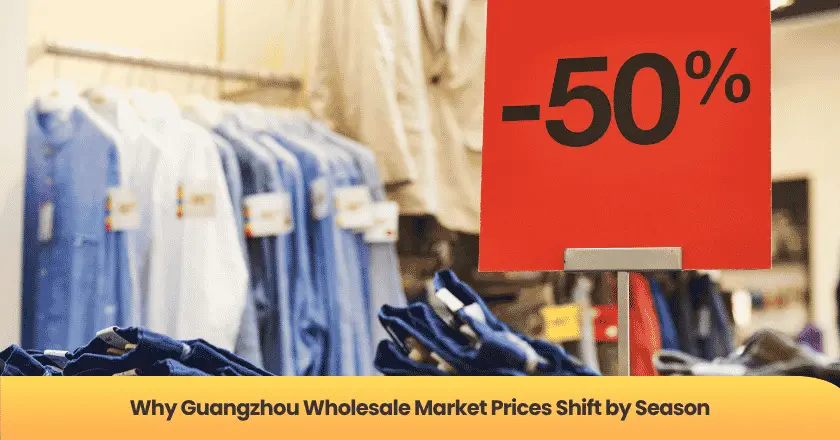
A buyer prices a bag in a Guangzhou market in early March and gets a workable number. He returns in mid-October to place the order and the same vendor quotes 12% higher, with a longer lead time and less interest in negotiating. Nothing about the product changed. He came back during the busiest sourcing weeks of the year, when the vendor had more buyers than capacity and no reason to compete for his order.
Prices in Guangzhou move on a calendar that has three layers: a trade fair cycle, a production year built around Chinese New Year, and a shipping peak. Buyers who read the calendar pay differently from those who do not.
Key Takeaways
• Guangzhou is several specialised wholesale districts rather than one market, and each has its own rhythm.
• The Canton Fair fills the city twice a year and shifts vendor attention away from ordinary buyers.
• The weeks before Chinese New Year carry a production rush, and the weeks after carry a slow restart.
• Peak shipping season raises delivered quotes even where factory prices have not moved.
• Quoted prices carry validity periods, so a number obtained months before an order is an indication rather than an offer.
Guangzhou Is Several Markets
Before the calendar matters, it helps to know that the city's wholesale trade is split by category across distinct districts.
Specialised Districts, Separate Rhythms
Guangzhou concentrates leather goods and bags in the Baiyun district around Sanyuanli, clothing and fabric in the Shisanhang and Zhanxi areas near the railway station, and further clusters covering shoes, accessories, cosmetics and electronics elsewhere in the city. Each district trades in its own category and follows its own seasonal pattern.
Fashion-driven districts turn over ranges fastest and show the sharpest seasonal movement. Districts serving more stable categories move less. Ask which pattern applies to your product rather than assuming a single city-wide rhythm, since a buyer of bags and a buyer of hardware are looking at different calendars.
Vendors Are Not Factories
Most stalls are trading operations or factory showrooms rather than production sites, which matters for pricing. A vendor holding stock prices against what it paid and what it can replace at, so its quotes react to material costs and to demand faster than a factory quoting its own production cost would.
This is why market prices can move within weeks while factory quotes for the same goods hold steadier. It is also why asking a vendor what it is currently paying for materials sometimes produces a more informative answer than asking why the price went up.
Range turnover drives part of the movement too. Fashion-led districts refresh their offer several times a year, and a design at the start of its run prices differently from the same design once several stalls are carrying it. Buyers arriving early in a cycle pay for novelty, and those arriving late find better numbers on something everyone now stocks.
Expert Tip: Ask a vendor what the same item cost three months ago and what it expects in three months. Most will answer, because the movement is not a secret and they are managing it themselves. The reply tells you whether you are looking at a genuine cost change or a demand-driven one, and those two call for different responses. A cost change you plan around. A demand change you time around.
The Fair Cycle
Twice a year Guangzhou hosts the largest trade fair in the country, and the effect on the city reaches well beyond the exhibition halls.
What the Canton Fair Does to the City
The China Import and Export Fair runs in spring and autumn at the fair complex on Pazhou, divided into three phases covering different product categories with break days between them.The 2026 spring session ran in three phases from mid-April to early May, and the autumn session falls in October and early November.
During those windows the city fills. Hotel rates rise, the districts near the venue congest, and market vendors find themselves with more enquiries than usual. Suppliers with fair booths are physically absent from their own premises, and staff left behind have limited authority to negotiate.
Accommodation and logistics costs move with the same cycle, and they belong in a trip budget rather than as a surprise. Hotel rates in the districts near the venue rise substantially during fair weeks, and rooms book out well in advance. Buyers travelling on a fixed budget sometimes find the trip costs more than the negotiation saved.
Before, During and After
The weeks immediately before a session are often the best time to negotiate, since vendors are preparing and want committed orders before their attention moves. During a session, expect firmer prices and slower responses. The fortnight afterwards frequently softens again as vendors follow up on leads that did not convert.
For buyers whose products match a specific fair phase, attending is efficient in a different way, since suppliers from across the country are concentrated in one hall. What it is not is a good moment to negotiate hard on a market stall in the city, which is a separate activity competing for the same days.
Common Mistake to Avoid: Planning a buying trip to coincide with the fair because it seems efficient produces a week that does neither job well. Fair days are for meeting suppliers from across the country, and market days are for working a district in depth with vendors who have time to talk. Attempting both means rushed hours in each, at the point in the year when hotels cost most and the city moves slowest. Separate the two purposes, or attend the fair and stay on for the quieter week after it closes.
The Production Year
Underneath the fair cycle sits a production calendar that affects prices, lead times and how willing anyone is to take on new work.
Chinese New Year and the Restart
Factories wind down for two to three weeks before the holiday and take one to two weeks to return to full output afterwards. The run-up is a rush, with capacity committed and little appetite for small or awkward orders. The period after is slower than it looks on paper, since workers return in stages and queues rebuild.
Prices reset around this point as well. Material contracts, wages and factory costs are frequently reviewed at the start of the year, so a quote given in December may not survive into March. Ask suppliers directly whether a price holds past the holiday rather than assuming it does.
Peak Shipping Season
Delivered quotes move with freight even when goods have not. Container rates climb ahead of the autumn retail season and again before the New Year shutdown as buyers pull stock forward, and a weekly reference such as Drewry's World Container Index shows the movement clearly enough to plan around.
Guangzhou's own port handles substantial volume and sits among the country's largest by throughput in the statistics published by the Ministry of Transport.Congestion in peak weeks affects booking availability rather than only price, which is why a shipment planned tightly against a deadline in September is a different proposition from the same shipment in February.
Expert Tip: Quote your goods on a port term and handle freight separately if you buy through peak periods. A delivered price embeds a freight assumption made when the quote was issued, and in a rising market that assumption gets revised or absorbed into a higher unit price you cannot see. Keeping the two visible lets you see which one actually moved, and it makes year-on-year comparisons meaningful rather than confusing.
Buying Against the Cycle
The pattern is predictable enough to plan around, which turns seasonality from a nuisance into an advantage.
When to Visit and When to Order
The quieter windows are generally late winter after the holiday restart, early summer between fair sessions, and the weeks following the autumn session. Vendors have time, capacity is available and negotiation is easier. The busy windows are the fair sessions themselves and the six weeks before Chinese New Year.
Visiting and ordering do not have to happen together. Many experienced buyers visit during quiet periods to build relationships and assess products, then place orders remotely once the range is settled. That separation removes the pressure to commit while standing in a stall, which rarely improves a decision.
Sample and development work has its own good and bad weeks. Asking for a new sample during the pre-holiday rush or a fair session puts your request behind everything else in the queue, while the same request in a quiet month often turns around in days. Where a launch depends on several sample rounds, starting in a quiet window is worth more than pushing hard in a busy one.
Holding a Price
Quotations carry validity periods, commonly fifteen to thirty days, because material costs move. A number obtained in March is an indication by August rather than an offer, and requoting after a delay is ordinary practice rather than a tactic.
Where you buy the same items repeatedly, ask about an annual or seasonal price agreement with a defined quantity commitment. Vendors and factories accept these more readily than buyers expect, since predictable volume is worth something to them, and it converts a seasonal problem into a planning one.
Expert Tip: Keep a simple record of what you paid for each item and when, across at least two years. Two columns and a date, updated after every order. After a few cycles you can see your own seasonality rather than relying on general advice, and you can tell a vendor precisely what you paid last spring. Buyers who negotiate from memory lose that argument, and buyers with a record usually find the conversation ends quickly.
Buying Through the Calendar Without Travelling
Reading the calendar helps most when somebody is present through all of it rather than during the two weeks a buyer can spare for a trip.
NewBuyingAgent handles all factory communication—perfect for multi-category buyers. Free up your time to focus on expanding your local market sales.
Timing also matters less when the pool of suppliers is wide enough that somebody always has capacity.
Only less than 5% of China's factories are within your reach. NewBuyingAgent gives you 100% Access to China's Factories through its 50,000+ cooperated partner factories—no language/region/time zone barriers. Its local reputation gets you full factory cooperation.
NewBuyingAgent is your perfect partner for global sourcing from China, backed by 30 years of expertise in trade, manufacturing and quality control. Its mission is to make China sourcing effortless and profitable for global buyers.
Frequently Asked Questions
When is the best time to visit Guangzhou wholesale markets?
The quieter windows are late winter once factories have restarted, early summer between fair sessions, and the weeks after the autumn session closes. Vendors have time to talk and capacity is available. Avoid the fair weeks themselves and the six weeks before Chinese New Year unless you are attending the fair specifically.
Should I combine a market trip with the Canton Fair?
They compete for the same days and serve different purposes. The fair concentrates suppliers from across the country in one venue, while market work means walking a district in depth with vendors who have time. If you attend the fair, consider staying on for the quieter week afterwards rather than splitting your days.
Why did my supplier raise the price after Chinese New Year?
Material contracts, wages and factory costs are commonly reviewed at the start of the year, so a quote given before the holiday may not survive it. Ask explicitly whether a price holds past the holiday when you receive it, and treat any quote beyond its validity period as an indication rather than an offer.
Can I fix a price for a whole year?
Sometimes, usually against a defined quantity commitment. Vendors and factories accept annual or seasonal arrangements more readily than buyers expect, since predictable volume has real value to them. Expect a clause allowing revision if a key material moves beyond an agreed range, which is reasonable on both sides.
Do factory prices move as much as market prices?
Generally less, and for different reasons. A market vendor holding stock prices against replacement cost and current demand, so it reacts within weeks. A factory quotes its own production cost, which moves with materials and wages rather than with how many buyers are in town. Where timing matters most, the gap between the two is worth understanding for your category.
Conclusion
Guangzhou runs on a calendar with three layers, and each is predictable. Avoid the fair weeks and the pre-holiday rush for negotiation, expect prices to reset in the new year, watch freight separately from goods, and keep your own record of what you paid and when. Buyers who plan against the cycle spend less than those who happen to arrive during it. For buyers who would rather have somebody present through the whole calendar, NewBuyingAgent handles factory selection, quality control and delivery from China.
Partial Sources
1. China Import and Export Fair (Canton Fair) — general information on session structure, phases and venue —https://cief.cantonfair.org.cn/en/cfintro/cfintro.html— Accessed 2 September 2026
2. Drewry Supply Chain Advisors — World Container Index, weekly composite spot rate per 40ft container across major east-west trade lanes —https://www.drewry.co.uk/supply-chain-advisors/supply-chain-expertise/world-container-index-assessed-by-drewry— Accessed 2 September 2026
3. Ministry of Transport of the People's Republic of China — port cargo and container throughput statistics, 2025 —https://xxgk.mot.gov.cn/jigou/zhghs/202601/t20260130_4199411.html— Accessed 2 September 2026
NewBuyingAgent
Related Resources



Начните сегодня
Давайте превратим ваши цели по закупкам в реальностьWeChat:+86 15157124615
WhatsApp:+86 15157124615
Адрес: Здание 10 #39 Xiangyuan Road, Ханчжоу, Китай
