

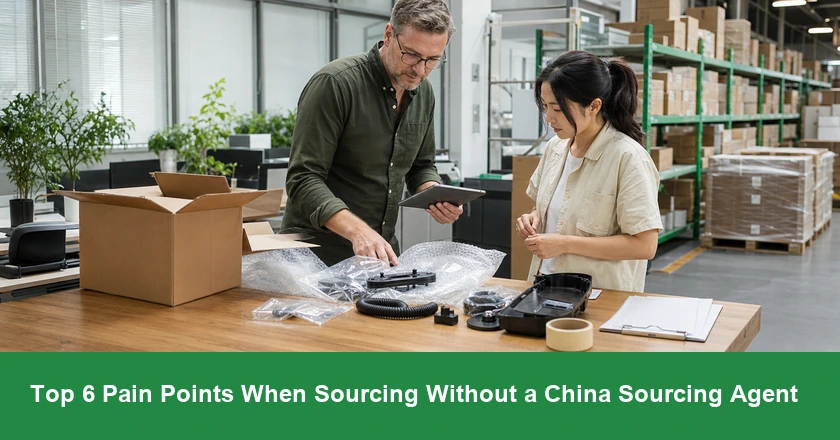
Direct China sourcing becomes expensive when the buyer discovers an evidence gap after the next payment, production decision, document release, or shipment commitment has already narrowed the remedy. A factory relationship can be valuable, but it does not automatically create a clear owner for every specification change, quality question, compliance record, or freight handoff.
The practical question is not whether every buyer needs a China sourcing agent. It is whether the buyer can receive timely proof, make a correction, and keep the order moving without becoming the default escalation desk for every exception. The six pain points below are ranked by how quickly they remove the buyer's lower-cost correction options.
What Direct Sourcing Needs Before It Becomes Expensive
- Risk: The first direct-sourcing failure is often a missing shared version of the product requirement, not an obviously bad factory.
- Cost comparison: A unit quote is not a complete decision until the product scope, delivery term, importer obligations, and handoff costs are comparable.
- Decision: Keep a direct model when the buyer has clear owners and usable evidence before each irreversible commitment.
- How it works: Add China-side support when evidence, correction, compliance, or shipment coordination repeatedly arrives too late for the buyer to act.
The Proof-Before-Commitment Framework: When Direct Sourcing Can Still Work
The Proof-Before-Commitment Framework says that direct sourcing can work when the buyer controls four things before the order becomes harder to change: the approved product requirement, the commercial scope, the evidence needed to release production, and the owner of each shipment handoff. A buyer with a stable product, a responsive factory, local knowledge, and a disciplined internal process may choose to keep those controls in-house. NewBuyingAgent covers these same local control points through product selection, cost negotiation, production follow-up, quality control, logistics coordination, and China-side factory management.
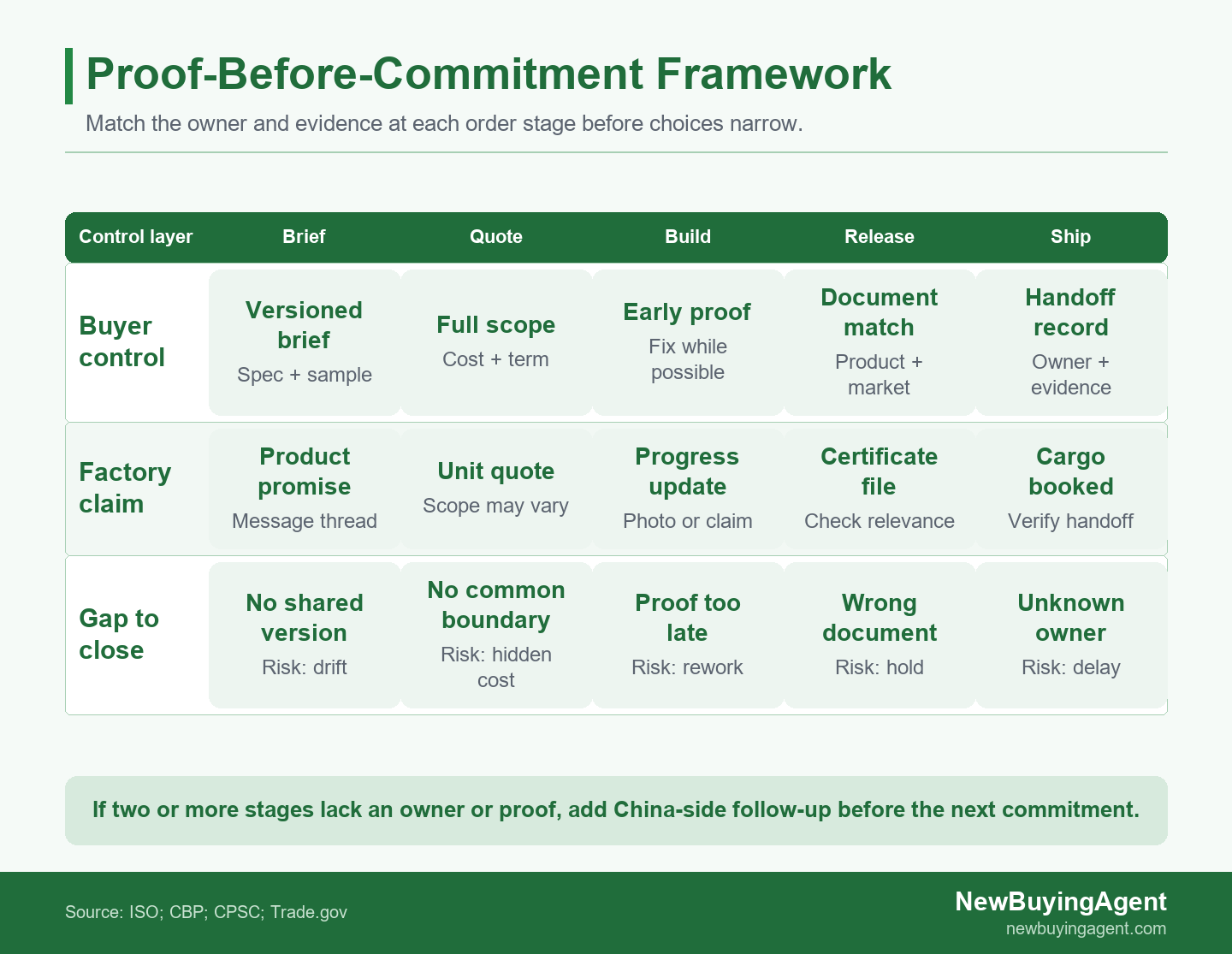
For direct sourcing to remain controlled, the buyer needs an owner and verifiable proof at every critical order handoff.
What direct sourcing cannot rely on is confidence generated by messages alone. The ISO 9001 overview includes communication and documented information among quality-management topics. That does not turn a chat log into a quality system, but it explains why a usable record matters when a sample revision, material substitution, or packing instruction needs to be checked against the actual order.
Use this framework as a boundary, not as a sales rule. If the buyer can name the owner, evidence, deadline, and correction action at every critical point, direct factory sourcing may remain the right model. If those answers repeatedly arrive after a problem has become expensive, the model needs more control before the next order.
The 6 Pain Points, Ranked by How Hard They Are to Reverse
This ranking does not measure factory quality or agent quality. It follows the point at which a buyer loses a practical remedy. A missed note in a product brief may still be corrected; the same issue discovered after packing, documentation, and booking can turn into rework, delay, inventory exposure, or an argument about responsibility.
#1 A Conversation Is Not Proof of Execution
A factory can answer every message quickly and still build from a different interpretation of the requirement. Here, execution evidence is proof that the actual order matches the approved requirement: a controlled product brief, signed sample record, measurement, material confirmation, photo tied to the lot, or inspection result. It is the bridge between what was said and what is physically being made.
The gap usually starts with a harmless-looking change: a color is described verbally, a component is substituted because it is "similar," or a packaging detail is confirmed without a revised reference. The issue becomes costly when the buyer has no single approved version to compare against. The point is not to produce more paperwork. It is to make the next production decision testable before the factory moves to the next step.
#2 The Lowest Unit Price Can Hide the Real Cost Boundary
A factory quote can be competitive and still leave the buyer with an incomplete comparison. Total landed cost is the cost of getting the agreed product to the agreed destination under a defined responsibility boundary. It may include product value, freight, duty, handling, documentation, and the operational work assigned to a party. The invoice price alone does not settle the commercial picture.
Before comparing two quotes, normalize the product version, packaging level, quality expectation, delivery term, destination, and timing. If one quotation covers an export-ready product and another silently shifts labelling, local handling, paperwork, or freight risk to the buyer, the lower number is not describing the same transaction. A China-side contact can clarify the scope, but the buyer still needs the written boundary before deciding that the cheaper quote is cheaper.
#3 Quality Problems Surface When the Cheap Remedies Are Gone
Quality control is most useful when it changes a decision while the product can still be corrected, separated, or held. A buyer who receives only a final photo has little room to react if the material, workmanship, packing, or quantity is already committed. The pain point is therefore not simply "no inspection." It is proof arriving after production choices and cash commitments have reduced the available options.
The CPSC's buyer best-practices guidance discusses assessing safety priorities and spot-checking for ongoing compliance in its U.S. consumer-product context. The wider operating lesson is simple: decide what evidence matters before the production stage at which a correction becomes disruptive. That could be a material confirmation, a pre-production sample, an in-process check, or a release record, depending on the product and destination.
Direct sourcing can remain disciplined when the buyer receives that evidence quickly enough to decide. It becomes fragile when the factory's first usable answer appears only after the buyer has already paid the balance, booked cargo, or promised stock to a customer.
#4 Documents Can Look Complete but Belong to the Wrong Product or Order
A certificate, test report, invoice, or label file is only useful when it applies to the actual product, model, market, date, and importer role. CPSC's Regulated Products Handbook illustrates why certification responsibility for regulated products cannot be established by forwarding an unmatched factory file. That is a clear example of why the buyer must connect the document to the finished product and the responsible party.
Product-specific certification responsibilities can differ materially between general-use and children's products, as well as between destination markets. The buyer should therefore ask whether the document matches the finished product, the applicable rule, and the importer role, rather than simply asking whether the factory has a certificate.
A commercial invoice is the trade document that identifies the goods and transaction value for a shipment, so errors can also affect entry evidence. CBP notes that product-specific import requirements can involve country-of-origin marking and other agencies. On the China side, Trade.gov's standards guide shows that national standards, conformity assessment, testing, and certification each have their own scope. Confirm the current requirement with the destination market's official source before authorizing release.
#5 Shipment Handoffs Create Gaps Between Who Pays, Who Acts, and Who Knows
Incoterms are a set of buyer-seller trade rules. They make clear which party handles each delivery task, pays each cost, and carries risk at each point. They matter because a shipment is not one action: booking, packing, labelling, commercial documents, export handling, freight, insurance, customs clearance, and arrival all have different owners. Trade.gov's Incoterms guidance explains that the rules clarify these tasks, costs, risks, and the point at which risk transfers.
The direct-sourcing pain appears when no one has agreed what proof closes each handoff. A booking confirmation does not prove that cartons match the approved packing instructions. A loading photo does not confirm that the commercial invoice, labels, carton marks, and final product remain aligned. For each critical handoff, name the owner, the evidence, the deadline, and the action if the evidence is missing.
#6 Your Team Becomes the Escalation Desk
The final pain point is cumulative. When no China-side owner coordinates exceptions, the buyer's operations team becomes the translator, document chaser, sample approver, quality reviewer, freight coordinator, and deadline manager. That work may be appropriate for a team with the right capacity and local knowledge. It becomes a hidden sourcing cost when the same person repeatedly resolves avoidable issues across time zones.
Track the exceptions for one live order. Count the hours spent clarifying a specification, obtaining a revised sample record, reconciling documents, following up on production proof, and repairing a shipment handoff. If those hours are rare, the direct model may be efficient. If they recur, the factory price is no longer the only number worth comparing.
A Practical Test: Is Direct Sourcing Still the Right Model?
Apply the Proof-Before-Commitment Framework to the next order instead of asking a broad question about agents. The table below is not a legal or financial assessment. It is a practical way to identify whether the buyer can still run the order directly or whether one or more control gaps need China-side follow-up before the next commitment.
| Control | Direct sourcing can work when | Escalate support when | Evidence to request |
|---|---|---|---|
| Product brief | One controlled version is approved. | Changes live only in messages. | Version, sample, measurements, materials. |
| Commercial scope | Quotes use the same product and term boundary. | Costs or responsibilities move between quotes. | Quote scope, term, destination, exclusions. |
| Quality and release | Proof arrives while correction remains possible. | The first meaningful proof is after packing. | Lot-linked photos, checks, release record. |
| Documents and shipment | Each handoff has an owner and matching record. | Files, cartons, and cargo are handled separately. | Invoice, labels, booking, packing, handoff proof. |
If two or more rows are consistently in the right-hand column, the buyer is not simply being careful. The order has an ownership gap. For a new product or a new China supply path, buyers can review how NewBuyingAgent can supply products from China.
Illustrative Calculation: The Cost of Becoming the Exception Buffer
Illustrative calculation: assume an operations lead spends eight extra hours each week for ten weeks clarifying product changes, chasing production proof, reviewing documents, and resolving logistics exceptions. At a fully loaded internal cost of USD 55 per hour, the coordination exposure is 8 hours x 10 weeks x USD 55, or USD 4,400.
That number is not an agent fee, a savings promise, or a measured NewBuyingAgent result. It is a way to make an invisible comparison visible. It also excludes the cost of rework, delayed launch, incorrect labels, duty mistakes, chargebacks, lost sales, or cash tied up in inventory. A buyer with a strong internal China team may accept this workload because it has strategic value. A buyer without that capacity should compare the recurring exposure with the specific support needed to remove it.
The limitation matters: one product change may take fifteen minutes, while a delayed release can consume days. Use the same formula with the buyer's own hours, time cost, product complexity, and order timing. The useful decision is not whether direct sourcing has a zero cost. It is whether the team is choosing and controlling that cost deliberately.
Where NewBuyingAgent Fits When the Gaps Repeat
NewBuyingAgent is a one-stop China sourcing agent service provider for global buyers, helping them simplify China procurement through local factory resources, product selection, cost negotiation, production follow-up, quality control, logistics coordination, and China-side factory management.
For a buyer developing or replacing a product, the useful starting point is a complete purchasing brief: product specification, target price, destination, timing, samples or references, and the evidence needed before release. NewBuyingAgent can use China-side factory resources and product and quality-control capability to turn that context into a coordinated product-supply path rather than leaving the buyer to reconcile separate conversations after each decision.
For a buyer that already works with a China factory, the need is different. The factory relationship may remain sound, while production follow-up, QC evidence, communication, and door-to-door logistics still need a local point of coordination. In that situation, buyers can see how NewBuyingAgent can manage existing China factories.
The practical value is not a promise to remove every risk. It is a clearer path from purchasing requirements to factory action, evidence, and delivery decisions. NewBuyingAgent draws on 30+ years of trade, manufacturing, and quality-control experience, 50,000+ cooperated factory resources, and 20,000+ product development and QC experts. The relevant proof for any order is still the current product, factory, records, and release decision.
Before asking for support, prepare the current product version, volume, target price, destination, timing, payment assumptions, existing factory context, and the exact point where evidence has been late or unclear. That makes it possible to determine whether the right response is new product supply, existing-factory management, focused quality follow-up, or a change to the direct model itself.
A controlled request also separates an occasional factory question from a genuine operating gap. It should identify which party confirms the product version, who records changes, when quality proof is due, which documents must match the final goods, and who owns the shipment handoff. That small operating picture lets a buyer ask for only the support that is needed, whether it is factory follow-up, product control, inspection coordination, or logistics coordination. It also gives both sides a practical baseline for deciding what should remain with the buyer's team and what should have a China-side owner. Without that baseline, a provider can receive a vague request and a buyer can receive a broad answer that does not solve the point where the process breaks.
When those details are ready, buyers can submit the product brief and delivery constraints for a sourcing review.
Frequently Asked Questions
These answers provide general operational guidance. Product-specific certification, customs, marking, tax, and destination-market obligations should be checked against current official guidance and qualified professional advice where appropriate.
Can You Source From China Without a Sourcing Agent?
Yes, buyers can source from China without an agent when they can control the product brief, evidence, compliance checks, and shipment handoffs themselves. The deciding factor is not the number of messages exchanged with a factory. It is whether the buyer can obtain the right proof early enough, assign an owner to each decision, and correct an issue before production, documents, or cargo make the problem expensive.
What Is the Biggest Risk of Direct China Sourcing?
The biggest risk of direct China sourcing is discovering a problem after cash, production, documents, and shipment commitments have made it difficult to reverse. A low price or responsive sales contact can hide this timing risk. Put the most important product, compliance, and handoff checks before the stage at which a delayed answer becomes a rework, hold, or delivery issue.
When Should a Buyer Use a China Sourcing Agent?
A buyer should use China-side sourcing support when recurring gaps in evidence, quality follow-up, compliance, or shipment coordination exceed the team's ability to correct them remotely. The trigger is a capability and timing gap, not a buyer-size label. If the same exceptions consume operating time on every order, a local sourcing and factory-management path can be more disciplined than continuing to manage each issue ad hoc.
NewBuyingAgent
Related Resources
Начните сегодня
Давайте превратим ваши цели по закупкам в реальностьWeChat:+86 15157124615
WhatsApp:+86 15157124615
Адрес: Здание 10 #39 Xiangyuan Road, Ханчжоу, Китай
