


An OEM agreement is most useful when it creates a proof record before an irreversible spend point. OEM means a factory arrangement in which goods are made to the buyer’s product and brand requirements. A price, quantity, and delivery date are necessary, but they do not answer who may change a material, what evidence releases a lot, or how a buyer recovers tooling if the relationship ends. Use the ten provisions below as a commercial review framework, then have qualified counsel adapt the agreement to the parties, product, and enforcement path.
The Ten Provisions Become Useful Only When They Create Proof
Each OEM provision should name the production decision, proof record, owner, timing, and consequence it controls. For buyers using NewBuyingAgent’s China sourcing support, that record also gives factory, quality, and logistics conversations one shared reference rather than a chain of disconnected updates.
That is the practical test for a brand buyer. A clause that says “quality,” “confidentiality,” or “delivery” without a defined reference, responsible party, and decision point can still leave the parties debating facts after material has been purchased or goods have been packed. The contract should make the operating record visible early enough to change the next action: hold, approve, rework, release, or exit.
The control order matters. First bind the actual parties and product version. Next control changes and acceptance. Then protect brand assets and tooling, align commercial execution, and state what happens when performance changes. The table is not a template and does not prescribe legal wording; it is a way to ask whether each provision can be checked in a real production file.
- Match every clause to a production decision that still can be changed.
- Keep one dated record that proves the decision, owner, and product version.
- State the agreed consequence before payment, shipment, or asset recovery becomes disputed.
| Provision | Decision It Controls | Proof to Retain |
|---|---|---|
| 1. Parties and authority | Who is bound? | Entity, signatory, and payment record |
| 2. Scope and document hierarchy | What may be produced? | SKU, drawings, sample, packaging, and priority order |
| 3. Change control | May a material or process change? | Dated approval and commercial impact |
| 4. Quality and acceptance | Does the lot conform? | Inspection method and result |
| 5. Nonconforming-goods remedy | What happens after a failed result? | Hold, rework, replacement, credit, or other agreed path |
| 6. Confidential use and IP | How may buyer assets be used? | Permitted-use and access record |
| 7. Tooling | Who controls the physical production asset? | Tool register, identification, custody, and return record |
| 8. Subcontracting and traceability | Where and by whom was the lot made? | Approved site and lot record |
| 9. Price, payment, and delivery | When do cost, risk, and release move? | PO, named term, place, and payment trigger |
| 10. Exit and dispute path | What happens after a material breach or disruption? | Notice, cure, return, and forum record |
1–2: Bind the Right Party and the Exact Production Scope
An OEM agreement should identify the legal parties and the authority that can bind each party before deposits or tooling commitments are made.
Start by reconciling the factory name used in the quote, contract signature, bank instructions, production address, and invoice. The aim is not paperwork for its own sake. It is to prevent a later argument over which party accepted the obligations. China’s Civil Code took effect on January 1, 2021 and includes a contracts part, a useful reminder that the agreement should govern a real legal relationship rather than function as a loose order memo. Read the official Civil Code page alongside transaction-specific legal advice.
Authorized product scope should identify the relevant SKU, drawings, samples, packaging, and document order of precedence.
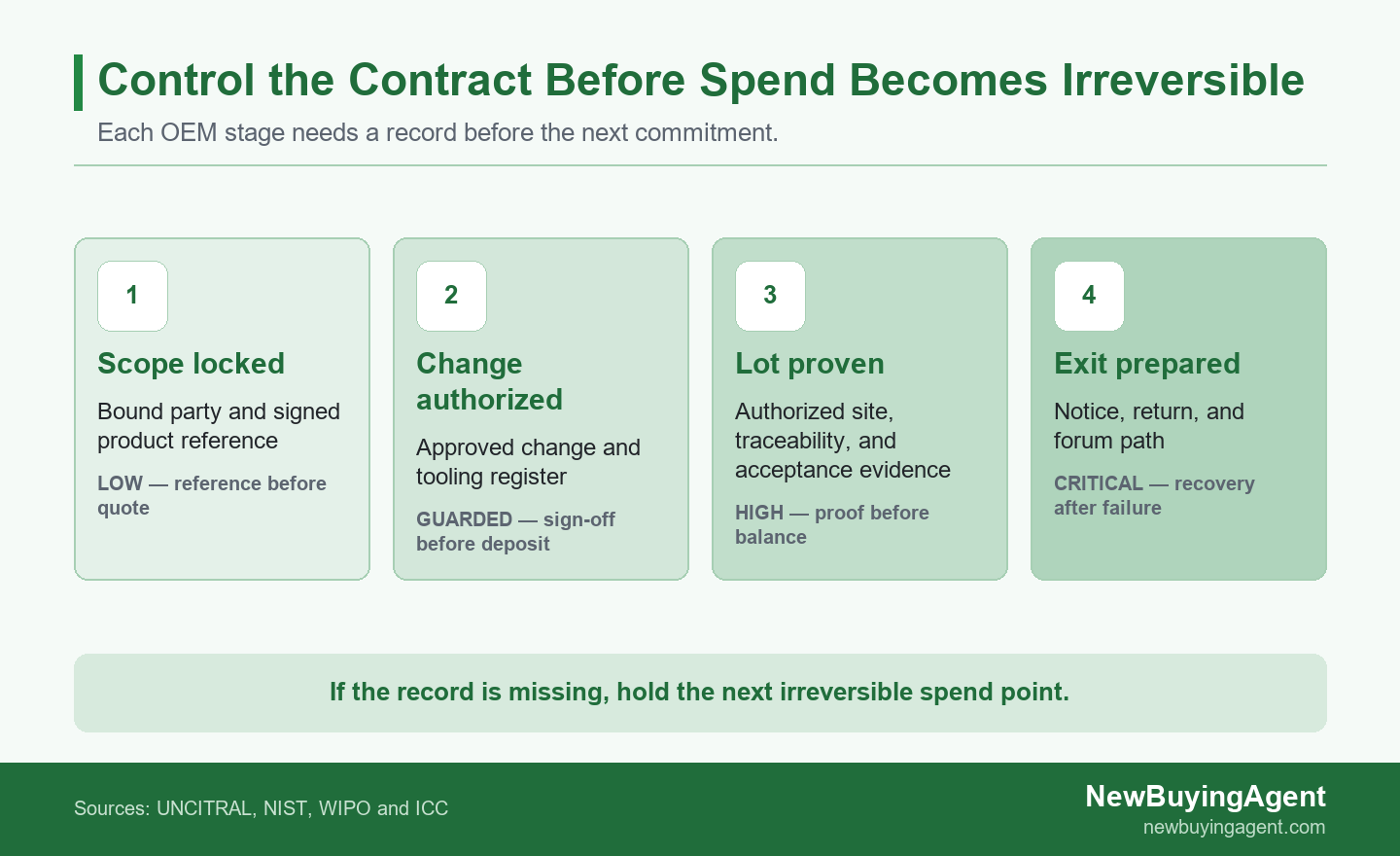
Risk ladder showing OEM contract controls required before each irreversible spend point
Provision 2 should answer a practical conflict: if a signed drawing, a golden sample, a packaging file, and an email do not say the same thing, which one governs? Put the answer in an annex list with revision dates. Identify what is part of the supplied product, what is reference-only, and who can approve a revision. This makes a later quality discussion about a controlled version, not recollection.
3–5: Turn Specifications, Changes, and Acceptance Into One Chain
A quality provision needs an attached product reference and a method for determining conformity, not a general statement that quality will be good.
Use the annexes to state the product requirements that matter for the category: material grade, dimensions and tolerances, colour or finish reference, required labels, packaging, applicable market requirements, and test method where relevant. Then connect them to the accepted sample and to a document-control rule. The contract should not silently treat a sample as permanent if the buyer later approves a signed revision.
Provision 3: Require Written Change Control Before the Cost Is Irreversible
Written change control should record the proposed change, affected product requirement, approval authority, and price or lead-time effect before production proceeds.
A change request should not be a vague message saying that a material is unavailable or a process must be adjusted. It should identify the old and proposed version, why the change is requested, the affected drawings or sample, the effect on price and lead time, and the date the authorized person accepted or declined it. Where a proposed change touches safety, compliance, performance, or brand appearance, qualified technical and legal review may be needed before the next production step.
The useful commercial rule is simple: no approved record, no progression to the next irreversible spend. That does not mean every small clarification stops a line. It means the agreement distinguishes a clerical clarification from a change that alters what the buyer is paying to receive.
Provisions 4–5: Define Acceptance, Inspection, and the Consequence of Failure
NIST describes lot acceptance sampling as using a random sample to decide whether an inspected lot should be accepted or rejected.
That distinction matters because an inspection photo or general “QC passed” note is not itself an acceptance rule. A contract can specify the inspection point, the lot definition, the sample plan or other method, the defect categories, who may inspect, what report is retained, and what follows a failed result. NIST’s acceptance-sampling guidance explains the core lot-level accept-or-reject logic; it does not select the buyer’s AQL, tolerance, or remedy.
Provision 5 should follow directly from provision 4. Decide whether a failure creates a hold, rework request, replacement obligation, credit discussion, further inspection, or another negotiated response. The key is to define the decision owner and the proof that triggers that decision before final payment or shipment release turns the issue into a distant claim.
6–7: Limit Use of Brand Assets and Make Tooling Recoverable
A confidentiality provision should define protected information, authorized use, disclosure limits, and exceptions rather than rely on an undefined secrecy label.
For an OEM relationship, the information set may include drawings, artwork, packaging layouts, price data, prototypes, test information, customer data, or manufacturing know-how. WIPO’s trade-secret guidance recommends defining confidential information, permitted access and use, disclosure restrictions, and exceptions rather than assuming all information carries the same protection. Use WIPO’s contractual-measures guidance as a drafting prompt, then obtain advice tailored to the governing law and product.
Tooling controls should state ownership, custody, identification, maintenance, permitted use, inventory evidence, and return conditions.
Tooling is a separate control because a buyer can own a design yet still lose practical access to the mold, die, fixture, or other production asset if there is no clear asset record. Put the tooling identifier, location, permitted product use, maintenance responsibility, inventory cadence, transfer conditions, and return process in a dedicated annex. Pairing paperwork with document marking and access discipline is sensible: WIPO lists access limits and supplier agreements among examples of reasonable protective measures for confidential information.
For a buyer already working with China factories, this is where local production evidence becomes useful. Rather than treating tooling and brand assets as isolated administration, use a China-side management path that can connect production progress, quality evidence, and logistics to the active order. Ask NewBuyingAgent to manage your China factories when those controls need to operate across an existing supplier relationship.
8–9: Connect Production Traceability to Price, Payment, and Delivery
A production control should state whether subcontracting is permitted and which records must identify the responsible production site or lot.
The purpose is not to add a generic ban without considering the product. It is to decide whether subcontracting needs written approval, what conditions an approved subcontractor must meet, and how the buyer can trace the lot back to its production path. If the agreement permits production to move, the evidence must move with it: site identity, lot identification, relevant approvals, and inspection scope should not be lost between documents.
Incoterms 2020 allocates important buyer and seller responsibilities for transport, delivery, costs, risks, and export or import formalities under B2B sale contracts.
Name the exact term, version, and delivery place in the PO and contract. The ICC’s Incoterms 2020 overview is useful for understanding that allocation. It does not replace the broader agreement: product conformity, payment trigger, packing evidence, document requirements, and delay consequences still need their own coordinated terms.
For a new product program, start with the whole purchasing requirement—product specification, quantity, target price, destination, and timing—so the contract assumptions are part of the supplied-product decision. Ask NewBuyingAgent to supply products from China when the buyer needs local factory resources and product/QC capability applied to that complete outcome, not to a disconnected contract step.
Provision 10: Define the Exit Path Before a Dispute Tests It
A disruption and dispute provision should set notice, cure, termination, asset return, governing law, and forum with qualified legal advice.
Do not rely on a one-line reference to “applicable law” or “arbitration.” The international sales framework may matter, but it has boundaries. UNCITRAL notes that the CISG can govern international sales of goods in its scope while issues such as validity and the effect of a contract on property fall outside it. Review the CISG scope at UNCITRAL with counsel before choosing a governing-law and dispute path.
For disruptions, define what must be reported, how quickly, what evidence accompanies the notice, what mitigation or cure discussion follows, and what happens to product, tooling, confidential material, and records if performance cannot continue. UNIDROIT’s force-majeure model, for example, includes notice of the impediment and its effect within a reasonable time. See the UNIDROIT provision as international-contract context, not as a substitute for negotiated wording.
If the parties choose arbitration, identify the institution, rules, seat, language, number of arbitrators, and notice details with qualified advice. A forum is not operationally specified merely because the word arbitration appears. CIETAC’s current rules took effect on January 1, 2024, which illustrates why a clause should point to a defined ruleset. Check CIETAC’s current arbitration rules if that institution is being considered.
Illustrative Scenario: A Material Change That the Contract Could Not Settle
A material substitution proposed after tooling is a practical test of whether an OEM contract has a usable control path.
Consider an illustrative USD 120,000, 12,000-unit consumer-goods order. A pilot sample has been approved and one tooling set is already funded. The factory then proposes a substitute material and says the delivery date will remain unchanged. Nothing about that request is automatically improper; the problem is whether the agreement tells the buyer what to compare, who may approve, and what must happen before production continues.
The Change Cannot Move Forward Until the Reference, Cost, and Lot Record Agree
In an illustrative USD 120,000, 12,000-unit order, a material substitution after tooling can expose the absence of an approved revision and acceptance record.
The buyer has a signed commercial agreement but the annex merely names the product and references the pilot sample. It does not state whether a later drawing, packaging file, email, or sample controls if the records differ. The buyer cannot safely assume that “same quality” answers the difference between a material change and an equivalent material that has been tested and approved.
The correct response is to hold the proposed substitution long enough to compare the old and proposed materials, identify the affected drawing or sample, and determine the price, lead-time, performance, packaging, or market-requirement impact. The decision is not “trust the factory” versus “reject the factory.” It is whether the evidence supports moving the 12,000-unit lot forward under the product reference the buyer actually approved.
The buyer asks for a dated revision, a comparison sample where appropriate, an identified approval authority, an updated commercial effect, and a lot record that links the eventual goods to the agreed version. The parties then add a document hierarchy, written change authorization, an inspection record, and a tooling register with a return condition. These controls create a usable path even if the answer is ultimately to approve the substitute.
Before the balance-payment trigger, the revised lot is checked against the signed exhibit and completed change record. The scenario is illustrative, not a reported client outcome, and the legal wording must be reviewed for the actual transaction. Its lesson is commercial: a clause becomes valuable when it changes the next decision while the buyer still has options.
Turn the Contract Review Into a China Sourcing Brief
A contract-and-sourcing brief should give reviewers the product reference, quantity, commercial assumptions, production stage, delivery route, and known control gaps.
Before signing or revising an OEM agreement, give legal and sourcing reviewers the same short source pack. Include the product and revision list, expected quantity, target price and payment structure, factory or existing-supplier status, tooling position, required testing or inspection evidence, intended delivery term and destination, and any concern that needs a change-control or exit rule. It is far more useful than asking a reviewer to infer the operating reality from a marked-up document.
If the buyer already has China factories, use the same brief to align contract assumptions with actual production status. If the buyer is starting a new product purchase, use it to keep product, cost, quality, and delivery requirements connected from the first sourcing conversation. NewBuyingAgent is a one-stop China sourcing agent service provider for global buyers; its local factory resources and product development and quality-control capability are most relevant when the controls affect the supplied product outcome rather than a single isolated paperwork task.
When the facts are ready, contact NewBuyingAgent about your product requirements.
Frequently Asked Questions
Is a purchase order enough for an OEM production relationship?
Usually no, because a PO may state price and quantity without allocating the operating controls that govern IP, changes, quality evidence, tooling, and an exit. A PO can be part of the agreement hierarchy, but a brand buyer should also know which product reference controls, how changes are approved, how a lot is accepted, and what happens if performance fails. It should also align the payment trigger with the acceptance record instead of assuming that a shipment date proves conformity. FAQ answers clarify contract-review boundaries but do not replace a transaction-specific legal review.
Should an OEM contract use Chinese law or another law?
Choose governing law and forum with qualified counsel based on the parties, assets, enforcement path, and transaction, then state the choice clearly rather than relying on an assumption. The buyer should discuss where the factory, tooling, records, payment obligations, and likely evidence sit, as well as whether a chosen court or arbitration route is commercially workable. The question is not which label sounds familiar; it is whether notices, evidence, recovery of assets, and enforcement can follow the agreed path. Do not borrow a governing-law clause from another deal without that review.
Do confidentiality terms replace an IP ownership provision?
No, because confidentiality controls disclosure and permitted use while ownership and licence terms identify who owns the brand assets, designs, improvements, and tooling. Both categories should connect to the actual product documents and assets in the relationship. The agreement should also identify what happens to copies, prototypes, digital files, and production assets when the authorized purpose ends. If a factory may use buyer material only for an authorized production purpose, say so clearly and obtain legal advice on the applicable law.
When should the buyer involve a China-side sourcing partner?
Involve the sourcing partner before product and commercial assumptions are frozen, or immediately when an existing factory order exposes a gap in specifications, quality evidence, or delivery control. The partner can help make the product and production facts usable for a sourcing decision, while qualified counsel handles the legal wording and jurisdiction-specific advice. It is helpful to provide the latest drawings, sample status, order quantity, supplier identity, and required delivery route at that point. Earlier coordination is especially useful before a buyer commits to tooling, a material change, or a balance-payment trigger.
NewBuyingAgent
Related Resources


Начните сегодня
Давайте превратим ваши цели по закупкам в реальностьWeChat:+86 15157124615
WhatsApp:+86 15157124615
Адрес: Здание 10 #39 Xiangyuan Road, Ханчжоу, Китай
