
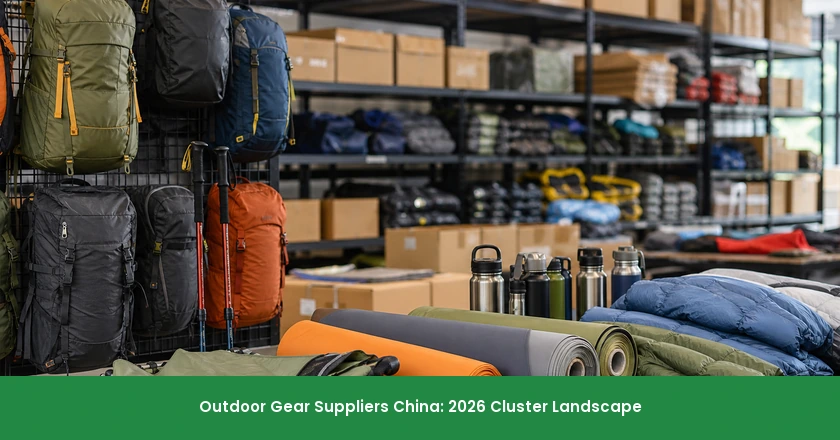
China's outdoor gear supplier landscape is not one city, one factory type, or one product category. It is a cluster map: textiles, footwear, bags, tents, furniture, metal frames, plastic parts, lighting, electronics, packaging, and export logistics all contribute to the final product. For buyers in 2026, the practical question is not "Which city is best?" It is "Which cluster capability fits this product, quality risk, delivery window, and market claim?"
This landscape uses a buyer-oriented lens. It does not rank individual factories or promise that one region is right for every order. Instead, it explains how to think about China's outdoor gear supplier base so buyers can source with clearer criteria and avoid treating every camping, sports, travel, and outdoor-lifestyle item as the same procurement problem.
Key Takeaways
- Outdoor gear suppliers in China should be mapped by capability: fabric, footwear, hardware, electronics, packaging, quality evidence, and logistics can sit in different cluster strengths.
- China's outdoor sports policy momentum supports category demand: national releases point to outdoor sports destinations, upgraded products, and a large sports equipment manufacturing base.
- Supplier clusters do not replace product evidence: buyers still need material proof, test reports, label control, inspection records, carton data, and delivery terms.
- NewBuyingAgent fits when buyers need cluster access translated into supplied products: local factory resources, product/QC capability, AI market analysis, and multi-industry cases can help match outdoor demand to practical sourcing decisions.
China's Outdoor Gear Landscape Is Moving From Volume to Fit
Outdoor gear demand is being shaped by a broader sports and outdoor economy. In January 2025, China's State Council-linked release said the country planned to build high-quality outdoor sports destinations, including around 100 destinations by 2030, and called for upgraded outdoor products and services. A September 2025 government news release said China's outdoor sports industry was expected to exceed 3 trillion yuan by the end of 2025 and noted that sports equipment manufacturing output value had risen from 1.12 trillion yuan in 2015 to over 1.5 trillion yuan.
Those numbers do not tell a buyer which supplier to use. They tell the buyer that outdoor gear is part of a serious industrial and consumption trend. The sourcing decision still depends on the product's construction. A tent is a textile, pole, zipper, coating, and packing problem. A camping chair is a metal frame, fabric, stitching, joint, load, and carton problem. A headlamp is an electronics, battery, housing, packaging, and safety documentation problem.
For a sourcing partner, the cluster landscape should lead to better questions. Which region has the right material base? Which supplier can support the product claim? Which factory can repeat the sample? Which logistics route fits the selling window? Which packaging can survive the journey? NewBuyingAgent's advantage is relevant when those questions need China-side factory resources and product/QC capability rather than a simple list of possible vendors.
Buyers should treat 2026 outdoor gear sourcing as a fit problem. Cluster scale helps only when it is connected to product evidence, market demand, price discipline, and delivery readiness.
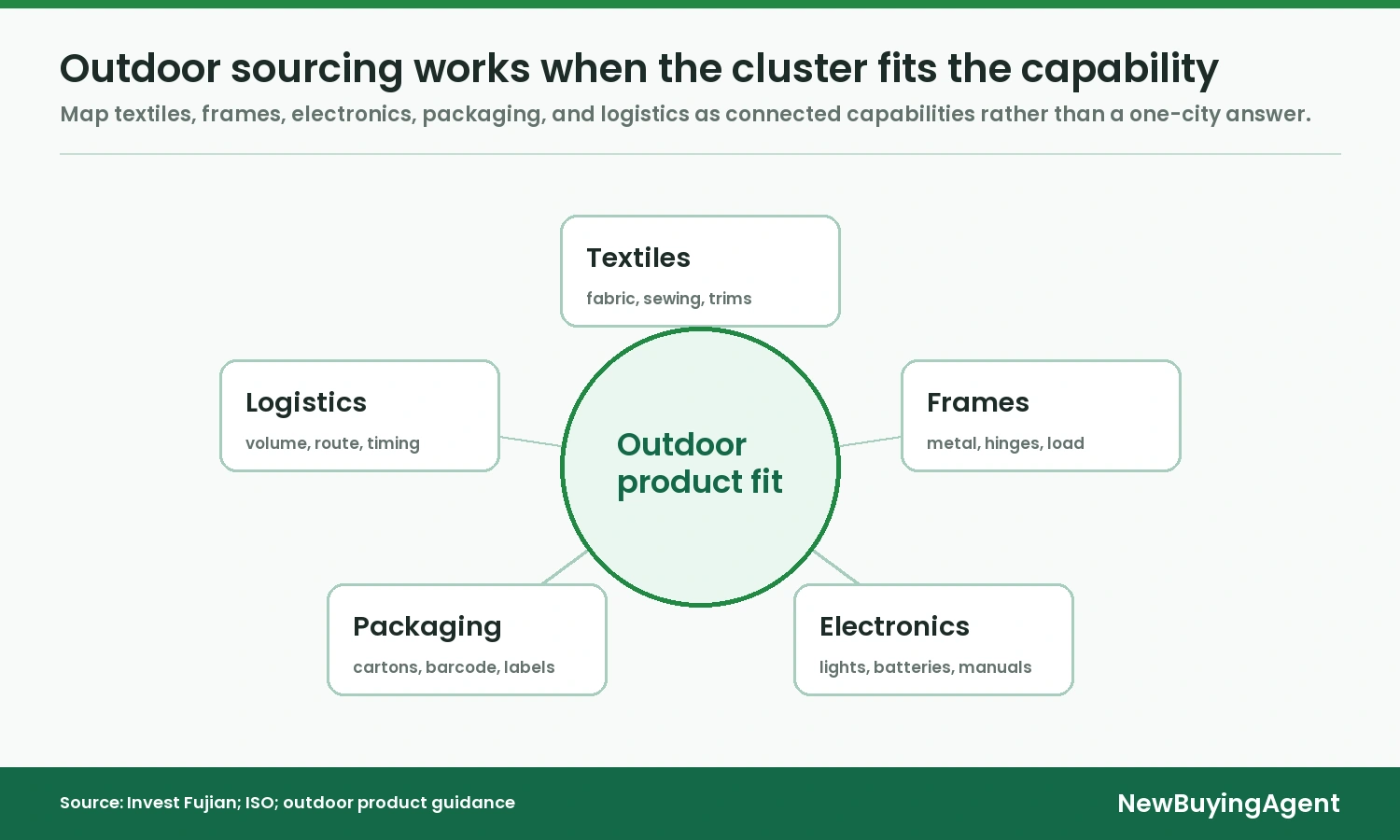
China outdoor gear sourcing works best when buyers map clusters by capability: textiles, frames, footwear, electronics, packaging, and export logistics.
How to Read the 2026 Cluster Landscape
Textiles, Footwear, and Apparel-Led Outdoor Products
Outdoor clothing, sports footwear, light packs, gaiters, gloves, hats, rain layers, and textile accessories depend heavily on fabric, sewing, finishing, trims, and quality consistency. Fujian is one of the clearest officially documented sports-product cluster examples. An Invest Fujian article says Quanzhou's modern sports product cluster focuses on leisure sports with textile footwear and apparel at its core, integrating petrochemical fibers, machinery and equipment, sports equipment, textiles and clothing, leather shoe manufacturing, and sports services. It also says the cluster's output value exceeds 800 billion yuan.
For buyers, the implication is not that every textile outdoor product must go to one city. The lesson is that cluster depth can matter when the product relies on materials, skilled labor, trims, branding, and repeated quality. If a jacket, shoe, or bag needs several material inputs, a sourcing agent should know which cluster can combine them without stretching the supply chain too far.
Camping Tents, Shelters, and Fabric Structures
Tents and shelters combine coated fabric, poles, stitching, zippers, ropes, pegs, carry bags, and carton packaging. They also carry safety and performance expectations. ISO 5912:2020 specifies requirements for camping tent safety, performance, and fitness for use. The CPSC sporting and camping equipment FAQ points to flammability considerations for camping tentage and reminds businesses that products used near flame sources cannot create substantial injury risk from extreme flammability.
Tent supplier evaluation should therefore focus on proof. The buyer needs fabric specs, coating consistency, seam treatment, pole strength, ventilation, packing method, warning labels, and test basis. Cluster location helps only if the supplier can connect those details to the final product version.
Sleeping Bags, Pads, and Insulated Soft Goods
Sleeping bags and insulated pads create a different sourcing challenge: warmth claims, filling consistency, compression, shell material, stitching, dimensions, and labeling. ISO 23537-1:2022 specifies requirements, test methods, and labeling provisions for adult-sized sleeping bags at certain limit temperatures. Buyers should be careful with temperature claims because the selling promise is easy to make and hard to support without evidence.
A sourcing agent should ask whether the buyer needs a laboratory-tested rating, a comfort-oriented product description, or a simpler seasonal product. The answer affects material choice, quote, packaging, and compliance file. For an early product test, the buyer may simplify claims. For a serious outdoor brand, the buyer should demand stronger evidence before scaling.
Furniture, Metal Frames, and Bulky Outdoor Goods
Camping chairs, folding tables, wagons, cots, racks, and outdoor storage products depend on metal tubes, hinges, joints, fabric strength, plastic parts, and cartons. The key cluster question is not only where the frame is made. It is whether fabric, frame, hardware, assembly, and packing can be controlled together. Bulky outdoor goods can look profitable in unit price and then lose margin through carton volume, weak packaging, high damage rate, or slow delivery.
Buyers should ask for load tests, corrosion checks where relevant, hinge durability, frame material, carton drop or compression needs, and spare-part logic. If a supplier cannot show how the product was tested, the buyer should treat the low quote as incomplete.
Lighting, Electronics, Batteries, and Smart Outdoor Gear
Outdoor gear increasingly includes headlamps, lanterns, portable fans, solar chargers, pumps, heated accessories, and smart devices. These items pull sourcing toward electronics, batteries, plastic housing, chargers, manuals, labels, and destination-market safety evidence. China's policy emphasis on sports equipment and technology can support this direction, but product-specific safety still controls the purchase decision.
Electronics-heavy outdoor products need stricter documentation than simple textile goods. Buyers should ask about battery type, charging port, instructions, warning labels, test reports, packaging, and transport restrictions. The sourcing agent should connect electronics capability with the outdoor use case, not treat the product as a generic gadget.
Seasonal Kits, Bundles, and Channel-Specific Goods
Many outdoor suppliers are strongest when products are grouped for a channel: camping starter kits, festival bundles, car-camping sets, backpacking accessories, outdoor gift packs, or retailer-specific display cartons. These products depend less on one manufacturing process and more on coordination across accessories, packaging, labeling, and shipment timing. A buyer may need a fabric item from one capability area, a plastic accessory from another, and a carton or insert from a packaging specialist.
This is where the cluster landscape becomes operational. The sourcing agent should not simply ask which factory can quote the bundle. It should ask which parts need stable repeat quality, which parts carry safety or performance claims, which parts can be substituted if a material is delayed, and which packaging version the sales channel will accept. For seasonal outdoor goods, the wrong bundle structure can miss the selling window even when each single component is acceptable.
Buyer-Oriented Cluster Map
| Cluster capability | Outdoor gear examples | Buyer risk to check |
|---|---|---|
| Textile and apparel depth | Outdoor clothing, bags, soft accessories, footwear uppers | Fabric specs, colorfastness, stitching, trims, repeat quality |
| Camping structures | Tents, shelters, awnings, tarps, carry bags | Coating, pole strength, seams, flammability, packing size |
| Hardware and frames | Chairs, tables, cots, wagons, racks, stands | Load, corrosion, joints, carton damage, bulky freight cost |
| Electronics and lighting | Headlamps, lanterns, fans, pumps, chargers, heated accessories | Battery safety, labels, manuals, test reports, transport restrictions |
Standards, Classification, and Delivery Shape the Real Landscape
Cluster access is only useful when it is tied to international trade execution. Trade.gov's China standards guidance shows that standards and conformity assessment are part of doing business with China. For buyers, that means a supplier's location or category reputation does not replace product-specific testing, certification, labeling, and inspection.
Classification and delivery also change supplier fit. The WCO Harmonized System overview explains that the HS is a multipurpose product nomenclature used widely for customs tariffs and trade statistics. ICC Incoterms 2020 clarify cost, risk, and obligations in trade contracts. Outdoor gear buyers should connect cluster choice to HS assumptions, carton volume, cargo-ready date, and receiving needs.
Logistics can be decisive for bulky products. Tents, chairs, wagons, and tables may have moderate unit cost but large volume. The World Bank LPI tracking indicator links logistics performance to shipment speed and supply-chain connectivity. In sourcing terms, a nearby component ecosystem is not enough if the final carton plan makes the product difficult to ship profitably.
How NewBuyingAgent Uses Cluster Access for Outdoor Buyers
NewBuyingAgent can help outdoor buyers translate a cluster landscape into a concrete sourcing decision. The buyer provides the product type, specs, quantity, target price, destination, launch timing, packaging expectation, and sales-channel requirements. NewBuyingAgent can then use local China factory resources, 50,000+ cooperated factory resources, product development and QC capability, and AI-driven product analysis to decide which sourcing path is practical for price, quality, market fit, and delivery.
For outdoor gear, this matters because the right supplier may depend on several capability layers. A camping set may require textile goods, metal frames, plastic accessories, retail packaging, barcode control, and carton consolidation. A branded sleeping bag may need material evidence and label discipline. A headlamp may need electronics and battery documentation. A sourcing partner with multi-industry case experience can help the buyer avoid choosing a supplier only because one piece of the product looks cheap.
NewBuyingAgent's AI-driven hot-product analysis can also help when the buyer is unsure which outdoor item deserves investment. A buyer may see camping growth but still choose the wrong style, bundle, color, or price point. Market-fit sourcing does not replace product testing, but it can narrow the starting point before the buyer commits samples, packaging, and production time.
For buyers already working with China factories, NewBuyingAgent's existing-supplier management service can also be relevant. The problem may not be finding a new supplier; it may be production follow-up, quality evidence, real-time reporting, or door-to-door logistics. In 2026, the better sourcing question is not "Which cluster is cheapest?" It is "Which China-side path can turn this outdoor product into reliable, sellable inventory?"
Frequently Asked Questions
What are the main outdoor gear supplier clusters in China?
Buyers should think in capability clusters rather than a single official list. Outdoor gear can involve textile and apparel depth, camping structures, metal frames, electronics, packaging, and export logistics. Fujian's Quanzhou sports-product cluster is one documented example for sports footwear, apparel, textiles, and related capabilities, but each product should still be matched by material, process, evidence, and delivery needs.
Is 2026 a good time to source outdoor gear from China?
China's outdoor sports policy and sports equipment manufacturing scale suggest strong category momentum, but buyers should not treat growth as a substitute for due diligence. A good 2026 sourcing plan still needs product specs, test evidence, packaging control, reliable lead time, and clear shipment terms before scaling an outdoor gear order.
How should buyers evaluate outdoor gear sources?
Evaluate each source by product evidence, not only by region or unit price. Ask whether the source can prove material, performance, safety, packaging, labels, carton data, and repeat production. For bulky or seasonal goods, also review lead time, cargo-ready date, carton volume, and delivery path.
How does NewBuyingAgent help with outdoor gear supplier clusters?
NewBuyingAgent helps buyers convert cluster access into a practical sourcing path. Instead of treating the landscape as a list of possible factories, it uses local factory resources, product/QC capability, AI product analysis, and delivery coordination to quote and supply China-sourced outdoor products that fit the buyer's price, quality, market, and timing needs.
NewBuyingAgent
Related Resources



Начните сегодня
Давайте превратим ваши цели по закупкам в реальностьWeChat:+86 15157124615
WhatsApp:+86 15157124615
Адрес: Здание 10 #39 Xiangyuan Road, Ханчжоу, Китай