

A new product can pass a sample review and still fail at shipment. Between a product idea and the first container, a buyer makes a run of decisions about market fit, specification, tooling, sampling, production approval and release, and each decision depends on evidence that either exists or does not. When those decisions are compressed into a single sample approval, unrecorded changes and unmeasured characteristics travel straight into mass production. New product introduction in China is safer to run as a sequence of stage gates, where each stage ends at a gate that reviews defined evidence and decides to proceed, hold, or stop.
New product introduction (NPI) is the staged process of moving a product from concept to shipment, where each stage ends at a gate that reviews defined evidence and decides to proceed, hold, or stop. In China sourcing, those gates connect the buyer's product decisions to factory capability, tooling, sampling and pre-production approval before mass production begins.
The practical question is not whether a sample looks acceptable, but which decision each stage is allowed to make and what evidence closes it.
What a Staged New Product Introduction Must Protect
A new product is only as controlled as its weakest gate, so the buyer should name the gates, assign evidence and owners, and apply a proceed, hold, or stop rule before mass production. The goal is not a longer approval meeting; it is a small number of decisions, each with a record that shows what was checked and who accepted it. The five gates below are the ones a buyer can write into a China supply brief.
- Best for: global buyers introducing a new consumer product with a China factory who need a controlled decision path rather than one sample review.
- How it works: concept and market fit, design and specification freeze, sample and tooling verification, production approval, and production and shipment release.
- Key advantage: each gate names its decision, evidence and owner, so a stage cannot be released on a verbal assurance.
- Decision: release a stage only when its gate evidence is reviewed and recorded, and hold, re-scope, or stop when it is not.
- Risk: an acceptable golden sample can leave the SKUs that share a tool or an unmeasured characteristic unverified.
What New Product Introduction in China Means as a Staged Path
New product introduction is the staged process of moving a product from concept to shipment, where each stage ends at a gate that reviews defined evidence and decides to proceed, hold, or stop. For a China-sourced product, the stages connect the buyer's product decisions to factory capability: what the market needs, what the design allows, what the tool can produce, and what the process can repeat. It is wider than a sample approval and narrower than the whole development program, because its job is to release each stage on evidence rather than to invent the product.
The discipline sits inside quality management rather than beside it. ISO 9001:2015 is the quality management system standard published by ISO/TC 176, Quality management and quality assurance, and the logic of planning, verifying and approving before release is the same logic a buyer applies to a new product. The buyer's own specification, contract and any applicable regulation set the content of the gates; the standard supplies the discipline of deciding on evidence.
Because a new product sits inside China manufacturing, it helps to see how requirements, tooling and production stages connect before writing the gate sequence; the China manufacturing and product guide explains how those stages relate.
Two limits matter from the start. A gate governs a decision that has been written down, so a buyer who has not defined the specification cannot gate it. And a gate records a decision; it does not guarantee the quality of every later unit.
The Stage Gates from Concept to Shipment
A stage-gate sequence separates a new product into distinct decisions from discovery to launch, so each stage is approved on its own evidence instead of being compressed into one review. The sequence is not a bureaucratic layer; it is the smallest set of decisions that keeps an unverified change from reaching mass production. For a China-sourced consumer product, five gates cover the path from concept to shipment.
The staged approach is an established way to organize product decisions. Stage-Gate International describes the Stage-Gate Innovation Performance Framework as integrating four drivers, including the Stage-Gate Discovery-to-Launch Process, into one innovation management framework. The buyer does not need the full framework; the transferable idea is that a product moves from discovery to launch through decisions rather than a single sign-off.
For a new product entering China sourcing, NewBuyingAgent's product-supply service sources the product against the gate sequence written into the brief, using local China factory resources and product-development/QC capability to connect each decision to the factory that must satisfy it.
Gate 1: Concept and Market-Fit Approval
The concept gate confirms that the product has a defined market, a target price band and a feasible sourcing route before design money is committed. At this stage the product is still an idea, and the cheapest place to stop a weak product is here. The evidence is commercial rather than technical: who will buy it, what it must sell for, and whether a China supply route can hit that price with acceptable quality and timing.
The buyer's action is to write down the target market, the target price band, the planned quantity and the destination, then test whether a factory can plausibly produce the product inside those constraints. If the answer is no, the project is re-scoped or stopped before tooling, not after.
Gate 2: Design, Specification, and DFM Review
The design gate freezes the specification and confirms that the design can be manufactured, so later changes have a baseline to be compared against and controlled. Freezing does not mean the design can never change; it means the approved version is written down and any later change goes through a controlled path. The design-for-manufacturing review belongs here because a feature that cannot be molded, assembled or packed reliably is a gate problem, not a production surprise.
Change control is a defined activity rather than a promise to be careful. IEEE 828-2012 establishes configuration management as identifying configuration items, controlling changes, and reporting the status of configuration items. That standard governs systems and software engineering, so the transferable lesson is narrow: identify each item that can change, control the change, and keep its status visible. A buyer can apply that lesson to a housing wall thickness or a revised label without claiming that a software standard governs the order.
Gate 3: Sample, Tooling, and Design Verification
The sample and tooling gate verifies the tool, the first articles and the design against the frozen specification, so an acceptable-looking sample does not hide an unverified dimension. This is the gate buyers most often treat as the finish line, but it is the point where the tool and the process first produce the real part. The evidence is a first-article inspection against the specification, plus the tool record and any deviation the factory wants to keep.
A useful rule is to separate what was verified from what was assumed. If a dimension, a material or a color was approved from a photo or a verbal description, the gate is not closed, and the affected items stay open until they are measured.
Gate 4: Pre-Production and Production Approval
The production-approval gate confirms that the process, controls and change records can produce the approved part repeatedly before mass production is released. A verified part is not yet a verified process; the question is whether the factory can repeat it across a run and a reorder. The evidence is a production-approval package: the control plan, the first-article results, the change record with a version and an effectivity, and the measurement method the factory will use.
That evidence package follows established industry practice. AIAG describes its Quality Core Tools, including APQP and PPAP, as the building blocks of an effective quality management system, and describes APQP as a key automotive approach to move projects from concept to launch. Those tools were developed for the automotive supply chain, so the transferable lesson is to approve the process on evidence before mass production, not to claim that a full PPAP submission is required for every consumer product.
Gate 5: Production Control and Shipment Release
The production and shipment gate keeps the shipped units matched to the approved configuration, identity and packaging so a reorder starts from the same baseline. By this stage the product is approved; the risk is drift rather than design. The gate confirms that the units leaving the factory are the units that were approved, that each variant carries its own identity, and that the packaging and labels match the approved artwork.
Variant identity is standardized on the trade side. GS1 states that a Global Trade Item Number (GTIN) supports the unique identification of trade items, so it can uniquely identify all of a company's trade items, defined as products or services priced, ordered or invoiced at any point in the supply chain. When a size or a color can be ordered separately, it is a separate trade item, so the shipment gate should confirm that each sellable variant carries the right identifier and label.
The shipment gate is also the handoff to the next order: the configuration, the change record and the identifier list stay together so a reorder can be quoted against a known product instead of a memory.
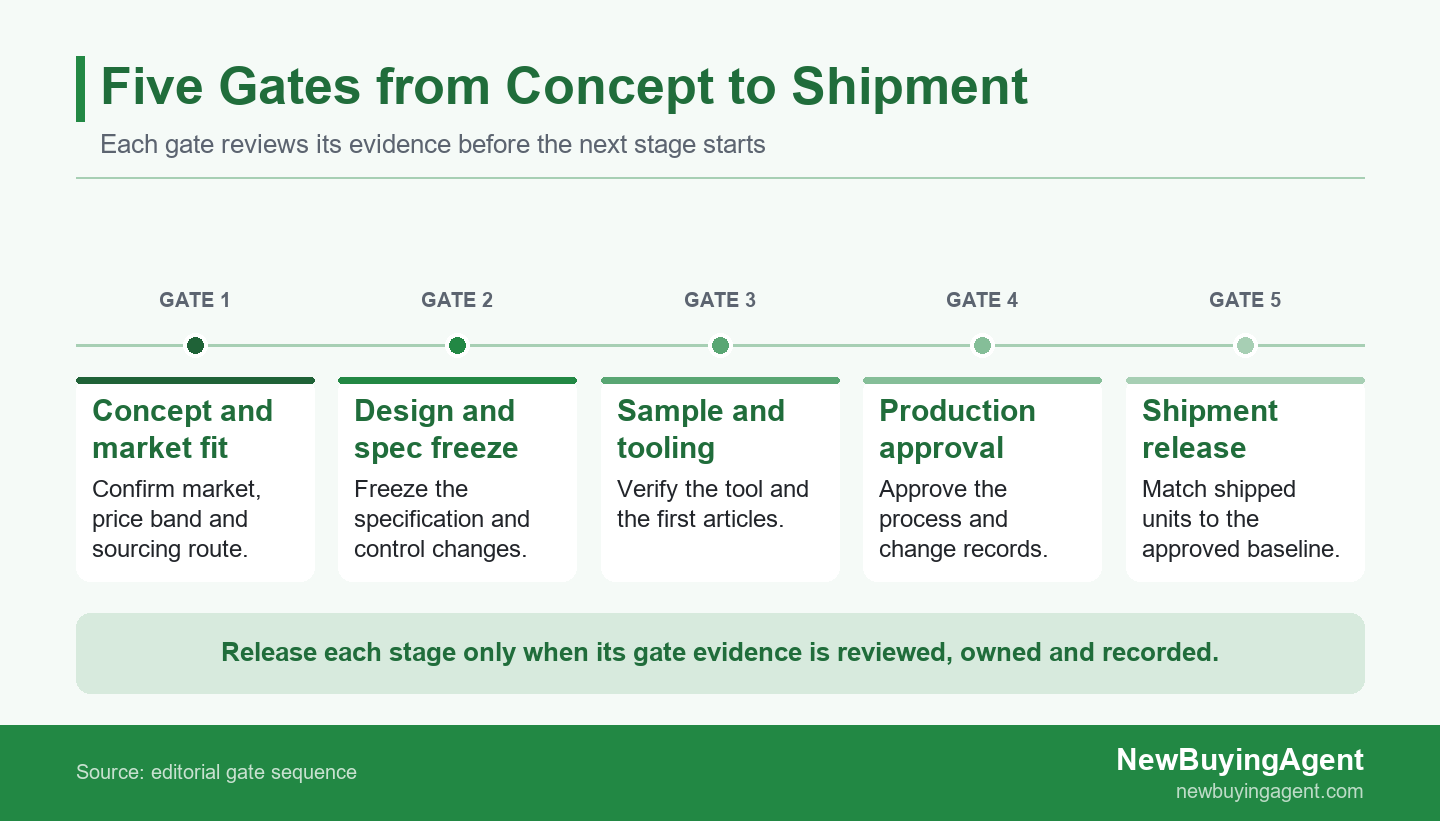
Five-stage new product introduction gate sequence from concept and market fit through design freeze, tooling, production approval, and shipment release
The Evidence to Request at Each Gate
A cross-gate evidence list shows the buyer what to request and who owns each decision, so a gate cannot be closed on a verbal assurance. The list below is deliberately short; it names the evidence that changes the release decision at each gate and the owner who must accept it. It is the part of the sequence a buyer can copy into a supply brief.
| Gate | Decision to close | Evidence to request | Owner |
|---|---|---|---|
| 1. Concept and market fit | Is the product viable at the target price and volume? | Target market, price band, quantity and a feasible sourcing route | Buyer |
| 2. Design and specification freeze | Is the design buildable and frozen? | Frozen specification, DFM review notes and the change path | Buyer and factory |
| 3. Sample and tooling | Does the tool and first article match the freeze? | First-article inspection, tool record and any recorded deviation | Factory and QC |
| 4. Production approval | Can the process repeat the approved part? | Control plan, approval package, change record with version and effectivity | Factory and QC |
| 5. Production and shipment | Do shipped units match the approved configuration? | Variant identifiers, label and packaging proof, and the release check | Buyer and factory |
Read the table as a release rule: a gate is closed only when its evidence exists and its owner has accepted it; anything less keeps the stage open.
Scale-up is treated as a readiness decision, not a formality. The NIST Manufacturing Extension Partnership is a program administered by the U.S. Department of Commerce's National Institute of Standards and Technology to strengthen small and medium-sized U.S. manufacturers through MEP Centers. The program supports U.S. manufacturers, so the transferable lesson is narrower: moving from a sample to volume is a readiness decision that benefits from documented evidence and named ownership, wherever the factory is.
Decision Rules and Boundary Cases
A gate sequence has to define when to hold, re-scope or stop, and it cannot replace a mandatory regulatory lifecycle for regulated products. Without a stop rule, a gate becomes a delay rather than a decision. And a product that sits inside a regulated category carries mandatory controls that an internal gate sequence does not remove.
That boundary is clearest in regulated categories. The FDA's Device Advice is the Center for Devices and Radiological Health's resource explaining medical device laws, regulations, guidances and policies across the entire product life cycle. Medical devices are not general consumer goods, so the transferable lesson is only that a regulated product follows its own mandatory lifecycle; an internal gate sequence adds control but does not substitute for it.
When to Hold, Re-Scope, or Stop
A gate decision should distinguish a missing evidence item that can be recovered from a market or feasibility failure that should stop or re-scope the project. Holding is for recoverable gaps: a measurement not yet taken, a change not yet recorded, a sample not yet verified. Stopping or re-scoping is for a broken premise: the product cannot hit the target price, the market does not exist at the assumed volume, or the design cannot be produced within the risk the buyer accepts.
The useful discipline is to state the condition for release before holding, so the hold has an exit. "Hold until the second color is measured against the master standard and the tooling change is recorded with a version" is a decision; "hold pending review" is not.
When You Already Have a Chinese Supplier
When a buyer already has a Chinese supplier, the gates shift from supplier selection to production evidence, change control and release follow-up. The concept and design gates are usually already closed, so the live questions are whether the existing factory can produce the new item to the approved specification, how a change will be controlled, and what evidence supports each release.
For an existing factory, the practical work is follow-up rather than sourcing. NewBuyingAgent's existing-factory management service connects local China follow-up and quality-control capability to the gate evidence, so a recorded change and its re-verification can be tracked through production instead of being rediscovered at shipment.
When a Stage Gate Is Skipped
Separate reversible preparation from the release that depends on missing gate evidence, and state the condition for release. In a real order the release is rarely all-or-nothing: some SKUs may be verified while others wait on a measurement or a change record. The point of the gate is to make that split explicit instead of allowing an incomplete configuration to start production.
Illustrative Example: A Tooling Change That Missed Its Gate
In this illustrative example, a consumer brand is introducing a new countertop kitchen appliance with 4 SKUs, 2 sizes and 2 colors, and plans 8,000 units for a first production run at a new China factory that shares one injection-mold tool for the outer housing. The design files are released, the tool is cut, first samples are available, and the buyer has approved one golden sample.
Dimensional checks on the golden sample pass for one size and one color, so the sample appears to close the design stage. Two gaps sit underneath it. The tool shop reduced a housing wall thickness after the design freeze to improve mold flow, and the change was never recorded against the frozen specification, so the approved drawing and the actual tool disagree. The second color was approved from a photograph, and no measured value against a master standard was recorded. Because the housing tool is shared, the unrecorded change can reach all four SKUs, and the unmeasured color leaves every unit of that color unverified.
The buyer's decision is to hold mass-production release for the affected SKUs while allowing reversible preparation such as packaging artwork proofing. The factory is asked to re-run first-article measurements on the changed housing, record the tooling change with a version and an effectivity, and measure the second color against the master standard before the affected SKUs are released.
Before mass production is released, the buyer reviews the first-article results and the change record against the frozen specification; after release, in-process checks confirm that each SKU stays on the approved configuration. This illustrative example invents no measured value and no passed test, and a closed gate is not a guarantee for every later unit; the product's own critical characteristics govern the real scope.
Put the Stage Gates Into the China Supply Brief
Put the gate sequence into the China supply brief: the gate list, the evidence and owner for each gate, the change path, the production-approval condition and the compliance inputs. Written this way, competing suppliers quote the same controlled product, and "the same as the sample" is replaced by a set of decisions the factory must satisfy. The brief also tells the factory what it must deliver before each stage may start.
Import and standards documentation belongs in that brief rather than at the end of the process. The U.S. International Trade Administration's China Country Commercial Guide covers customs, regulations and standards, including tariff and non-tariff barriers, import requirements and documentation, and product standards. Naming the applicable documentation in the gate list keeps compliance evidence attached to the shipment gate instead of surfacing at the port.
For a new product entering China sourcing, prepare the product concept, the specification and design files, the target quantity, the target price, the destination and the delivery timing. NewBuyingAgent can use its local China factory resources and product-development/QC capability to develop a product quotation around those requirements, including the gate sequence, the evidence list and the release conditions. With that brief ready, send your product requirements to NewBuyingAgent.
Frequently Asked Questions
Is new product introduction the same as product development?
No; product development creates and tests the design, while new product introduction is the staged path that carries that design through tooling, production approval and shipment with a decision at each gate. Development answers what the product should be; introduction answers whether a factory can produce it, repeat it, and ship it to the approved configuration. A project can have a finished design and still fail introduction if the tool, the process or the evidence is not controlled.
How many stage gates does a China-sourced product need?
Most consumer products need five gates: concept and market fit, design and specification freeze, sample and tooling verification, production approval, and production and shipment release. A simpler or lower-risk product can combine two gates into one meeting, but the decision and its evidence still have to be recorded. A complex or regulated product may add a gate, for example a compliance review before shipment.
Can a buyer skip gates for a simple product?
A buyer can combine or lighten gates for a low-risk product, but the decisions still need evidence and an owner; what should not be skipped is the record that shows a decision was made. The risk of skipping is not the ceremony, it is the unrecorded change or the unmeasured characteristic that reaches production. For a simple product the evidence can be shorter, not absent.
What should a buyer prepare before the first gate?
Before the first gate, a buyer should prepare the product concept, the target market and price band, the target quantity, the destination, and the delivery timing, because those inputs decide whether the sourcing route is feasible. They also become the reference the later gates are measured against, so a vague brief at gate one usually produces a vague quotation later. Prepare them in writing before requesting a quote.
NewBuyingAgent
Related Resources

Начните сегодня
Давайте превратим ваши цели по закупкам в реальностьWeChat:+86 15157124615
WhatsApp:+86 15157124615
Адрес: Здание 10 #39 Xiangyuan Road, Ханчжоу, Китай
