

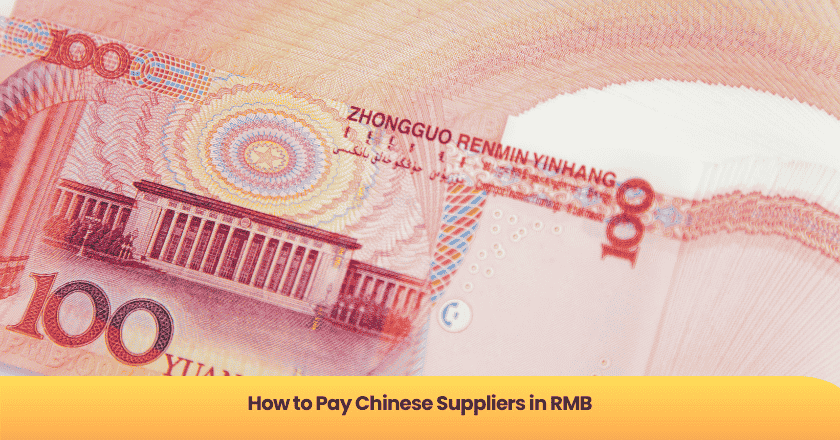
The way global importers structure payments to Chinese suppliers is shifting — quietly but meaningfully. With the USD/CNH exchange rate climbing nearly 7% since early 2023, and China's cross-border payment infrastructure maturing fast, the question of which currency to pay in is no longer just a back-office detail. It directly affects your landed costs, supplier relationships, and ultimately your margins.
This guide covers everything serious importers need to know about paying Chinese suppliers in RMB (Renminbi — also referred to as CNY on the mainland and CNH in offshore markets): practical mechanics, regulatory compliance traps, a real cost comparison, and what's changing in 2026.
Key Takeaways
- Paying in RMB can eliminate the hidden currency buffer Chinese suppliers quietly build into USD quotes — typically 3–8% of invoice value — giving you real negotiating leverage.
- Eight distinct payment channels exist for settling RMB invoices from overseas, each with different risk profiles, fee structures, and processing timelines.
- RMB transactions incorrectly recorded as "domestic sales" rather than "export transactions" disqualify suppliers from Chinese VAT export rebates — ultimately raising your cost of goods.
- Underground banking networks are not a grey area. They violate PBoC regulations, can trigger supplier bank account freezes, and leave you with no legal recourse.
- CIPS (Cross-Border Interbank Payment System) — China's own international payment rail — is expanding into 110+ countries and is increasingly competitive with SWIFT on both speed and cost.
- Digital platforms like Airwallex and Wise are displacing legacy SWIFT transfers for mid-sized importers, offering mid-market FX rates and transparent, all-in fee structures.
Why the Currency You Choose Actually Matters
Most importers default to USD without much deliberation. It's familiar, it's globally liquid (meaning it trades freely across most banking systems), and the majority of Chinese export invoices are quoted in it as standard.
But that convenience carries a hidden cost that rarely appears on any invoice.
Chinese manufacturers pricing in USD face real exposure when the RMB/USD rate moves. To manage that risk, they build in a buffer — a quiet cushion baked into the quote to protect their margin if the yuan strengthens.Some suppliers are pricing in 5–8% currency risk protection on top of their production costs, and most buyers never see that line item because it's folded into the unit price.
Paying in RMB removes that equation from your supplier's side. Some will pass the saving back as a direct discount — typically 2–5% for established buyers with a track record. Others won't volunteer it, but the negotiating leverage is real and documented. At $500,000 in annual procurement, a 3% reduction returns $15,000 to your business. That's not a rounding error.
There's also a treasury management angle worth considering. If your company holds RMB-denominated assets — from domestic Chinese sales, a joint venture, or retained earnings in a Chinese entity — paying suppliers in RMB eliminates a needless round-trip currency conversion and the spread that comes with it.
Expert Tip: Before your next supplier negotiation, request dual-currency quotes — one in USD and one in RMB. The spread between the two reveals precisely how much currency risk your supplier is pricing into their offer. Use that number as your negotiating anchor. Suppliers who initially resist will often become more flexible once they understand you've done the math.
Eight Ways to Pay Chinese Suppliers in RMB
Not all payment channels work equally well for every importer. Here's an honest breakdown of what's available in 2026.
1. Bank Wire Transfer via SWIFT
The backbone of international trade finance. Your bank converts your home currency into RMB and routes it through the SWIFT network — the global messaging system banks use to send international payment instructions. Secure, well-understood by Chinese banks, and accepted universally. The cost, however, is real: expect a $25–$50 flat fee per transfer plus a currency conversion spread of 1–3%, which is the bank's markup over the real exchange rate. Settlement takes 3–5 business days. Best suited for large, infrequent orders where the per-transfer cost is a small percentage of the total.
2. CIPS (Cross-Border Interbank Payment System)
China's own equivalent of SWIFT, purpose-built for RMB-denominated cross-border settlement. CIPS now connects over 1,400 financial institutions across 110+ countries, and adoption is accelerating in 2026. If your bank is a CIPS participant, payments can settle same-day and fees tend to be meaningfully lower than equivalent SWIFT transactions. Worth a direct conversation with your bank's trade finance desk.
3. Wise (formerly TransferWise)
Wise routes transfers using local bank rails in each country rather than the SWIFT network, which translates to the mid-market exchange rate (the rate you see on Google, with no markup) and a transparent 0.4–0.8% all-in fee. For payments under $100,000 USD equivalent, Wise is typically the most cost-efficient regulated option for individual transfers. KYC (Know Your Customer) verification — standard ID checks under anti-money laundering regulations — is required at account setup but is generally straightforward.
4. Airwallex
Built specifically for business cross-border payments, Airwallex has become a practical tool for importers without a physical presence in China. It offers multi-currency wallets, competitive FX rates, and — increasingly useful — batch payment capabilities that let you distribute RMB to multiple factory accounts from a single funded wallet. In 2026, Airwallex expanded its direct China payment rails, reducing reliance on correspondent banking chains.
5. Alipay Cross-Border
Alipay's cross-border rails — operated by Ant Group — allow international buyers to initiate RMB payments directly to Chinese business accounts. Near-instant processing and wide supplier acceptance make it attractive for small to medium transactions. The limitation: setting up a verified business account requires working with an Alipay-authorized partner in your country, which isn't always available outside major markets.
6. WeChat Pay Cross-Border
Functionally similar to Alipay, and embedded in the supplier relationships many importers already manage via WeChat messaging. Acceptance is broad for transactions under $50,000 equivalent. Non-Chinese residents typically need to work through a local intermediary to access the payment function, which adds a step but doesn't eliminate the option.
7. Letters of Credit (LC) in RMB
For high-value first-time transactions or when dealing with an unvetted supplier, an LC issued in RMB through a Chinese correspondent bank provides the strongest buyer protection available. The bank releases payment only when the supplier presents specific shipping documents proving goods left China. Setup costs $500–$1,500 and takes 7–14 days — not practical for routine orders, but defensible for high-stakes ones.
8. China-Based Payment Agent
Some importers work with a licensed China-based procurement or payment agent holding a registered RMB corporate account. You pay the agent in your home currency; they pay the supplier in RMB through domestic banking channels. Particularly useful when consolidating orders across multiple factories into a single invoice — a common scenario for importers sourcing from 3–5 manufacturers simultaneously. Agent fees typically run 3–5% of the transferred amount.
Compliance Realities You Can't Afford to Ignore
Here's what most basic payment guides skip over: paying a Chinese supplier in RMB through a domestic corporate account can inadvertently reclassify the transaction as a domestic sale rather than a genuine export transaction. That distinction creates real consequences — for your supplier and, transitively, for your cost of goods.
Chinese export regulations entitle suppliers to a VAT export rebate from the government on many categories of manufactured goods, typically 9–13% of the invoiced value. This rebate is a deliberate policy tool to keep Chinese exports price-competitive internationally. It only applies when the transaction is properly filed as an export — meaning export customs declaration (报关), proper documentation, and foreign currency settlement or appropriately structured RMB settlement.
If the payment flows through a channel that records the transaction as a domestic sale, that rebate disappears. Suppliers absorb the loss initially, then recoup it over time through price adjustments or subtle quality trade-offs. Neither outcome serves your interests.
- Verify that your payment arrangement explicitly preserves the supplier's ability to file for export customs declaration.
- Request a copy of the export customs clearance certificate (出口报关单) after each shipment — this document confirms goods legally left China as an export.
- If using a payment agent, confirm in writing that their structure does not reclassify transactions as domestic sales.
China's standard VAT rate on manufactured goods is 13%. For legitimate exports, this is rebated to the supplier. A structural mistake in your payment setup effectively removes that rebate, and the cost finds its way back to your invoice over time — often invisibly.
Expert Tip: When structuring an RMB payment arrangement with a new supplier, bring a China-based freight forwarder or trade compliance advisor into the conversation early. They see both the payment documentation and the customs filing simultaneously, and can identify structural misalignment before it compounds into a sustained cost problem.
What Does It Actually Cost? A Realistic Comparison
Advertised fees rarely tell the full story. Here's a total-cost breakdown for a $30,000 USD equivalent RMB payment in 2026, accounting for both transfer fees and FX spread:
- SWIFT bank wire: $35–50 flat fee + 1.5–2.5% FX spread = $490–$800 total cost
- CIPS (via participating bank): $10–25 flat fee + 0.5–1% spread = $160–$325 total cost
- Wise: No flat fee + 0.4–0.8% transparent fee = $120–$240 total cost
- Airwallex: No flat fee + 0.5–1% (volume-tiered) = $150–$300 total cost
- Payment agent: 3–5% commission = $900–$1,500 total cost, inclusive of compliance, verification, and multi-vendor distribution services
For large single payments, CIPS via a participating bank delivers the best combination of cost and regulatory standing. For mid-sized frequent transfers, Wise and Airwallex compete closely on fees and are worth running side-by-side. Payment agents carry the highest percentage cost but offer bundled compliance and consolidation services that standalone payment platforms don't provide.
Common Mistake to Avoid: Evaluating payment methods based solely on the advertised transfer fee, ignoring the FX spread. A bank advertising "zero transfer fee" often earns more from the currency conversion markup than a platform charging a transparent 0.6% all-in fee. Always compare the amount your supplier actually receives in RMB for every dollar you send — that's the only number that matters.
2026 Trends Reshaping Cross-Border RMB Payments
Three shifts deserve attention from any importer planning their payment infrastructure for the next 12–18 months.
CIPS adoption is accelerating beyond expectations. China has been building CIPS as a strategic alternative to SWIFT dependency for years. In 2025–2026, uptake accelerated significantly in Southeast Asia, the Gulf Cooperation Council (GCC) countries, and parts of Latin America — driven partly by trade policy diversification and partly by straightforward economics. The network will be larger by the end of 2026 than it is today, and more importing businesses will have access to it through their existing banking relationships.
Digital RMB (e-CNY) is entering B2B territory. The People's Bank of China has been running e-CNY retail pilots since 2021. Cross-border B2B pilots began in earnest in 2025, focused on select free trade zones including Shenzhen and Hainan. It's not a mainstream option yet, but importers with operations in those zones are beginning to explore e-CNY settlement directly with suppliers. If the pilots scale as the PBoC intends, the fee structure of cross-border RMB payments could change substantially within a few years.
Trade policy uncertainty is pushing more importers toward RMB invoicing. With US-China tariff policy remaining volatile, a growing segment of buyers — particularly mid-market European importers — are negotiating RMB invoicing explicitly to decouple their payment exposure from USD/CNH rate swings. For European buyers, RMB pricing also provides a partial hedge against EUR/USD volatility, which adds a secondary layer of appeal.
Expert Tip: Set a rate alert for USD/CNH (or EUR/CNH if you're Europe-based). When the rate moves more than 1.5% within 30 days, use it as a natural opening to revisit payment currency preferences with active suppliers. Those conversations are far easier when you've already established dual-currency invoicing as a standard practice in your contracts.
Frequently Asked Questions
Can I pay a Chinese supplier in RMB without holding a Chinese bank account?
Yes. Platforms like Wise, Airwallex, and CIPS-connected banks all allow overseas buyers to send RMB without maintaining a Chinese account. Payment agents offer the same capability with additional compliance and supplier-side coordination. You don't need local banking infrastructure to access RMB payment rails.
Will paying in RMB automatically get me a lower price?
Not automatically — but the leverage is real. Chinese suppliers quoting in USD typically include a currency buffer to cover exchange rate risk. When you pay in RMB, that risk disappears from their side of the equation. Suppliers you've worked with for a year or more are generally the most receptive to renegotiating around this. Frame it as a mutual benefit, not a demand.
Is cryptocurrency a legal option for paying Chinese suppliers?
No. Cryptocurrency transactions involving RMB are explicitly prohibited under current PBoC regulations. Chinese suppliers cannot legally receive crypto as business payment, and attempting to route payment this way exposes both parties to regulatory and legal risk. This prohibition is actively enforced.
What happens if my payment gets flagged by Chinese financial authorities?
Payments flagged under China's anti-money laundering review process can result in the recipient account being frozen — sometimes for weeks. The supplier cannot access funds or ship goods during that period, regardless of what your purchase order or contract specifies. This is the single strongest argument for using licensed, regulated payment channels from the start.
How long do RMB wire transfers realistically take?
Via SWIFT: 3–5 business days. Via CIPS: often same-day if initiated before the daily cut-off. Wise and Airwallex typically settle within 1–2 business days. Reputable payment agents operating through licensed domestic channels usually complete transfers within 1–3 business days. Informal or unregulated channels offer no reliable timeline — and no legal guarantee of delivery.
Is a Letter of Credit worth using for RMB payments?
For orders above $50,000 with a supplier you haven't worked with before, an LC adds meaningful, documented protection. The bank won't release funds until specific shipping conditions are met — giving you real recourse if the supplier doesn't perform. For established, verified supplier relationships, the $500–$1,500 setup cost and administrative overhead typically outweigh the protection value.
Final Thoughts
Paying Chinese suppliers in RMB is no longer a specialist manoeuvre reserved for companies with China offices or dedicated trade finance teams. As CIPS expands, digital payment platforms mature, and the cost of USD-denominated currency buffers becomes more transparent, RMB payment is increasingly a practical and cost-effective strategy for any serious importer.
The critical variable isn't the payment platform — it's the compliance structure underneath it. Getting the export documentation right, preserving your supplier's access to VAT rebates, and using regulated channels aren't optional considerations. They're what separates a payment arrangement that works from one that quietly erodes your margins or, worse, freezes your goods mid-shipment.
NewBuyingAgent
Related Resources
Начните сегодня
Давайте превратим ваши цели по закупкам в реальностьWeChat:+86 15157124615
WhatsApp:+86 15157124615
Адрес: Здание 10 #39 Xiangyuan Road, Ханчжоу, Китай
