

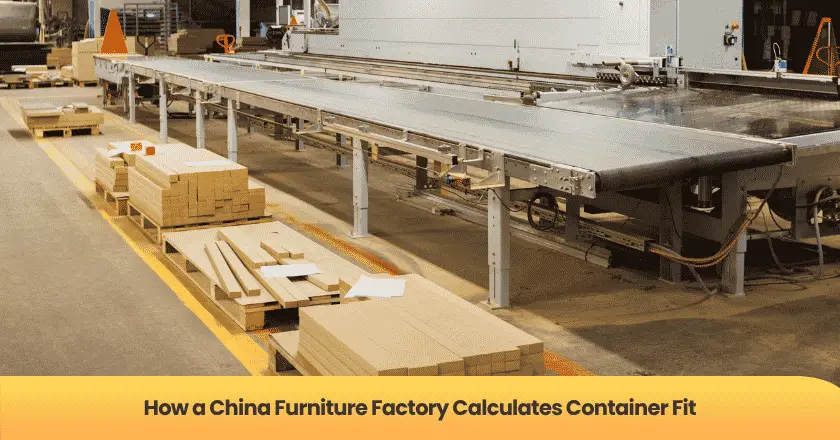
Two factories quote a bookcase at $41 and $43. The cheaper one packs 168 units into a forty-foot container and the dearer one packs 214, because its carton is 40mm shallower and its shelves nest rather than stack. On landed cost the more expensive bookcase wins comfortably, and the buyer who compared the two numbers in an inbox never saw it.
Furniture is bulky relative to its value, so freight is a large share of what it costs to land. That makes container fit an arithmetic problem worth doing yourself rather than a logistics detail to delegate.
Key Takeaways
• Freight is sold by volume, so cubic metres per unit is the number that decides your shipping cost.
• Nominal container volume overstates what you can load, because real cargo leaves void space.
• Carton dimensions matter more than product dimensions, since the carton is what occupies the container.
• Knock-down construction and nesting are the two design levers that move the number most.
• A design change made once improves every shipment, while a negotiated discount improves one order.
The Basic Arithmetic
The calculation has three steps and takes a few minutes once you have the right inputs.
From Carton to Cubic Metres
Start with the carton rather than the product. Multiply carton length by width by height in metres to get cubic metres per carton, then divide by units per carton to get cubic metres per unit. That figure is what freight is actually sold against.
Ask suppliers for carton dimensions and units per carton in the first quote round, always. A quotation without them is incomplete for any bulky product, and requesting them costs one line in an email.
From Cubic Metres to Units Per Container
Container dimensions are standardised. ISO 668 classifies series 1 freight containers by external dimensions and specifies ratings along with minimum internal and door opening dimensions, with ISO 1496 as the authoritative document for internal dimensions.
Take the internal volume for the container type you ship in, from your forwarder or carrier rather than from memory, then divide by cubic metres per carton. That gives a theoretical carton count, which is the number to start from and never the number you achieve.
Container type is part of the calculation rather than a given. A high cube offers additional internal height over a standard box, which on a product whose carton stacks awkwardly can be worth an entire extra layer. Ask your forwarder what is available on your lane and price both, since the rate difference is often smaller than the volume difference.
Expert Tip:Ask both the factory and your forwarder for units per container and compare the two answers. Factories calculate from carton volume and forwarders calculate from loading experience, and the gap between them is the void space nobody accounts for on paper. I treat a large discrepancy as a signal to ask how the container will actually be stacked, which occasionally reveals that a carton dimension needs changing by a few centimetres to stack cleanly.
Why the Theoretical Number Is Wrong
Dividing volume by volume assumes cargo behaves like liquid. Real cartons leave gaps, and the gaps are where the difference between two similar quotes hides.
Void Space and Stacking
Cartons stack in whole numbers. A carton that is slightly too tall to fit four layers leaves a band of unused height across the entire container floor, and a carton slightly too wide to sit two across leaves a strip down the length. These losses are not proportional to the excess, they are proportional to the whole layer.
This is why carton dimensions should be designed against container dimensions rather than against the product alone. Reducing a carton by three centimetres can be worth an extra layer, which on a forty-foot container is a substantial number of units.
Pallets are a decision with a volume cost attached. Palletised cargo loads and unloads faster and protects goods better, and the pallet itself occupies height that would otherwise hold product. For furniture moving into a warehouse with forklift handling the trade is usually worth it, and for goods going straight to a store it frequently is not.
Weight, Shape and Doors
Furniture is usually volume-limited rather than weight-limited, so the maximum payload rarely binds. Solid wood is the exception, and a container of dense hardwood pieces can reach its weight rating with volume to spare.
Shape matters too. Irregular items, assembled chairs and anything with protruding legs waste space that a rectangular carton would use. Door opening dimensions occasionally constrain oversized single pieces, which is worth checking before designing something that fits the container but not the doorway.
Common Mistake to Avoid:Comparing furniture quotes on unit price alone is the most consistently expensive habit in this category, and it feels like diligence at the time. Two factories within a dollar of each other can differ by 20% or more on container fill, which on a bulky item outweighs the price gap several times over. Ask for carton dimensions and units per carton with every quote, calculate units per container yourself, and convert freight into cost per unit before ranking anybody. The order frequently reverses.
The Design Levers
Container fit is not fixed. Several design decisions move it substantially, and most cost little to implement.
Knock-Down and Nesting
Shipping knocked down is the single largest lever in furniture. An assembled chair occupies its own volume plus the air around its legs, while the same chair in flat components occupies a fraction of it. The trade is assembly work at the destination and an instruction sheet nobody reads carefully.
Nesting is the second. Bowls, stools, tables with removable legs and anything conical or tapered can be designed so units sit inside one another. Ask the factory directly whether a design can nest, since production engineers see this immediately and rarely volunteer it when nobody asked.
Carton Engineering
Right-sizing the carton is the quiet lever. Excess headroom above the product, unnecessarily thick internal packing and a carton designed for a previous product all waste volume. So does over-specifying board strength, which adds wall thickness across every carton in the container.
Balance this against damage. Furniture transit damage is high enough that under-packing costs more than the freight it saves, so the target is a carton sized to the product with appropriate protection rather than the smallest possible box.
Sequence the levers rather than applying all of them at once. Knock-down first, since it usually moves the number most. Nesting second, where the geometry allows it. Carton right-sizing third, because it is a refinement of whatever the first two produced. Buyers who start with carton engineering optimise a box around a design that should have changed.
Expert Tip:Ask what the carton would look like if the design changed in one specific way, and ask for the revised units per container alongside it. Removable legs, a shallower back panel, a shelf that ships loose rather than fixed. Factories answer these quickly because it is ordinary engineering, and the numbers make the trade visible. I have seen a single removable component add 30% to container fill, which is a better outcome than any negotiation on that product produced.
Turning the Number Into a Decision
Container fit only matters once it is converted into cost per unit and compared like for like.
Converting Fill Into Cost
Divide the all-in cost of a container on your lane by the units it holds, and add that to the unit price. Rates move enough to matter, so use a current reference such as Drewry's World Container Index rather than an invoice from last year.
The same logic applies to air freight for smaller shipments, where pricing runs on chargeable weight, the greater of actual and volumetric weight. Bulky furniture components are volumetric almost by definition, which is why air freight on this category is rarely economic.
Mixed loads complicate the sum in a useful direction. Where several products ship together, cartons of different sizes can fill each other's gaps, and a container carrying three products often achieves better utilisation than any of them would alone. Ask your forwarder or consolidator to plan the load rather than assuming products stack independently.
Where the Payback Sits
A design change improves every container you ever ship of that product, while a price concession improves one order. On a product you expect to reorder, the design lever is worth more even when the immediate saving looks smaller.
Bring the calculation into the development stage rather than applying it afterwards. Changing a design before tooling and cartons exist is a conversation, and changing it after the first production run is a project.
Expert Tip:Keep a single sheet per product recording carton dimensions, units per carton, cubic metres per unit and units per container, and update it whenever anything changes. Factories occasionally alter carton specifications between orders for their own reasons, and a shipment that suddenly holds fewer units is easy to miss and expensive to absorb. The sheet takes minutes to maintain and it catches the change on the packing list rather than on the freight invoice.
Where the Volume Question Meets Supplier Choice
Container fit is influenced by product design, carton dimensions and packaging decisions, and factories making the same type of furniture can differ significantly in how effectively they manage these factors.
This is why supplier choice matters when the goal is to make better use of container space. A factory that can optimize carton dimensions and packaging without compromising product protection may achieve a different container utilization result from another factory producing an otherwise similar item.
NewBuyingAgent works with a network of 50,000+ partner factories across China, giving buyers access to a broader range of sourcing options than they may be able to reach independently. This allows suppliers to be considered based on factors such as product requirements, pricing, production capabilities and cooperation.
A broader supplier base can also help identify more competitive purchasing options. Depending on the product and order, NewBuyingAgent can help reduce purchasing costs by around 5%–10% through supplier sourcing and negotiation.
For furniture buyers, however, the lowest quoted unit price is not the only consideration. The more useful comparison is often the combination of product price, carton configuration, container utilization and product protection.
NewBuyingAgent also has 20,000+ product development and QC experts across China, providing support during product development and production. This helps connect product and packaging requirements with what the factory actually produces.
For buyers sourcing furniture or multiple product categories from China, NewBuyingAgent combines a broad factory network with product development, QC and factory communication—giving buyers more options to evaluate before committing to a supplier. Contact now.
Frequently Asked Questions
How do I calculate how many units fit in a container?
Multiply carton length by width by height in metres for cubic metres per carton, divide by units per carton for cubic metres per unit, then divide the container's internal volume by cubic metres per carton. Treat the result as theoretical, since real loading leaves void space, and ask your forwarder for a practical figure alongside it.
Why do two similar products differ so much on container fill?
Usually carton geometry rather than product size. Cartons stack in whole layers, so a carton slightly too tall for an extra layer wastes height across the entire floor. Knock-down construction and nesting also make large differences, and neither is visible in a photograph or a unit price.
Is knock-down always better for furniture?
For container fill, almost always, and it carries costs elsewhere. Assembly falls to the customer, instructions and fixings have to be produced properly, and assembly complaints damage reviews quickly. Compare landed cost per unit for both versions and weigh the improvement against the customer experience for your particular product.
Should I redesign a product to improve container fit?
It is worth costing whenever you expect to reorder, since a design change benefits every future shipment while a discount benefits one order. Ask the factory what a specific change would do to units per container, since production engineers can answer quickly and the numbers make the trade explicit.
Who should calculate container fit, me or the supplier?
Both, and comparing the two answers is the point. Factories calculate from carton volume, forwarders from loading experience, and the gap between them is the void space nobody accounts for on paper. Doing your own calculation also lets you compare suppliers before either of them knows you are comparing.
Conclusion
Do the volume arithmetic before the price negotiation. Ask for carton dimensions and units per carton with every quote, calculate units per container yourself, treat the theoretical figure as an upper bound, and ask what a design change would do to it. In furniture the buyer who understands cubic metres consistently lands cheaper goods than the buyer who understands only unit price. For buyers comparing factories on landed cost rather than quoted price, NewBuyingAgent handles factory selection, quality control and delivery from China.
Partial Sources
1. International Organization for Standardization — ISO 668:2020, Series 1 freight containers: classification, dimensions and ratings —https://www.iso.org/standard/76912.html— Accessed 3 September 2026
2. Drewry Supply Chain Advisors — World Container Index, weekly composite spot rate per 40ft container across major east-west trade lanes —https://www.drewry.co.uk/supply-chain-advisors/supply-chain-expertise/world-container-index-assessed-by-drewry— Accessed 3 September 2026
3. International Air Transport Association — Air Cargo Tariffs and Rules: What You Need to Know, covering chargeable and volumetric weight —https://www.iata.org/en/publications/newsletters/iata-knowledge-hub/air-cargo-tariffs-and-rules-what-you-need-to-know/— Accessed 3 September 2026
NewBuyingAgent
Related Resources


Начните сегодня
Давайте превратим ваши цели по закупкам в реальностьWeChat:+86 15157124615
WhatsApp:+86 15157124615
Адрес: Здание 10 #39 Xiangyuan Road, Ханчжоу, Китай
