
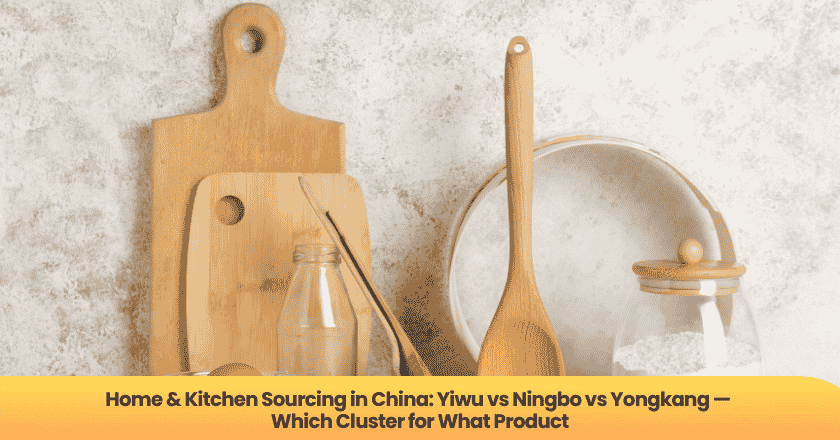
Three Zhejiang province clusters within 200km of each other dominate global home and kitchen product manufacturing. Each one specializes in a different product slice — and buyers who don't match the cluster to the product end up with the wrong supplier doing the wrong work at the wrong price.
Key Takeaways
- Three Zhejiang province clusters dominate China's home and kitchen export categories: Yiwu (small home goods, accessories, decorative items, broad consolidation), Ningbo (small appliances, kitchen electrics, kettles), Yongkang (metal hardware, stainless steel kitchenware, tools).
- Yiwu's role is unique — it's the world's largest small commodities trading hub, with the famous Futian Market spanning 6.4 million square meters. Best for buyers needing variety across many SKUs at moderate volumes, not for deep OEM development.
- Ningbo dominates small kitchen electrics — kettles, blenders, toasters, juicers. Major brand OEM (KitchenAid, Cuisinart, Black & Decker, Hamilton Beach competitors) concentrates here.
- Yongkang is the "hardware capital of China" — stainless steel cookware, metal utensils, kitchen tools, scissors, locks, even electric scooters. Industrial scale that other clusters don't match.
- US import duties on Chinese home and kitchen products in 2026: typically 35–40% effective (low MFN + 10% Section 122 + 25% Section 301 List 3). Some kitchen electrics on List 4A at 7.5%.
- Container loading and product safety compliance (food contact, electrical safety, chemical migration) are the two operational variables that most affect actual landed cost vs headline factory price.
For US and European retailers buying home and kitchen products, three Zhejiang province clusters within roughly 200 kilometers of each other handle the majority of Chinese exports in this category. Yiwu, Ningbo, and Yongkang each specialize in different product segments. Treating them interchangeably — sourcing kitchen electrics from Yiwu, small accessories from Yongkang, or hardware from Ningbo — produces predictable disappointments: wrong supplier base, wrong MOQ structure, wrong quality tier for the price point.
For buyers building home and kitchen product lines through Chinese sourcing, choosing the right cluster for the right product is the foundation. This guide walks through what each cluster does best, the realistic MOQ and pricing differences, the compliance requirements that matter for these categories, and how to navigate a multi-cluster sourcing program when your product line spans more than one specialization.
Part 1: Yiwu — The World's Small Commodities Trading Hub
Yiwu's Futian Market is the world's largest small commodities wholesale market, spanning 6.4 million square meters and housing over 75,000 vendor booths. The market is itself only one part of a broader Yiwu sourcing ecosystem that includes thousands of factories within the surrounding region and a vast trading company infrastructure.
What Yiwu does well
Decorative home accessories. Picture frames, candles, vases, decorative items, seasonal goods (Christmas, Halloween, Easter products are a major Yiwu specialty). High variety at moderate volumes.
Small home textiles. Pillows, throws, basic blankets, kitchen towels, table linens. Lower-end residential textiles primarily.
Plastic household items. Storage containers, organizers, basic kitchen tools, bathroom accessories. Wide range across price tiers.
Hardware and miscellaneous. Hooks, racks, basic tools, locks, smaller hardware items. Often supplied through trading companies that aggregate from multiple factories.
Consolidation across many SKUs. Yiwu's defining strength: consolidation. A single sourcing trip or single trading company relationship can deliver 20–50+ SKUs across many product categories. For variety-driven retailers (gift shops, home goods boutiques, dollar-store category buyers), Yiwu is structurally without equal.
Small-batch flexibility. Stock-equivalent products available at very small quantities (10–500 units typical). Custom OEM with modest customization at 500–2,000 units.
What Yiwu doesn't do well
Deep OEM with serious tooling investment. Yiwu suppliers are not equipped for the engineering depth required for complex custom products. The model is variety and consolidation, not deep customization.
Premium or technical products. Yiwu's average quality tier is mid-to-low. Premium home and kitchen products typically come from other clusters or non-Yiwu factories.
High-volume single-SKU production. Single-SKU runs above 50,000 units are usually better served by direct factory relationships outside the Yiwu trading-company structure.
Regulated electrical products. Small kitchen electrics or anything with significant safety certification requirements typically fits better in Ningbo.
Typical MOQ and pricing
Stock products: 10–500 units. Light customization (color, packaging): 500–2,000 units. Custom OEM with new tooling: 2,000+ units (and Yiwu may not be the right cluster for the work).
Pricing tier: budget to low-mid. A basic decorative pillow at $3–8 ex-Yiwu vs $8–20 from a higher-tier supplier elsewhere. A plastic storage organizer at $1–4 vs $3–10.
Part 2: Ningbo — Kitchen Electrics and Small Appliance OEM
Ningbo, located on the East China coast roughly 200 km south of Shanghai, is China's dominant small appliance and kitchen electrics manufacturing region. The cluster spans Beilun, Cixi, and Yuyao districts.
What Ningbo does well
Small kitchen electrics. Electric kettles, coffee makers, blenders, juicers, toasters, electric pressure cookers, slow cookers, food processors, mixers, electric grills, air fryers. Most of the world's mid-market kitchen electrics come from Ningbo factories.
Major brand OEM. Ningbo factories supply KitchenAid, Cuisinart, Hamilton Beach, Black & Decker, Breville, and many other major Western kitchen electrics brands. The infrastructure exists for sophisticated product development, regulatory compliance, and large-volume production.
Consumer electronics adjacent products. Personal care electrics (hair dryers, shavers — though these often come from Guangdong instead), home electric devices.
Stainless steel kitchenware adjacent. Some overlap with Yongkang — Ningbo has capability in higher-end stainless steel cookware integrated with electric heating elements.
Quality tiers within Ningbo
Tier 1: Major brand OEM factories. Serve Western brand mass production at established quality levels. Typical MOQ: 10,000+ units. Typical unit pricing: USD 8–25 for standard kitchen electrics, $25–80 for premium.
Tier 2: Mid-market factories. Serve growing brands and retailer private label. MOQ: 2,000–5,000 units. Pricing somewhat below Tier 1 but with variable quality and weaker compliance infrastructure.
Tier 3: Lower-end factories. Serve domestic Chinese mass market and some gray-market exports. Lower MOQ (500–2,000) but significant quality and compliance risk for brand-quality work.
For US/EU bound product, work with Tier 1 or established Tier 2 factories. The cost difference vs Tier 3 is often 20–40%, which is substantial but justified by the quality, compliance, and reliability differentials.
Compliance considerations specific to kitchen electrics
UL certification (US): Required by most major US retailers for kitchen electrics. Cost: USD 5,000–25,000 per product family. Timeline: 4–10 weeks.
FCC certification (US): Required for any device with wireless capability or that emits RF.
CE certification (EU): Required for EU sale. Multiple directives apply.
Energy efficiency: Energy Star (US) optional but valuable. Various EU energy efficiency directives.
Electrical safety: GS mark (Germany/EU) widely required by EU retailers.
Food contact materials: Any kitchen electric with food-contact components requires food-grade material certifications (FDA, LFGB, etc.).
Tier 1 Ningbo factories handle this certification work as standard practice. Tier 3 factories often produce certifications of questionable quality.
Part 3: Yongkang — The Hardware Capital of China
Yongkang, in central Zhejiang province, is the largest hardware and metalware manufacturing cluster in China. The local government estimates Yongkang produces over 70% of China's hardware exports across various subcategories.
What Yongkang does well
Stainless steel cookware. Pots, pans, kettles, cooking utensils, mixing bowls, food containers. Major Western cookware brands have long Yongkang supplier relationships.
Metal kitchen utensils. Knives, scissors, kitchen tools, peelers, can openers, graters, ladles, tongs. Wide range from budget to premium.
Hardware and tools. Hand tools, power tool components, locks, hinges, hooks, brackets. Industrial and consumer markets both served.
Electric scooters and personal mobility. A surprising specialty — Yongkang is a major global producer of electric scooters and similar personal mobility products.
Industrial metal products. Beyond consumer goods, Yongkang has significant capability in industrial metalware, equipment components, and machinery parts.
Typical MOQ and pricing
Stock-equivalent stainless steel cookware (pots, pans, basic kitchenware): 200–1,000 units. Custom OEM with branded packaging: 1,000–5,000 units. Custom design with new tooling: 5,000+ units.
Pricing tier: mid-market dominant. Budget-tier products possible but the cluster's strength is mid-tier quality at competitive pricing.
A basic stainless steel skillet from Yongkang: $3–8 ex-factory at MOQ. Premium tri-ply stainless cookware: $15–40. Knife sets: $5–25 depending on quality tier.
Compliance considerations for metal kitchenware
Heavy metal testing. Lead, cadmium, and other heavy metal migration testing for any food-contact metal product. FDA and EU LFGB standards.
Food contact certification. FDA 21 CFR Part 175–178 for US; LFGB testing for EU.
Sharp edge and safety testing. For knives, scissors, and other sharp items.
California Proposition 65. California-specific chemical warning requirements affect some metal products with certain alloys or coatings.
Tier 1 Yongkang factories handle these standards as routine. Specifying compliance requirements explicitly in the purchase order is essential.
Part 4: Side-by-Side Comparison
| Dimension | Yiwu | Ningbo | Yongkang |
|---|---|---|---|
| Strongest category | Decorative, accessories, broad consolidation | Kitchen electrics, small appliances | Stainless steel cookware, metal hardware |
| Typical price tier | Budget to mid | Mid to upper | Mid |
| Typical MOQ | 10–2,000 (very flexible) | 2,000–10,000+ | 200–5,000 |
| Best supplier model | Trading companies for variety | Direct factory for OEM | Direct factory or specialized agent |
| Quality consistency | Variable (depends on supplier tier) | Tier 1 high; Tier 3 low | Generally consistent at mid-tier |
| Best for buyers needing | SKU variety, small batches, consolidation | Single high-volume kitchen electric programs | Mid-volume stainless cookware and metal products |
| Compliance infrastructure | Variable | Strong at Tier 1 | Strong at Tier 1 |
| Typical lead time | 30–60 days | 60–90 days | 45–75 days |
Common Mistake: Buyers source kitchen electrics from Yiwu trading companies because Yiwu is the famous "all-purpose" home goods market. Yiwu trading companies do sell kitchen electrics, but they're sourcing them from Ningbo factories and adding margin. The buyer ends up paying Yiwu trading-company markup on Ningbo manufacturing — roughly 15–30% above what direct Ningbo factory engagement would cost. For buyers ordering kitchen electrics in production volumes, Ningbo direct is the right answer. Yiwu is the right answer when you need 5–10 different SKU types in single shipment — paying the consolidation premium for the operational simplicity.
Part 5: Building a Multi-Cluster Home/Kitchen Sourcing Program
Most home and kitchen brands have product lines that span multiple Zhejiang clusters. A typical assortment might include:
- 15 decorative items (Yiwu)
- 5 kitchen electrics (Ningbo)
- 8 stainless steel cookware items (Yongkang)
- 12 small accessories and tools (Yiwu or Yongkang depending on item)
Running 4 separate supplier relationships across 3 clusters is operationally complex. Five practices help.
Practice 1: Match supplier model to product
For unique high-volume SKUs (your hero kitchen electric, your signature cookware): direct factory relationship in Ningbo or Yongkang. For variety-driven SKUs (decorative items, accessories): Yiwu trading company consolidation.
Practice 2: Use a single sourcing agent across clusters
Rather than 3 trading company relationships in 3 cities, work with a single sourcing agent who has supplier networks across all three clusters. The agent absorbs the multi-cluster coordination work and presents a single point of contact.
The right sourcing agent for multi-cluster work has demonstrable supplier relationships in each cluster — not just paper claims. Ask for specific factory names and recent visit dates.
Practice 3: Consolidate freight
Goods from all three clusters can be consolidated through Ningbo port (Beilun) — the major export port for the region. A single consolidated container significantly reduces per-unit freight cost vs separate shipments.
Practice 4: Standardize compliance documentation
Different cluster suppliers have different default compliance practices. Standardizing requirements across suppliers (specifying same lab certifications, same documentation format, same testing scope) makes audit-readiness consistent across the SKU portfolio.
Practice 5: Visit clusters in geographic sequence
Yiwu, Ningbo, and Yongkang are within 200 km of each other. A 5–7 day Zhejiang trip can productively visit all three clusters with manageable travel time. Plan visits annually for active sourcing programs.
Expert Tip: When building a multi-cluster home/kitchen program, prioritize establishing your direct factory relationships first (Ningbo for kitchen electrics, Yongkang for cookware) and then layer in Yiwu trading companies for variety-driven accessories. Establishing direct factory relationships requires more upfront work but produces 15–30% lower unit costs on the high-volume SKUs that drive most of your revenue. Yiwu consolidation handles the long tail of variety SKUs where per-unit savings would be small.
Part 6: Compliance Across Home and Kitchen Categories
Five compliance areas that affect home and kitchen products from any of the three clusters.
Food contact safety
Any product that contacts food or beverages: cookware, kitchen utensils, food storage, dishware, cutlery. US: FDA 21 CFR Part 175–178. EU: Regulation 1935/2004 + LFGB testing standards. Testing cost: USD 200–800 per product. Critical for verifying food-grade materials are actually food-grade.
Electrical safety
Any plugged or battery-powered device: kitchen electrics, small appliances, electric tools. US: UL certification (commonly required by major retailers). EU: GS mark, CE marking. Cost: USD 5,000–25,000 per product family. Timeline: 4–10 weeks.
California Proposition 65
California-specific chemical warning requirements affect products containing listed chemicals (lead in some metal alloys, BPA in some plastics, formaldehyde in some products). Required warning labels for products sold in California; non-compliance triggers private litigation.
Reach and chemical safety (EU)
REACH compliance for chemical content in products sold in EU. Particularly relevant for plastic items, products with treated surfaces, products with paints or finishes.
Energy efficiency
For plugged kitchen electrics: Energy Star (US, voluntary but commercially valuable), EU energy efficiency directives (mandatory for some categories). For LED lighting and similar: Energy Star or DOE energy efficiency requirements.
Part 7: The 2026 Tariff Math on Home and Kitchen Products
| Product category | MFN | Section 122 | Section 301 | Effective rate |
|---|---|---|---|---|
| Decorative home items (HTS 6913, 7013, etc.) | 0–8% | 10% | 25% (List 3) | 35–43% |
| Stainless steel cookware (HTS 7323) | 2% | 10% | 25% (List 3) | 37% |
| Kitchen electrics — kettles, blenders, etc. (HTS 8516) | 0–4% | 10% | 25% (List 3) | 35–39% |
| Small appliances — toasters, etc. (HTS 8516.79) | 5.3% | 10% | 7.5% (List 4A) | 22.8% |
| Hand tools (HTS 8205) | 0–5.7% | 10% | 25% (List 3) | 35–40.7% |
| Plastic household items (HTS 3924) | 3.4% | 10% | 25% (List 3) | 38.4% |
| Hardware items (HTS 8302) | 2.5–4.5% | 10% | 25% (List 3) | 37.5–39.5% |
For most home and kitchen brands, Chinese sourcing remains structural despite the tariff disadvantage. The 25-point Section 301 cost is a meaningful margin pressure but rarely sufficient to justify abandoning Chinese cluster depth for less-developed alternatives.
The Bottom Line
Three Zhejiang province clusters within 200 km of each other dominate Chinese home and kitchen exports. Yiwu provides variety and consolidation through its massive small commodities trading market. Ningbo dominates kitchen electrics and small appliances with major brand OEM infrastructure. Yongkang is the hardware capital, leading in stainless steel cookware and metal products.
Choosing the right cluster for each product type is the foundation of effective Chinese sourcing in this category. Multi-cluster programs are operationally complex but typically deliver better economics than single-cluster sourcing — direct factory relationships for high-volume SKUs in their natural cluster, with Yiwu consolidation for variety-driven tail SKUs.
The 2026 tariff environment puts most Chinese home and kitchen products at 35–40% effective duty. Vietnamese alternatives offer 25-point savings in theory but limited capability in practice for most home and kitchen specialties. Chinese sourcing remains structural for the cluster-specialized products these three Zhejiang regions cover.
Compliance — food contact safety, electrical safety, California Prop 65, REACH — matters more in this category than buyers sometimes realize. Working with Tier 1 or established Tier 2 suppliers (rather than the cheapest available) is essential for the products that go into US/EU regulated markets.
FAQ
Should I source from Yiwu trading companies or direct factories?
Depends on product. For variety-driven SKUs (decorative items, accessories) at moderate volumes: Yiwu trading companies provide consolidation that direct factory relationships can't match efficiently. For high-volume single-SKU production (a hero kitchen electric, your signature cookware line): direct factory relationships in Ningbo or Yongkang produce better economics. Most successful programs use both — Yiwu for tail SKUs, direct factories for hero SKUs.
How do I know if my Ningbo kitchen electric factory has real UL certification capability?
Request copies of UL certificates for products they've previously certified, with the UL file numbers. Verify the file numbers through UL's online database. Real UL-experienced factories have multiple files in their history; factories claiming UL capability without prior certifications are typically just promising future work without operational track record.
Is Yongkang or Foshan better for stainless steel cookware?
Yongkang for cookware specifically. Foshan has cookware capability but it's not a Foshan specialty — Foshan's strength is residential furniture (covered in our furniture cluster guide). Yongkang's hardware capital positioning makes it the right answer for stainless steel cookware programs.
Can I visit all three clusters in a single trip?
Yes — they're all in Zhejiang province within roughly 200 km of each other. A 5–7 day trip can productively visit Yiwu, Ningbo, and Yongkang with reasonable travel time between cities. Most international travelers fly into Hangzhou or Shanghai (Pudong) and ground-travel to the clusters.
What's the realistic timeline for a custom OEM kitchen electric?
For a moderately complex product (e.g., an electric kettle with custom design): 6–9 months from spec to first production-ready samples, plus 1–2 months for first production order. The longest pole is typically UL certification work (4–10 weeks) and first-batch quality stabilization (2–4 weeks).
How important is in-person factory visit before placing first order?
For Ningbo kitchen electrics OEM and Yongkang cookware programs: highly recommended for orders above USD 30,000. The capability claims and quality differentiators that justify premium pricing are difficult to verify remotely. For Yiwu trading company sourcing of stock products: less critical, the trading company model works adequately remotely for established relationships.
What's the freight situation from Zhejiang to US?
Excellent. Ningbo port (Beilun) is one of the largest container ports in the world, with frequent vessel service to all major US ports. Container availability is generally good. Per-container rates from Ningbo to US West Coast: similar to Shanghai-to-LA rates. Lead time: 18–22 days transit to LA, 28–32 to East Coast.
NewBuyingAgent
Related Resources
Начните сегодня
Давайте превратим ваши цели по закупкам в реальностьWeChat:+86 15157124615
WhatsApp:+86 15157124615
Адрес: Здание 10 #39 Xiangyuan Road, Ханчжоу, Китай
