

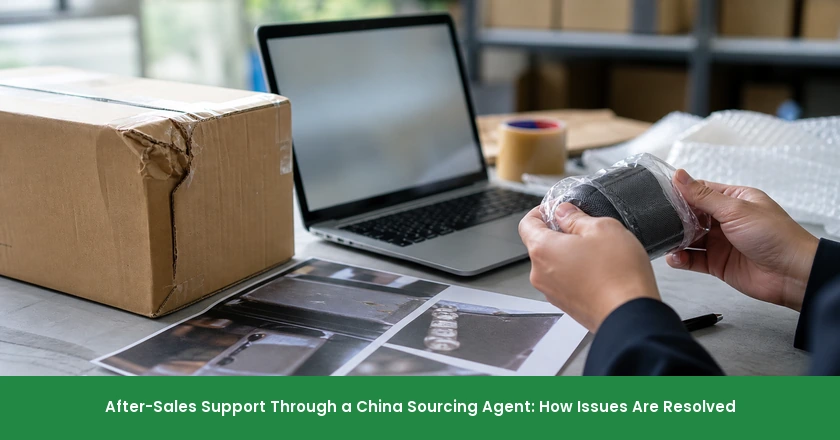
After-sales problems in China sourcing rarely arrive as one neat event. A buyer may see customer complaints, missing parts, broken packaging, a labeling error, a color mismatch, late cartons, weak spare-part support, or a product defect that appears only after use. The question is not only who is responsible. The urgent question is how quickly the issue can be documented, traced, negotiated, corrected, and prevented from repeating.
A China sourcing agent can be valuable after shipment because the agent is close to the factory, language, production records, inspection evidence, and local logistics options. The best support is not a vague promise to "help if anything happens." It is a structured process: capture evidence, classify the issue, isolate the affected batch, communicate with the factory, check the root cause, negotiate a remedy, and update the buyer until the case is closed.
Key Takeaways
- After-sales support is evidence work: photos, videos, batch numbers, inspection records, order files, packaging marks, customer reports, and shipment documents must be organized before a factory can act.
- A sourcing agent adds value through China-side execution: local communication, factory follow-up, corrective-action pressure, replacement coordination, and logistics support are difficult to run from overseas time zones alone.
- Not every issue has the same remedy: rework, spare parts, replacements, credit notes, discounts, refunds, testing, recalls, and future-order controls depend on severity and proof.
- NewBuyingAgent's role is strongest when after-sales support connects to the original sourcing file: product specs, sample approvals, quality-control records, production progress, and shipment data make resolution faster.
After-Sales Support Starts Before the Problem Appears
Good after-sales support begins during sourcing, not after a complaint arrives. If a buyer has no confirmed product specification, no sample approval record, no packaging file, no inspection checklist, no accepted defect limit, and no clear shipment document trail, the after-sales case becomes an argument. If those records exist, the issue becomes a managed investigation.
International quality frameworks support this logic. ISO 10002 addresses complaint handling in organizations, while ISO 9001:2015 frames quality management around meeting customer and applicable requirements consistently. In sourcing terms, that means the agent should help preserve the order evidence needed to judge whether a complaint is a design issue, factory issue, packaging issue, logistics issue, user misuse, documentation gap, or mixed case.
Commercial rules matter too. ICC Incoterms rules affect when cost and risk transfer between seller and buyer. That does not solve every after-sales dispute, but it helps separate product responsibility from shipping responsibility. A cracked carton at destination, a missing accessory in sealed packaging, and a product that fails in use may require different evidence and different negotiations.
For NewBuyingAgent, the after-sales advantage comes from connecting the original order file to local China execution. When buyers provide product requirements, quantity, target price, destination, and timing, the sourcing process can preserve the evidence later needed for problem solving. If the buyer already works with a factory, NewBuyingAgent can support China-side communication, production progress follow-up, inspection evidence, and real-time reporting so that issue resolution has a factual base.
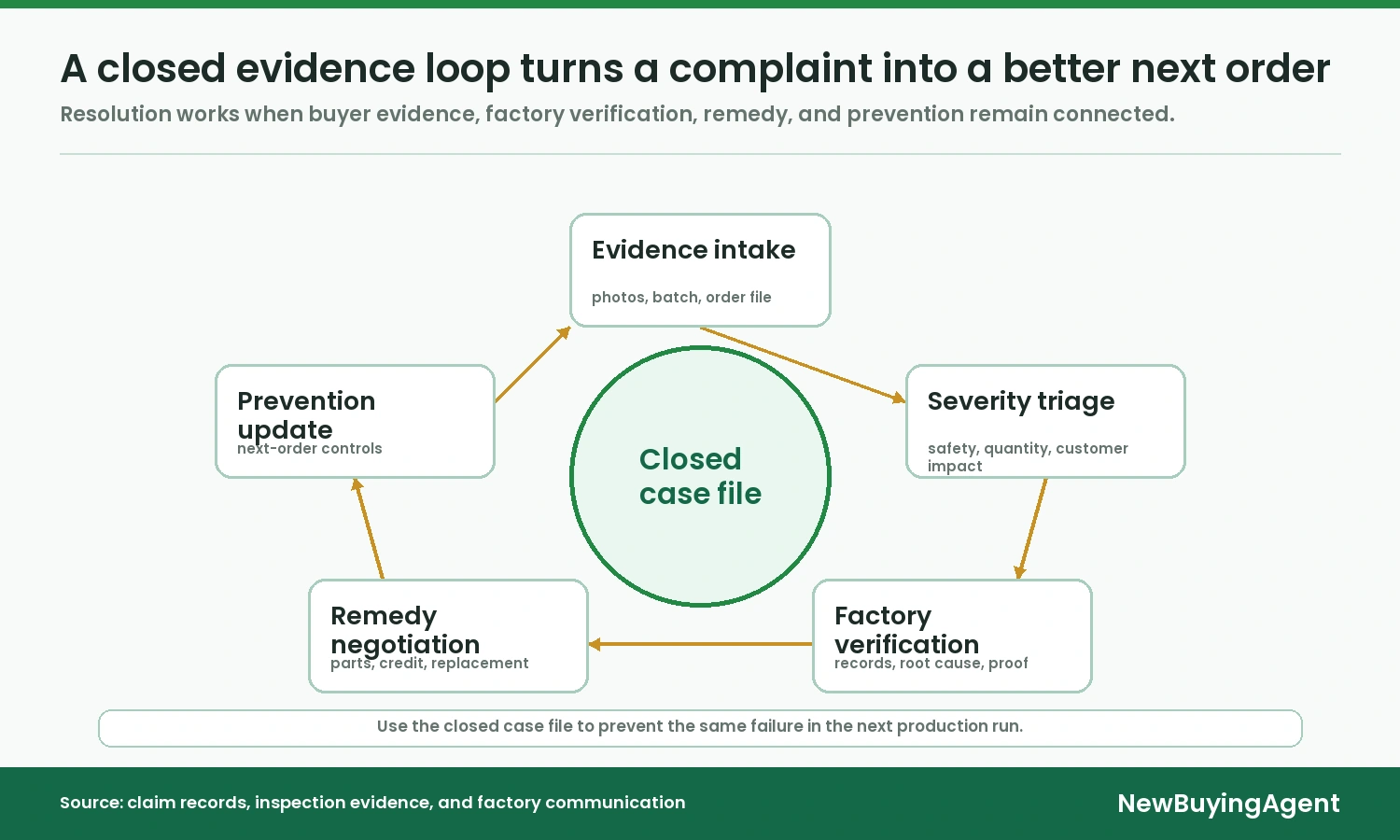
After-sales support works best as a closed loop: evidence intake, severity triage, factory verification, negotiated remedy, and prevention for the next order.
The Issue Resolution Workflow
1. Capture Evidence Before Assigning Blame
The first step is evidence intake. The buyer should send the sourcing agent order number, product model, batch or carton marks, photos, videos, customer complaint examples, quantities affected, warehouse receiving notes, and any platform or retailer notice. The agent should compare those records with the sample approval file, purchase order, packaging artwork, inspection report, loading photos, invoice, packing list, and shipping documents.
This step prevents a common mistake: negotiating from emotion before facts are clear. A factory may reject a vague complaint, but it is harder to ignore a structured evidence file showing model number, batch identity, defect photos, affected quantity, and inspection comparison. Good evidence also protects the buyer when multiple parties are involved, such as factory, trading company, forwarder, warehouse, marketplace, and final customer.
2. Classify Severity and Contain the Risk
Not all after-sales issues deserve the same response. A small packaging typo, a missing screw bag, a safety-related defect, and a possible recall risk require different escalation. The sourcing agent should classify the issue by severity, affected quantity, customer impact, safety impact, marketplace impact, legal exposure, and whether goods are still in transit, in a warehouse, or already sold.
For consumer products, safety escalation can be serious. The U.S. Consumer Product Safety Commission recall guidance explains business responsibilities around corrective action and recalls for unsafe products. A sourcing agent does not replace legal counsel or regulator communication, but the agent can help gather factory evidence, production records, parts information, and replacement logistics needed for the buyer's response.
3. Verify the Factory Side of the Story
Once the issue is classified, the sourcing agent should contact the factory with a concise case file. The factory should be asked to check production records, material batches, worker station records, outgoing inspection data, packaging line records, test reports, and any subcontracted process. If the factory claims the goods were correct at shipment, the agent should request evidence rather than accept a verbal answer.
Factory-side verification should be time-bound. The agent can set a response window, define the documents needed, and ask for a root-cause statement. If needed, the agent can visit the factory, arrange third-party inspection, check remaining inventory, or inspect spare parts. The goal is not confrontation for its own sake; it is to convert the complaint into a factual case that can support a remedy.
4. Negotiate the Remedy That Matches the Loss
After the root cause is understood, the sourcing agent helps negotiate a remedy. Options may include replacement parts, repair instructions, rework, free replacements, partial credit, refund, discount on future order, expedited production, additional inspection, or packaging redesign. The right remedy depends on the evidence, contract terms, severity, cost, and the buyer's immediate customer obligations.
Warranty and payment rules can affect the discussion. The FTC's guide to federal warranty law is relevant when buyers make warranty promises in the U.S. market, and Trade.gov's payment problems guidance explains dispute pressure points in international transactions. A sourcing agent should not invent legal rights, but it should help the buyer preserve evidence and negotiate in a commercially practical way.
5. Close the Loop With Corrective Action
After a remedy is agreed, the agent should push for corrective action. That means identifying what will change before the next production run: material control, mold adjustment, worker training, packaging reinforcement, accessory counting, label approval, function testing, final inspection criteria, or shipping protection. If the factory only sends replacements without changing the cause, the same problem can return in the next batch.
The closure file should include the complaint summary, evidence list, factory response, root cause, agreed remedy, timeline, shipment plan, and prevention measures. For recurring buyers, that file should feed directly into the next purchase order and inspection checklist. After-sales support is successful only when the buyer can ship the next order with less risk.
| Issue type | Evidence needed | Common resolution path |
|---|---|---|
| Wrong specification or color | Approved sample, order spec, photos, model number, and production batch | Factory verification, replacement, credit, or future-order correction |
| Missing parts or accessories | Packing list, accessory count standard, carton photos, customer reports, and warehouse notes | Spare-part shipment, accessory counting control, and next-batch inspection update |
| Functional defect | Videos, test conditions, inspection records, affected quantity, and product history | Root-cause check, rework, replacement, testing, or corrective action |
| Packaging or transit damage | Carton photos, loading photos, warehouse receiving notes, and shipping route | Packaging redesign, carrier claim support, carton reinforcement, or replacement goods |
Where a China Sourcing Agent Adds the Most Value
A sourcing agent adds the most value when the issue requires local factory pressure and evidence interpretation. Overseas buyers can send emails, but time-zone gaps, language differences, relationship distance, and limited factory visibility can slow the case. A China-side agent can ask specific production questions, compare factory claims with inspection records, and keep the factory focused on a remedy.
NewBuyingAgent can be especially useful when after-sales issues intersect with product development, quality-control resources, local factory options, and logistics coordination. If the original factory is responsive, the team can work toward correction. If the factory is not responsive, the team can use broader China factory resources to assess alternatives for the next batch. The point is not to promise that every dispute ends perfectly. The point is to create a practical path from problem evidence to buyer decision.
The agent is also valuable when an issue spans several functions. A missing part may require factory records, spare-part production, courier options, carton marking, warehouse instructions, and customer-service timing. A packaging failure may require carton testing, material change, master carton redesign, and freight handling review. A label issue may require artwork correction, factory rework, marketplace document updates, and new inspection photos. Coordinating those pieces is difficult if the buyer has no China-side partner.
What Buyers Should Prepare for Faster Resolution
Buyers can improve after-sales outcomes by preparing a clean issue file. The file should include order number, product name, model, purchase order, photos, videos, defect quantity, total quantity, customer complaint examples, platform notice if applicable, carton marks, warehouse receiving notes, and the remedy requested. If the buyer has already promised replacement or refund terms to customers, that should also be stated so the sourcing agent understands the urgency.
It helps to separate facts from assumptions. "Twenty out of 600 units have broken hinges after two weeks of use" is stronger than "many customers say the product is bad." "Carton 18 and carton 22 arrived crushed at the warehouse" is stronger than "shipping was careless." A precise case file lets the sourcing agent push the factory with evidence instead of asking the factory to interpret scattered complaints.
Buyers should also keep after-sales clauses practical in sourcing agreements. They can define spare-part support, defect reporting windows, acceptable evidence formats, factory response time, replacement responsibility, packaging redesign responsibility, and inspection changes after a confirmed defect. These clauses do not eliminate every dispute, but they make resolution faster because the agent and factory have a shared reference.
Limits Buyers Should Understand
A China sourcing agent can help collect evidence, communicate with the factory, negotiate remedies, coordinate replacements, and improve the next production run. The agent cannot erase all commercial risk, force an impossible refund without evidence, replace destination-market legal advice, or act as a regulator. Buyers should treat after-sales support as a risk-reduction system, not as a guarantee that every product problem becomes cost-free.
There are also cases where the buyer's own commitments matter. If a buyer changed the product after testing, sold into a market without checking local requirements, promised a warranty without planning service parts, or approved weak packaging to save cost, the remedy may be shared or limited. A fair after-sales process should identify the true cause, not assign blame automatically.
The strongest sourcing relationship is therefore built before, during, and after production. The same evidence that supports quotation, sampling, inspection, and shipping should also support after-sales resolution. When that continuity exists, the buyer can respond faster, negotiate with more leverage, and reduce repeated problems in future orders.
Frequently Asked Questions
Can a China sourcing agent get a refund from the factory after shipment?
Sometimes, but it depends on the evidence, contract terms, factory responsibility, defect severity, and commercial relationship. A sourcing agent can organize the case, communicate locally, and negotiate a remedy such as refund, credit, replacement, spare parts, or future-order compensation. Strong evidence improves the buyer's position.
What evidence should I send when reporting an after-sales issue?
Send order number, product model, affected quantity, total quantity, photos, videos, carton marks, batch information, customer complaints, warehouse notes, and the requested remedy. If the issue affects safety, marketplace compliance, or customer warranties, flag that urgency immediately.
Does after-sales support cover logistics damage?
It can support the investigation, but responsibility depends on packaging, loading evidence, shipping terms, carrier handling, insurance, and receiving records. A sourcing agent can compare carton design, loading photos, warehouse notes, and Incoterms responsibility to help the buyer decide whether to pursue factory correction, carrier claim support, or packaging improvement.
How does NewBuyingAgent help after a product problem appears?
NewBuyingAgent helps by organizing evidence, communicating with the China-side factory, checking production and inspection records, negotiating a practical remedy, coordinating replacement or spare-part options, and feeding the findings into the next order's quality-control plan. That keeps after-sales support connected to real sourcing execution.
NewBuyingAgent
Related Resources


Начните сегодня
Давайте превратим ваши цели по закупкам в реальностьWeChat:+86 15157124615
WhatsApp:+86 15157124615
Адрес: Здание 10 #39 Xiangyuan Road, Ханчжоу, Китай
