


A supplier rebid reopens competition for an existing purchasing requirement. It tests whether another supplier can offer a better combination of capability, quality, delivery and cost; it does not, by itself, authorize moving production.
Rebid when the required capability or commercial fit is missing and a credible repair cannot close the gap. Stay and repair when the cause is understood, the supplier can correct it, and the improvement can be verified. For buyers sourcing from China, the difficult part is often protecting current orders while discovering which of those conditions actually applies.
Repair the Cause, Rebid the Capability Gap
Repair is worth pursuing when a correctable cause has a credible owner and evidence of improvement can follow. Rebidding becomes useful when the supplier’s capability or commercial offer no longer fits the requirement, rather than merely because a conversation went badly. Keep the safety and acceptability of current supply separate from the choice about future business.
- Diagnose before allocating blame: compare the failure with the approved specification and the buyer’s own changes.
- Make recovery testable: require a cause, corrective action, responsible person and evidence-based review point.
- Compare complete alternatives: account for repair, qualification, transition and ongoing operating costs.
- Separate product scopes: a factory may remain suitable for an established range but not a new variant.
A Supplier Rebid Is Not an Immediate Replacement
A rebid can test alternatives while the current supplier continues delivering acceptable orders. Procurement should distinguish permission to seek offers from the decision to award business and the later decision to transfer production. Those decisions need different evidence: comparable bids reveal commercial options, but they do not establish that a new factory can reliably make the product.
The CIPS procurement cycle places market testing before tender evaluation and contract award. That distinction is useful when management asks for “a new supplier” before anyone has defined the actual shortfall. The first useful output may be a tested cost assumption or a clearer capacity requirement, not a replacement order.
Write down what the competition is intended to resolve. Is the existing factory unable to hold a tolerance, unwilling to reserve capacity, or quoting a price that no longer makes sense for the order mix? Give candidates the same specification revision, quantity assumptions, packing requirements, delivery basis and acceptance criteria. Otherwise, a cheaper offer may simply remove something the incumbent was expected to provide.
Do not announce a transfer date on the strength of an attractive quotation. Set a decision point after the alternative’s capability and transition requirements are understood, with a separate owner for keeping current supply under control.
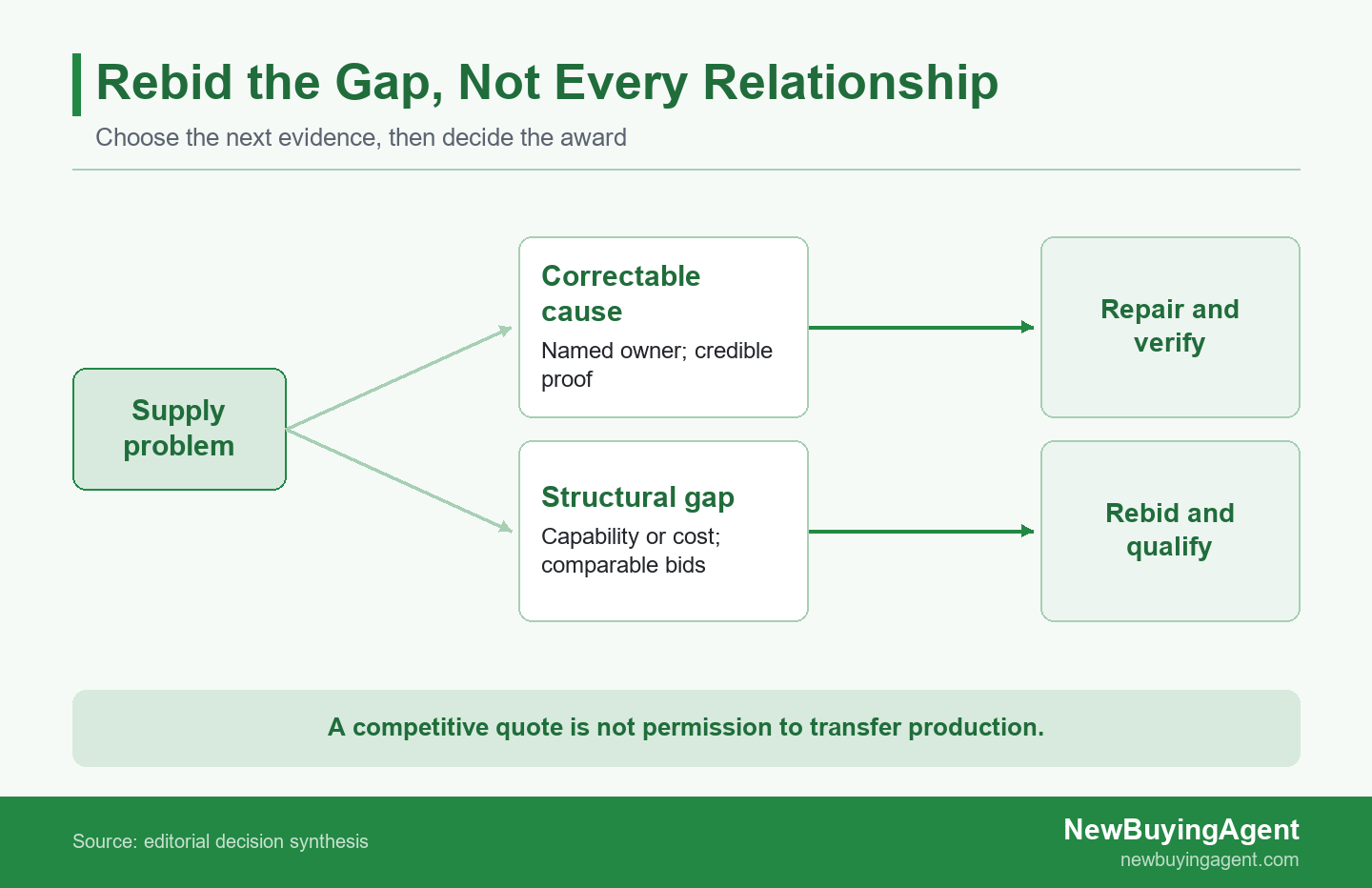
Supplier problem branches into verified repair or competitive rebidding, with production transfer requiring its own readiness check
Check Whether the Supplier—or the Buying Process—Needs Repair
Assess both parties against the same approved requirements before deciding who must change. A missed delivery after a late artwork approval is different from a missed delivery against an unchanged, accepted schedule. This distinction does not excuse supplier failures; it identifies whether changing factories would remove the cause or merely carry the same buying-process problem into another relationship.
Remove Buyer-Caused Friction First
Late approvals, conflicting revisions and order changes that cannot fit the production window can create the same failure at the next supplier. Check when the factory received the final drawing, who approved deviations and whether the promised date was reconfirmed after the scope changed. Separate documented supplier commitments from dates that only existed in the buyer’s internal plan.
New Zealand Government Procurement identifies joint delivery and problem-solving as a factor in successful supplier relationships. In practice, that means the recovery conversation needs buyer-owned actions as well as factory actions. An engineering approval waiting in your inbox is not something the production supervisor can fix.
Give one buyer-side owner authority to resolve conflicting instructions. Ask the supplier to flag feasibility problems before accepting a change, and record the agreed effect on cost and timing. If the supplier knew a commitment was impossible but accepted it without qualification, that remains a supplier issue. A fair diagnosis can identify shared responsibility without dissolving accountability.
Give a Credible Supplier a Bounded Recovery Plan
A credible recovery plan connects an evidenced cause to a corrective action, a responsible owner and resources to implement the change. It also identifies an opportunity to verify the result before the buyer increases exposure. “We will pay more attention” is not enough: procurement needs to know what will operate differently and how that difference will be checked.
Repair is more attractive when the factory has previously met the same requirement, the failure is traceable to a bounded change, and management is willing to expose the relevant production evidence. Examples include restoring a missed maintenance control or correcting an approved packing instruction. A new machine, different material system or substantially higher output rate may require a more demanding capability decision.
ASQ’s corrective-action method distinguishes implementing the change from verifying its effectiveness. Agree the verification method, acceptance criteria and reviewer before the trial. Choose a review point that reflects the production opportunity and product risk, not a universal number of days or orders. If the promised evidence is missing, do not quietly convert the trial into normal replenishment.
When the factory remains technically suitable but China-side follow-up is weak, NewBuyingAgent’s product development and quality-control capability can support closer production visibility. Its existing-factory management service combines local supplier communication with production progress and pre-production, in-process and final-stage inspections. That gives buyers a practical route to manage the retained factory while checking whether agreed changes reach actual production.
Rebid When the Required Capability or Trust Is Missing
Rebid when the gap appears structural rather than a correctable execution problem. Persistent process limits, commercial terms that remain unsupported after clarification, or unreliable records can make further recovery requests a poor use of time. The trigger is the evidence and consequence of the mismatch, not a fixed count of complaints or the length of the relationship.
| Decision factor | Repair is more credible | Rebid is more useful |
|---|---|---|
| Capability | Proven process; bounded breakdown | Required process or capacity is missing |
| Response | Cause, owner and test are specific | Repeated promises without usable evidence |
| Economics | Cost drivers can be explained and changed | Comparable offers expose a persistent gap |
| Records | Relevant production history is traceable | Material records are unreliable or withheld |
Start by defining the required outcome, not demanding that the factory become a different business. A supplier serving stable repeat orders may not have the equipment, engineering support or scheduling flexibility needed for your new range. It can be a good supplier for its original scope and the wrong supplier for the expansion.
New Zealand Government Procurement recommends addressing performance problems promptly and keeping a written record of discussions in its performance-management guidance. Preserve the failed requirement, the supplier’s explanation and what the agreed remedy achieved. If suspected falsification or unsafe product is involved, escalate the affected supply immediately; do not wait for an ordinary price competition to finish. Contract remedies and product obligations need the appropriate specialist review.
For a requirement that exceeds the incumbent’s capability, NewBuyingAgent’s local China factory network and industrial-cluster sourcing access provide a different route to product supply. Its product-supply service can use the buyer’s specifications and quality requirements to guide factory matching, product selection and quotation. The purchasing brief should identify the capability gap explicitly, so the next offer addresses the problem rather than only undercutting the current unit price.
Compare the Cost of Repair with the Cost of Transition
Compare future costs over the same quantity and planning period, including the cost of repairing the incumbent and the cost of changing supply. A lower unit price is only one input. Normalize what each offer includes, then examine whether the expected advantage survives qualification expenses, transition work and differences in ongoing quality, delivery and working-capital requirements.
New Zealand Government Procurement’s total-cost guidance includes handover, transition and re-tendering effort among costs to consider. For a product order, build your own relevant list: sample development, testing, tooling transfer or duplication, engineering time, additional inspection, overlapping inventory and freight changes. Do not assume that the new factory’s quote includes any of these unless the offer says so.
Consider an illustrative annual requirement of 20,000 units. A qualified alternative is USD 0.40 cheaper per unit on the same delivery and quality basis, giving USD 8,000 in annual purchase-price savings. If transition costs are USD 9,000 while the incumbent needs USD 2,000 of future repair work, changing adds USD 7,000 in initial costs relative to repair. The initial net advantage is therefore only USD 1,000, before remaining operating differences and uncertainty.
That is a comparison to investigate, not an automatic approval. A tooling delay or extra verification round could consume the apparent advantage; a documented reduction in recurring rework could increase it. Ask finance and operations to test the assumptions most likely to change the answer. Use a lower-volume case if the annual forecast is uncertain, and avoid counting the same freight or inspection expense twice.
Past spending that cannot be recovered should not, by itself, justify staying. Still-recoverable tooling, usable inventory and outstanding commitments are different: their future value and obligations affect the decision. Keep unacceptable safety or conformity risk outside a simple savings trade-off. A cheap route that cannot meet the required product standard is not a commercially equivalent alternative.
Run Repair and Rebidding in Parallel When Continuity Is at Risk
A controlled parallel approach can preserve usable incumbent capacity while another supplier is assessed for the requirement the incumbent cannot reliably meet. It works only when product scope, order commitments and acceptance decisions remain clear. Budget the extra qualification work and identify who controls allocation, so parallel activity does not become duplicate purchasing or competing versions of the specification.
Illustrative Scenario: Keep the Standard Range, Rebid the New Variant
In an illustrative 6,000-unit metal desk-organizer order, a new 2,000-unit variant exposes a fixture limitation while the established 4,000-unit range remains within the proven process. A retail buyer has added narrower slots to the design. The approved presentation sample looks acceptable, but it was not enough to show that the factory could repeat the new geometry during normal production.
The pilot shows slot distortion, and the fixture review finds that the fixture does not consistently support the new geometry. Records distinguish the new variant from the standard range; the standard product’s existing production evidence remains relevant to that unchanged scope. The buyer’s inference is a variant-specific capability limitation, not proof that every product from the factory has become unreliable. The affected variant still requires its own acceptance decision.
Procurement keeps the standard range with the incumbent, subject to its normal acceptance controls, and opens a rebid for the new variant. Engineering separates the drawings and acceptance requirements so candidates quote the actual narrow-slot design. Meanwhile, the incumbent can propose a revised fixture, with a technical owner, funding and a credible trial schedule. Procurement limits commitments while comparing that repair route with the cost and readiness of an alternative.
Neither a revised fixture drawing nor a cheaper bid wins the remaining volume by itself. A representative production run and dimensional checks against the agreed criteria must show whether the new variant can be made consistently enough for the planned supply. If the incumbent demonstrates recovery, the buyer can reconsider allocation; if not, a qualified alternative may take the variant. This is an illustrative decision, not a reported client result or permission to release unverified units. It shows why supplier-level labels such as “keep” or “replace” can be too broad.
Before You Award New Business, Check the Handover
A successful bid is not an executable production transfer until qualification, outstanding commitments and handover requirements are understood. Confirm access to approved specifications, samples and production assets, then identify what stock and open orders remain with the incumbent. Match the transfer plan to realistic alternative capacity and the buyer’s inventory position, rather than assuming both factories can change over immediately.
New Zealand Government Procurement’s transition guidance calls for attention to risks, resources, responsibilities and handover communications. Apply that planning discipline to named purchasing actions: who reconciles work in progress, who confirms tooling availability, who approves the first production run, and who informs logistics of the revised pickup plan. Review termination and confidentiality obligations with qualified advisers where needed.
If the capability review points to a new product-supply requirement, prepare the product specification, quantity, target price, packing requirements, destination, delivery timing and unresolved quality concerns. NewBuyingAgent can use its local factory resources and product/QC capability to quote and supply against that brief. To discuss a quotation aligned with those requirements, request a product quote from NewBuyingAgent.
FAQ: Supplier Rebidding and Relationship Decisions
Should I rebid every year?
No universal annual schedule fits every supply relationship. Review competition when the requirement, market, cost structure or supplier performance changes enough to justify it, while following any applicable purchasing policy. A stable, low-risk arrangement may need benchmarking rather than a full tender. Include the time suppliers and your team spend preparing offers; repeated competitions with no realistic prospect of an award can reduce their value.
Should the incumbent be invited to bid?
Usually, if it remains eligible and can meet the same requirements. Give the incumbent the same scope and evaluation criteria as other candidates, while protecting confidential information from competing offers. Its known production performance is relevant evidence, but familiarity should not excuse a capability gap. If the decision has already been made to exclude it, do not run a nominal competition that implies otherwise.
What if the factory controls the tooling?
Resolve tooling access and transfer rights before assuming that another factory can use it. Physical possession, contractual ownership, outstanding charges and the tool’s condition are separate questions. Review the relevant agreements with qualified advisers and confirm what can actually be transferred. If duplication is necessary, include its cost and lead time in the alternative plan instead of treating the existing tool as immediately available.
Can better payment terms justify staying?
They can influence the commercial comparison, but they cannot compensate for unacceptable product risk. Compare when cash leaves the business, any financing cost and the reliability of the offered terms alongside price and quality. Distinguish an existing arrangement from a concession that has only been discussed. Staying can be commercially sensible when the total package remains competitive and the supplier can still meet the required product and delivery conditions.
NewBuyingAgent
Related Resources


Get Started Today
Let's Turn Your Sourcing Goals into RealityWeChat:+86 15157124615
WhatsApp:+86 15157124615
Address:Building 10 #39 Xiangyuan Road, Hangzhou, China
