

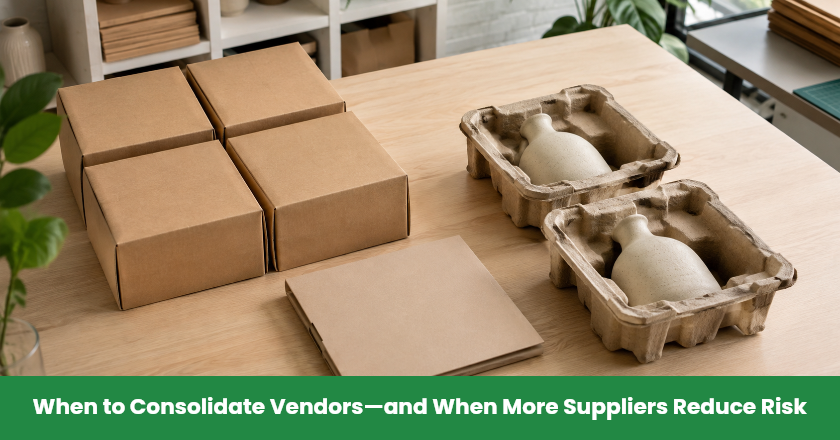
A shorter vendor list is useful only if the business keeps the capability it needs. Combining routine purchases can reduce duplicate ordering and improve pricing, but moving unrelated products into one factory can discard specialist knowledge and make future changes harder. The practical choice is not simply fewer suppliers versus more suppliers. It is which relationships create avoidable work, which sources contribute something difficult to replace, and whether the proposed change still saves money after qualification and transition costs.
Consolidate Duplicate Work, Preserve Useful Capability
Consolidate vendors when equivalent supply costs less overall; retain more suppliers when they preserve a needed capability or usable alternative. Removing duplicate purchasing work can improve efficiency, while removing a specialist may create replacement costs that exceed the discount. Approve consolidation by qualified product family, and require each additional supplier to solve a specific operating or risk problem.
- Common mistake: Counting commercial accounts as if each represented an independent factory.
- Cost comparison: Separate recurring savings from one-time migration spending and work that merely changes hands.
- Risk: An extra supplier helps only when its capability is useful and its relevant failure exposure differs.
- Decision: Consolidate routine categories selectively; keep specialist requirements and exit information intact.
Fewer Vendor Accounts Does Not Have to Mean Fewer Factories
Commercial consolidation can reduce buyer-facing contacts while preserving separate specialist production sources. A purchasing business may place orders through one commercial interface that arranges different factories for cartons, protective inserts and print finishing. That simplifies a relationship layer, but it does not automatically change how many production locations exist, what they can make, or how easily the buyer could replace them.
Vendor consolidation means combining purchases under fewer commercial supplier relationships. Supplier rationalization is the broader review of which relationships to retain, combine, develop or stop using. Neither exercise should begin with an arbitrary target for the smallest possible list.
NIST describes supply chains as including multiple material tiers, service providers and logistics specialists in its supply-chain management guidance. The implication for a buyer is to record both the entity receiving the order and the production capability behind it. Changing the payee is not the same decision as moving the work.
For example, a packaging assortment could retain separate carton, insert and print-finishing specialists while routing commercial coordination through one provider. Ask which sources remain, who approves substitutions, how their performance stays visible, and what information remains available if the commercial relationship ends. The arrangement reduces contacts only if it genuinely removes coordination work; otherwise, it adds an intermediary without removing the buyer's original burden.
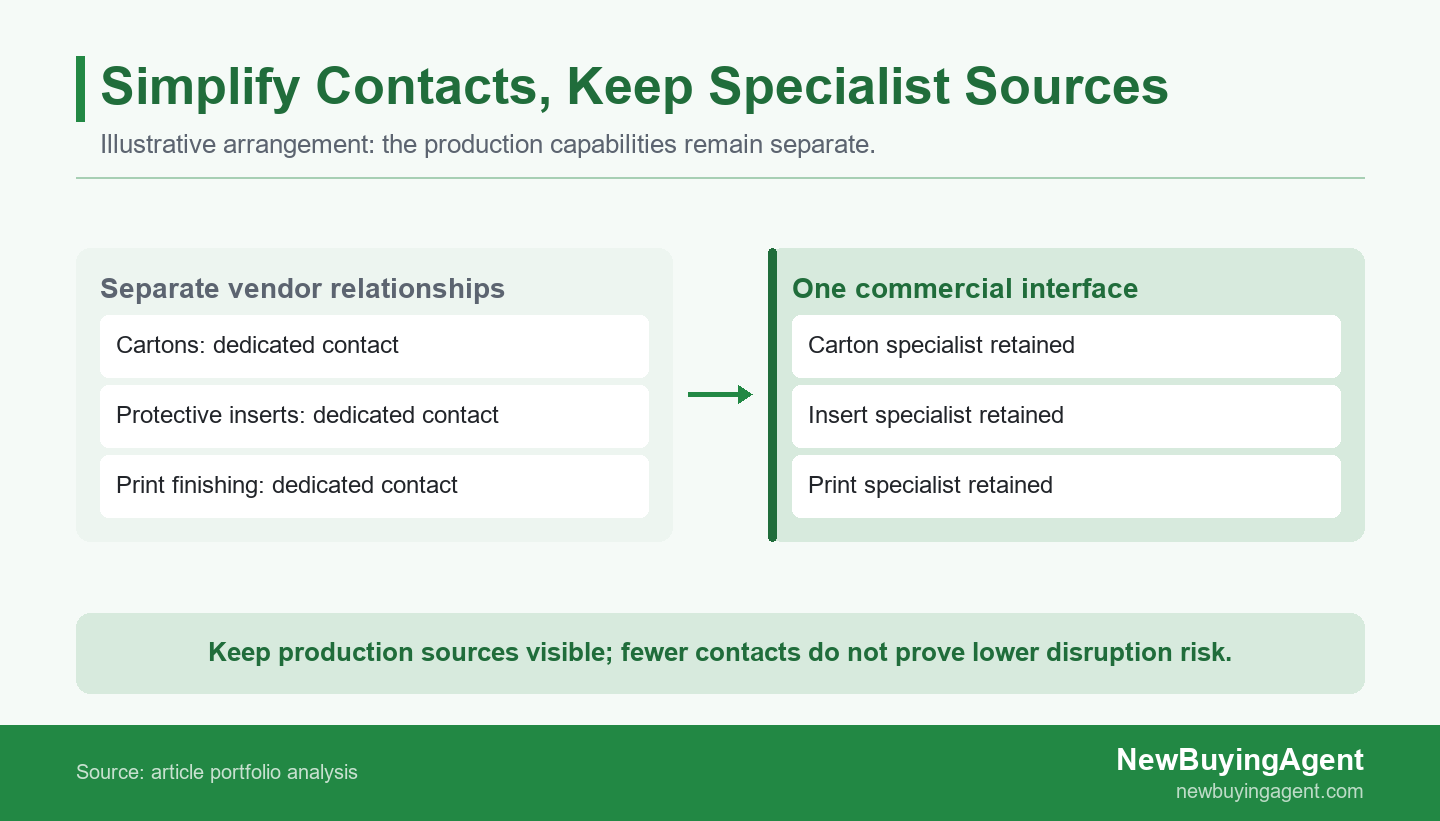
Commercial consolidation reduces buyer contacts while retaining separate carton, insert and print-finishing specialists
When Vendor Consolidation Improves the Purchase
Consolidation is strongest where specifications are interchangeable, demand is repeatable and the remaining supplier can serve the combined workload. Routine items purchased through several overlapping relationships are better candidates than products that merely share a catalogue heading. Before negotiating combined volume, establish that the receiving supplier can meet the same product requirements and identify a real reduction in purchasing or production work.
A useful starting category has stable drawings, predictable replenishment and little supplier-specific development. The business can compare the current and proposed arrangement on the same quality and delivery basis. Conversely, a frequent design-change category needs a capability review before anyone promises that aggregation will improve price.
Confirm the Products Are Truly Interchangeable
Similar product names do not establish equivalent materials, processes or acceptance criteria. Two display cartons may differ in board structure, coating, print tolerance and packing-line behavior. If the proposed common source changes any of those features, the exercise includes product requalification, not just a commercial negotiation.
NIST advises buyers to examine supplier capabilities, quality documentation and production capacity rather than only unit price in its supplier-selection guidance. Apply that distinction to the combined scope: engineering checks the process, quality confirms the acceptance criteria, and procurement verifies the workload the supplier is actually accepting.
Group products by the process and requirements that make them interchangeable. Do not assume a passed sample for one material qualifies a different family. If the new supplier needs unfamiliar equipment, outsourced finishing or new tooling, price those changes and evaluate the actual production arrangement before including the category in a consolidation award.
Check the Work That Will Actually Disappear
A consolidation saving is credible only when duplicate transactions or production costs actually disappear. Fewer invoices may reduce accounts-payable work, but quality checks, product approvals and shipment coordination may still be necessary. Distinguish an eliminated task from a task transferred to another department or included in a provider's quotation.
Record the current order-handling effort and the proposed replacement arrangement. Combined volume may support a better production run, but minimum quantities, storage and replenishment constraints can offset that benefit. Time released for other work is an operational benefit; it is not automatically a cash saving unless an expense is genuinely removed.
For buyers building a multicategory China purchase, NewBuyingAgent's product-supply service offers a route from product requirements to quoted supply. Its local China factory resources and industrial-cluster access support sourcing across different product families. Buyers can request a coordinated product offer without assuming that one factory should manufacture every item in the assortment.
When More Suppliers Earn Their Place
Keep a specialist or qualified alternative when its distinct process, responsiveness or independence solves a specific supply problem. A low-spend source may contribute a difficult finish, material capability or short-run development service that the main supplier cannot reproduce economically. Its value should be assessed against the cost and consequences of replacement, rather than its position near the bottom of a spend report.
NIST describes splitting supply sources to support different cost, responsiveness and customization needs in its discussion of strategic supplier relationships. This supports giving suppliers different jobs: an efficient repeat-production source and a specialist capable of rapid product changes do not necessarily duplicate each other.
The strongest retention reason is concrete. A protective-packaging specialist may understand how a fragile product behaves in transit. A finishing supplier may hold the process knowledge needed for an approved appearance. Retaining that expertise can be cheaper than rebuilding it elsewhere, even when the specialist's unit price is higher. Document the capability and the consequence of losing it, rather than defending the relationship because it is longstanding.
OECD emphasizes understanding supply-chain vulnerabilities and managing risk rather than retreating from international trade in its resilience guidance. At the product-category level, a useful application is to ask which disruption an additional source would actually address. A second sales company using the same critical process does not solve the same problem as a separately qualified production route.
More suppliers can also create inconsistent output, uneconomic order sizes and extra approvals. A dormant quotation is not usable production capacity, and a technically capable alternative may not remain ready without meaningful business. Keep an additional source only with a defined role, a realistic sustaining arrangement and a way to confirm that its capability remains current. If those conditions cannot be met, record the remaining exposure instead of presenting a contact list as protection.
Compare Four Supplier-Portfolio Options
Choose a portfolio arrangement by its operational benefit, retained production capability, management burden and exit condition. A buyer can consolidate routine categories while retaining specialists and developing an alternative for one critical process. These options are therefore compatible building blocks across product families, not mutually exclusive company-wide policies or a ranking of sourcing providers.
The comparison below considers four arrangements against common operating dimensions, assuming the buyer keeps the same product requirements. It is an editorial comparison of methods, not a provider endorsement or measured savings benchmark. Unknown capability or migration cost must be resolved before an arrangement is approved.
| Arrangement | Operational benefit | Production capability | Management burden | Approval condition |
|---|---|---|---|---|
| Consolidate routine categories | Fewer repeated transactions | Equivalent output from fewer sources | Transfer work, then fewer relationships | Positive net benefit; receiving source qualified |
| Retain specialist suppliers | Preserves difficult process knowledge | Distinct expertise remains available | Separate technical and commercial relationships | Documented capability worth its ongoing cost |
| Develop a qualified alternative | Creates a usable switching option | Independent route for defined products | Qualification and readiness maintenance | Alternative addresses the actual failure exposure |
| One interface, multiple sources | Simplifies buyer-facing coordination | Specialist factories can remain separate | Provider oversight and source visibility | Clear substitution control and exit information |
Based on this comparison, consolidate interchangeable routine purchases when the net benefit is positive, retain specialists when their capability matters, and add alternatives only where they can address a defined disruption. Choose one commercial interface when it simplifies coordination without concealing the production sources or making a future transfer impractical.
A decision to retain more factories need not preserve every historical vendor account. Equally, a single-interface arrangement should be rejected if the buyer cannot obtain adequate information about where its products are made. The right structure follows the work and the product requirements, not a purchasing dashboard target.
When existing China factories will remain part of the arrangement, NewBuyingAgent's factory-management service can support production follow-up, quality control and logistics coordination around that retained supply. Its product-development and QC capability is relevant when the buyer needs to keep different category requirements intact during the change. Provide the current orders, approved samples, transfer scope and unresolved quality issues so factory-side work supports the actual purchasing decision.
Calculate Net Savings Before Closing Vendor Accounts
First-year consolidation benefit equals recurring savings minus transition spending and any new recurring costs. Use the same period and product scope for every input, and distinguish cash removed from staff time made available. A lower quotation is only one component; qualification, tooling, excess inventory and changed shipment arrangements can turn an attractive purchasing discount into a weak transition proposal.
ASQ includes transaction, communication, problem-resolution and supplier-switching costs in supplier performance management. Use that wider cost boundary before approving the move. Keep uncertain costs visible as estimates and test what happens if expected handling savings are not realized.
Illustrative Scenario: Consolidating Display-Packaging Suppliers
Consider a hypothetical home-goods importer buying 120,000 packs annually across 6 packaging families from China. Of these, 4 families are routine display cartons and 2 use protective inserts for fragile products. A proposed common vendor offers to take the whole assortment, and the carton drawings are available. However, the insert proposal has only a presentation sample, so the buyer requires a transit trial using production-made inserts before including that scope.
The proposed insert cracks in the transit trial. Four routine carton families meet their specified checks. The buyer therefore calculates consolidation economics for the cartons alone: 4,000 USD in annual price reductions plus 10,000 USD in genuinely removable outsourced handling expense, less 2,000 USD in additional recurring storage and coordination costs. This produces 12,000 USD in annual net recurring savings. Qualification, setup and transfer together are estimated at 8,000 USD; these costs belong to the proposed carton move, not the retained insert business.
In this illustrative example, 12,000 USD annual recurring savings minus 8,000 USD transition costs leaves 4,000 USD first-year benefit. Approve only the four routine carton families; retain the protective-insert specialist. Remove the two insert families from the transfer scope and keep their approved specification and supplier. A blanket award would have bundled a failed technical substitution into an otherwise plausible purchasing improvement.
Before closing the routine-vendor accounts, the buyer must confirm production-scale carton performance, actual setup invoices and first-cycle handling work. The estimate assumes a full year at the new operating level: a delayed transfer reduces first-year savings. If the removable handling expense is only half the estimate, annual net savings fall to 7,000 USD and the first-year result becomes a 1,000 USD cost increase. These are hypothetical inputs, not NewBuyingAgent client results. The decision remains conditional on product performance and actual costs; the smaller vendor list is not the acceptance test.
Move Categories in Stages and Keep an Exit Route
Retire a vendor only after the receiving source demonstrates the transferred scope and the buyer retains the information needed to move again. A controlled transition keeps current supply operating while new output is qualified, then removes the old arrangement when agreed evidence is available. The stopping point is reliable production and an orderly handover, not the date someone deletes an account.
The Cabinet Office's UK Sourcing Playbook calls for joining the outgoing supplier exit plan to the incoming supplier mobilization. That guidance concerns public-service sourcing, not private China purchasing rules, but the operational connection is useful: an incoming supplier's launch plan must account for what the outgoing source still holds or performs.
Assign named owners for drawings, tooling access, approved samples, remaining inventory and open orders. Agree who authorizes the next transfer stage and what result stops it. Avoid simultaneous changes to materials, artwork, factories and shipping arrangements when a narrower move would make failures easier to identify. Keep documents in formats the buyer can access without relying on the departing vendor's systems.
Turn the Portfolio Decision Into a Sourcing Brief
Give each product family a retain, consolidate or develop-alternative decision before asking for a new supply offer. Mark requirements that cannot change, assumptions still awaiting validation and the earliest realistic transfer date. This gives a potential supplier a defined scope to price and prevents an apparently simpler quotation from quietly replacing specialist performance with a different product.
For a consolidated China product purchase, prepare the product specifications, quantities by family, target price, destination and delivery timing, together with any retained-specialist boundaries. Then request a product quotation from NewBuyingAgent. As a one-stop China sourcing agent for global buyers, it uses local factory resources to quote and supply products around those requirements. Compare the resulting offer with the current arrangement on product fit, total cost and deliverability—not simply the number of names on the vendor list.
Frequently Asked Questions
Should dormant vendor accounts be deleted?
Dormant accounts should be reviewed separately from active production sources. Finance may restrict unused accounts to prevent unauthorized purchasing while procurement preserves qualification history and current contact records for genuine alternatives. Check open obligations and record why the account is inactive; an old record alone is neither a reason to keep purchasing nor proof of a ready backup.
Must a second supplier receive half the volume?
No fixed equal split is required to keep an alternative useful. The allocation should support current capability without creating uneconomic minimum orders or excessive inventory. Agree how readiness will be maintained and checked. A supplier receiving no meaningful work may require a fresh production trial before it can safely take a larger allocation.
Can one factory support both premium and budget ranges?
One factory can support both ranges when it can keep their specifications and acceptance criteria distinct. Confirm material identification, production instructions and checks for each range. Shared machinery does not require identical quality requirements, but a buyer should not rely on a product name or packaging change to prevent unintended substitutions between the ranges.
Who should approve an exception to a consolidation target?
An exception should be approved by the people responsible for its cost and product consequences. Procurement records the reason, quality or engineering confirms the capability need, and finance reviews the ongoing premium. Set a review trigger, such as a product redesign or a qualified replacement becoming available, so an exception remains a current business decision rather than permanent habit.
NewBuyingAgent
Related Resources

Get Started Today
Let's Turn Your Sourcing Goals into RealityWeChat:+86 15157124615
WhatsApp:+86 15157124615
Address:Building 10 #39 Xiangyuan Road, Hangzhou, China
