

A dedicated China sourcing account manager is useful when factories, product files, shipment dates, and buyer approvals need one China-side point of accountability. It is not useful merely because one person answers messages quickly. A named contact can still leave an unresolved colour change, price exception, inspection finding, or delivery risk circulating between a factory and a buyer who cannot tell who must act next.
The practical distinction is simple: the manager owns the movement of evidence and the closure path; the buyer keeps the product, commercial, risk-acceptance, and release decisions that have not been explicitly delegated. That boundary gives the buyer a better test than friendliness or response speed. It also keeps a sourcing relationship workable when an exception crosses more than one factory, product record, or deadline.
Before the first material exception, the buyer should agree the role contract, the issue trigger, and the report format that will support the next choice.
Four Tests for a Dedicated Account-Manager Role
A dedicated account-manager role is accountable only when it names the manager's closure duty, the buyer's decision rights, escalation triggers, and a report that turns evidence into a bounded choice.
Use the four tests below when evaluating a China sourcing contact. They work whether the buyer is developing a new product, managing a long-running purchasing program, or retaining existing factories.
- Closure: Does every material exception have a next action, an owner, and a due date?
- Decision rights: Is it clear which product, commercial, quality, or release choices still require buyer approval?
- Issue route: Does the manager know which evidence and impact make an issue urgent enough for a buyer decision?
- Report output: Does the update ask for a specific choice, rather than simply repeat what each factory said?
If any answer is no, the role may still be helpful for communication, but it is not yet an accountable operating role. The buyer should clarify it before an exception has narrowed the available choices.
Define the Role as a Decision Interface, Not a Personal Promise
A dedicated China sourcing account manager should own the movement of evidence, exceptions, and next actions across factories, while the buyer's team retains the approvals it has not explicitly delegated.
In practice, that means the manager keeps the working picture current. They request missing evidence, compare a factory update with the approved record, identify linked dependencies, set the next follow-up, and make sure the buyer can see the decision window. It does not mean the manager silently changes an approved specification, accepts a cost increase, waives a quality requirement, or authorizes shipment.
The GOV.UK Sourcing Playbook describes ownership as leading an activity with overall responsibility for it. Used here as a governance reference, that is a more useful definition than treating ownership as being copied on an email chain.
A short role charter can prevent most ambiguity. It should identify the items the manager follows, the reports the buyer receives, the people who can approve material choices, and the point at which the manager must raise an exception. The charter should be specific to the buyer's product and current supplier network; it is not a generic job description.
A decision right is the person who can approve or reject a product, commercial, quality, or release choice. Naming that person beside each material choice prevents a recommendation from being mistaken for approval.
| Role | Owns | Does not decide by default |
|---|---|---|
| Account manager | Evidence requests, cross-factory follow-up, exception record, escalation, and closure tracking | Unapproved product, cost, risk, or release trade-offs |
| Buyer approver | Product requirement, commercial route, risk acceptance, and release choice | Day-to-day China-side coordination |
| Factory contact | Current production facts, corrective action, and factory confirmation | Buyer approval or cross-factory priority |
| Specialist | Technical, quality, regulatory, freight, or legal input within their remit | Replacing the buyer's named approver |
For a new purchasing need, that role boundary can sit alongside the product brief from the first supplier conversation. Buyers who need China-side support for a defined requirement can use NewBuyingAgent's product-supply service for a defined purchasing need while keeping their own approval map visible.
Separate Coordination Authority From Buyer Decision Rights
A sourcing account manager can gather options and recommend a route, but a buyer should explicitly retain decisions on product requirements, commercial trade-offs, risk acceptance, and release unless those rights are formally delegated.
The U.S. Federal Acquisition Regulation includes production support, surveillance, and status reporting, including timely reporting of potential and actual delivery slippages, among contract-administration functions. That does not turn the person reporting a possible delay into the person who accepts its commercial consequences.
Write down the decision right in plain language: “The manager may recommend a revised inspection date; the buyer's named approver confirms it.” This makes it safer for a manager to act quickly, because raising an issue is no longer confused with authorizing the outcome.
Make the Manager Own Closure, Not Every Specialist Task
The manager should own closure by naming the next action, evidence source, responsible party, and due date for every material exception, even when a technical, commercial, or buyer approver owns the final decision.
Closure is a coordination responsibility, not a claim that one person has every specialist skill. A manager may need a factory engineer to confirm a process change, a buyer's quality lead to interpret an acceptance criterion, or a freight specialist to price a route. The manager's job is to make those dependencies visible and keep the exception from being treated as complete until the agreed evidence and decision have been recorded.
A useful closeout line is concrete: “Factory to provide revised artwork reference by Tuesday; buyer product lead to confirm version B by Wednesday; packaging remains on hold until both are complete.” A vague line such as “factory is checking” has no closure owner and no decision path.
Give Escalations One Owner and a Decision Trigger
Escalate when evidence shows that a change can affect an approved requirement, committed date, cost, quality, or the buyer's release choice; the manager should send the impact and options to the named approver before the decision window closes.
An escalation means raising an issue to the person who can make the next decision. It is not a louder status update. The trigger should be based on impact, not on how many emails have been exchanged or how frustrated a factory contact sounds.
World Bank contract-management guidance calls for escalation procedures for critical situations or bottlenecks and clear reporting procedures with defined level, frequency, templates, and minimum information. A China sourcing team can apply that principle without importing a public-procurement process wholesale: agree the route before the exception arrives.
| If the manager sees | The escalation should include | Likely buyer decision |
|---|---|---|
| A factory changes an approved specification or artwork | Current and proposed versions, affected SKUs, sample or photo, timing effect | Keep, revise, or hold the approved version |
| A production or inspection date may slip | Current milestone, reason, recovery action, revised date, shipment effect | Accept the revised plan, expedite, split, or hold |
| A quality finding affects an agreed requirement | Finding, affected scope, photos or record, containment action, recheck date | Rework, reinspect, accept a documented route, or stop release |
| A cost or MOQ change alters the purchase case | Supplier explanation, costed options, quantity impact, deadline | Approve, renegotiate, revise quantity, or select another route |
One owner should send the escalation and chase the response, but the report should still show the action owner for each component. That distinction matters when the manager needs information from a factory, a sample decision from the buyer, and a logistics update from another party at the same time.
Where the buyer keeps established supplier relationships, this same structure applies. The need is not to replace the factories; it is to make their evidence and exceptions comparable. Buyers can see how NewBuyingAgent manages existing China factories when they need that China-side follow-up path.
Ask for Reports That Make a Decision Possible
A decision-ready report contains the current evidence, the buyer impact, the proposed action, the named action owner and date, and the exact decision needed. It makes the relevant risk visible before the buyer chooses a route.
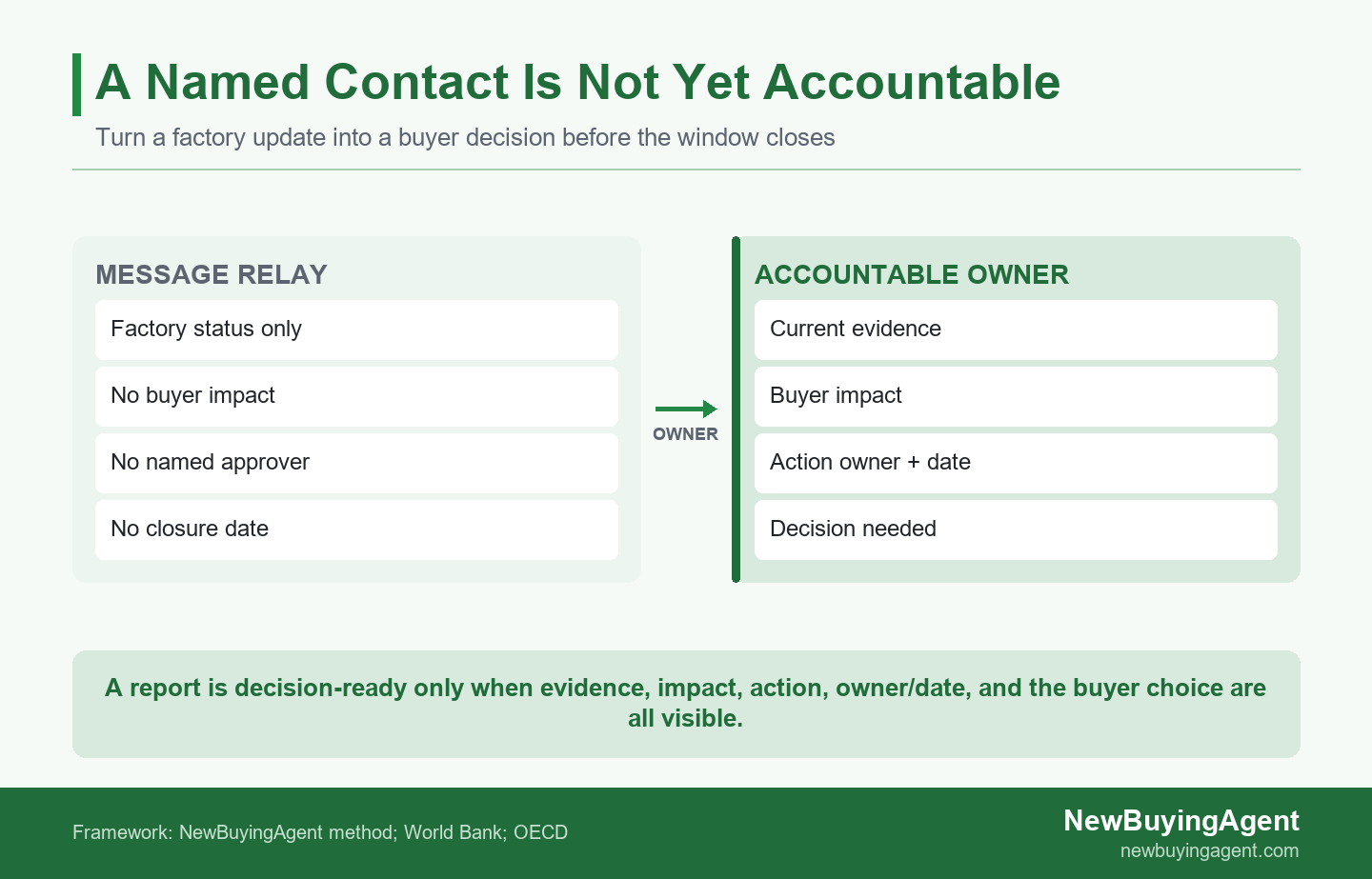
Before-and-after diagram showing a factory status update becoming a decision-ready sourcing report
A report is not decision-ready just because it is detailed. It needs to reduce uncertainty for the buyer who must decide. A photo without a reference version, a shipment date without an affected-order list, or a “please advise” message without options may describe activity, but it does not make the next move clear.
World Bank borrower procurement guidance says to finalize a contract management plan and implement monitoring, evaluation, and payment systems. For a buyer's account-manager report, the transferable lesson is to make the action and its follow-through visible rather than leave an exception as a one-off message.
| Report field | What the buyer needs to see |
|---|---|
| Evidence | The current factory record, photo, sample reference, inspection finding, or date confirmation |
| Buyer impact | The effect on the approved product, order, cost, quality, delivery date, or release condition |
| Recommended action | A realistic next route, plus what it changes |
| Action owner and date | Who supplies the next evidence or completes the next action, and by when |
| Decision needed | The named buyer choice and the deadline for making it |
The five fields are deliberately compact. If one is missing, return the update with a clear question. That is not administrative friction; it protects the buyer from making a product or release decision from an incomplete picture.
Illustrative Scenario: A Colour Change Across Three Factories
In the illustrative 2,400-set kitchen-accessory launch, a post-PO handle-colour request becomes a buyer-level exception because it crosses the tool factory, packaging sleeve, display carton, and inspection window.
The Manager Escalates the Impact; the Buyer Approves the Route
The illustrated manager should present the verified impact and keep affected artwork on hold; the buyer should approve the original version, a revised version and date, or a split route after reviewing that evidence.
This is an illustrative scenario, not a reported NewBuyingAgent client result. A retailer has ordered 2,400 kitchen-accessory sets made by three China factories: silicone tools, packaging sleeves, and a display carton. For record matching, that order is 2400 sets across 3 factories.
The buyer asks for a new handle colour after the POs are issued and twelve days before the planned inspection window.
The tool factory can make the change, but the packaging factory has an earlier artwork version and the carton factory needs confirmation of the final SKU reference.
The tool factory provides a current sample photo and a proposed production date for the new handle colour. The packaging factory's artwork still shows the earlier colour, while the carton factory lacks a confirmed final SKU reference. The planned inspection window is 12 days away, so the buyer needs the linked production and packaging impact before approving a route.
The colour request is not a factory-only update because it affects the buyer's approved version, packaging, timing, and final acceptance evidence.
The buyer chooses whether to keep the original version, approve the new version with a revised date, or split the affected SKU after reviewing the documented impact.
The account manager should not relay the three replies separately. The buyer should receive one exception record that maps the change across 3 production records, 1 inspection window, and 2 packaging references, rather than fragmented status messages.
FAR production-surveillance guidance says surveillance reviews contractor performance plans, schedules, controls, industrial processes, and actual performance to identify factors that may delay performance. The sourcing application is not a legal rule; it is a practical reminder to compare a proposed change with the current production evidence before deciding.
In this example, the manager's evidence pack should show the requested colour, the approved colour reference, current artwork, affected factory milestones, inspection implications, and a recommendation. The buyer can then compare a clearly bounded set of routes: keep the original version, approve the revised version with a changed date, or split the affected SKU if that fits the commercial plan.
The manager records the selected route, sends the approved version to all three factories, and keeps the packaging artwork on hold until the buyer's choice is confirmed.
Before release, the manager provides a current sample or production photo, final artwork reference, factory confirmation, and revised milestone status for the selected version.
In this illustrative example, the manager owns the evidence pack and escalation; the buyer owns the commercial product and release decision.
Once the buyer chooses, the manager records the route, sends the confirmed version to all three factories, and keeps the artwork hold in place until the selected files agree. Before release, the manager should provide the current sample or production photo, final artwork reference, factory confirmation, and revised milestone status. The manager owns the evidence pack and escalation; the buyer owns the product and release choice.
Prepare an Accountability Brief Before You Ask for China-Side Support
FAR quality-assurance guidance says surveillance plans should specify the work requiring surveillance and the method of surveillance. For a sourcing brief, that translates into naming the product records, open orders, active exceptions, and evidence that need a visible owner.
Prepare a concise accountability brief with the product requirement, open purchase orders, approved samples or specification files, named buyer approvers, current supplier status, target delivery dates, and the decisions that cannot wait for a routine update. That input lets a China-side manager distinguish a normal follow-up from an escalation that needs buyer attention.
Buyers evaluating a China sourcing partner can use public success stories as sourcing context, while treating project outcomes as conditional rather than promised.
For a focused comparison, review NewBuyingAgent success stories for sourcing context.
Use that review as one input, not as a substitute for defining the current operating need. A suitable partner should be able to work from the buyer's actual product records and supplier position, explain who will follow each exception, and distinguish coordination from approval. The buyer should also test whether the proposed reporting rhythm matches the order's decision windows. A weekly update may be sufficient for a stable replenishment order, while an unresolved sample, artwork, inspection, or booking decision may need a shorter exception path.
| Brief item | Why it belongs in the first discussion |
|---|---|
| Approved product file | Shows the version against which a factory change will be assessed. |
| Open-order and milestone view | Shows where an exception can affect inspection, booking, or delivery. |
| Named buyer approvers | Prevents a manager from chasing an undefined approval route. |
| Known exceptions and deadlines | Lets the team decide which items need evidence, a recommendation, or immediate escalation. |
The brief also helps the buyer decide whether the primary need is a new product-supply route or China-side management of existing factories. It makes the handoff more useful because the first conversation begins with an ownership boundary and a current decision picture, not a generic request for updates. It also gives both sides a shared list of documents to refresh when an approved version, milestone, or buyer choice changes. That shared list reduces the chance that an old file quietly becomes the working reference.
If you are ready to define the role around a live requirement or existing supplier program, send a China sourcing accountability brief to NewBuyingAgent.
Frequently Asked Questions
Does an account manager make sourcing decisions for the buyer?
An account manager should not make sourcing decisions for the buyer by default. A useful account manager gathers evidence, coordinates responses, and raises choices, while the buyer retains the commercial and release decisions assigned to its team. The buyer can delegate a defined authority in a contract or approval map, but that should be explicit. The manager's accountability is strongest when they can prepare a recommendation without being expected to make an unapproved trade-off.
What should appear in a China sourcing account-manager report?
The report should show the current evidence, what changed, the buyer impact, the named action owner and date, and the exact decision needed. For example, instead of “packing is delayed,” the update should identify the affected order, the confirmed factory position, the revised packing date, the shipment consequence, the recovery action, and whether the buyer needs to approve a revised route.
When should a sourcing issue be escalated?
Escalate when the manager has evidence that a change can affect an approved requirement, a committed date, cost, quality, or the buyer's release choice. Do not wait for every fact if the decision window is closing; state what is confirmed, what remains open, who owns the missing evidence, and when the next update will arrive. Routine differences that do not change a buyer decision can remain in normal follow-up.
Is a dedicated manager useful with existing China factories?
Yes, when the buyer retains the factories but needs one China-side owner to make status, evidence, exceptions, and next decisions visible across them. The manager should not displace the buyer's supplier relationships or approval rights. Instead, the role creates a clearer operating record across active orders, quality findings, production updates, and delivery dependencies.
NewBuyingAgent
Related Resources


Get Started Today
Let's Turn Your Sourcing Goals into RealityWeChat:+86 15157124615
WhatsApp:+86 15157124615
Address:Building 10 #39 Xiangyuan Road, Hangzhou, China
