

A supplier can send a valid business license, a searchable Unified Social Credit Code, and a registration that lists manufacturing, and still not be the company that makes the order or receives the deposit. The code is a strong identity check and a weak operational one. It confirms that a registered entity exists; it does not confirm who produces the order, who receives the deposit, or whether the supplier can perform.
Unified Social Credit Code is the 18-character legal identity number that China assigns to a registered company or other organization. It is unique nationwide, stays unchanged for the life of the entity, and appears on the business license. It replaced the separate business registration number, organization code, and taxpayer identifier with one number that can be looked up in the public record.
What a Unified Social Credit Code Actually Proves
A Unified Social Credit Code proves that a registered Chinese legal entity exists, carries a unique number that stays with it for life, and can be found in the public record. It does not prove that the entity runs the factory that makes your order, owns the account that receives your deposit, or can pay its debts. Read it as the first gate in a supplier approval, not as the approval itself.
- Best for: buyers who hold a supplier's business license and Unified Social Credit Code and need to know what else to verify before a first order or a repeat order.
- What the code confirms: legal identity, a unique and stable number, and a searchable registration record.
- What it leaves open: production reality, the payment counterparty, financial condition, and the document scope the order needs.
- How to use it: run it as gate one in a five-check evidence chain, then record each check with an owner and a release condition.
- Main risk: treating a valid, searchable code as proof that the supplier is verified.
What the Unified Social Credit Code Is
The Unified Social Credit Code is the 18-character number that identifies a registered company or other organization in China. It is issued at registration, printed on the business license, and used as both the business registration number and the taxpayer identifier. For a buyer it is the one number that ties a supplier's name, registration record, and tax identity together, which is why it is the natural starting point for a supplier check and a poor place to stop.
The code is not a marketing convention; it is defined in national policy. China's State Council set out the unified social credit code system in a 2015 plan that defines the code as an 18-character identifier with five parts: a registration management department code, an institution category code, the administrative division code of the registration authority, a subject identifier, and a check digit. The same plan describes the "three-in-one, one license, one code" reform, which merged the business registration number, the organization code, and the taxpayer identifier into one number, and states that the code is unique and stays unchanged for the life of the entity.
The code resource itself is administered inside China's market regulator. China's National Organization Code Unified Social Credit Code Data Service Center, a unit under the State Administration for Market Regulation, manages the unified code resource and runs a public query platform. The lookup itself runs through the National Enterprise Credit Information Publicity System, the official public system where a registered entity's basic registration record can be viewed, not through a private verification service.
The system now covers almost every kind of registered organization. SAMR reported in September 2026 that the code system has run for 11 years since it took effect on 1 October 2015, that 19 coding departments assign codes to 36 types of entity, and that about 333 million entities have been coded cumulatively with about 208 million still existing. That scale is why the number is a reliable identity anchor and also why a valid number is common: it says a registration exists, not that the supplier is a good one. To judge what sits behind a registration, it helps to understand how China's manufacturing and product-development stages fit together, which the China manufacturing and product guide sets out.
What the 18 Characters Do—and Do Not—Tell You
The 18 characters tell a buyer which registration authority and administrative region issued the record and which entity it belongs to. That is enough to confirm that a registered entity exists and to search its public record. The characters carry no field for factory size, production lines, ownership of equipment, or financial condition. Read them as a record locator, not a summary of the supplier.
The construction is fixed by a national standard rather than left to each registry. GB 32100-2015, the coding rule for the unified social credit code, is an in-force mandatory national standard issued on 17 September 2015 and effective from 1 October 2015. Because the rule is standardised, the same number means the same thing wherever it is read, and a buyer can rely on its shape even when the supplier is unfamiliar.
That consistency is what makes the code useful across a whole market. The identifier is used both as the business registration number with the market regulator and as the taxpayer identifier, and an entity must hold one before it can operate. The same public summary records that the database held over 188 million legal entities as of 2023. None of those facts describes a factory, a balance sheet, or a bank account; they describe a registered identity.
What the Code Cannot Prove About a Supplier
A valid code cannot show that the registered entity is the factory that makes the order, that it is the company the buyer will pay, or that it is financially healthy. The registry record documents legal registration, not operations, control, or credit. Each of those questions needs its own evidence, and the code is only useful when a buyer knows which question it has answered and which ones remain open.
The gap matters because the operating environment is not fully transparent. The U.S. International Trade Administration's China Country Commercial Guide reports that significant trade barriers persist for U.S. companies, including non-transparent regulatory processes and selective enforcement of laws. That is a general statement about the market, not about any one supplier, but it explains why a buyer should verify operations directly rather than assume them from a registration record.
For a supplier the buyer already uses, the open questions become a follow-up problem. NewBuyingAgent's existing-factory management service uses local China follow-up and quality-control capability to keep production, change, and release evidence attached to the entity the buyer has verified, so a registration check and the day-to-day reality do not drift apart.
A Registered Entity Is Not Necessarily the Factory
A registered entity can be a trading company, an agency, or a holding company rather than the plant that makes the product. Its business scope may list manufacturing while the work is outsourced to a different factory. The registration record cannot settle that question, because it records what the entity is registered to carry out, not what it operates. Production evidence, not a scope line, is what shows who makes the order.
A business scope is the list of activities a registered entity is permitted to carry out, as recorded at registration. It is a permission list, and a trading company can hold the same permission as a manufacturer. What separates them in practice is where the work happens. A buyer asking the production question wants the site address and the process, not another document from the same entity. A short video of the line, a walk-through with the process steps visible, the equipment list, and the capacity for the order quantity all answer a question the registration record cannot.
A Valid Code Is Not a Credit Score
A valid code is not a credit rating, and it is not a financial-health check. The number is a registration and tax identifier; it says nothing about whether the supplier pays its bills, holds enough working capital, or can absorb a defect claim. A buyer who reads a valid code as a credit signal is reading the wrong document.
The confusion usually comes from the phrase "social credit". The social credit system is a broad governance strategy rather than a single score; widely reported ideas of one unified social credit score are misconceptions, and the system is fragmented and focused mainly on businesses. The Unified Social Credit Code is the identifier used across that work, not a rating produced by it. If a buyer wants a credit or payment-history view, that is a separate check with its own sources.
Build the Evidence Chain the Code Cannot Replace
A defensible supplier approval adds four checks around the code: match the payment counterparty to the registered entity, evidence the production behind the order, check the entity's status and recent changes, and confirm the document scope the order needs. Together with the identity check, these five gates turn a single lookup into a repeatable decision. Release only when all five agree; otherwise hold.
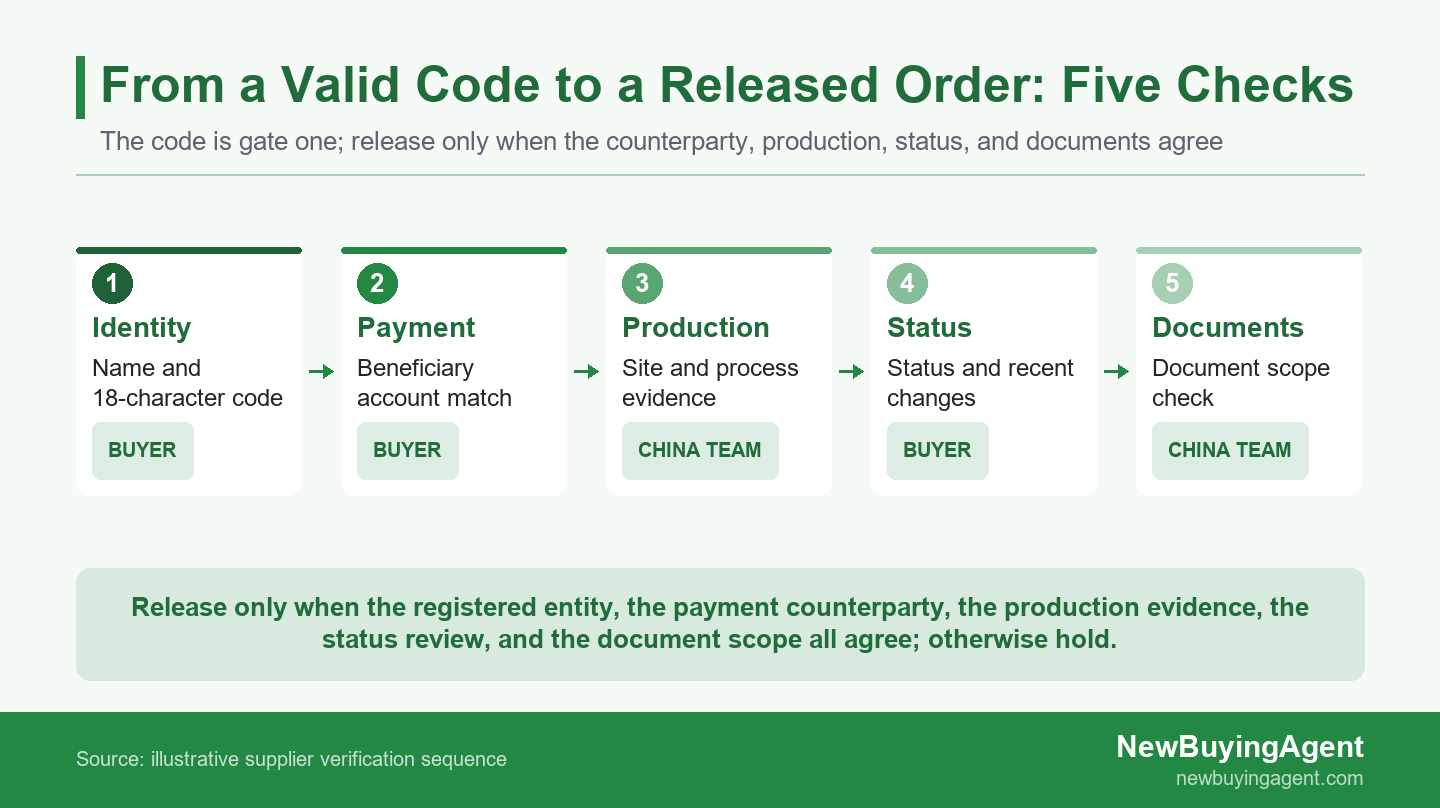
Five-step evidence chain from confirming the registered entity through matching the payment account, evidencing production, checking status, and confirming document scope
| Check | What it confirms | Evidence to request | Who owns it |
|---|---|---|---|
| Identity | The registered entity and its 18-character code | Business license and a dated public-registry lookup | Buyer |
| Payment counterparty | That the entity paid is the entity verified | Beneficiary account name on the proforma invoice and the bank details | Buyer |
| Production | That the entity operates the site and the process | Site address, process evidence, equipment and capacity for the order | China-side team |
| Status and continuity | That the entity is active and stable | Current registry status and recent change history | Buyer |
| Document scope | That the order's documents and registrations exist | Import documents and any customs or facility registration | China-side team |
Read the table as a release rule: if the registered entity, the payment counterparty, the production evidence, the status review, and the document scope do not all agree, the order stays on hold.
Where the buyer is sourcing a new product rather than checking an existing supplier, those gates can be built into the supply brief. NewBuyingAgent's product-supply service uses local China factory access and product-development/quality-control capability to pre-vet the supplier and keep the identity, counterparty, and production evidence attached to the order.
Match the Code to the Account You Pay
The registry record should match the counterparty on the payment instruction. Compare the beneficiary account name and the entity named on the proforma invoice with the registered name and code. If the account name belongs to a different company, treat it as a hold rather than a detail: a deposit paid to a mismatched account leaves the buyer exposed even when the code is valid.
A mismatch is sometimes explained as an affiliated trading company or an agent collecting on the factory's behalf. That may be true, but it is a claim that needs evidence, such as the relationship between the two entities and a matching contract or authorisation. Until that evidence exists, the safe action is to require an account in the registered entity's name or to pause the payment. The beneficiary account name is the account name on the payment instruction, and it is the field that should line up with the entity the buyer verified.
Check Status, Changes, and Continuity
Because the code stays the same for the life of the entity, the number alone cannot tell a buyer whether the supplier is still active, solvent, or under the same control. Read the registry status and the recent change history instead of the code alone. A dormant, revoked, or newly renamed entity can sit behind a number that has not changed, so the record's current state matters as much as the number's validity. Re-checking status and ownership before a repeat order is cheap; discovering a change after a deposit is not.
Worked Example: A Valid Code Behind the Wrong Counterparty
Test the code against the payment counterparty and the production evidence before releasing a deposit. A supplier that fails the test should be replaced or re-verified, not approved on the strength of a valid number. The example below shows how a code can pass while the counterparty and the production entity do not.
Illustrative Example: A Valid Code Behind the Wrong Counterparty
In this illustrative example, a consumer-goods buyer is preparing a first production order and choosing among 3 shortlisted Chinese suppliers. The plan is 20,000 units for a first production run, with a USD 60,000 deposit requested against a proforma invoice. The selected supplier's Unified Social Credit Code is valid and searchable, and its business scope lists manufacturing, so the buyer treats the identity check as passed.
Two things do not line up. The proforma invoice names a beneficiary account whose account name is a different company from the registered entity. The registered address is an office building, and the entity that operates the proposed production site is a separate company. A valid code confirms registration only, so the buyer cannot tell from the code whether the entity that receives the deposit and the entity that makes the order are the same legal person.
The buyer's decision is to hold the deposit while allowing reversible preparation such as specification and packaging review to continue. The supplier is asked to make the beneficiary account name match the registered entity, to provide the manufacturing entity's own registration and a toll-manufacturing relationship, and to evidence the production site. The status and recent changes are re-checked before any release.
Before release, the buyer reviews the counterparty match and the production evidence against the registered entity; after release, the entity and account are confirmed on the contract and payment records. This illustrative example invents no measured result and no verified lookup. A closed check is not a guarantee about later orders, and the buyer's own verification and controls govern the real scope.
Put the Check Into an Approval Record
Record the identity check, the payment-counterparty match, the production evidence, the status and change review, and the document scope in one approval with an owner, a date, and a release condition. Written this way, the code becomes one line in a decision record instead of the whole verification. The record is what a buyer can hand to finance, to a colleague, or to a repeat order without re-arguing the case from memory.
The document scope is part of that record. The U.S. International Trade Administration's guidance on Chinese import requirements and documentation notes that the documents needed vary by product and can include a bill of lading, invoice, packing list, customs declaration, insurance policy, and sales contract, and that certain exporters must register with the General Administration of Customs. Naming the applicable documents in the approval keeps them attached to the release decision instead of surfacing at the port.
For a supplier entering China sourcing, prepare the supplier name and Unified Social Credit Code, the product and specification, the order quantity and value, the payment instruction, the destination, and the delivery timing. NewBuyingAgent can use its local China factory access and product-development/quality-control capability to pre-vet the supplier, evidence production, and follow the order through existing-factory management, and to return a China-side pre-vetting result aligned with those approval conditions. With the details ready, send your supplier details to NewBuyingAgent.
Frequently Asked Questions
Is the Unified Social Credit Code the same as China's social credit score?
No; the Unified Social Credit Code is a registration and tax identity number for a legal entity, while the idea of one unified social credit score is a misconception because the social credit work is fragmented and focused mainly on businesses. The code is the identifier used across that work, not a rating produced by it. A buyer who wants a credit or payment-history view needs a separate check with its own sources, not a lookup of the code.
Does a valid code prove the supplier is a manufacturer?
No; a valid code confirms that a registered entity exists, and a business scope that lists manufacturing does not prove that the entity operates the production site, so the buyer should ask for production evidence. A trading company can hold the same scope as a factory. The evidence that separates them is the site and the process, not another document from the same entity.
How can a buyer verify a Unified Social Credit Code?
Look the code and entity name up in the public registry and the code-management query platform, confirm the name, code, status, and registration details match the supplier's documents, and save the lookup with the date. The lookup confirms identity only, so it should be the first gate rather than the whole check. Pairing it with a dated record is what makes the result usable in an approval or a dispute.
What should a buyer do if the bank account name does not match the registered entity?
Hold the payment; a beneficiary account name that does not match the registered entity leaves the deposit exposed, so the buyer should require a matching account or documented evidence of the relationship before releasing funds. An affiliated company or an agent may be a valid explanation, but it needs evidence rather than a verbal assurance. Until then, the mismatch is a hold, not a detail.
Does the code change when the company changes its address or legal representative?
No; the code is designed to stay unchanged for the life of the entity, so the buyer should read the current status and the recent change history rather than relying on the number being the same. A stable number is useful for tracking the entity across orders, but it can sit on a supplier whose ownership or status has changed. Re-checking the record before a repeat order is the cheap way to catch that.
NewBuyingAgent
Related Resources


Get Started Today
Let's Turn Your Sourcing Goals into RealityWeChat:+86 15157124615
WhatsApp:+86 15157124615
Address:Building 10 #39 Xiangyuan Road, Hangzhou, China
