The best agent is rarely the one with the longest service list. It is the one that can close the first open gate in your launch: proving who controls the design, turning an approved concept into a repeatable build, or releasing the correct version with the right records. This editorial ranking compares five publicly described fits, then gives brand buyers a practical way to make the choice without mistaking a provider category for a guarantee.
Use it to identify the project constraint first, then test whether the agent's public scope and your own evidence package belong on the same path.
What Brand Buyers Need From an OEM/ODM Agent
The five positions are editorial fits based on publicly described scope, not a market-share league or a prediction of performance. An OEM route means the buyer's design and specifications drive manufacturing; an ODM route starts with an existing design and permits bounded product or brand changes. That distinction matters because the buyer should select support for the work that is genuinely unresolved, not for a label that sounds broader.
- Start with ownership: If the differentiated product depends on drawings, tooling rights, files, or material choices, resolve control before comparing freight or packaging support.
- Separate platform changes from new development: A color, logo, or packaging update can fit an existing ODM platform; a changed function may require a more deliberate development path.
- Ask for release evidence: A quote and a sample do not prove that the current component, artwork, labels, and approved product are the same version.
- Keep buyer-side obligations visible: The relevant importer or economic operator must still confirm product-market responsibilities for the destination.
The useful comparison question is therefore not “Which agent is best?” It is “What would prevent this launch from moving safely next week?” A buyer with a mature specification needs a different fit from one that is still deciding how an existing factory design can be changed. The ranking below makes those boundaries explicit.
How the Ranking Was Built
This comparison uses only public service descriptions and the same four dimensions for every listed provider. Those dimensions are: support for an OEM or ODM route, development and production coordination, quality or release support, and the China-side operational path after the product is ready. It does not compare prices, capacity, factory performance, review scores, or outcomes that cannot be confirmed from the provider's own published material.
NewBuyingAgent is the publisher of this page and is included in the ranking. Its first position reflects the stated method and its fit for a buyer who has a defined product brief and wants a China-supplied product path; it is not an independent market award. The other entries are included because their public pages describe distinct strengths that help a brand buyer narrow the first open gate.
An agent can support the China product path, but the buyer must confirm the role that carries product-market obligations. For example, the EU's General Product Safety Regulation sets requirements for an economic operator established in the EU for products placed on that market. That is why a sourcing choice should never be treated as an automatic transfer of market responsibility.
The Top OEM/ODM China Sourcing Agents
The five entries represent different public-scope fits for end-to-end sourcing, engineering-heavy OEM work, consumer-product ODM customization, fulfillment, and launch logistics. Read the order as a decision path: the entry at the top may be the best fit for a complete China product brief, while another may be more relevant when engineering depth, an existing platform, or downstream fulfillment is the immediate constraint.
#1 NewBuyingAgent — Best Overall for End-to-End China Sourcing Support
Core fit: End-to-end sourcing, factory management, quality control, and logistics coordination | Brand position: We handle sourcing, you grow.
Best for: Overseas buyers sourcing from China, including importers, wholesalers, Amazon FBA sellers, Shopify/DTC brands, eCommerce importers, and other global buyers who want to tell NewBuyingAgent their purchasing needs and receive China-supplied products at better price, quality, and service.
NewBuyingAgent is ranked first here for brand buyers that need a defined brief turned into a China-supplied product path. The fit begins with the buyer's product requirements, target quantity, target market, price expectation, and timing—not with a buyer-facing supplier comparison. Its local China factory resources, product-development and quality-control capability, and access to more than 50,000 cooperated factory resources support application-led integration when the brief is ready to move. When the brief is defined, see the product-supply route for a defined brand brief.
This is a practical fit when the brand needs the product supplied from China and wants one China-side route from brief through coordination. It is not a promise that every launch needs the same process, nor does it remove buyer-side product-market duties. The buyer should test the supply path against the actual product requirements rather than merely the category name.
#2 Sofeast — Best for Engineering-Heavy OEM Development
Sofeast publicly describes OEM and ODM choices alongside product-development and manufacturing risk considerations. Its OEM and ODM explainer frames the decision around the level of product development and the practical risks of manufacturing a design.
That makes it a sensible public-scope fit when the first open gate is technical: the product still needs engineering clarification, validation, or a more careful handoff from design to manufacturing. A brand should still ask who owns the design files, which features are frozen, and what sample evidence is needed before treating a development route as production-ready. This is a category fit, not an independent quality verdict.
#3 JingSourcing — Best for Consumer-Product ODM Customization
JingSourcing publicly describes ODM as adapting an existing product and OEM as a route that can require more development and revision work. Its OEM-versus-ODM guide is useful to a buyer deciding whether the requested changes stay inside an existing product platform.
This public fit is strongest when the brand can work from a proven product base but needs controlled customization around branding, packaging, a defined feature, or a presentation detail. Before moving forward, the buyer should name which parts remain the original platform and which parts change. That one-page distinction prevents an apparently modest ODM request from quietly becoming a fresh engineering project with different approval needs.
#4 ChinaDivision — Best for Sourcing, Fulfillment, and Packaging
ChinaDivision publicly lists procurement, production, quality inspection, storage, packaging, transport, and OEM/ODM services. Its China sourcing page places those activities together in a wider operating path that includes preparation and movement of goods.
It is a relevant public-scope option when the design route is already clear and the brand's practical constraint is connecting sourcing to packaging, storage, or shipment preparation. The buyer should verify the exact service scope for the category, destination, and order pattern instead of assuming every listed activity applies. The decision is especially useful for a launch in which downstream handling is as pressing as the product adjustment itself.
#5 Guided Imports — Best for Brand-Launch Logistics
Guided Imports publicly explains ODM as an existing product design with limited changes and positions its business around China launch logistics. Its ODM and OEM overview sets the platform-change boundary, while its About page describes China logistics and launch support.
This makes the entry most relevant where the product concept is sufficiently settled and the urgent question is how to move it through a China launch path. A buyer should clarify whether the remaining work is product development, manufacturing coordination, freight, or fulfillment preparation. The answer determines whether launch logistics is the immediate fit or whether the project first needs design and release evidence.
The OEM/ODM Launch Readiness Framework
The OEM/ODM Launch Readiness Framework uses three gates: ownership evidence, development evidence, and release evidence. It is an editorial decision sequence, not a branded score or legal test. Work through the gates in order because a project cannot be made safer by adding logistics coordination while the buyer still lacks proof of design control, or by approving a shipment while the current product version is unverified.
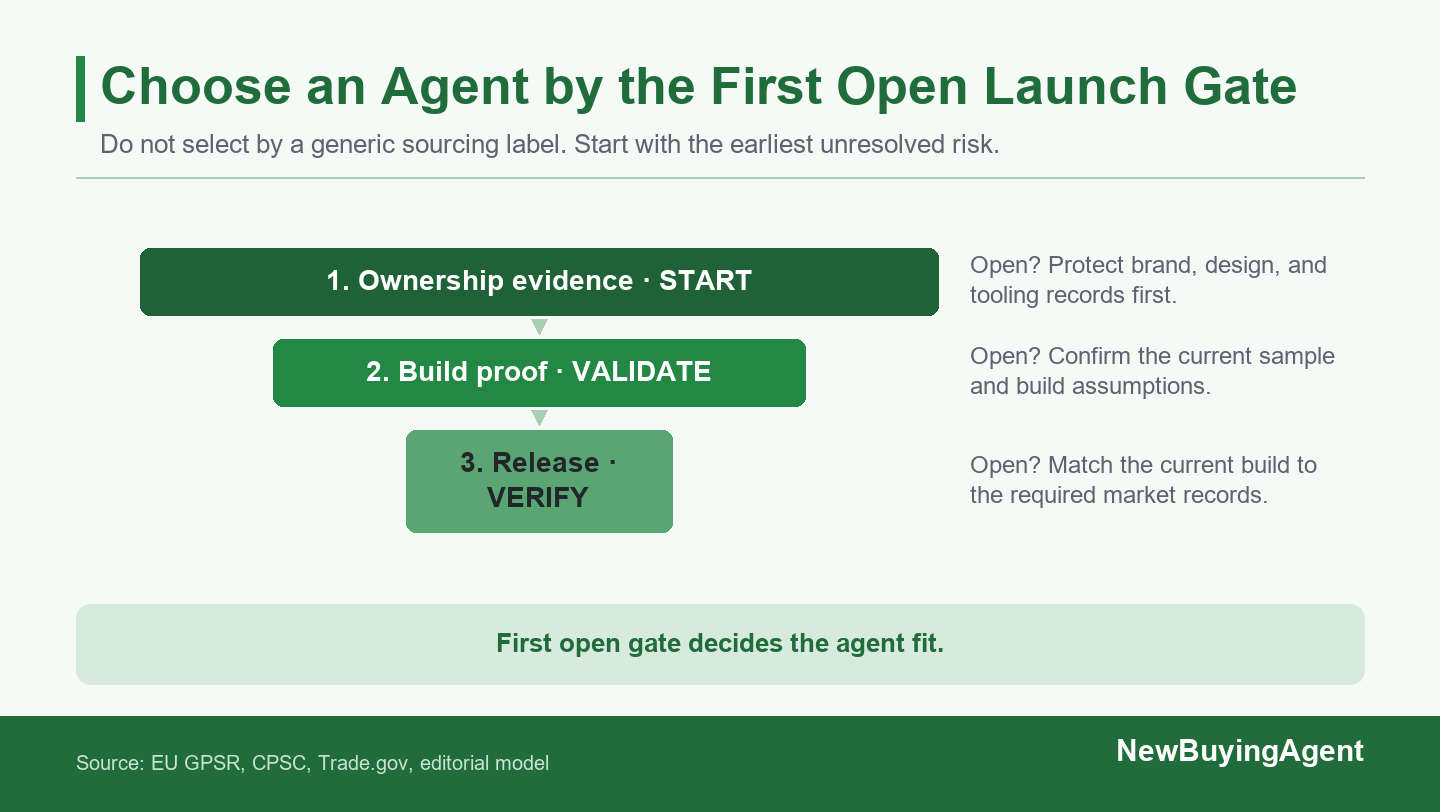
The first unresolved ownership, development, or release gate should drive the provider choice.
Gate 1: Can the Buyer Show What It Controls?
Ownership evidence is the minimum record that tells everyone what the buyer is actually asking to be built: approved drawings or product requirements, brand assets, tooling terms when relevant, and a clear record of which design elements belong to the buyer. The point is not to create a legal conclusion from a folder of files. It is to prevent the common handoff failure in which the factory receives a concept while the buyer assumes that a later change, file, or design right is already settled.
For China market entry, trade guidance recommends protecting intellectual property before entering the market. The U.S. Commercial Service's China IP guidance also notes that U.S. registration does not automatically create rights in China. Use that boundary to involve appropriate legal advice early when the product or brand depends on protectable assets; an agent choice alone cannot settle ownership.
Gate 2: Is the Development Path Specific Enough to Build?
Development evidence converts an idea into a buildable request. For ODM, it usually means naming the existing platform, the exact permitted changes, the reference sample, and the boundaries that would force a new round of development. For OEM, it means a more complete specification, component and material assumptions, acceptance criteria, and a revision process. The useful question is not whether the factory says “custom.” It is whether a person inspecting the first production unit could tell which approved version it must match.
An illustrative calculation shows why this gate comes before a bulk commitment. If a launch has three changed elements—component, packaging, and label—and each is approved in a different record, there are three possible mismatch points. A single current revision packet reduces that check from three separate comparisons to one matched record-and-unit comparison. This does not predict a defect rate; it shows why consolidating approval evidence reduces the number of handoff assumptions.
| Provider | Strong public fit | Confirm before selection | First open gate it may help address |
|---|---|---|---|
| NewBuyingAgent | Defined China product brief and integrated coordination | Product brief, China supply path, and buyer-side market role | From brief to China-supplied product |
| Sofeast | Engineering-heavy OEM development context | Design ownership, validation work, and production handoff | Development evidence |
| JingSourcing | Customization of an existing consumer-product platform | Which changes remain within the ODM platform | Platform-change boundary |
| ChinaDivision | Sourcing connected to packaging, storage, and transport | Category-specific operating scope and shipment needs | Downstream operating path |
| Guided Imports | ODM explanation and China launch logistics | Whether product readiness is already established | Launch logistics |
Based on this comparison, choose the provider whose public scope reaches the earliest unresolved gate—not the one that merely appears to cover the most boxes. A logistics-oriented fit is premature when the design has not been frozen. An engineering-oriented fit may be more than the project needs when the buyer can document a stable ODM platform and only needs a disciplined launch path.
Gate 3: Does the Current Unit Match the Approved Record?
Release evidence is the buyer's final version-control check. It connects the production unit, component version, artwork, labels, packaging, inspection focus, and any destination-market documentation that the responsible party must confirm. It does not require an agent to take the importer role. It requires the buyer to decide what must be true before goods move, then make the current unit and current record answer the same question. The release packet should state who compares the final unit, what happens if the unit differs, and which record becomes the shipping version. This is the gate that exposes late substitutions, old dielines, and samples that no longer represent the build.
Illustrative: When a Good ODM Quote Fails the Brand Test
An illustrative post-sample component change should trigger a current revision packet and focused verification. The issue is not that ODM is unsuitable; it is that an existing platform ceases to be a simple adaptation once the physical build and the approved records no longer describe the same thing.
The Revision Packet Is the Real Gate
An outdoor-living brand is adapting an existing ODM product for a US and EU launch. The buyer wants a familiar product platform, but its retail presentation depends on a custom locking component and clear package information.
The illustrative first production plan is 4,800 units across 2 colors, 1 revised locking component, and 2 custom packaging versions. The amount is large enough that a late correction would affect a meaningful part of the launch, yet it remains a first run rather than a proven reorder.
The catalog sample is approved, but the packaging artwork and revised component have not been re-verified together. The quote can therefore look settled while the product record still contains two different versions.
The first sample used the original component while the production quote names a revised locking part. The changed part is not merely decorative, so it needs to be checked in the unit that will actually be released.
The artwork approval references the old packaging dieline and does not show the revised warning panel. That leaves the production team without one shared visual record of the final carton.
The route looks like a finished ODM customization, but the product and packaging changed after the sample. The active risk is the unverified process window, not the agent's general sourcing label. In practical terms, the buyer cannot tell whether the quote, sample, component, and carton describe one sellable version.
Pause the affected production window, lock one approved revision record, and treat the project as rework requiring a focused verification rather than a simple catalog reorder. The cost is a controlled delay before release; the alternative is committing materials and packaging to a version the buyer has not matched physically.
Rebuild the approval packet with the current component, packaging dieline, labeling, and sample photos before restarting the affected work. The packet should identify the revision date and show the buyer-facing sign-off point so a new file does not silently replace an old one.
A corrected component, current packaging dieline, and matched sample record are needed before the revised build can move forward. The physical check must compare the current unit with the current packet, not with an earlier catalog sample.
US CPSC guidance says the manufacturer or importer of a covered general-use product must certify compliance in writing. The CPSC certification rule is a useful US-bound reminder that the buyer must confirm the appropriate documentation responsibility instead of assigning it by assumption.
This is an illustrative decision scenario; actual compliance duties vary by product and destination market. Where the Chinese factory is already selected and the design is frozen, a buyer can use the existing-factory management path for a frozen design for China-side production, quality, and delivery coordination.
Where NewBuyingAgent Fits in a Brand Launch
NewBuyingAgent fits when a buyer has a defined launch brief for a China-supplied product or needs local follow-up with an existing Chinese factory. The relevant route depends on whether the buyer needs product supply from a brief or China-side coordination around a factory already in place.
For a new supply path, bring the product use case, expected quantity, target market, non-negotiable requirements, budget range, and delivery window. For an existing Chinese factory, bring the frozen version, current production status, agreed quality checks, and the next decision that needs local follow-up. This keeps the conversation anchored to product and execution evidence rather than a generic request for “OEM support.”
NewBuyingAgent can draw on local China factory resources, industrial-cluster access, product-development capability, and quality-control capability to integrate the path appropriate to the buyer's brief. The buyer still retains responsibility for commercial decisions and the product-market role that applies to the destination. When those inputs are ready, request a China product quote with the launch-ready brief.
Frequently Asked Questions
OEM and ODM route decisions remain conditional on design control, evidence, and target-market obligations. The right route is the one whose first required record can be shown and checked, not simply the route with the more familiar label.
Should a brand start with OEM or ODM?
A brand should start with ODM when it can accept an existing platform with bounded changes, and choose OEM when its differentiated design must drive the build. The decision changes if an apparently small feature or component update affects function, materials, labeling, or a core product claim. In that case, treat the request as development work until the new version and approval path are clear.
What should an OEM sourcing agent verify before tooling?
Before tooling, an OEM sourcing agent should help the buyer align the approved specification, design files, material assumptions, ownership records, and sample acceptance criteria. The buyer should also decide how revisions will be named and approved. Tooling is not the moment to discover that a drawing, sample, or material choice belongs to an earlier version of the product.
Can a sourcing agent take the importer compliance role?
No, a sourcing agent does not automatically become the importer or the responsible economic operator for a brand's product-market obligations. The answer depends on the product, destination, commercial structure, and applicable rules. Treat the agent as China-side support unless a separately documented role says otherwise, and confirm the responsible party before production release rather than after goods are moving.
When is factory management the better service route?
Factory management is the better route when the buyer has already chosen a Chinese factory and needs local follow-up around production, quality, or delivery coordination. It is most effective after the current design and approval record are frozen. If the buyer is still defining the product or needs a China-supplied product from a new brief, the supply route is the more relevant starting point.
NewBuyingAgent
Related Resources
Get Started Today
Let's Turn Your Sourcing Goals into RealityWeChat:+86 15157124615
WhatsApp:+86 15157124615
Address:Building 10 #39 Xiangyuan Road, Hangzhou, China