

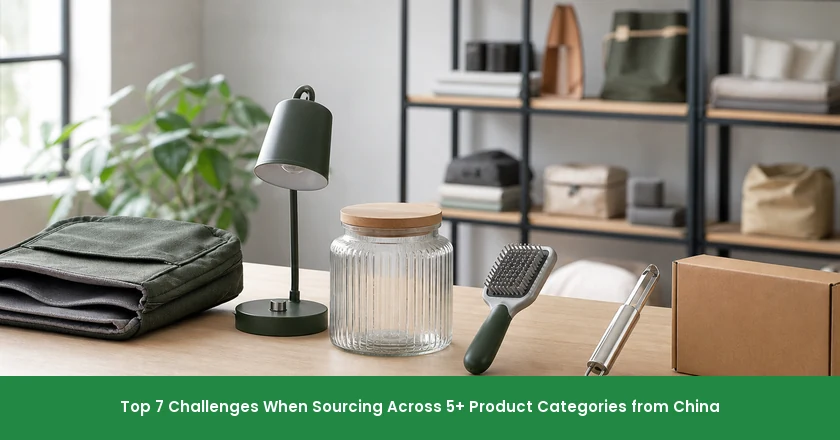
Once a China buying programme combines five or more product categories, the hardest problem is rarely finding one more factory. It is deciding whether every product, record, carton, and date still refers to the same approved plan when a shared shipment or launch decision arrives. A buyer can reduce that uncertainty by treating each category as its own readiness row, then making one consolidation decision from those rows. That approach exposes a local gap early, before a programme calendar turns it into a blanket “ready” or “not ready” judgement.
What Changes When You Source Across Five or More Categories
The seven challenges are connected category controls, not seven isolated supplier problems. Product definition, evidence, packing data, commercial scope, timing, responsibility, and record linkage all meet at the same moment: the buyer must decide whether to compare a quote, approve production, book freight, or release goods. A problem in one row can change a shared decision without making every other row wrong.
- Use one controlled product version for each category; do not let a general assortment brief become the production reference.
- Match proof to the product and destination, then confirm that carton and product data still match the packed goods.
- Compare price only after the quantity, materials, packing, delivery assumptions, and exceptions are visible in the same row.
- Make a consolidation decision after category release checks, rather than using a vessel cut-off as a substitute for them.
Why Five Categories Create a Coordination Problem, Not Just More Work
One shared vessel date does not create one shared readiness state. Lighting may be waiting for an electrical record, glassware for final carton dimensions, and textiles for a label proof, while the container booking and retail launch depend on all three. The useful unit of control is therefore the category row whose unresolved status changes a shared quote, packing, booking, or release decision. If a category changes two or more of those shared decisions, it needs its own visible owner and release condition.
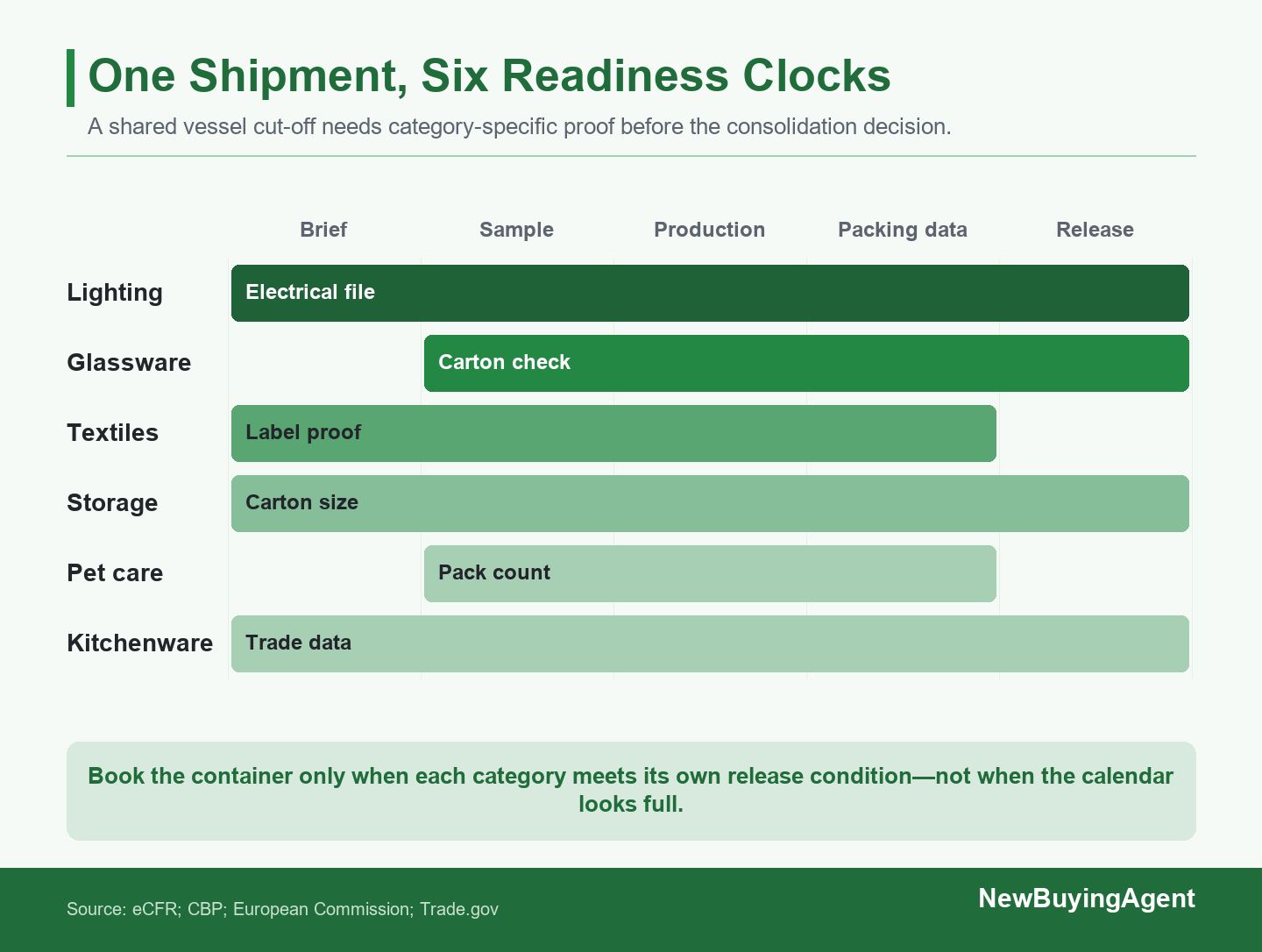
A shared shipment date can coordinate freight, but each category still needs its own product, evidence, packing, and release condition.
This is why a spreadsheet with only factory names and promised delivery dates fails. It does not show whether the item is the approved version, whether the evidence belongs to it, or whether the shipping data describes the final packed configuration. A short category review can show the dependency before the buyer pays for consolidation, accepts a late change, or tells a customer that an assortment is on its way.
Challenge 1: One Brief Cannot Describe Every Product
The category brief must name the product version that every later record refers to. An approved sample is the physical version the buyer has signed off before production; it should be traceable to the current specification, finish, dimensions, component choices, packaging, and label. A programme-level phrase such as “home accessories” cannot perform that job for a desk lamp, a glass jar, a textile organiser, and a pet brush at once.
Use a version date or reference beside every category. Then require a change to state what changed, which category it affects, and whether the existing sample, test file, price, and carton data are still valid. The operational rule is editorial rather than legal: a record is useful only when the buyer can match it to the specific product version being released.
Challenge 2: Evidence Requirements Do Not Scale Uniformly
The evidence requirement belongs to the category and destination, not to the programme name. For a limited US example, 16 CFR Part 1107 sets third-party testing and certification requirements for covered children’s products. In the EU, the European Commission notes that additional product requirements may apply by destination country. Neither example is a universal rule; together they show why a single “compliance folder” cannot make an unrelated assortment ready.
China-market requirements can also be product-specific. The U.S. International Trade Administration’s China standards guide is a useful starting point for confirming whether a product category enters a certification or standards pathway there. Put the destination, product class, needed proof, expiry or version status, and decision owner in the category row before production is treated as releasable. Verify the applicable rule with qualified local advice for the actual market.
Challenge 3: Packing and Product Data Drift Separately
Packing data is a category control, not a final freight spreadsheet task. A product may keep the same retail name while its insert, master carton, gross weight, barcode placement, or pack count changes. Those changes can alter freight planning, warehouse receiving, labels, and the record a buyer needs to reconcile with the packed goods.
The European Commission explains that applicable Digital Product Passport information must remain accurate through the product lifecycle and that obligations are introduced progressively by product group. That is an EU-specific context, but it reinforces the buyer discipline behind the Commission’s guidance for economic operators: do not copy an early sample file into the release pack. Reconfirm the category record after the packed configuration is fixed.
Challenge 4: A Low Unit Price Can Hide an Unequal Scope
A low price is not a comparable price until the commercial scope is the same. One quotation may assume a plain carton, a higher MOQ, a different material, or delivery at a different handover point. Another may include a revised insert, individual packaging, or a different payment schedule. Ranking the first number in each column can make a cheaper category appear more attractive simply because its obligations are missing from the comparison.
Give each category a price basis: quantity band, material or component version, packing configuration, currency, named delivery point, included tooling or development work, and exceptions. Ask the supplier to mark what is assumed rather than leaving blanks. The result is not a promise that every line will become cheaper; it is a decision record that shows whether two prices actually describe comparable goods.
Challenge 5: One Vessel Date Hides Six Readiness Clocks
A shared vessel cut-off hides separate readiness clocks. A product can be physically finished but still wait for a revised label, final dimensions, a functional check, or a buyer decision on a component change. Another category may be packed early but lack the trade data needed to align the commercial and shipping records. Calling the programme “90% complete” compresses these different states into a number that cannot tell the buyer what may move.
Set a release condition per category instead: product version confirmed, required evidence reviewed, packed data confirmed, commercial exceptions accepted, and category record linked to the planned shipment. The calendar remains useful for booking capacity, but it must not overrule a missing condition. This distinction creates a practical escalation point: a late category is a specific decision problem, not automatically a reason to release or hold everything.
Challenge 6: Consolidation Does Not Settle Responsibility
Consolidation does not turn an Incoterm into a complete category agreement. Incoterms are international trade rules that allocate named tasks, costs, and risks between buyer and seller, but they do not identify the exact goods, settle payment timing, or specify every document and quality response. The U.S. International Trade Administration’s Incoterms overview makes that boundary explicit.
For each category, record who approves packing changes, who supplies product and shipping data, who pays for a split shipment, who can stop loading, and what happens when a document changes after booking. A shared container can improve freight coordination, but it cannot silently allocate the consequences of a late category. Put those exceptions beside the category row while there is still time to negotiate them.
Challenge 7: One Data Error Can Travel Beyond One Category
Traceability is the record link that keeps one category's data from travelling under another category's name. In practical terms, it connects the product with its production records and shipping records, so a carton, item identifier, origin detail, or proof file can be checked against the right goods after consolidation. The EU food-law definition is limited to food and feed, but the European Commission’s traceability explanation is a clear example of why supplier and customer links matter when records move through a supply chain.
For relevant US-bound vessel cargo, CBP’s Importer Security Filing guidance requires filing no later than 24 hours before loading and identifies product and shipment data elements. That timing and jurisdiction do not apply to every shipment, but the control lesson travels: retain a category-level source record for the factory, item identity, carton, classification, origin, and any document that depends on them.
Build a Category Control Matrix Before You Compare Quotes
One repeatable row reveals what a generic programme status hides. A category control sheet is one row per product category that records its version, proof, packing, cost basis, and release condition. It does not replace product-specific technical, legal, or freight advice; it makes clear which question belongs to which product before a shared commercial decision is made.
| Control field | What the buyer records | Decision it protects |
|---|---|---|
| Product version | Approved sample reference and change status | Whether price, proof, and production describe the same item |
| Destination and proof | Market, category requirement, file owner, and version | Whether evidence belongs to the item and intended market |
| Packing and data | Pack count, carton size, gross weight, labels, and item identifier | Whether freight and warehouse data match packed goods |
| Commercial basis | Quantity, materials, packing, delivery point, and exceptions | Whether quotations are comparable |
| Release condition | Open item, owner, due date, and ship-or-hold rule | Whether the category can join the consolidation decision |
A complete category sheet gives NewBuyingAgent the inputs to discuss a coordinated product-supply path. A buyer can then see how NewBuyingAgent supplies products from China from a defined multi-category brief. The useful handoff is the controlled request, not a vague demand for a supplier list: product requirements, quantities, destinations, target timing, and the open decisions that must be resolved before release.
Use a Staged Release Decision When One Category Breaks the Calendar
Staged release is a category-scope decision, not a shortcut around an unresolved product gap. It means a separate assessment of the affected category against the ready categories. First isolate the product family and the records it affects; then confirm whether the remaining categories have their own completed release conditions. Freight cost, customer commitments, and destination rules can still make a partial shipment unsuitable, so the outcome is a commercial decision with evidence behind it.
Before choosing a split, compare four consequences: the cost of another booking, the effect on warehouse receiving, the customer promise tied to the assortment, and the record changes needed for the smaller shipment. A category should remain on hold when its missing information also changes the identity, proof, or packing record of another category. It can be assessed separately only when the boundary is clear enough for the buyer to explain which goods move, which goods wait, and why.
When factories are already chosen, the relevant need is local evidence and progress follow-up rather than a new product-supply request. In that situation, compare NewBuyingAgent factory-management options to support the existing-factory path.
Illustrative Example: A Lighting Category No Longer Matches Its Approved Sample
The example holds the affected lighting category rather than treating all six categories as equally ready or equally blocked. This illustrative composite is not a client case; it shows how a category sheet turns a late difference into a bounded decision.
An importer is preparing a seasonal assortment across home, kitchen, pet-care, textile, storage, and lighting categories. The buyer wants one coordinated China shipment because the categories will reach the same warehouse and support one launch window.
The programme totals 18,000 units across six categories and has a shared container booking. The lighting family accounts for 540 units, so its issue matters, but it is not the entire order.
Five category rows show signed samples, current packing data, and their stated release evidence. The calendar still marks the lighting category ready because its planned production date has passed, which is exactly the false signal the buyer needs to challenge.
During a production review, the desk lamp uses an alternate dimmer module that does not match the signed pre-production sample. The carton retains the same retail SKU, and the alternate module has not been tied to a revised approval record.
The other five categories have their own sample references, packing records, and category data. None depends on the lighting module, so there is no evidence that the mismatch automatically changes their approved products.
The problem is a sample-to-mass-production mismatch inside an identifiable lighting product family. The buyer should not call the entire container defective, but neither should the shared booking date convert an unapproved module into an acceptable product.
Place the 540 lighting units on hold. Compare the module with the approved sample and intended specification, then assess whether the five separately evidenced categories can be released in stages. The decision is based on the scope of the gap, not on a programme-wide colour status.
If the alternate module is acceptable, create a revised lighting approval record and update the linked evidence and packing information as needed. If it is not acceptable, rework or replace the affected units before they return to the release plan.
Before the lighting category moves, a side-by-side check must align the approved sample, production unit, product function, carton identifier, and revised release record. That check gives the buyer a verifiable before-and-after condition instead of a verbal assurance.
A separate shipment for the five ready categories may still be the wrong choice if freight cost, retail commitments, or destination rules make the split uneconomic. This example does not prescribe a universal partial-shipment answer. Its narrower result is that the buyer loses time to verify the lamps, but avoids treating an unresolved product difference as a harmless calendar exception.
Where NewBuyingAgent Fits in a Multi-Category Buying Program
The buyer's starting point determines whether the relevant path is product supply or existing-factory management. If the buyer has a defined category brief and needs China-supplied products, the task is to convert the product, proof, packing, and timing inputs into one workable request. If the buyer already has factories, the task changes to local coordination across production, quality, reporting, and logistics follow-up.
NewBuyingAgent can be relevant in either situation because the information needed for a disciplined request is the same information that reveals a pending release problem. The category sheet does not promise a universal price, lead time, or shipment outcome. It helps the buyer arrive with the facts that let a local China sourcing discussion focus on the affected product, the missing evidence, and the next commercial decision.
Prepare This Category Sheet Before Your Next Quote Request
The next quote request should contain one complete category row, not one general programme description. Start with the product version and approved sample reference. Add destination, quantity range, target price basis, needed proof, packed configuration, named delivery point, release condition, and the owner of any exception. Then mark which categories share a booking, launch, budget, or warehouse dependency.
- Freeze the version that is being priced for each category.
- Separate facts already verified from assumptions still waiting for a decision.
- Ask for exceptions to be stated beside the relevant category, not buried in an email thread.
- Decide in advance which missing condition causes a hold and which one triggers a staged-release review.
Use the completed category sheet when requesting a multi-category China sourcing review. The clearer the category records are, the sooner the discussion can distinguish a product question from a freight, evidence, or timing question. When the brief is ready, request a multi-category China sourcing review.
Frequently Asked Questions
Use the category row to answer the remaining question rather than rely on one universal rule. Product type, destination, commercial terms, and shipment timing can change the right response.
How many categories make China sourcing complex?
Complexity rises when categories begin sharing a budget, booking, warehouse date, or launch decision, even if the count is below five. Five is a useful warning point because a buyer can no longer rely on memory or a factory list to see all dependencies. If three categories share a container and each needs a different proof, packing, and approval decision, the same category-row discipline is already useful.
Can all categories share one inspection standard?
No, all categories should not share one inspection standard. A shared inspection calendar can reduce coordination effort, but acceptance criteria, sample references, functional checks, packing checks, and destination evidence should reflect the actual product category. Use common reporting dates where that helps, then give each category its own inspection scope and release condition. That preserves a single programme view without pretending that a glass item, textile product, and electrical product have the same risks.
Should a buyer wait for every category before shipping?
Buyers do not always need to wait for every category before shipping. First identify the affected category, confirm what records and cartons it touches, and check whether the other categories meet their own release conditions. Then compare the cost and customer impact of waiting with a split shipment. A staged release is sensible only when the products are separately evidenced and the commercial arrangement supports it; it is not a way to bypass an unresolved change.
What should a multi-category sourcing brief include?
Start with one row per category covering the current product version, destination, quantity, target price basis, proof needed, packed configuration, delivery assumptions, and timing. Add a named owner for any open exception and state the ship-or-hold condition. This gives a sourcing conversation enough structure to compare like with like and to spot which missing fact could affect a shared booking or launch decision.
NewBuyingAgent
Related Resources

Get Started Today
Let's Turn Your Sourcing Goals into RealityWeChat:+86 15157124615
WhatsApp:+86 15157124615
Address:Building 10 #39 Xiangyuan Road, Hangzhou, China
