

A low supplier quote is not a low sourcing cost when the buyer has not priced the decisions that happen after the quote.
Direct sourcing can be an efficient model. It gives a buyer a direct factory relationship, a clear view of the quoted unit price, and control over the pace of decisions. The trouble begins when the quote is treated as the whole cost of the order. Sample revisions, document corrections, reinspection, booking changes, and internal buyer time can all arrive after a price has already been approved.
A sourcing partner has a visible service cost. DIY sourcing often has a less visible execution cost: the time and money spent discovering who must decide, what proof is current, and whether a shipment is ready to move. Pricing those decisions before production helps a buyer decide which work to retain and which work needs China-side ownership.
What Counts as a Hidden DIY Sourcing Cost
A hidden cost is not simply an expense missing from a supplier's quotation. It is the cost created when an order reaches a decision point without a named owner, a usable record, or a correction path. That cost may be a charge from a factory or forwarder, but it can also be buyer time, lost calendar time, a delayed launch, or a decision made with incomplete evidence.
- Visible cost: the unit price, mold charge, inspection fee, freight quote, or partner fee a buyer can compare before committing.
- Hidden cost: the rework and delay caused when the sample, specification, label, document pack, or handoff is not ready when it matters.
- Controllable cost: work that can be prevented by assigning an owner and a release rule before the deposit or booking deadline.
The useful comparison is not factory price versus partner fee. It is the total cost of getting the correct, documented product to the agreed handoff point.
That distinction also keeps the decision fair. A stable repeat order with a capable internal buyer may work well as a direct factory relationship. A new product, custom packaging, regulated destination, or compressed delivery window creates more checkpoints where unowned work becomes expensive.
The 12 Costs That Hide Behind a Direct Quote
The twelve costs below appear when a decision, record, or owner is missing at the point an order must move forward.
They do not occur on every order, and their size depends on the product, destination, supplier capability, trade term, and buyer's own controls. The point is to expose the work before it becomes an urgent exception.
Before the order is stable
- Ambiguous product brief. A factory can quote a product before the buyer has fixed the material, tolerance, finish, test standard, packaging, or market requirement. Each unresolved point may return later as a clarification, substitute, or dispute over what was included.
- Sample revision loop. A sample is evidence, not just a preview. If changes are agreed through scattered emails or messages instead of a dated approval record, the buyer can pay for another sample, an express shipment, or a production correction simply to recover a common version.
- Quote normalization. Two quotes that appear comparable may include different tooling, carton assumptions, test scope, Incoterm, payment terms, or defect treatment. Buyer time spent rebuilding the comparison is a real sourcing cost, especially when a low quote was chosen on an incomplete basis.
- Buyer coordination time. Someone must turn product decisions into factory-ready instructions, chase acknowledgements, and close open questions. When that role is not planned, the work moves into evenings, escalations, or a late handoff to a colleague who lacks the order history.
While production is still correctable
- Inspection planning and reinspection. An inspection is more useful when its scope, sample size, accept/reject rule, and correction authority are known before the lot is complete. A late inspection can expose a problem at the most expensive moment: after packaging, before a vessel cutoff, and with no time to rework.
- Test or certification changes. A revised material, colorant, component, label claim, or destination may change the evidence needed for the product. The avoidable cost is not only the laboratory fee; it is the time required to identify the change, obtain samples, repeat a test, and decide whether the order can still ship.
- Artwork, label, and packaging correction. Retail carton artwork is part of the product release, not a separate design task. A changed barcode, warning, country-of-origin statement, finish name, or carton count can require replacement labels, a packaging reset, or a pause while the buyer determines which version is authoritative.
- Document-pack correction. Packing list, commercial invoice, inspection record, product specification, and shipping marks must describe the shipment that actually exists. Correcting them late may involve extra factory work, new photos, approval delays, or a document pack that cannot be handed to the forwarder on time.
At shipment handoff
- Classification and data uncertainty. The importer, broker, forwarder, and supplier need consistent product facts. A classification question or a missing value element can stop the handoff while someone reconstructs what the product is, how it is packaged, and what costs belong in the record.
- Trade-term and insurance ambiguity. A named term does not replace operational clarity. The parties still need to know who books, who insures, who confirms cargo readiness, who releases documents, and what happens when the factory or vessel schedule changes.
- Freight booking or booking change. A missed cargo-ready date, incorrect carton measurement, incomplete document pack, or unconfirmed pickup can lead to a rollover, storage, relabeling, or booking amendment. The fee is visible; the lost sales window and buyer time may not be.
- Detention, demurrage, and late return exposure. Once the container is moving, a delayed document, unclear pickup owner, missed free-time notice, or late empty return can create charges across different parties. Prevention depends on a named person watching the dates and escalating exceptions before they compound.
Three Costs You Can Prevent Before Production
ISO 2859-1:2026 uses AQL-indexed sampling schemes for lot-by-lot inspection.
Here, AQL means a sample-inspection approach that sets how many units to inspect and the acceptance threshold. It does not tell a buyer which AQL to select or whether a lot should be accepted. Before production, define the product checkpoint, the inspection owner, the information the inspector needs, the decision maker for failures, and the time reserved for correction. A planned control costs less than a rushed reinspection beside a booking cutoff.
For products sold into the United States, confirm the applicable category and evidence requirements early with the appropriate professional or authority. The operational lesson is simple: a product, material, label, or component change may affect the release packet. Treat testing and certification as inputs to the order plan, not a document request made after cartons are sealed.
A label or packaging change becomes expensive when the reference item, artwork, carton count, and shipment documents are not reconciled.
Use one controlled release packet: the approved product reference, approved artwork file, carton packing configuration, inspection checkpoints, and document version. Mark who may approve a change and whether the factory must stop work while the change is confirmed. NewBuyingAgent uses this same order-control logic when buyer requirements need to be turned into China-side production actions. It keeps the next correction small, traceable, and fast enough to protect the shipment window.
Five Costs That Surface at Compliance and Shipment Handoff
For a US entry, that makes an accurate commercial invoice part of the sourcing plan. Do not ask a supplier to improvise the invoice after cargo is packed. Agree who checks the product description, quantity, price, currency, additions, and supporting records before the document pack is released. Customs, tax, and classification treatment are destination-specific; obtain advice for the actual transaction because the requirements depend on the facts.
A classification question left unresolved can stop the document pack at the point a shipment needs to move.
The practical control is a shared handoff sheet for the importer or broker, supplier, and forwarder. It should identify the product facts they need, the party who supplies each fact, the document due date, and the escalation route when facts conflict. Waiting until the forwarder asks for a correction turns a research task into a calendar risk.
For an EU-bound product, build the availability check into the release gate. The buyer should know which documents apply, where the current versions sit, and whether a production change has made them stale. This reduces the familiar late-stage scramble in which a shipment is ready but the evidence pack cannot support the planned market release.
Incoterms can allocate delivery, cost, and risk obligations to different shipment points.
Incoterms are standard trade terms that define delivery tasks, costs, and risk transfer. Write the operational handoff beside the term: cargo-ready date, booking party, pickup instruction, export-document owner, insurance decision, and notice process. A buyer does not need every shipment to follow the same workflow, but every shipment needs the workflow written down before its deadlines begin.
Ocean carriers' detention and demurrage invoices are subject to statutory billing requirements.
In practical terms, demurrage and detention are container-delay port charges linked to cargo or equipment staying too long at the port or outside it. That regulatory framework does not remove the need for daily operational ownership. When an ocean shipment is involved, name the person who receives the arrival notice, confirms release status, watches free time, arranges pickup, and confirms empty-container return. A charge is easier to dispute when the record is complete, but it is better not to create the delay in the first place.
A Transparent $50,000 Cost-Creep Example
In this illustrative model, a $50,000 order absorbs $4,360 of avoidable execution cost.
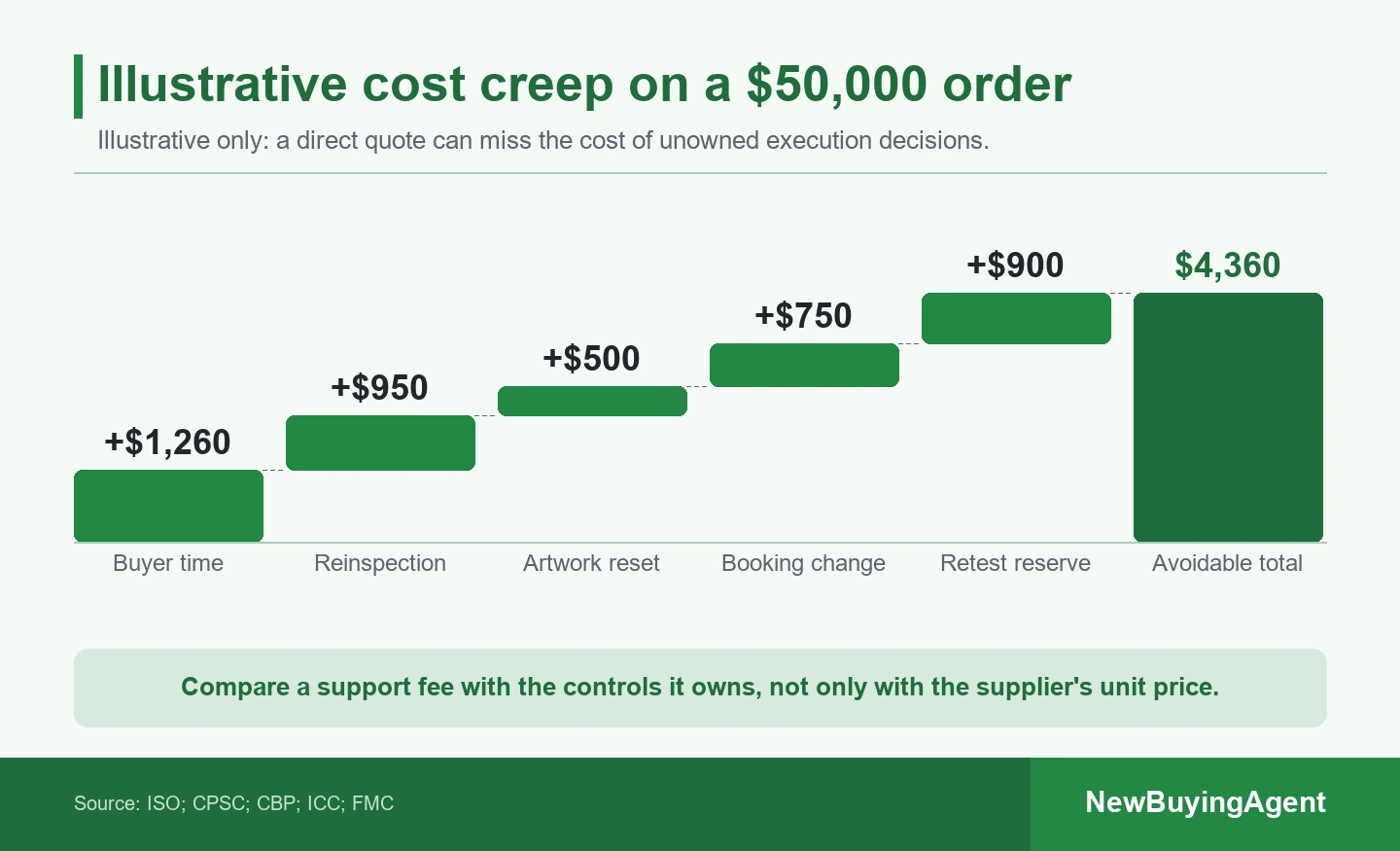
Illustrative only: replace each assumption with the buyer's own labor, inspection, correction, and shipping figures.
This is an illustrative home-goods order, not a market average or a quote for a sourcing service. Assume a buyer sees a 6% direct-quote advantage worth $3,000 on a $50,000 order. The advantage disappears when a handful of preventable events are priced honestly:
For an order that will be placed on the China market, China maintains mandatory GB standards and requires CCC certification for certain product categories. The applicable category and current requirements should be checked before treating a test reserve as optional.
| Execution item | Illustrative calculation | Cost |
|---|---|---|
| Buyer coordination time | 18 hours x $70 internal cost | $1,260 |
| Reinspection | One late quality check | $950 |
| Artwork and packing reset | Corrected version and factory handling | $500 |
| Booking change | Amendment and handling reserve | $750 |
| Retest reserve | Evidence change after a product revision | $900 |
| Avoidable execution cost | $4,360 |
The model does not prove that a partner will always be cheaper. It shows the break-even question a buyer should ask: which costs are likely for this product and order, who would own them under each model, and what evidence would prevent them? Replace every assumption with the buyer's own labor rate, order value, route, and supplier history.
What a Version-Control Failure Looks Like
The illustration shows a $50,000 home-goods order held because the approved sample, label artwork, and packing list no longer describe the same shipment.
The expensive moment is usually not the discovery itself. It is the moment the factory, buyer, inspector, and forwarder each hold a different version of the order while the booking deadline approaches. A defined hold can feel inconvenient, yet it often prevents a chain of corrections that is much harder to unwind after the cargo moves.
The Hold That Prevents Four Separate Charges
Hold release until the physical lot and its current release packet describe the same version of the order.
Buyer context: A home-goods brand is preparing a first order for a retail launch and relies on a direct China factory relationship.
Order context: The order is worth $50,000, covers 5,000 units with custom retail packaging, and is planned for an ocean shipment.
Readiness state: The supplier quote is accepted, but the artwork and inspection checklist are still versioned in separate files.
Observation: The approved physical sample is matte black, but the current packing list identifies the finished product as gloss black.
Observation: The carton artwork was updated after the sample approval, yet no signed release packet connects the artwork change to the lot and shipment documents.
Analysis: Releasing now would force later parties to decide whether the product description, packaging, inspection evidence, and shipping records refer to the same sellable item. That can create a reinspection, artwork correction, booking amendment, and document correction rather than one controlled review.
Decision: Place a release hold. The hold is not a verdict that the factory is wrong; it is a boundary that prevents an unverified version from becoming the shipping version.
Corrective action: Compare the finished lot, dated sample approval, current artwork, carton count, inspection record, packing list, and commercial invoice. Reconcile 5 document types for 1 outbound shipment, correct the mismatched item, issue one dated release packet, and send the approved version to the supplier, inspector, broker, and forwarder.
Verification gate: Release only when photos or inspection evidence show the physical lot matches the approved product and the document pack repeats the same SKU, finish, quantity, packaging, and shipment details.
Boundary: This is an illustrative example only; actual duties, compliance needs, and costs depend on the product and destination. It shows an execution control, not a universal compliance procedure or legal conclusion.
When DIY Still Fits and When China-Side Support Earns Its Cost
NewBuyingAgent can supply China products after a buyer shares purchasing requirements. Its China product-supply route can be relevant when a buyer needs product requirements connected to production and delivery execution.
For buyers keeping existing suppliers, NewBuyingAgent can support production follow-up, quality control, and logistics coordination. This existing-factory management support is different from replacing the factory or presenting a new supplier shortlist.
Direct sourcing remains a sensible choice when the buyer has a stable specification, a tested factory relationship, clear destination requirements, current records, and a named internal owner for production and shipment decisions. China-side support earns its cost when those controls are missing, when the order has many handoffs, or when a buyer needs someone close to the factory to convert a decision into verifiable action.
| Order condition | DIY can work well when | China-side support earns attention when |
|---|---|---|
| Product specification | The reference item and acceptance criteria are stable. | New components, packaging, materials, or market requirements are still changing. |
| Supplier execution | The factory reliably confirms changes and provides usable records. | Follow-up, quality evidence, or escalation needs a local owner. |
| Shipment handoff | Internal staff own documents, booking, and exception decisions. | Multiple parties need one coordinated release packet and deadline watch. |
The decision is therefore not about avoiding all fees. It is about buying enough ownership to protect the commercial advantage that made the direct quote attractive in the first place.
Price Ownership Before You Pay a Deposit
Name the owner, evidence, correction route, and shipment handoff before deposit.
Use a one-page order control sheet before confirming production. It does not need to replace a purchase order or a quality plan. It needs to make the commercial decisions visible enough that the next person can act without guessing.
- Owner: who approves the product, artwork, inspection result, documents, and cargo release.
- Evidence: which dated sample, specification, test record, inspection result, photo set, and document version proves readiness.
- Correction route: who can stop work, who pays for a revision, and how the corrected version is rechecked.
- Shipment handoff: who sends the final pack, confirms cargo readiness, monitors the booking, and resolves a deadline exception.
For unresolved owners or records, send the order brief for a cost-ownership review.
Frequently Asked Questions
DIY sourcing is not automatically cheaper because the comparison must include coordination, correction, and delay costs.
Is DIY China sourcing always the lower-cost option?
DIY China sourcing is not always the lower-cost option when execution work is not controlled. DIY can cost less when the product, factory, documents, and internal ownership are already stable. It can cost more when a buyer absorbs repeated clarification, rework, inspection, booking, and escalation work without pricing that time. Compare the total expected cost of execution, not just the supplier quote and a partner's visible fee.
Which hidden costs matter most on a first order?
First orders usually need the most attention around the product brief, approved sample, packaging artwork, inspection plan, and document handoff. These are the points where the buyer and factory are still learning how decisions will be recorded and checked. A small cost to clarify them before production is generally easier to manage than a correction after the product is packed or the vessel cutoff is near.
Can a sourcing partner handle compliance responsibility?
A sourcing partner can support evidence collection, production follow-up, quality control, and logistics coordination, but responsibility depends on the product, destination, contract, and the parties involved. Importers and manufacturers should confirm their obligations with appropriate legal, customs, testing, and regulatory specialists. The useful operational question is who will collect the current evidence, identify a production change, and hold release when the record is incomplete.
When should buyers keep China sourcing directly?
Keep sourcing directly when you have a capable internal owner, an established factory, a controlled specification, and reliable order records. It can be a strong model for repeat products with predictable handoffs. Add China-side support when the product is new, the order has multiple approvals, the destination creates additional evidence needs, or no one close to the factory owns the correction and shipment-release process.
NewBuyingAgent
Related Resources


Get Started Today
Let's Turn Your Sourcing Goals into RealityWeChat:+86 15157124615
WhatsApp:+86 15157124615
Address:Building 10 #39 Xiangyuan Road, Hangzhou, China
