


Multi-category China sourcing becomes hard to control when every product line creates its own file, message thread, sample note, inspection photo, and shipping assumption. Visibility is not the same as having more dashboards. It is the ability to see whether the product version, quote, quality evidence, carton data, trade term, and delivery plan still describe the same order.
For buyers sourcing furniture, hardware, outdoor goods, pet products, home items, electronics, or mixed seasonal assortments, the best tool set is practical rather than fashionable. Each tool should answer a buyer decision: can this product be quoted, approved, produced, released, shipped, received, or reordered without hidden assumptions?
Key Takeaways
- Visibility starts with a shared product truth: every category needs a locked requirement record before quotes, samples, QC reports, and cartons can be compared.
- The most useful tools are decision tools: a tracker that does not change a cost, quality, release, or delivery decision is only administrative noise.
- Multi-category buyers need both commercial and technical visibility: target price, payment exposure, sample status, defects, HS code assumptions, carton dimensions, and delivery term all affect the same margin.
- NewBuyingAgent fits this problem because visibility depends on local execution: its local China factory network, product development and QC capability, and cross-category cases help turn a mixed brief into supplied China products with clearer price, quality, and delivery control.
Visibility Means One Shared Version of the Order
The first mistake is to treat visibility as shipment tracking. Tracking matters, but it is late-stage visibility. By the time a container is moving, the buyer has already accepted product version, quantity, packaging, carton data, export documents, and payment timing. If those earlier records are weak, the tracking number only tells the buyer where the problem is traveling.
Import authorities make this point indirectly. CBP's basic importing guidance places responsibility on importers to understand applicable requirements, which means the buyer cannot rely on a vague product name or chat history when goods enter a market. The World Customs Organization explains the Harmonized System as an international product nomenclature, so category visibility must also include classification assumptions, not only pictures and prices.
Trade terms are another early visibility layer. Trade.gov's Incoterms guidance and the ICC Incoterms rules both reinforce that cost and risk responsibilities depend on the selected term. A multi-category buyer comparing FOB hardware, EXW furniture, and DDP pet accessories without normalizing the term is not comparing supplier performance. The buyer is comparing different cost boundaries.
The combined evidence points to a practical rule: a visibility tool is useful only if it improves a buyer's release decision. Product naming, trade terms, quality requirements, carton identity, logistics timing, and customs information all have to describe the same order. The WTO Trade Facilitation Agreement text reinforces the same idea for release and clearance: usable information matters before goods move.
According to CBP reasonable-care guidance, importers need a disciplined way to verify transaction information. This means a multi-category visibility stack should also show who checked the fact, when it was checked, and which release decision changed because of it.
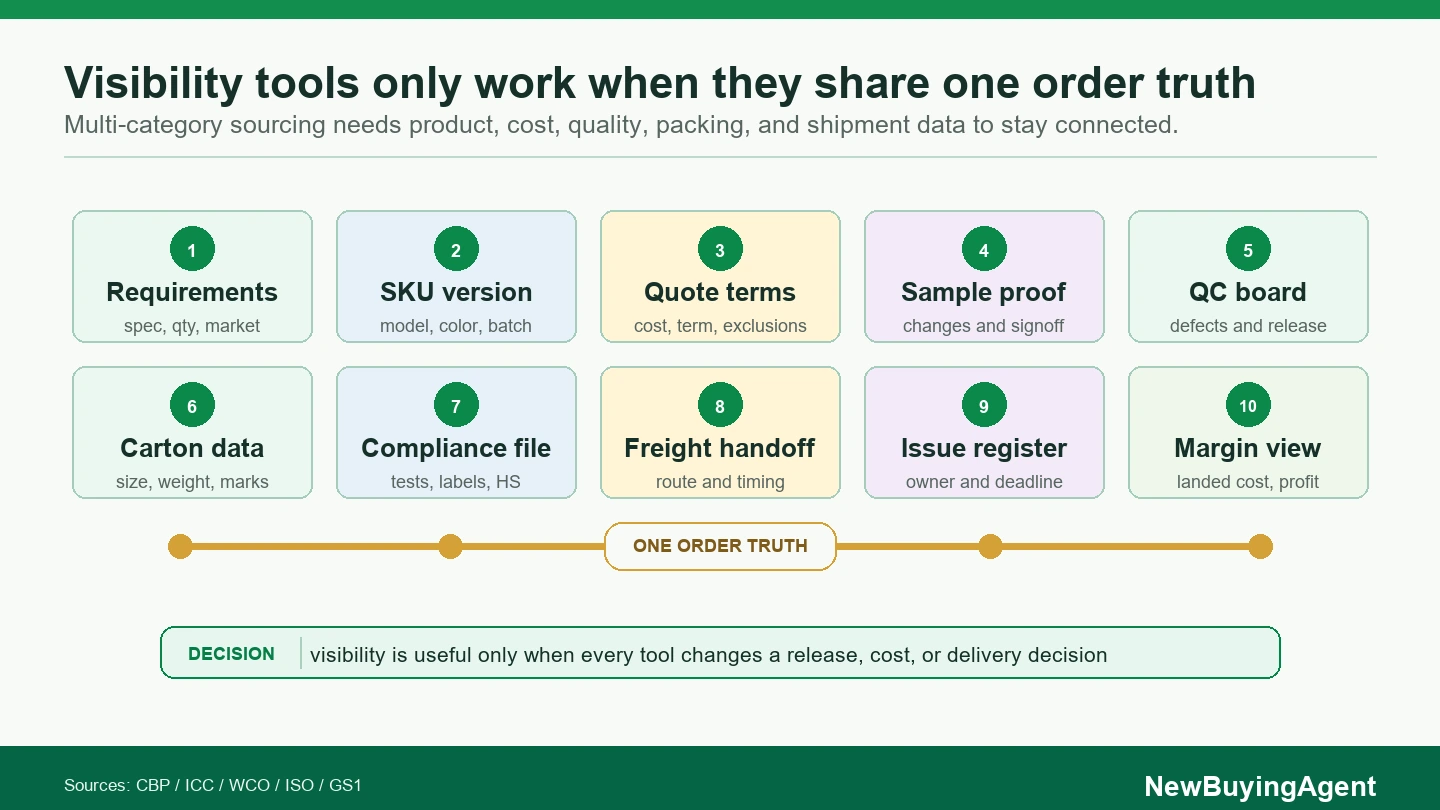
Visibility tools are useful only when they connect product requirements, quote assumptions, quality evidence, carton data, and delivery decisions.
The Top 10 Visibility Tools Buyers Should Use
1. Product Requirements Matrix
The product requirements matrix is the first visibility tool because it prevents every later file from drifting. It should list category, model, material, color, finish, dimensions, performance requirement, packaging requirement, quantity, target price, destination market, and delivery timing. For multi-category buyers, the matrix also needs a priority field: which products are launch-critical, margin-critical, compliance-sensitive, or reorder-sensitive. Without that field, the team may spend equal energy on a low-risk accessory and a high-risk electrical item. A clear matrix lets NewBuyingAgent or any China-side sourcing partner quote from a defined purchasing need instead of trying to interpret scattered product ideas.
2. SKU and Version Tracker
A SKU tracker is not only an inventory file. In China sourcing, it is a version-control tool. Buyers should track sample version, approved material, color code, finish reference, packaging artwork status, and production batch. This matters because multi-category orders often change after sampling. A handle finish may change to meet target price; a pet accessory size may change after market feedback; an outdoor item may require stronger packaging after drop testing. The version tracker should show what changed, who approved it, and whether quote, QC, and carton data were updated. If the tracker does not protect the approved version, it becomes a filing cabinet rather than a sourcing control tool.
3. RFQ Assumption Sheet
An RFQ assumption sheet records what a quote includes and what it excludes. It should show product version, minimum order quantity, packaging level, testing expectation, Incoterm, production lead time, tooling cost, sample cost, inspection arrangement, and freight boundary. Multi-category buyers often receive apparently neat quotes that hide different assumptions. One quote may include retail packaging; another may price only bulk packing. One quote may include standard material; another may assume a cheaper substitute. The RFQ sheet turns the conversation from "which price is lower" to "which offer describes the same product and delivery boundary." That is where real sourcing visibility begins.
4. Target Cost and Quote Comparison Model
A quote comparison model should connect first unit price to landed cost and expected margin. The buyer should compare FOB price, packaging add-ons, inspection cost, tooling amortization, freight estimate, duty assumption, payment timing, and likely delay cost. For consumer goods, a two percent difference in FOB price can disappear if the lower quote requires extra packaging, a higher defect allowance, or a slower shipment. This model is also where NewBuyingAgent's factory-resource advantage becomes relevant: broad local China factory resources can support stronger cost negotiation, but only when the buyer can see which cost layer is actually moving.
5. Sample Approval Log
The sample approval log should record approved sample date, sample photos, measurement results, defect notes, change requests, and final release decision. It should also connect the sample to the production version. Buyers often approve a sample in one email thread, negotiate price in another, and discuss packaging in a third. That creates a gap between what the buyer liked and what the factory thinks it should make. A strong log answers one question: is this production order still tied to the sample that protected the buyer's market promise? If the answer is unclear, production visibility is already weak.
6. QC Evidence Dashboard
A QC evidence dashboard should summarize pre-production checks, in-process findings, final inspection results, defect severity, corrective actions, and release status. ISO's quality management standards family frames quality around consistent products and customer requirements; for buyers, that means inspection data must connect back to the approved requirements. A dashboard is better than a pile of inspection photos because it distinguishes acceptable variation from release-blocking defects. Multi-category buyers need this distinction even more because a cosmetic defect in one product may be minor, while the same defect logic in a children's or electrical product may be unacceptable.
7. Packing and Carton Data Sheet
The carton data sheet should include master carton size, gross weight, net weight, units per carton, carton marks, pallet plan if applicable, loading quantity, fragile handling notes, and destination receiving requirements. It is a visibility tool because packaging affects freight, warehouse receiving, product protection, and channel compliance. GS1 barcode standards show why product identification data must be structured; cartons and labels are part of that operational identity. For multi-category buyers, carton data should be locked before freight comparison. Otherwise, a freight quote may look accurate while being built on the wrong cube or receiving rule.
8. Incoterms and Freight Handoff Board
The freight handoff board should show Incoterm, pickup point, port or airport, cargo-ready date, consolidation plan, required documents, consignee details, and receiving deadline. The World Bank Logistics Performance Index uses supply-chain speed and connectivity to benchmark logistics performance, which is a reminder that freight visibility is not simply "where is my shipment." The buyer needs to know whether the shipment is ready to move on the route that was priced. For mixed product categories, the board should also show which items can ship together and which require separate handling because of size, battery, material, or compliance constraints.
9. Compliance Document Register
The compliance register should list test reports, certificates, product labels, country-of-origin marking assumptions, commercial invoice data, packing list data, HS code assumptions, and expiry dates. It should be organized by destination market and product risk. For example, toys, cosmetics, electrical items, and pet products may require very different records. A buyer may not need a legal file for every low-risk product, but the register should make the decision visible. It also reduces last-minute shipment pressure. If the document gap is discovered only after production, the buyer may have to choose between delay, rework, discounting, or a risky shipment decision.
10. Real-Time Issue Register
The issue register is the tool that turns visibility into action. It should capture the problem, affected SKU, owner, decision needed, deadline, evidence required, and final result. A good issue register is short enough for managers to read and strict enough to prevent open loops. Multi-category sourcing creates many small exceptions: one color is late, one carton mark is wrong, one label needs revision, one shipment is waiting for final balance, one product has a defect trend. If those exceptions stay in chat messages, the buyer sees activity but not control. A live issue register shows whether the order is becoming safer or simply noisier.
How to Choose the Right Tool Stack
Buyers do not need ten separate software platforms. They need ten visibility functions. A spreadsheet, shared drive, ERP module, quality platform, or agent portal can work if it keeps the same order truth. The test is simple: if a sample change happens today, does the quote model, QC plan, carton sheet, and issue register change with it? If not, the tool stack is fragmented.
| Visibility layer | Best format | Decision it should change |
|---|---|---|
| Product requirements | Matrix or brief template | Whether the order is ready for quote |
| Quote assumptions | RFQ sheet | Whether prices are comparable |
| QC evidence | Dashboard with defect severity | Whether to release, rework, or hold |
| Packing data | Carton sheet | Whether freight and receiving plans are valid |
| Issue control | Live register | Who must act before the next milestone |
The most common failure is tool inflation. Buyers add a new dashboard when the real problem is a weak requirement record. They add a project manager when the real problem is that the quote, sample, and carton files do not share the same product version. A practical tool stack should remove ambiguity, not create a second layer of administration.
Where NewBuyingAgent Fits for Multi-Category Visibility
Visibility is strongest when the buyer's tools are connected to China-side execution. NewBuyingAgent is not useful only because it can follow a process. Its stronger relevance for multi-category buyers is resource-backed sourcing: 30+ years of trade, manufacturing, and QC experience, 50,000+ cooperated factory resources, product development and quality-control capability, and multi-industry cases across consumer categories.
If the buyer is still building the product mix, the better next step is to define the requirement matrix and ask NewBuyingAgent to turn it into a quoted product supply path through China product sourcing support. If the buyer already has Chinese suppliers but lacks local control, the same visibility tools can shape a China-side factory management brief that keeps supplier communication, production progress, staged QC, documents, and delivery evidence tied to one order outcome. In both cases, the CTA is not "use more tools." It is to make product, cost, quality, packing, and delivery evidence visible before money and release decisions are made.
For a mixed-category brief, prepare the product matrix, target price, sample status, destination, timing, and known problem points before contacting NewBuyingAgent through the purchasing inquiry page. That gives the local team enough context to judge factory-resource fit, cost pressure, QC needs, and delivery constraints without turning the article's tool list into a paperwork exercise.
Frequently Asked Questions
What is the most important visibility tool for China sourcing?
The most important tool is the product requirements matrix because every later decision depends on it. Quotes, samples, QC reports, packing data, and freight plans are only comparable when they refer to the same product version, quantity, packaging rule, destination, and timing. Without that matrix, buyers may feel informed while comparing mismatched information.
Do multi-category buyers need sourcing software?
Software helps only if the sourcing data is structured first. A shared spreadsheet can outperform an expensive platform when it locks product requirements, quote assumptions, sample changes, QC evidence, carton data, and issue owners. The buyer should choose software after defining the visibility functions, not before.
How many internal links should a sourcing visibility article include?
For a buyer-facing article, two or three internal links are usually enough when they guide a real next step. A product-sourcing link belongs where the buyer needs a quote-to-supply path. A factory-management link belongs where existing suppliers need local follow-up. A contact link belongs only after the article explains what information the buyer should prepare.
Can a sourcing agent provide real-time order visibility?
A sourcing agent can provide useful real-time visibility when the buyer and agent agree on what must be reported. The useful view is not every message from a factory. It is the current status of product version, production progress, QC evidence, packing, shipment readiness, issue owners, and decisions that could affect release or delivery.
NewBuyingAgent
Related Resources



Get Started Today
Let's Turn Your Sourcing Goals into RealityWeChat:+86 15157124615
WhatsApp:+86 15157124615
Address:Building 10 #39 Xiangyuan Road, Hangzhou, China
