

A China sourcing agent red flag is not just a strange email or an uncomfortable sales call; it is a missing control that can turn price, quality, payment, documentation, or delivery into the buyer's problem after money has already moved. The safest warning signs are therefore operational: unclear quote basis, weak product evidence, vague payment records, poor production visibility, and trade terms that do not explain who carries cost and risk.
The goal is not to assume every agent is risky. The goal is to know when an agent has enough China-side execution capability to turn a purchase need into a supplied product, and when the buyer should slow down before deposit, sample approval, or shipment release.
Key Takeaways
- Definition: A sourcing agent red flag is a missing control in identity, quote basis, quality evidence, payment record, production visibility, or delivery responsibility.
- Highest-risk moment: The warning signs become expensive after deposit, tooling, packaging, or seasonal inventory commitments are already locked.
- Decision rule: A buyer should pause when the agent cannot explain what evidence will exist before production and before shipment release.
- NewBuyingAgent fit: NewBuyingAgent reduces these risks by turning buyer requirements into quoted China-supplied products through local factory resources, product/QC capability, production follow-up, and logistics coordination.
A Red Flag Is a Missing Control, Not Just a Bad Feeling
International trade already contains enough uncertainty without adding a weak agent layer. Trade.gov's due diligence guidance says companies should investigate political, economic, and financial conditions and carefully choose foreign partners to support successful and profitable relationships. That principle applies directly to China sourcing agents: the buyer is not only buying a service, but also trusting a China-side operator to protect the product decision before cost becomes committed.
Good red flag detection focuses on controls. Who is the contracting party? What product version is being quoted? Which quality evidence will be produced? What payment record exists? Which Incoterms rule applies? What happens if the packed lot is not ready? Trade.gov's Incoterms overview explains that Incoterms define responsibilities for shipment, insurance, documentation, customs clearance, and other logistics activities. When an agent cannot explain those boundaries, the buyer may be comparing incomplete offers.
A practical rule helps: if a red flag cannot be converted into a document, milestone, inspection record, or hold/release decision, it is probably still too vague. The 10 warning signs below are ranked by how quickly they can damage margin, inventory, or delivery confidence.
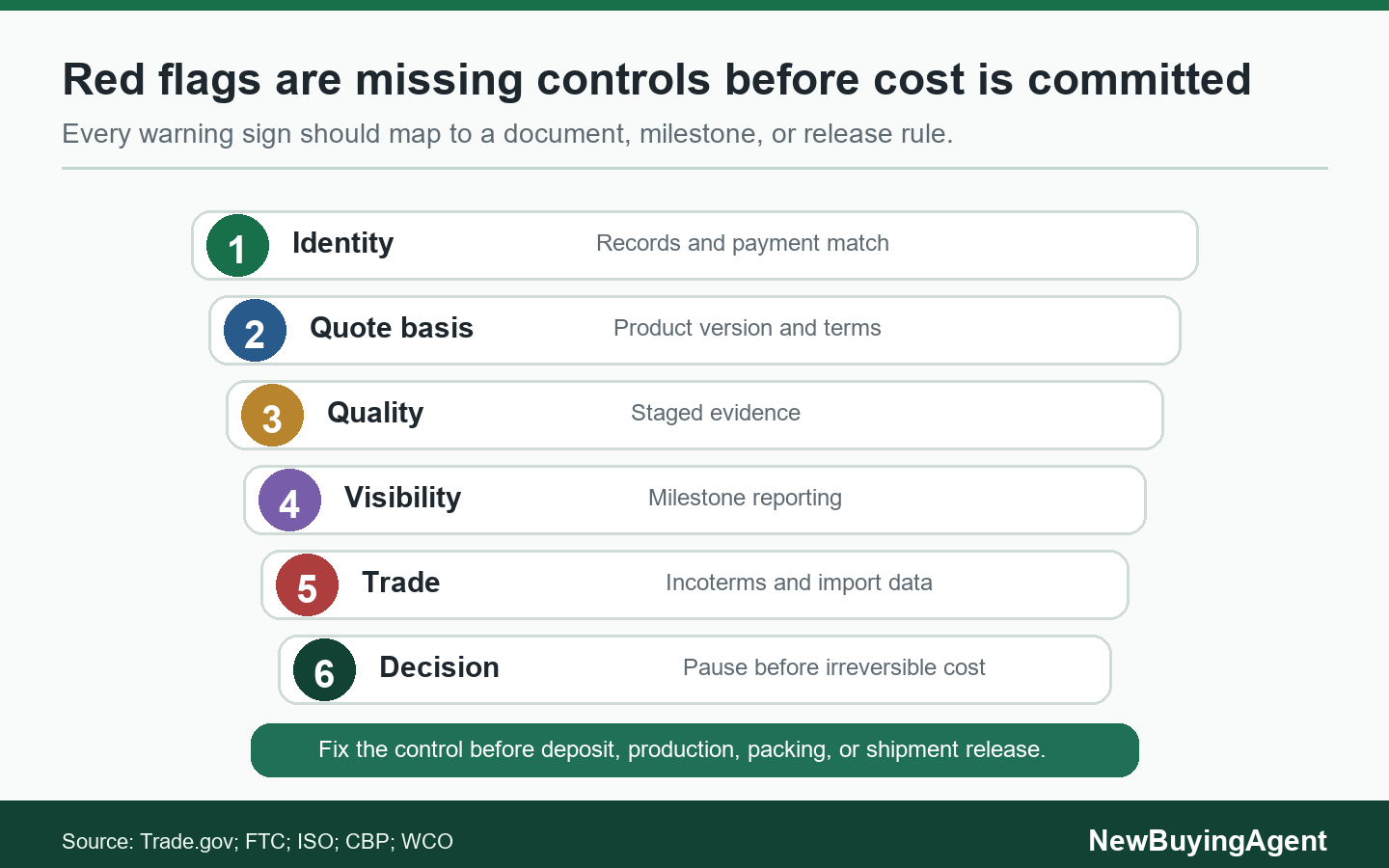
Red flags become easier to act on when each warning sign maps to a missing control: identity, quote basis, quality evidence, payment record, production visibility, or delivery responsibility.
Top 10 Red Flags When Choosing a China Sourcing Agent
1. The Agent Cannot Explain the Quote Basis
The biggest red flag is a quote that looks complete but does not explain what is included. Product version, material, packaging, logo method, carton size, inspection basis, trade term, lead time, and destination assumptions can change the real price. A low number without those assumptions is not a strong offer; it is an unpriced risk transfer.
The buyer should ask what exact product version is being quoted and what would change the price. If the answer stays vague, pause before deposit. A credible agent can explain how product specs, quantity, target price, destination, and timing become a quote. If the agent treats price as a magic number instead of a set of controlled assumptions, the buyer may discover the real cost only after the order is underway.
2. Identity and Business Records Are Hard to Verify
A buyer does not need a legal investigation for every small order, but basic identity and business records should not be mysterious. The agent should provide consistent company information, payment records, contact channels, and contract details. If names, payment accounts, invoice entities, or business descriptions do not match, the buyer should slow down.
The FTC's ReportFraud site exists because scams and bad business practices can cross channels and borders. In sourcing, payment urgency, mismatched records, and inconsistent identity details should trigger a written verification step before money moves. A trustworthy agent should welcome clean records because they protect both sides.
3. Payment Terms Move Faster Than Product Evidence
A deposit request is not automatically suspicious, but payment timing should follow evidence timing. The warning sign appears when the agent asks the buyer to pay quickly while product specs, sample status, packaging, quality control, or delivery basis remain unclear. Money can move in minutes; production recovery can take weeks.
Buyers should ask what evidence exists before deposit, what evidence exists before production, and what evidence exists before shipment release. If payment is the only urgent item, the agent's priorities may not match the buyer's risk. Better payment structure is not only about cash flow; it is also a discipline that keeps product decisions from becoming irreversible too early.
4. Quality Control Is Treated as a Late Formality
Quality control should not begin when cartons are already sealed. ISO 9001:2015 is built around quality management system requirements, and the sourcing lesson is simple: quality is process control, not only final discovery. If an agent treats inspection as an optional final step, the buyer may have no leverage when defects appear.
Ask how quality evidence will be staged. Pre-production confirmation, in-process checks, final-stage inspection, photos, measurement records, packaging checks, and release rules should be proportional to the product risk. For furniture, electronics, outdoor gear, baby products, or products with safety claims, late quality discovery is especially expensive.
5. Product Specs Are Replaced by Generic Photos
Photos help, but they cannot replace specifications. A sourcing agent who relies on nice images without material, size, function, finish, tolerance, packaging, and label details may leave the buyer exposed to sample-to-production drift. The risk is not only that the product is different; it is that the buyer cannot prove what was supposed to be made.
Buyers should turn every critical feature into a written requirement. If the product has a claim, the proof basis should be named. If the product has a color, material, size, load, battery, label, or carton requirement, it should appear in the brief. A serious agent should help convert visual preference into a controlled product version before quoting at scale.
6. Shipment Terms Are Blurry
Shipment terms can hide margin damage. A quote may look cheaper because it excludes freight, insurance, customs clearance, delivery to warehouse, or documentation work. If the agent cannot explain where responsibility transfers, the buyer may be comparing unlike offers.
CBP's basic importing guidance notes that imported merchandise must clear customs and may be subject to duties, taxes, and fees. The WCO Harmonized System overview explains why product classification matters in customs and trade statistics. A sourcing agent does not need to replace a customs broker, but it should make product, invoice, carton, and shipment data clean enough for the buyer's import process.
7. Production Visibility Is Promised but Not Structured
"We will update you" is not a production-control system. A buyer needs milestone visibility: material readiness, production start, mid-production status, packing status, final inspection, loading, and documents. If the agent cannot say what will be reported and when, the buyer may receive bad news only when the order is already late.
Structured visibility matters most for seasonal goods, retail programs, e-commerce launch dates, and project orders. A two-day update delay can be harmless for a simple reorder but damaging when a container cutoff, promotion, or customer delivery date is fixed. Ask for reporting rhythm before the order starts, not after silence becomes a problem.
8. The Agent Sells Absolute Certainty
Claims that sound too absolute are a warning sign. China sourcing can reduce risk, improve price discipline, and improve product evidence, but no serious agent should imply that every order will be the cheapest, flawless, and immune to delay. Strong agents explain controls and boundaries; weak agents lean on certainty language.
The safer question is not whether the agent can promise perfection. It is whether the agent can explain what happens when a sample fails, material changes, production slips, packaging is weak, or the final inspection finds defects. A good answer names the control path. A weak answer repeats confidence without evidence.
9. The Agent Cannot Support Existing China Suppliers
Some buyers already have China sources. The red flag appears when an agent can only discuss new product quoting and cannot help with current production communication, progress follow-up, quality evidence, or logistics coordination. For existing-source orders, the buyer's problem may be China-side execution rather than new sourcing.
NewBuyingAgent's existing supplier management service fits this situation because it focuses on local China communication, production progress, staged QC, real-time reports, official reports within 24 hours, and door-to-door logistics. The buyer should use that kind of support when the production source is already in place but release confidence is weak.
10. The Agent Cannot Connect Product Risk to Market Fit
A product can pass basic quality checks and still fail commercially if the style, bundle, price tier, color, packaging, or channel expectation is wrong. The final red flag is an agent who treats sourcing as only finding a product at a price, without asking whether the product fits the buyer's market.
NewBuyingAgent's AI-driven hot-product analysis and multi-industry case experience are relevant here. Buyers who are unsure which product style or bundle deserves investment can review Trending Products before committing to sampling and production. Market-fit analysis does not replace QC, but it can prevent the buyer from scaling a technically acceptable product that customers do not want.
Red Flag Decision Matrix
| Red flag type | Buyer risk | Evidence to request | Decision rule |
|---|---|---|---|
| Quote basis unclear | Hidden cost and version drift | Specs, packaging, terms, lead time | Do not pay before assumptions are written |
| QC is late | Low leverage after defects appear | Pre-production, in-process, final records | Stage quality checks before release |
| Shipment terms vague | Freight, duty, and clearance surprises | Incoterms, carton data, invoice records | Compare offers on the same delivery basis |
| Visibility weak | Late discovery and missed launch dates | Milestones, photos, reports, escalation path | Define reporting rhythm before production |
The comparison reveals that most red flags are fixable only before the buyer commits money or time. Once deposit, packaging, tooling, or seasonal delivery is locked, the same warning sign becomes a recovery problem rather than a screening problem.
How NewBuyingAgent Helps Buyers Avoid Red-Flag Decisions
NewBuyingAgent is relevant when buyers want a China-side sourcing path that starts from the purchase need and ends in supplied products, not in vague coordination. The buyer shares product specs, volume, target price, destination, and timing. NewBuyingAgent uses local China factory resources, product development and quality-control capability, cost negotiation, production follow-up, and logistics coordination to quote and supply products from China with clearer evidence and execution control.
The safer next step is to prepare a red-flag prevention brief before asking for a quote: product version, must-have materials, target market, packaging needs, acceptable payment rhythm, inspection expectations, delivery term, and launch deadline. Buyers can submit that brief through NewBuyingAgent's contact page when they need a product supply offer, or use the existing supplier management path when the source is already active but China-side visibility is weak.
The strongest sourcing agent is not the one that removes all uncertainty. It is the one that turns uncertainty into visible controls before the buyer's cost is committed.
Frequently Asked Questions
What is the biggest red flag in a China sourcing agent?
The biggest red flag is an agent who cannot explain the quote basis and evidence path. If product specs, packaging, quality checks, delivery terms, and payment timing are vague, the buyer may be accepting hidden cost and quality risk. A low price is not useful until the buyer knows what product version and trade responsibilities it represents.
Should buyers reject an agent after one warning sign?
Not always. Some warning signs can be fixed with clearer documents, better milestones, or revised payment timing. The buyer should reject or pause when the agent resists clarification, cannot provide consistent records, treats QC as late paperwork, or pressures payment before product evidence is ready. The pattern matters more than one awkward answer.
How early should quality control be discussed?
Quality control should be discussed before deposit or sample approval. The buyer should know what will be checked before production, during production, and before shipment release. Late inspection can still find defects, but it gives the buyer less leverage and can create schedule pressure, rework cost, or partial-shipment decisions.
How does NewBuyingAgent reduce sourcing agent red flags?
NewBuyingAgent reduces red-flag exposure by turning buyer requirements into quoted China-supplied products with local factory resources, product/QC capability, production follow-up, and logistics coordination. For buyers with existing China sources, its local management service adds communication, staged QC, real-time reporting, and door-to-door delivery support so release decisions rely on evidence rather than silence.
NewBuyingAgent
Related Resources
Get Started Today
Let's Turn Your Sourcing Goals into RealityWeChat:+86 15157124615
WhatsApp:+86 15157124615
Address:Building 10 #39 Xiangyuan Road, Hangzhou, China
