

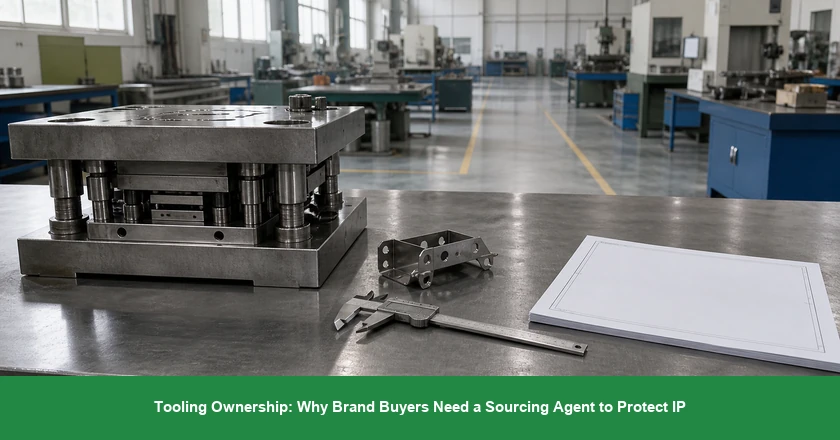
Tooling ownership is not proved simply because a buyer paid a mould, die, fixture, jig, pattern, or production file invoice. It becomes useful when the buyer can identify the actual asset, connect it to the approved product revision, show the agreed use boundary, and reconcile that record before a change, release, or factory transfer. For brand buyers sourcing from China, that evidence chain protects far more than a piece of steel: it protects the product definition that the tool is meant to reproduce.
That is an operational guide, not legal advice. The ownership, enforceability, registration, and dispute questions for a particular product depend on the agreement, jurisdiction, facts, and evidence. Qualified IP and contract counsel should decide those legal issues. The sourcing work described here helps a buyer keep the practical records that counsel, commercial teams, and factories need to see.
What Tooling Ownership Must Prove
Practical tooling control depends on an identified tool, agreed use boundary, approved revision, and physical evidence.
A tool register is a list that identifies each physical tool and connects it to its current product version and records. It gives the buyer a common reference when a factory says a die has been repaired, a sample was made, or a tool is ready to move. Without that reference, an invoice can show payment while leaving the buyer unable to prove what was paid for, where it is, or which version it currently produces.
- Ownership: Identify the asset, serial or tool ID, funding arrangement, and governing agreement.
- Use: State which products, parties, locations, and subcontracting arrangements are permitted.
- Version: Link the tool to an approved drawing, sample, material, finish, and change history.
- Evidence: Keep dated photos, condition records, first-off output, and release or transfer records together.
Use the tool register as the single cross-check before a trial, repair, release, or transfer. It should reconcile the physical identity, written boundary, approved revision, and dated evidence rather than leaving those records in separate email threads.
| Record | What it establishes | When to recheck it |
|---|---|---|
| Tool identity | Which physical mould, die, or fixture is being discussed | First trial, repair, transfer |
| Written boundary | Ownership, permitted use, access, maintenance, and handover expectations | Before making tooling and when the relationship changes |
| Approved revision | Which product definition the tool is allowed to produce | Every proposed modification |
| Dated evidence | Condition, location, output, and current release status | Before release or movement |
For a documented new-product brief, NewBuyingAgent can help connect local China factory resources and product development and quality-control capability to the evidence a buyer needs before the supplied product moves forward. Its role is China-side sourcing support, while the buyer and qualified counsel retain IP and contractual decisions.
Separate the Assets That Are Often Blurred Together
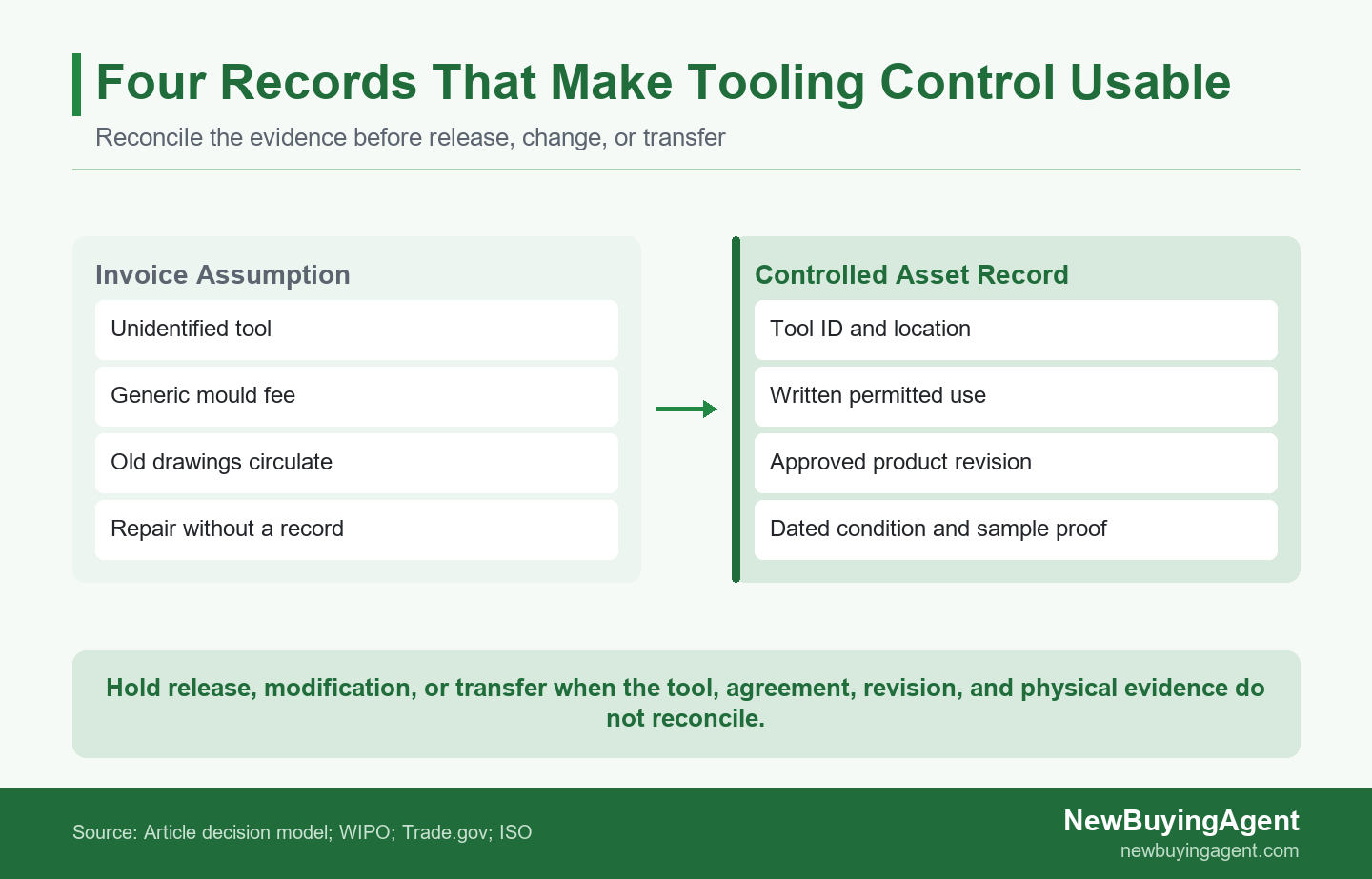
Four-step flow linking tool ID, written use rules, approved revision, and dated evidence before a tooling decision
Trade.gov advises companies to plan IP protection early and keep original documentary evidence when operating in China. That is a useful starting point for tooling work because a buyer usually needs several assets to agree, not one catch-all ownership label. A logo, a confidential CAD file, a patentable feature, a steel die, and a production sample can each create a different risk and a different record requirement.
WIPO explains that trademark rights are territorial and are protected in the countries or regions where they are registered. Brand identifiers therefore belong in the buyer's wider IP plan, rather than in a factory email alone. Packaging artwork, logos, and product marks should be controlled as named files with approved versions and authorized recipients.
Patents are a distinct IP category and do not replace confidentiality controls or physical-tool records. A patent strategy may matter for an invention; it does not by itself identify which die is in a particular factory, which drawing it follows, or whether the factory may modify it. Treat legal protection and factory evidence as complementary layers.
Design files and confidential know-how
WIPO describes trade secrets as commercially valuable confidential information subject to reasonable steps to keep it secret. In plain language, a trade secret is valuable information kept confidential through protective steps. Drawings, tolerances, bills of materials, test methods, process notes, and packaging artwork may need controlled access. Decide which revision is approved, who may receive it, how it is transmitted, and whether any external party needs a limited, documented use right.
Access control is not a substitute for a contract, and a contract is not a substitute for version control. Both are more useful when the buyer distributes one named revision, records the recipient, and avoids letting old files continue through chat groups after a new version is approved. That discipline also makes it easier to explain what information was shared if a commercial question appears later.
Physical tools and production evidence
A physical tool should carry a visible identity and a record of its location, condition, and linked product version.
Ask for a durable ID or label that is practical for the tool, dated photographs that show the ID, the factory location or storage point, and a condition record before a trial, repair, or transfer. Link the record to the part number and drawing revision, not merely to a broad product nickname. A photo of an unmarked die may show that something exists, but it rarely proves which version it is or whether it is the asset covered by the agreement.
Put Ownership and Use Boundaries in Writing Before Tooling
CIETAC publishes arbitration rules and institutional information, illustrating why dispute-resolution language should be chosen deliberately with qualified counsel. The buyer's agreement should be tailored for the transaction and should name the exact assets covered, who owns them, permitted product use, confidentiality, access, storage, maintenance, modification approval, subcontracting limits, and the process for return or transfer when the relationship ends.
Do not assume a line reading “tooling fee” answers those questions. It may not say whether the factory can run the tool for another customer, whether a replacement insert needs approval, who pays for ordinary maintenance, or how a tool must be packed and released if production moves. A buyer should ask counsel to translate the commercial intent into appropriate contract language before paying for new tooling. The factory-facing record should then use the same asset names and revisions as the agreement.
Make Change Control the Bridge Between IP and Production
ISO 9001:2015 specifies quality-management requirements for consistently meeting customer and applicable requirements. That does not prescribe a buyer's tooling clause or prove a factory is suitable. It does support the practical discipline of keeping requirements and changes controlled rather than relying on an informal “same as before” message.
A concise change notice can do most of the work. Record the previous revision, proposed change, reason, affected orders or tools, sample or measurement evidence, decision owner, and whether production may continue while the decision is pending. Include changes to steel grade, cavity count, texture, coating, dimensions, material source, process route, packaging, or any feature that could change fit, performance, appearance, or compliance evidence.
Change control is especially important when a factory proposes a “small repair.” The buyer needs to know whether the repair alters the tool only, changes the product output, or affects a defined batch that must be held. If the answer is unclear, treat it as an evidence gap, not as a reason to accelerate production.
Verify the Record at Three Production Moments
Trade.gov describes product description, quantity, price, weight, and specifications as information used in a pro forma invoice. The exact documents used in a transaction will vary, but the buyer should keep the agreed product description visible in its commercial record and connect it to the current drawing and release evidence.
Before the first trial
Before the first trial, the buyer should align the approved revision, tool ID, acceptance criteria, and authorized contacts.
Confirm what the tool is expected to make, which files are current, which critical features will be checked, and who can approve a deviation. The buyer does not need to inspect every technical detail personally, but the decision record should make clear whether a first sample is for appearance, dimensional fit, function, or a limited trial. That distinction prevents a prototype from being treated as a broad production release. The decision rule is simple: a trial may answer a narrow question only when the record says exactly which question it answers and what it does not yet prove.
After the production-representative sample
A production-representative sample needs a stated measurement method and recorded result, not just a photograph.
NIST's length-unit guidance is a reminder that a measurement only becomes comparable when the unit and method are clear. For a custom part, the buyer should link key dimensions or functional checks to the sample record, the gauge or method used, and any permitted deviation. If the sample is hand-finished or uses a temporary process, label that limitation rather than treating the result as proof of mass-production capability. In practice, a result that cannot be linked to a method, a revision, and a production-representative condition should remain a learning record, not a release record.
Before release or transfer
Before release or transfer, the current revision, tool condition, storage location, and agreed handover evidence should reconcile.
Check that photographs show the stated tool, the condition matches the record, the current product version is identified, and any approved change is attached. If documents conflict, hold the affected release until the buyer can reconcile them. A transfer is much easier when the asset register, agreement, invoice, change history, and physical record tell the same story. The key insight is that a tool can be physically present yet commercially unusable when the buyer cannot connect it to a controlled product definition and an agreed handover path.
Illustrative Scenario: A Die Exists, but the Released Version Is Unclear
An invoice and informal photos may leave a buyer unable to confirm what tool exists or which product version it can produce.
For context on the kind of China-side support that can sit around a project like this, readers can review NewBuyingAgent success stories. They are not evidence for this illustrative scenario and do not replace project-specific legal or technical review.
Reconcile before repair or transfer
The corrective sequence is to identify the tool, align it with the current revision, document the proposed change, and verify the next sample.
A brand is moving a metal accessory program after repeated fit complaints. A 2,400-unit repeat order uses 1 stamping die and 2 current product revisions. The factory has photos of a die, but no visible tool ID or linked revision record.
The invoice says only “mould fee” and names no drawing revision. Photos show a die but not its storage location or condition. The factory proposes a repair, but the buyer cannot tell whether the problem comes from the die, strip material, process settings, or an older drawing.
The right response is not to argue over a photo or authorize a repair by chat. Hold irreversible die work, request dated ID-visible images and condition notes, reconcile the tool to the current approved drawing, and identify the proposed modification. That creates a factual basis for the buyer and counsel to decide the commercial and legal path.
After written approval, the buyer requests a sample made from the recorded tool and checks it against the agreed revision before releasing the affected 2,400-unit order. This is an illustrative control example, not a reported client result or a prediction of any legal outcome.
Where NewBuyingAgent Fits in Tooling-Control Work
NewBuyingAgent can provide China-side continuity for product evidence and factory communication while the buyer and qualified counsel retain IP and contractual decisions.
For a new product, the useful starting point is a documented purchasing need: the product purpose, current drawing or sample revision, tool status, material and finish notes, quantity, target price, destination, timing, and the evidence needed before release. Its local China factory resources and product development and quality-control capability are relevant because the evidence must stay connected to the product being quoted and supplied—not because the sourcing agent decides the buyer's IP rights.
Begin by separating open questions from fixed requirements. A buyer may know that a mould must deliver a particular appearance or fit while still needing a technically supported recommendation about process, material, or sample evidence. That is a useful sourcing question when it is described honestly. The tool record should state what is known, what has been approved, what evidence remains required, and who can release the next change. It should not present an unverified factory statement as a final product decision.
NewBuyingAgent's broader resource base can help a global buyer discuss a China-supplied product around price, quality, market fit, and delivery, while the buyer keeps control of the commercial brief. The point is not to add another workflow layer. It is to make the local factory conversation work from an identifiable product version, tool record, and evidence requirement, so a manufacturing question does not become an undocumented assumption.
When the buyer already has a China factory, the decision changes. The buyer can use NewBuyingAgent's factory-management service for an existing China factory when local follow-up is needed for production progress, quality evidence, or an agreed handover. In that situation, the factory relationship remains in place. The China-side support can help keep named photos, sample evidence, inspection findings, packing details, and the current status visible to the buyer before a release decision.
That distinction matters for tooling control. An existing-factory problem may be a missing location record, an unclear condition report, or a change that has not been linked to a revised sample. The practical request is to confirm the evidence against the buyer's approved record, not to substitute a new legal interpretation or promise that every factory dispute can be solved on site. The buyer should still direct contract, ownership, registration, and enforcement questions to qualified counsel.
Before requesting support, assemble one concise package: the tool ID or best available identification, current drawing or sample revision, dated photos, factory location, status of any proposed change, quantity affected, destination, timing, and the agreement or decision that needs to be checked. When that package is ready, share the tooling and product brief with NewBuyingAgent.
Frequently Asked Questions
Does paying for tooling mean the buyer owns it?
No, a tooling payment alone may not prove ownership or define permitted use, access, maintenance, and transfer rights. The buyer should have a written agreement reviewed for the transaction and a record that identifies the actual tool, its current product version, location, condition, and evidence. Payment is important, but it is only one part of the chain a buyer may need when production changes or moves.
What should a tooling ownership record include?
A tooling ownership record should identify the tool, current part revision, location, photographs, condition, permitted use, and the agreement that governs it. Add the date of the first trial, the relevant sample or measurement record, any approved changes, and the planned transfer or release process. The record is most useful when its asset name and revision match the buyer's contract and commercial documents.
Can a factory change a mould without written approval?
A factory should not make a change that can alter the agreed product or tool condition without the buyer's written approval and an identified affected scope. A buyer should ask for the old and proposed version, reason, tool or order affected, evidence required, and whether production can continue while the decision is pending. The appropriate contract language and remedies should be determined with qualified counsel.
When is factory management the better sourcing fit?
Factory management is the better fit when the buyer already has a China factory but needs local follow-up on production status, quality evidence, or an agreed handover. For a new product that still needs a quote and supplied-product path, start with a documented purchasing brief instead. Neither route replaces legal advice on IP ownership, registration, contract drafting, or enforcement.
NewBuyingAgent
Related Resources
Get Started Today
Let's Turn Your Sourcing Goals into RealityWeChat:+86 15157124615
WhatsApp:+86 15157124615
Address:Building 10 #39 Xiangyuan Road, Hangzhou, China
