

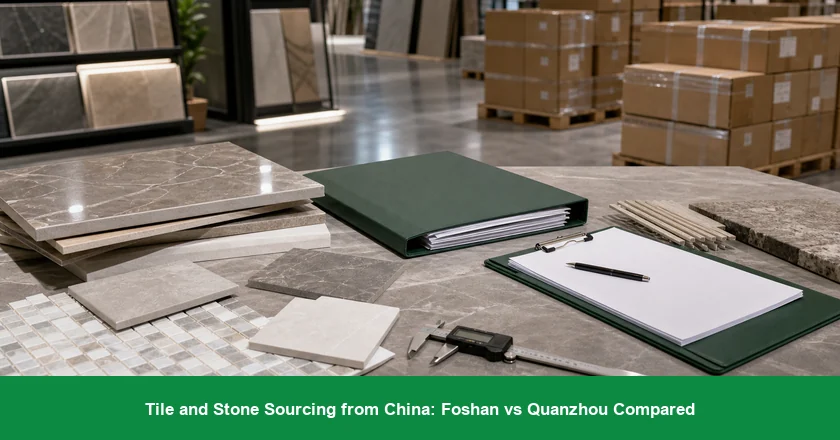
Tile and stone sourcing from China fails when buyers treat Foshan and Quanzhou as interchangeable building-material hubs. The better question is whether the order behaves like a ceramic tile program, a slab program, or a stone fabrication project.
Key Takeaways
- Foshan fits ceramic systems: buyers usually look there for porcelain tile, ceramic tile, slabs, sanitary surfaces, showroom access, and design-format choices.
- Quanzhou fits stone paths: Nan'an/Shuitou is more relevant when natural stone, marble, granite, engineered stone, cutting, and fabrication variation matter.
- The best city is not the cheapest city: compare usable area, breakage, shade variation, cutting yield, packing, freight, and receiving risk.
Foshan vs Quanzhou Is a Material Decision First
A buyer should not start with the city name. Start with the material behavior. Ceramic tile and porcelain slabs are industrial surface products where batch shade, size tolerance, glaze, format, carton strength, and breakage rules matter. Natural stone and marble are geological surface products where block variation, veining, slab yield, resin, cutting, finishing, and installation matching matter.
Based on our analysis, a 1,000-square-meter hotel floor order can look similar on a quote sheet but behave completely differently in production. A porcelain tile program may lose money through shade mismatch and breakage. A marble program may lose money through slab yield, vein mismatch, and fabrication waste. The sourcing city should follow that risk profile.
Foshan and Quanzhou represent different sourcing strengths. China Ceramics City industry information places Foshan inside a core ceramic tile and sanitary ware ecosystem, and SouthCN regional coverage reinforces Foshan's role as a ceramic production and trade hub.
Quanzhou's comparison point is stone depth rather than tile breadth. The China Nan'an Shuitou International Stone Exhibition listing reflects the region's stone-industry concentration, while China Daily coverage of Nan'an stone trade shows why buyers often connect Quanzhou-area sourcing with stone slabs, projects, and fabrication.
The buyer's task is to verify the production promise before treating either cluster as automatically cheaper. Trade.gov due-diligence guidance supports checking supplier claims, and Trade.gov export-document guidance shows why product, packing, and shipment documents must match before release.
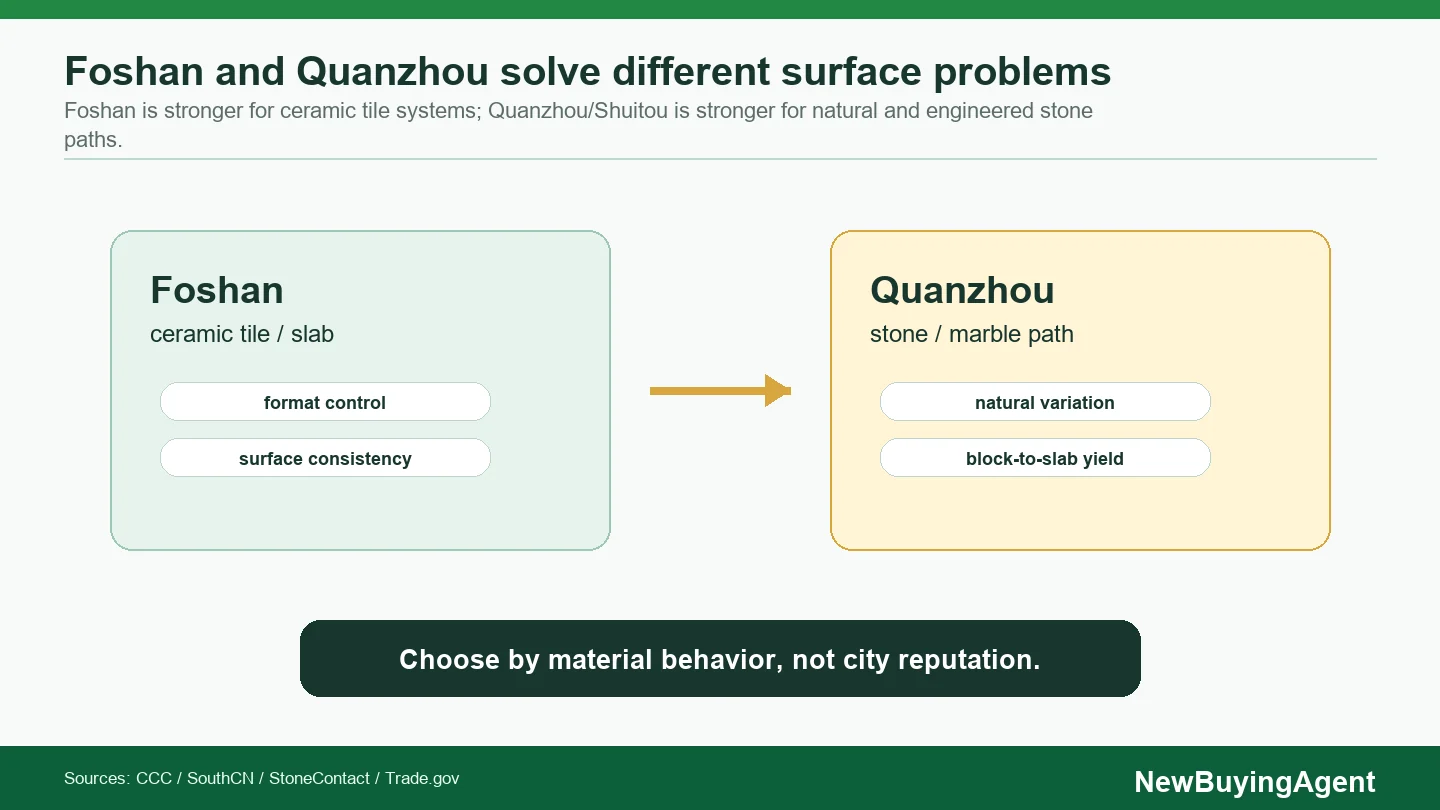
Foshan and Quanzhou should be compared by material behavior, not by city reputation alone.
Where Foshan Is Usually Stronger
Foshan is usually the stronger starting point when the buyer needs ceramic tile, porcelain tile, sintered slab, sanitary surface coordination, design variety, or showroom comparison. The advantage is not just the number of sellers. It is the concentration of ceramic-related product formats, surface choices, and export-facing presentation.
Ceramic tile buyers need format and batch control
For ceramic and porcelain tiles, the buyer should define size, thickness, water absorption class, surface finish, anti-slip expectation, carton packing, pallet method, and shade-control rule before deposit. A tile can look acceptable in a showroom but fail in a project if shade variation, caliber, or carton breakage is not controlled.
NewBuyingAgent's industrial-cluster sourcing access is relevant here because buyers often need a practical product path, not a tour of showroom options. Local factory resources and QC capability help turn a visual sample into a sourced product with price, quality, packing, and delivery assumptions tied together.
Foshan is better when design choice and repeat format matter
Retail and project buyers often need multiple sizes, finishes, and repeatable batches. Foshan is useful when the buyer needs a family of products rather than a single natural stone lot. The buyer should ask whether the selected surface can be repeated across future orders and whether the factory can keep color, format, and packing stable.
The decision rule is to treat the sample as a system. A tile sample is not only color. It includes the body, surface, edge, carton, pallet, and batch code. If those elements are not locked, the buyer may receive a different product even when the model name stays the same.
For commercial orders, buyers should also check how the supplier handles replacement logic. A factory that can produce a beautiful first batch may still create margin loss if it cannot provide spare cartons, identify the same shade family, or explain how a later replenishment will be approved. This is where local factory-resource access matters: the buyer needs a practical route to stable supply, not only a good-looking sample board.
Where Quanzhou and Shuitou Are Usually Stronger
Quanzhou, especially the Nan'an/Shuitou stone path, is usually stronger when the order depends on natural stone, marble, granite, engineered stone, countertop fabrication, wall cladding, luxury surface variation, or cutting-to-size work. The core risk is not only finding a stone. It is controlling how a selected block or slab becomes usable installed material.
Stone buyers need yield and variation control
Natural stone sourcing begins with variation. Veins, color movement, fissures, resin, polishing, thickness, and slab sequence can change the final installed look. A buyer who compares only square-meter price may miss the real cost: unusable areas, extra cutting, rejected slabs, replacement timing, or mismatch at installation.
The practical rule is to compare usable square meters, not quoted square meters. For stone, a lower slab price can become expensive if yield is weak, if the buyer needs book-matched patterns, or if the fabrication partner cannot hold edge, cutout, and finish requirements.
Buyers should ask for photos or video of the selected slab sequence before cutting, then connect that evidence to the piece list. If the project includes countertops, stairs, vanity tops, or lobby panels, the release file should show which slab becomes which finished piece. That discipline prevents the common problem where the buyer approves a material family but receives pieces that do not work together on site.
Quanzhou fits fabricated stone and project surfaces
Hotel, villa, countertop, lobby wall, and high-end project buyers often need a stone path that includes slab selection, cutting, polishing, packing, and replacement logic. The buyer should ask how material variation will be documented before cutting and how finished pieces will be marked before packing.
NewBuyingAgent's product development and quality-control capability helps when the buyer's issue is not a simple quote. A stone project needs evidence around slab identity, fabrication drawings, piece marks, edge finish, packing, and site sequence. Those details protect the buyer from paying for material that cannot be installed cleanly.
The service fit is strongest when the buyer has a market or project requirement but does not have the local time to manage many factory-side decisions. In that situation, the useful advantage is not a list of potential suppliers. It is the ability to translate drawings, target budget, destination rules, and quality expectations into a China-side supply path that keeps material, processing, packing, and delivery aligned.
Foshan vs Quanzhou Comparison Table
The right answer is not "Foshan is better" or "Quanzhou is better." The right answer depends on whether the order is tile-led, stone-led, or mixed.
| Decision point | Foshan fit | Quanzhou / Shuitou fit | Buyer rule |
|---|---|---|---|
| Main material | Ceramic tile, porcelain tile, sintered slab | Natural stone, marble, granite, engineered stone | Choose by material behavior first |
| Variation risk | Batch shade, caliber, glaze, format consistency | Vein, block, slab yield, fabrication variation | Define acceptance before production |
| Cost driver | Format, surface, firing, packing, breakage | Block source, slab quality, cutting, finishing | Compare delivered usable area |
| Best buyer | Retail, project tile, sanitary surface buyers | Hotel, villa, countertop, luxury stone buyers | Do not force one cluster into the other |
The key insight is that mixed surface orders often need two sourcing logics. A hotel project may use Foshan for ceramic bathroom wall tile and Quanzhou/Shuitou for lobby stone. Combining them under one quote without separating quality rules creates confusion.
Mixed orders also change negotiation leverage. Ceramic tile pricing may depend on repeatable model volume, while stone pricing may depend on slab selection, fabrication yield, and crate sequence. Buyers should not push both categories through one average discount target. A better brief separates target price by material family and asks which cost items are controllable in each cluster. This also keeps negotiation honest when one material has room for price movement and the other needs tighter quality protection before deposit, production, and shipment release.
What Buyers Should Check Before Paying a Deposit
For tile, check shade, caliber, carton, and breakage rules
Tile buyers should also ask how the factory separates production lots and how many spare cartons are reasonable for the channel. A distributor may need carton-level consistency for resale, while a hotel project may need replacement pieces after installation damage. The better quote names these realities before payment, because replacement cost is usually highest after the project is already delayed.
A tile order should have a sample reference, shade-control rule, carton quantity, pallet method, and breakage expectation before deposit. If the buyer needs repeat orders, the factory should explain whether future batches can match the approved version or whether new shade approval will be needed.
According to Trade Department shipping guidance, shipping choices affect cost and timing. For tile buyers, this matters because heavy, fragile goods can lose margin through weak packing, poor palletization, or shipment method rather than unit price alone.
For stone, check slab identity, cutting plan, and packing marks
Stone buyers should treat each crate as part of the installation plan. Piece marks, crate lists, and photos should make it easy for the destination team to find the correct panel or countertop without unpacking everything at once. If the shipping file is vague, even good fabrication can turn into receiving confusion, storage cost, and installation delay.
A stone order should show selected slabs, sequence, cutting drawing, piece marks, finish rule, edge detail, and packing method. If the buyer only sees finished photos after cutting, it may be too late to correct material mismatch or fabrication errors without delay and waste.
According to ICC Incoterms rules, delivery terms change risk and cost responsibilities. For stone and tile, buyers should link Incoterms to packing, inland freight, export handling, and destination receiving because the goods are heavy and damage-sensitive.
When to Ask NewBuyingAgent for a Quote
If the order is tile-led, prepare size, surface, thickness, quantity, destination, carton requirement, and acceptable shade variation. If the order is stone-led, prepare material type, slab expectation, drawings, finish, piece list, destination, and packing requirement. Then use NewBuyingAgent's China product supply service to turn those requirements into a quoted sourcing path.
Before sending the brief, separate "must match" and "can vary" requirements. For tile, must-match items may include shade range, anti-slip surface, carton strength, and repeat supply. For stone, must-match items may include slab sequence, finish, thickness, edge, and crate marking. That separation helps NewBuyingAgent judge whether the order belongs in a Foshan ceramic path, a Quanzhou/Shuitou stone path, or a split path.
For repeat project orders, the stronger next step is to send a short material-risk brief through NewBuyingAgent's purchasing inquiry channel. The team can judge whether Foshan, Quanzhou/Shuitou, or a split approach is more likely to protect price, quality, delivery, and buyer margin.
FAQ
Is Foshan better than Quanzhou for tile sourcing?
Foshan is usually better for ceramic tile, porcelain tile, slabs, and showroom-driven surface selection. It is not automatically better for natural stone or marble fabrication. Buyers should choose by material behavior, batch-control needs, and project risk rather than city reputation.
Is Quanzhou better for natural stone sourcing?
Quanzhou's Nan'an/Shuitou path is usually more relevant for natural stone, marble, granite, engineered stone, and stone fabrication. Buyers should focus on slab identity, yield, variation, cutting, finish, packing, and replacement logic before comparing square-meter price.
Can one order use both Foshan and Quanzhou suppliers?
Yes, mixed building-material projects may use Foshan for ceramic tile and Quanzhou/Shuitou for stone. The buyer should separate the QC rules, packing rules, and delivery assumptions for each material path. One combined price can hide very different risks.
What is the biggest cost risk in tile and stone sourcing?
The biggest risk is comparing quoted area instead of usable delivered area. Breakage, shade mismatch, slab waste, cutting errors, packing damage, and delayed replacements can erase a cheaper unit price. Buyers should compare final usable material at destination.
NewBuyingAgent
Related Resources


Get Started Today
Let's Turn Your Sourcing Goals into RealityWeChat:+86 15157124615
WhatsApp:+86 15157124615
Address:Building 10 #39 Xiangyuan Road, Hangzhou, China
