Direct China sourcing can drain 20+ hours a week when the buyer's team becomes the translator, quote auditor, production chaser, QC interpreter, freight coordinator, document checker, and recovery manager. The number is a scenario estimate, not a universal statistic, but it is realistic when the same sourcing exceptions repeat across active orders.
The hidden cost is hard to see because no invoice says "lost sourcing hours." The work hides in message threads, late-night calls, file checks, carton questions, rework decisions, and shipment updates. The Hidden Hours Ledger helps buyers separate normal sourcing decisions from recurring work that should be prevented, delegated, or built into a better China-side operating path.
Key Takeaways
- Definition: Hidden sourcing hours are the internal labor hours spent fixing unclear quotes, weak production visibility, QC gaps, freight uncertainty, documentation issues, and recovery work.
- Scenario estimate: Twenty hours a week equals about $36,400 a year at a $35 fully loaded hourly cost, before rework, delay, or lost sales focus.
- Framework: The Hidden Hours Ledger tracks six time drains from product clarification through shipment recovery.
- Service fit: NewBuyingAgent is relevant when buyers want China-sourced products supplied through local factory resources, product/QC capability, and China-side execution rather than constant internal chasing.
The Hidden Hours Ledger Starts Between Quote and Release
The Hidden Hours Ledger starts with a simple observation: most sourcing time is not spent making one big decision. It is spent carrying small uncertainties from quote to sample, sample to production, production to inspection, inspection to shipment, and shipment to customer commitment. Each uncertainty seems manageable until it repeats every week.
Trade.gov's due diligence guidance encourages companies to investigate potential partners before doing business. In direct China sourcing, that due diligence often turns into scattered work: document requests, capability checks, ownership questions, reference checks, payment caution, and follow-up when answers are incomplete. Without a China-side execution path, the buyer's own team becomes the control system.
Freight terms add another layer of time. Trade.gov's Incoterms overview explains that delivery terms define buyer and seller responsibilities. When those responsibilities are unclear, the buyer may spend hours discovering who owns inland pickup, export handling, insurance, loading, delay cost, or document handoff. The hidden time sits in the gap between a low quote and a reliable landed-cost decision.
The Hidden Hours Ledger does not argue that direct sourcing is always wrong. It argues that buyers should count the coordination burden with the same seriousness they count unit price. If direct sourcing uses 20+ hours every week, the buyer is already paying for a sourcing function. The only question is whether that function is organized well enough to protect margin.
The most useful ledger entries are specific enough to prevent recurrence. "Checked freight" is too vague. "Confirmed carton dimensions after packing because the original quote used estimated cartons" tells the buyer exactly where the next brief must improve. Good time tracking should reveal the cause, not merely the calendar burden.
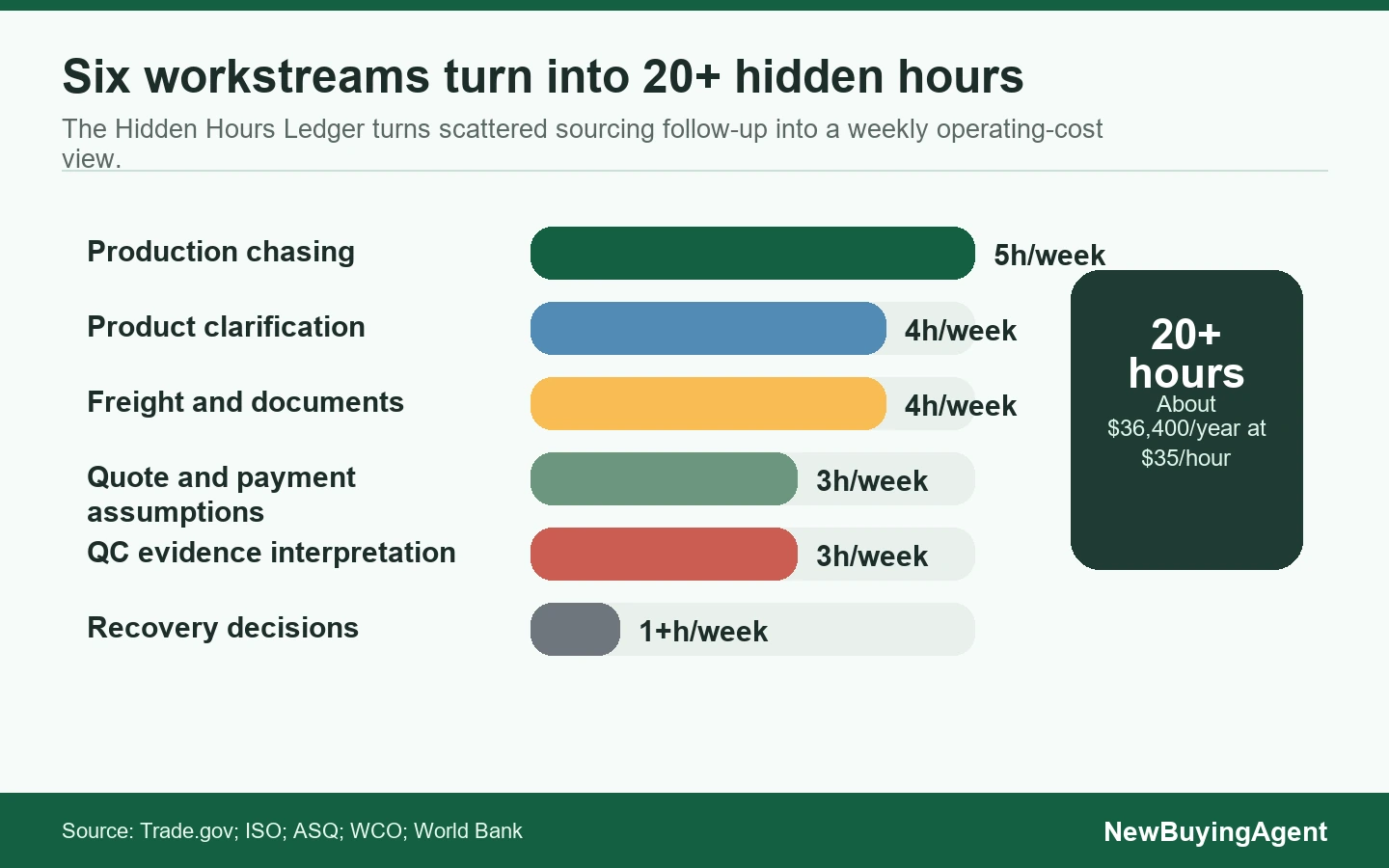
The Hidden Hours Ledger shows how six recurring workstreams can turn direct China sourcing into a 20+ hour weekly operating load.
Where the 20+ Hours Usually Go
Product and version clarification can take 3-5 hours
The first time drain is product clarification. Buyers ask whether the quoted product is the same as the sample, whether the material changed, whether accessories are included, whether color and finish match the approved version, whether packaging is retail-ready, and whether the latest design file was used. None of this is wasted work. The problem is that direct sourcing often requires the buyer to run the clarification loop manually.
When multiple SKUs, colors, cartons, or private-label details are involved, version control becomes a weekly task. A buyer may spend 3-5 hours just keeping the product definition stable. If the product definition is unstable, every later step becomes slower: price, QC, packing, documents, and release.
Quote and payment assumptions can take 2-4 hours
The second drain is quote interpretation. A quote may list unit price but leave uncertainty around tooling, sample fees, material upgrade, packaging, inner carton, outer carton, inspection, inland freight, export handling, payment timing, or shipment basis. The buyer then has to reconstruct the quote into a decision-ready cost picture.
Trade.gov's import tariffs and fees overview explains that duties vary by product and country. That matters because a quote that excludes classification, freight basis, or cost components may be cheaper only until the landed-cost calculation appears. Hidden hours grow when the buyer has to rebuild the cost picture after each revision.
Production chasing can take 4-6 hours
Production chasing is the work buyers expected the factory to make easy: material arrival, line start, in-process status, finish confirmation, packing schedule, inspection date, and shipment readiness. The buyer asks for updates, waits, follows up, translates short answers into internal status, and decides whether the order is still on schedule.
ISO 9001:2015 reinforces the value of planned and controlled processes. Direct sourcing becomes time-heavy when the buyer cannot see whether the process is controlled. The team must then monitor each milestone manually, which can easily consume 4-6 hours in active production weeks.
QC evidence interpretation can take 2-4 hours
QC evidence can save or consume time depending on its clarity. Useful evidence answers a release question: Does the current lot match the approved sample, specification, workmanship level, packaging plan, and defect limits? Weak evidence creates more questions than answers. The buyer may receive photos, short messages, or a report but still lack a decision rule.
ASQ's cost of quality resource is relevant because it shows how prevention and appraisal costs differ from internal and external failure costs. If the buyer saves time before production but spends it after defects appear, the time did not disappear. It moved to a more expensive point in the order.
Freight, tracking, and documents can take 3-5 hours
The fifth drain is shipment coordination. Buyers may need to confirm carton dimensions, gross weight, packing list, commercial invoice, HS code, booking status, pickup date, port handoff, vessel change, tracking update, and arrival expectation. Each item may take minutes; together they become a meaningful weekly workload.
The WCO Harmonized System overview explains why product nomenclature supports customs and trade statistics. The World Bank tracking and tracing LPI indicator also shows that shipment visibility is a recognized logistics capability. Direct sourcing gets costly when the buyer has to manufacture that visibility through manual follow-up.
Recovery work can take the remaining hours
Recovery work is the most frustrating category because it exists only after something went wrong. It includes renegotiating a late order, deciding whether to accept defects, asking for replacements, revising channel commitments, updating customer-service scripts, changing freight plans, or arranging local fixes. Recovery hours often appear after the buyer thought the order was nearly finished.
Trade.gov's import regulations overview notes that many countries require documentation and may have safety, quality, conformity, testing, labeling, or licensing requirements. When these questions are handled late, recovery work can spread across sourcing, logistics, compliance, and sales teams. The hidden hours are cross-functional, which is why they are easy to underestimate.
Scenario Estimate: What 20+ Hours Costs
Assume an active buyer spends 20 hours a week on direct sourcing exceptions: 4 hours on product clarification, 3 on quote and payment assumptions, 5 on production chasing, 3 on QC evidence, 4 on freight and documents, and 1 on recovery decisions. At a $35 fully loaded hourly cost, that is $700 per week. Over 52 weeks, the internal labor cost is about $36,400.
Now add the cost of one avoidable mistake per quarter. If a packaging issue creates $1,500 in rework or replacement cost, and a shipment delay creates $2,000 in channel or warehouse pressure, four quarters can add $14,000. Under these assumptions, the combined annual burden becomes $50,400 before the buyer prices senior attention, customer reviews, or missed product-development work.
This calculation is intentionally conservative and should be replaced with the buyer's own data. The point is not to prove a fixed number. The point is to make direct sourcing time visible enough to compare against a better sourcing path.
| Weekly drain | Scenario hours | Why it appears | Reduction rule |
|---|---|---|---|
| Product clarification | 4 | Version, material, packing, sample drift | Lock specs before price comparison |
| Production chasing | 5 | No reliable China-side milestone visibility | Require current-lot evidence |
| QC and release | 3 | Evidence lacks decision threshold | Define hold, rework, or release rules |
| Freight and documents | 4 | Landed-cost and handoff details are late | Price delivery basis and document needs early |
Based on the ledger, the buyer should not ask whether direct sourcing is theoretically efficient. The buyer should ask whether the current execution pattern is forcing the growth team to operate as a China-side sourcing desk every week.
Where NewBuyingAgent Fits When Hidden Hours Keep Returning
NewBuyingAgent fits when buyers want direct sourcing uncertainty turned into a supplied product path from China. Instead of rebuilding product, factory, QC, and shipment visibility from scattered messages, buyers can place the commercial brief into a quote path supported by local China factory resources, product/QC capability, and China-side execution.
For buyers starting new orders, NewBuyingAgent's product-supply service can reduce hidden hours by putting product selection, quote assumptions, production evidence, QC, and delivery basis into one China-sourced product offer. That does not mean the buyer stops making business decisions. It means the buyer stops spending weekly hours rebuilding the sourcing control system from scattered messages.
For buyers already working with China factories, NewBuyingAgent's factory-management service is relevant when the product source exists but the follow-up load is too high. China-side communication, production progress follow-up, staged QC, real-time reporting, official reports within 24 hours, and door-to-door logistics coordination can shift routine execution work away from the buyer's growth team.
NewBuyingAgent's 50,000+ cooperated factory resources, 20,000+ product development and quality-control expert resources, 30+ years of trade/manufacturing/QC experience, AI-driven hot-product analysis, flexible payment support, and multi-industry case experience matter because hidden hours are rarely caused by one isolated issue. They come from the chain between product fit, price, quality, production, packing, and delivery.
How to Cut Hidden Hours Before the Next Purchase Order
Before the next purchase order, create a Hidden Hours Ledger for four weeks. Record every sourcing exception in one row: date, order, issue, owner, time spent, decision made, and what would prevent it next time. Sort the rows by repeated cause rather than by supplier or SKU. If 60% of the time is caused by unclear product version, freight handoff, or late QC evidence, the buyer has a system problem, not a people problem.
Then decide which work must stay inside the buyer's team. Product strategy, pricing strategy, channel promise, and customer positioning usually stay with the buyer. China-side status evidence, packing proof, supplier communication, shipment coordination, and routine exception tracking may be better handled through a sourcing partner. Buyers ready to compare options can send the order brief through NewBuyingAgent's contact page so the hidden-hour problem can be priced against a real product-supply path.
Frequently Asked Questions
Is 20+ hours a week common in direct China sourcing?
Twenty hours a week is a scenario estimate, not a fixed industry average. It becomes realistic when a buyer handles multiple active orders and repeatedly manages quote clarification, production chasing, QC evidence, freight, documents, and recovery decisions. Buyers should track their own hours for four weeks before judging the cost.
Which hidden sourcing hours are most expensive?
The most expensive hidden hours are usually the ones that happen late: rework decisions, shipment changes, inspection disputes, document corrections, and customer-commitment changes. Early clarification hours may be annoying, but late recovery hours usually carry higher cost because production, freight, payment, or launch plans are already committed.
Can direct sourcing still work for experienced buyers?
Yes. Direct sourcing can work when the buyer has strong product specs, reliable China-side visibility, clear delivery terms, controlled QC evidence, and enough internal capacity. The warning sign is not direct sourcing itself; it is recurring exception work that senior people must handle every week because the operating system is incomplete.
How can NewBuyingAgent reduce hidden sourcing hours?
NewBuyingAgent can reduce hidden sourcing hours by using local China factory resources and product/QC capability to turn buyer requirements into China-sourced products with clearer evidence. Buyers still define the commercial need, but routine China-side execution can stop consuming the team's weekly growth time.
NewBuyingAgent
Related Resources

Get Started Today
Let's Turn Your Sourcing Goals into RealityWeChat:+86 15157124615
WhatsApp:+86 15157124615
Address:Building 10 #39 Xiangyuan Road, Hangzhou, China