


A SPOC communication architecture for multi-category China sourcing is a controlled route linking the buyer with the operating parties, not a promise that one person performs every task. It classifies the update, ties it to the record that governs the next action, reaches only the affected audience, and shows acknowledgement when work depends on receipt. Buyer agreements still set the actual decision rights and formal notices.
When a buyer sources several categories from China, the communication problem is rarely a lack of messages. It is that an instruction, a routine factory update, a request for buyer approval, and a link from one factory’s task to another’s all travel through the same inbox or chat. Each recipient then has to guess what changed, which file is current, and whether a response is required.
A SPOC Architecture Is a Routing System, Not One Person Doing Everything
A SPOC architecture gives every material message one route, one governing record, and one controlled audience. Here, SPOC means a single controlled route between the buyer and the operating parties. A buyer should be able to see where an instruction belongs, which current file or record controls it, who must know, and whether anyone has acted. The role may be held by one named contact or supported by a small team; the route should remain usable if people change.
- Classify before forwarding. An instruction, a status update, a decision request, and an exception do not need the same recipients or proof.
- Name the governing record. The latest chat message is context; the named current record is what controls the next action.
- Route by impact. Include a factory, category owner, or buyer approver because the update affects their work or choice—not because they are on a habitual group thread.
- Use acknowledgement deliberately. Receipt, understanding, and completed action are different states, especially when one factory’s work enables another’s.
The result is not more administration for its own sake. It is a shorter path from a material update to the appropriate next action, with less risk that a buyer decision becomes lost in routine factory traffic.
Start With a Message Map, Not a Shared Inbox
A message map stops different kinds of information from being treated as interchangeable factory updates. Start by assigning a purpose to every material message. If it changes the work, it is an instruction. If it reports a measured position against an agreed plan, it is a status update. If it asks the buyer to choose among options, it is a buyer-choice request. If it can block a linked task or invalidate the current plan, it is an exception.
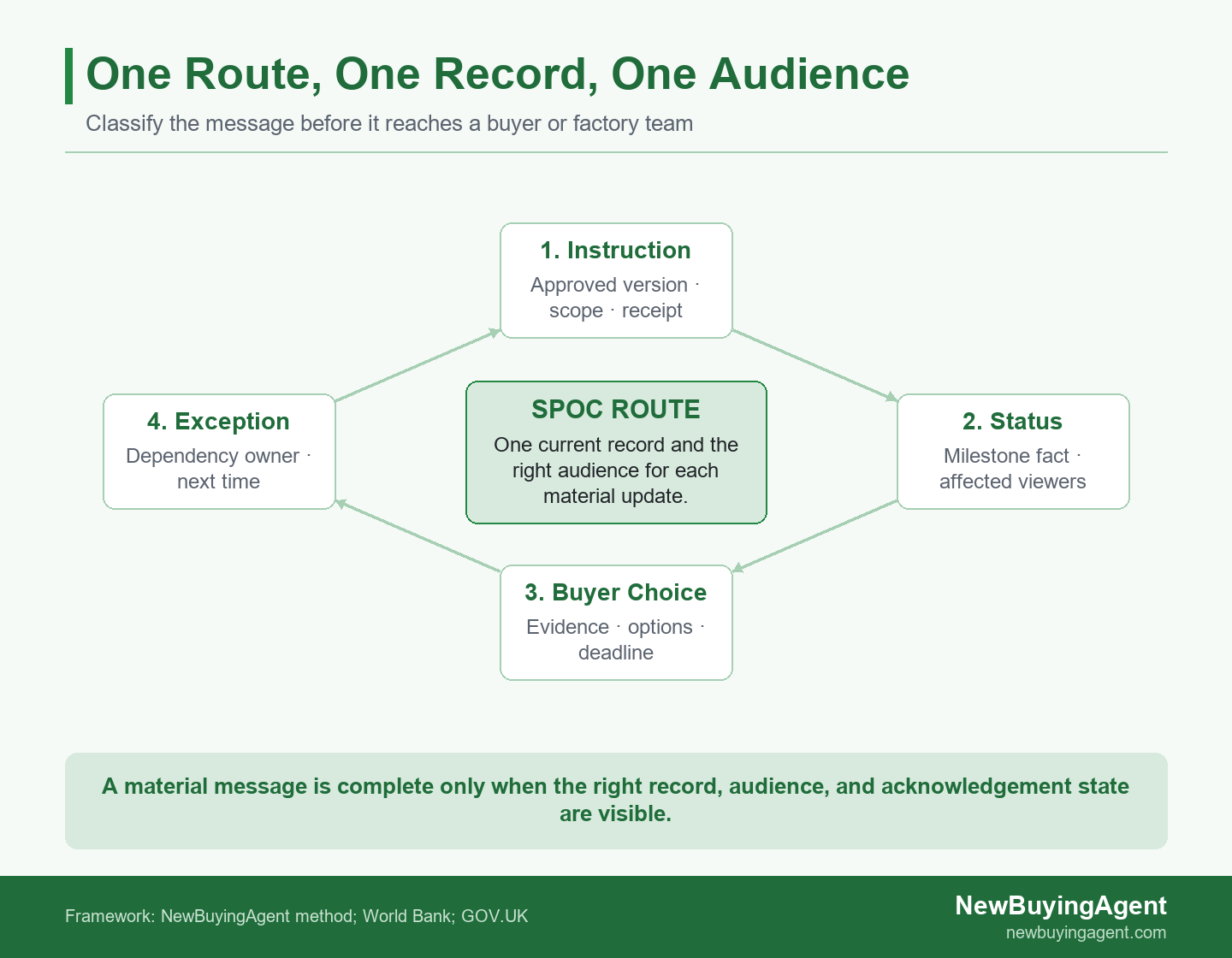
Diagram showing four message routes in a multi-category China sourcing SPOC architecture
GOV.UK guidance says key records should be filed in an agreed central area where appropriate colleagues can access them. Its examples include change-control, risk, governance, and correspondence records. A commercial China sourcing programme does not need to copy a public-sector filing system, but it does need an agreed place for the current order, approved files, dependency log, and buyer decisions.
| Message class | Governing record | Controlled audience | Required signal |
|---|---|---|---|
| Instruction | Approved specification, file, or PO reference | Affected factory and any linked factory | Receipt against version and scope |
| Status | Milestone, production, or booking record | People monitoring the stated milestone | Update posted; action only if a trigger is met |
| Decision | Scoped buyer-choice record and decision log | Named buyer approver and affected operating owner | Buyer response, conditions, and date |
| Exception | Dependency or exception record | Owners of the blocked work and any needed approver | Owner, next action, and response time |
The map can be lightweight. A named shared folder, controlled sheet, project system, or buyer-approved workspace can all work. The important rule is that a message points to a record; it does not become the only record just because it was sent quickly. For a new programme covering several categories, use NewBuyingAgent to source a defined multi-category product requirement from China with those routing inputs established at the brief stage.
Separate Instruction, Status, Decision, and Exception Messages
Instruction, status, decision, and exception messages need different recipients and different evidence. An instruction should identify the affected SKU, category, version, source record, and confirmation deadline. A status update should report a defined milestone and distinguish a verified fact from an estimate. A buyer-choice request should not bury the choice in the final line of a general update; it should state the change, affected scope, evidence, options, and latest useful response time.
Exceptions need the sharpest boundary. They are not simply “urgent” messages. They identify a dependency that cannot move under the current information. For example, a factory waiting for a packaging file may need the buyer’s controlled artwork record; a factory waiting for a carton dimension may need confirmation from another factory. The exception record identifies the blocked work and the person expected to remove the block.
Give Every Route a Source of Truth
World Bank guidance pairs good communication with systematic administration and full, accurate records. A source of truth is the named current record that controls the next action, rather than the last chat message. In sourcing, it may be the approved artwork version, the live order line, the current booking instruction, or the shared dependency record.
Each record needs a small minimum set: identifier, revision date or timestamp, scope, owner, and the next action it controls. A link to that record can travel in email, messaging software, or a meeting note. If recipients have to infer the governing version from attachments or screenshots, the route is not yet controlled. This distinction is especially important when the buyer, sourcing partner, and factory teams operate in different time zones and applications.
Route Updates by Buyer Impact, Not by Factory Habit
Recipient rules should be based on who is affected by the information and who must act next. That rule reduces two familiar failures: copying every factory on a buyer question that does not affect its work, and leaving out the one factory whose next step depends on the update. The sourcing partner can manage the route, but the buyer should still see when a message creates a commercial, product, timing, or release choice.
GOV.UK guidance includes communication and coordination in the plan for day-to-day interaction and internal alignment. That principle fits multi-category sourcing: design the normal route before a linked order creates pressure, rather than adding recipients after competing interpretations already exist.
A useful audience rule has three questions:
- Which category, SKU group, or factory action is actually affected?
- Which person owns the next operating step?
- Does the update require a buyer choice, or only visibility for the buyer?
Only the third question takes the message into a buyer decision path. This keeps routine production or packing visibility from becoming a stream of unnecessary approval requests, while making a real buyer choice clear enough to act on.
Buyers that keep existing supplier relationships can apply the same audience rule without changing commercial ownership. Where China-side coordination is needed across those relationships, see how NewBuyingAgent manages existing China factories.
Create a Shared Route for Cross-Factory Dependencies
World Bank borrower guidance connects a finalised contract management plan with implemented monitoring and evaluation systems. A cross-factory dependency is a task or input at one factory that changes another factory’s next action. For a buyer coordinating several China factories, create one visible dependency record before teams start maintaining competing interpretations.
Use the record where one factory’s input changes another’s work: a packaging factory needs a final product dimension; a bundle assembler needs a confirmed component count; a printed insert depends on a buyer-approved claim; or a booking plan depends on confirmed carton data. The record should name the dependency, source record, affected parties, current state, owner, and next timestamp. It is a shared object, not a chain of copied messages.
Keep Buyer Approval Requests Out of Routine Status Traffic
A buyer approval request should be a separate decision packet when a change needs a buyer choice. The packet needs five components: what changed, the affected scope, the evidence behind the statement, the available options, and a clear response deadline. It should also identify the record that will be updated after the buyer responds.
This is not an account-manager authority model. The routing function may gather facts, compare scope, and ask the right people to respond. It should not turn an unclear reply, an emoji in a group chat, or a factory’s proposal into a buyer approval. A clear packet preserves speed precisely because it prevents a decision from being re-opened later by someone who was not aware of its scope or condition.
Use Acknowledgement Rules to Expose a Broken Route
Acknowledgement rules make a route testable by separating received, understood, and acted-on states. “Seen” can be enough for a low-impact status update. A revised packaging instruction needs a confirmation that the factory has identified the correct version and affected scope. A cross-factory dependency needs an action state: waiting, in progress, confirmed, or blocked.
GovS 008 says supplier performance-management information should be available to relevant stakeholders. The relevant word matters. A buyer does not need every factory conversation. The buyer does need a reliable view when a fact affects the choice the buyer must make, the date the buyer has committed to, or the scope that another party is relying on.
Set acknowledgement expectations in advance. For example, require a version-and-scope confirmation before an instruction becomes active; require a named owner and next update time for a blocked dependency; and require a buyer response to be recorded before a decision packet is closed. If the expected signal is missing, the route has failed visibly. The team can repair the path before the missing message becomes an untraceable assumption.
Illustrative Scenario: A Packaging Claim Update Across Four Categories
A packaging update can use different routes for a factory instruction, no-change confirmations, and a buyer decision. Consider a retailer launching 120 home-office accessories from four China factory teams: desk organisers, cable-management products, lighting accessories, and printed pack-in cards. The retailer revises one packaging claim for 36 cable-management SKUs after approved purchase-order files are already in use.
FAR Part 4 says contract files should provide a complete history that supports informed decisions and later review. In this illustrative sourcing scenario, that record history starts with a scoped question: does the new claim affect only the printed card for the 36 specified SKUs, or does it change cartons, labels, products, or any of the other 84 SKUs as well?
Three factory teams have received a forwarded chat message. The printed-card factory has a print gate approaching, but the other three factories only need to know whether their physical product or carton instruction changes. The forwarded message includes the new wording, but not the SKU scope, file version, or an explicit no-change statement. The buyer has not received a scoped choice request; it only sees several factory updates that appear related but do not tell the same story.
One Update, Three Different Routes
This illustrative example tracks 120 home-office accessories across 4 factory teams. Its affected scope is 36 specified SKUs, 1 card-file version, and 3 no-change confirmations. A routing loop closes only when scope, record version, required recipients, and the buyer response match. The sourcing partner creates one dependency record with the 36-SKU list, current card-file version, print-gate time, and links to the live order lines. Route one is an instruction to the printed-card factory: update only the approved card file for the named SKUs and confirm the version before print. Route two is a no-change confirmation to the desk-organiser, lighting-accessory, and unaffected cable-product teams: confirm that no product or carton instruction changes under this update.
The third route is a buyer choice request. It states that the revised wording applies to the 36 listed SKUs only, that the other 84 remain on the original version, and that an expanded scope would require a new controlled request. Once the buyer approves that scope, the partner records the date and conditions. The loop closes after the printed-card factory confirms the new file, the three other teams confirm no affected instruction, and the buyer-facing record shows the decision. The architecture has not approved a claim on the buyer’s behalf; it has made the exact scope and route visible.
Set Up the Architecture With a Buyer Communication Brief
A communication brief should name categories, factories, live records, approvers, channels, and cross-factory dependencies. Add the primary operating language, approval time expectations, and the conditions that require a buyer decision rather than routine visibility. This gives a sourcing partner enough information to configure routes before multiple threads take on a life of their own. Buyers can review NewBuyingAgent public cases as partner-evaluation context.
For each active category, prepare the product or SKU group, factory contact, current PO or order reference, controlled files, next milestone, and any linked factory input. Then name the buyer role that can decide a scope, cost, timing, product, or release trade-off. The purpose is not to impose a rigid communication tool. It is to make the route dependable even when tools, people, and factory workflows differ.
Also agree the working protocol before the first order update. State which channel can carry a quick notification, where the governing record sits, and which messages require a version-and-scope reply. Give every category a normal status route, but reserve the buyer-choice route for changes that need an actual approval. For a shared dependency, name the upstream factory, the downstream factory, the record they both use, and the time at which the route must be reviewed if no confirmation arrives.
Keep the brief current as categories are added or roles change. A three-minute update to a factory list or approver map can prevent an otherwise well-run project from falling back to disconnected group messages. The buyer does not need to prescribe every conversation. It only needs to make the routes for instructions, shared dependencies, and buyer choices discoverable before they are needed.
Treat each agreed route as a living operating record, and review it when categories, contacts, or channels change.
When your multi-category sourcing brief is ready, include the categories, factory list, current records, approvers, channels, and dependencies you want to coordinate, then send NewBuyingAgent a multi-category sourcing communication brief
Frequently Asked Questions
Does a SPOC have to be one named person?
An effective SPOC does not have to be one named person, because the controlled route, record, and recipient rule must survive staff changes. One person may operate the route day to day, while specialists contribute technical, packaging, logistics, or quality information. The design fails only when the route exists solely in one person’s memory or private inbox.
Can a buyer still speak directly with factories?
Buyers can speak directly with factories when material conclusions return to the agreed route for the people whose work or choice changes. Direct technical clarification can be efficient. The sourcing partner’s role is not to block useful contact; it is to make a material conclusion visible to every party whose next action depends on it.
What makes a factory update a buyer decision?
A factory update becomes a buyer decision when it asks the buyer to choose among options or accept a change to an approved requirement, cost, date, scope, or claim. The request should say exactly which choice remains open and what happens if a response is late. It should not rely on a general status email to imply approval.
Can this architecture work with existing China suppliers?
Yes. Existing supplier relationships can keep their commercial structure while using a shared message map, source record, and dependency route for cross-factory work. Start with the orders and files already in use, then agree which messages must return to the shared record. The buyer can introduce the architecture gradually, beginning with the dependencies that create the most confusion.
NewBuyingAgent
Related Resources


Get Started Today
Let's Turn Your Sourcing Goals into RealityWeChat:+86 15157124615
WhatsApp:+86 15157124615
Address:Building 10 #39 Xiangyuan Road, Hangzhou, China
