

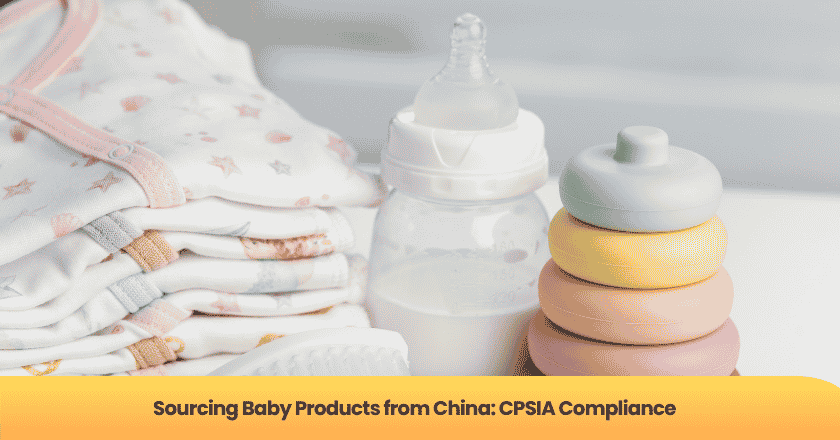
Baby products is a high-trust, low-tolerance category. A single CPSIA failure on a children's product can mean forced recall, $100K-per-violation penalties, Amazon listing removal, and brand damage that takes years to recover. The testing budget is the price of admission, not an optional line item.
Key Takeaways
- Baby and children's products sold in the US must comply with the Consumer Product Safety Improvement Act (CPSIA), which sets total lead limits at 90 ppm in paint/coatings and 100 ppm in substrate materials, restricts 8 phthalates to 0.1% maximum in plasticized components, and requires Children's Product Certificates (CPCs) for every product.
- Toys specifically must comply with ASTM F963-23 (mandatory for toys manufactured after April 20, 2024). The standard covers mechanical and physical safety, flammability, heavy metal content, and electrical safety for toys with electronic components.
- Testing must be conducted at CPSC-accepted laboratories. Test reports from non-accepted labs are invalid and don't satisfy CPSIA requirements. Testing cost: USD 500–1,800 per SKU for initial certification, with periodic batch testing required for ongoing production.
- For EU markets, EN 71 covers mechanical/physical safety (EN 71-1), flammability (EN 71-2), and heavy metal migration (EN 71-3). Plus REACH compliance for chemicals and CE marking for legal market access.
- Penalties for CPSIA violations: USD 5,000–100,000 per violation, plus mandatory recalls, Amazon listing removal, and potential criminal liability for severe cases. The cost of compliance failure is typically 50–200x the cost of proper testing.
- Major Chinese baby product clusters: Ningbo and Yiwu for general baby goods, Shenzhen for baby electronics (monitors, smart devices), Qingdao for stainless steel and metal items (bottles, sterilizers), Foshan for furniture (cribs, high chairs).
- Tracking labels required on every children's product: importer name, address, contact, batch information, date and place of manufacture. Used to enable targeted recalls.
For US importers building baby and children's product brands, sourcing from China remains structural — the depth of supplier ecosystem, the range of categories covered, and the cost competitiveness make alternatives less attractive for most product types. What's different about baby products is the regulatory environment: this is one of the most heavily regulated consumer goods categories in the US, with non-compliance consequences that can be catastrophic for a brand.
The Consumer Product Safety Improvement Act (CPSIA), signed in 2008, fundamentally changed how children's products enter the US market. Combined with ASTM F963-23 (the current toy safety standard, mandatory for toys manufactured after April 20, 2024), CPSIA imposes mandatory third-party testing, comprehensive documentation, tracking label requirements, and importer accountability that doesn't apply to most other categories. For baby products specifically — items intended for use by infants and young children — the testing requirements are particularly extensive because the regulatory framework assumes maximum protective standards for the most vulnerable consumer group.
This guide walks through what CPSIA actually requires, how testing costs work, what happens when compliance fails, what EU EN 71 adds for European markets, and how to structure a Chinese sourcing program that satisfies the documentation burden. The compliance work is real but tractable — and it's far cheaper than the alternative.
Part 1: What CPSIA Actually Requires
The Consumer Product Safety Improvement Act regulates "children's products" — products primarily intended for use by children 12 years of age or younger. The law sets specific chemical limits, requires third-party testing, mandates documentation, and creates importer accountability for compliance.
Chemical content limits
Lead in substrate materials. Maximum 100 ppm total lead content in any substrate material that's accessible during normal use. Substrate materials include plastics, fabrics, woods, and other base materials.
Lead in paint and surface coatings. Maximum 90 ppm total lead in any paint, coating, or surface treatment. This stricter limit reflects the higher risk of paint chips being ingested.
Phthalates. Maximum 0.1% (1,000 ppm) for each of 8 specific phthalates: DEHP, DBP, BBP, DINP, DIBP, DPENP, DHEXP (DnHP), DCHP. Applies to plasticized components — primarily flexible plastics, vinyl, rubber components.
Cadmium. Various limits depending on product type, with the strictest limits applying to children's jewelry.
Other heavy metals. Limits vary by product type. ASTM F963-23 sets soluble heavy metal migration limits for toys.
Third-party testing requirement
All children's products must be tested by a CPSC-accepted laboratory before being sold in the US. The testing must verify compliance with all applicable children's product safety rules. Self-testing or testing at non-accepted labs does not satisfy CPSIA — even if the lab uses identical methods.
CPSC maintains a database of accepted laboratories at cpsc.gov. The database is searchable by the type of testing required. Major international testing companies (UL, SGS, TÜV, BV, Intertek) typically operate CPSC-accepted labs in China where most production happens; some Chinese-domestic labs are also accepted.
Children's Product Certificate (CPC)
For each children's product, the importer must issue a Children's Product Certificate stating that the product complies with all applicable rules. The CPC must include:
- Product identification (description, model, SKU)
- Importer information (name, US address, contact details)
- Manufacturer information (name, address)
- Place and date of manufacture
- Place and date of testing
- CPSC-accepted lab information
- Reference to specific test reports
- Signed declaration by an authorized person
The CPC must be available to CBP at import and to retailers/distributors throughout the supply chain. Amazon specifically requires CPC submission before listing children's products and may audit the documentation.
Tracking labels
Every children's product must have a permanent tracking label affixed to the product (and packaging where practicable). The label must include:
- Importer name
- US address and contact
- Manufacturing date and location
- Batch or production run identifier
- Material composition information
The purpose is enabling targeted recalls — if a batch is found to have safety issues, the tracking label allows precise identification of affected products without recalling the entire SKU history.
Part 2: ASTM F963-23 for Toys
For toys specifically (a subset of children's products), ASTM F963-23 adds detailed safety requirements beyond the chemical content limits.
Mechanical and physical safety
Small parts testing under 16 CFR Part 1501 — toys for children under 3 cannot have small parts that fit through a small parts cylinder (designed to test choking hazard). Testing requirements vary by age grading.
Sharp edges and points testing — toys cannot have hazardous sharp components.
Tension and torque testing — components like eyes, noses, ribbons must withstand specified pull forces (15 lb pull test for plush toys is a key example) without detaching.
Drop and impact testing — toys must maintain safety after typical use scenarios.
Flammability
Soft toys, fabric components, and certain plastics must pass flame spread testing. Different limits apply to different material categories.
Heavy metal migration
Beyond CPSIA's total lead content limits, ASTM F963-23 sets migration limits for soluble heavy metals: antimony, arsenic, barium, cadmium, chromium, lead, mercury, selenium. Migration testing measures how much of these elements would leach out under simulated use conditions (saliva, sweat, ingestion).
Electrical safety (for electronic toys)
Electronic toys must comply with 16 CFR Part 1505 for electrical safety. This covers battery compartments, wiring, electrical components, and electromagnetic compatibility.
The April 20, 2024 transition
ASTM F963-23 became mandatory for all toys manufactured after April 20, 2024. Toys manufactured before that date can comply with either F963-17 or F963-23. For sourcing programs starting in 2026, all production is under F963-23.
The differences between F963-17 and F963-23 include updated heavy metal migration limits, additional testing for cosmetic toys, expanded battery testing requirements, and updates to projectile toy testing. Most products that complied with F963-17 also comply with F963-23 with minor adjustments, but new testing is required for the updated standard.
Part 3: The Realistic Cost of CPSIA Testing
The testing budget is one of the most underestimated cost lines for new baby product brands. Realistic numbers:
| Test type | Typical cost (USD) | Notes |
|---|---|---|
| Lead content (substrate + paint) | 150–400 per material | Multiple materials per product means multiple tests |
| Phthalate content | 200–500 per plasticized component | Required for any flexible plastic |
| ASTM F963-23 mechanical testing | 300–800 per product | Depends on complexity |
| ASTM F963-23 flammability | 200–400 per product | For applicable materials |
| Small parts testing | 100–250 per product | For under-3 product testing |
| Heavy metal migration | 200–500 per material | For toys |
| Tracking label compliance | 50–100 per product | Minor cost |
| Total per SKU initial testing | $500–1,800 | Wide range based on complexity |
For a brand launching 10 SKUs: typical CPSIA initial testing budget USD 5,000–18,000. For a brand launching 30+ SKUs: $15,000–55,000.
Ongoing batch testing
CPSIA requires periodic re-testing to verify continued compliance. The testing frequency depends on product type, production cycles, and material changes. Typical pattern:
New material lot from supplier → testing required
Significant production process changes → testing required
Annual minimum verification testing for stable production
Annual ongoing testing budget: typically 30–60% of initial testing cost.
Cost of compliance failure
The financial math on CPSIA testing makes the budget less debatable when compared to non-compliance consequences:
Civil penalty per violation: USD 5,000–100,000
Forced recall costs: Variable, often USD 50,000–500,000+ for moderate-volume products
Amazon listing removal: Lost revenue from suspended product listings, can be brand-fatal for primarily-Amazon brands
Brand reputation damage: Hard to quantify but sometimes the largest cost
Potential criminal liability: For severe or knowing violations, criminal charges possible
A USD 1,500 testing investment that prevents a $200,000 recall is a 130x ROI. The compliance budget is the price of admission, not an optional cost.
Common Mistake: Brands try to save on testing by using non-CPSC-accepted labs (often Chinese domestic labs that aren't on the CPSC list). The "test reports" they produce are not legally valid for CPSIA compliance — the products are technically untested under CPSIA standards even if they would pass at an accepted lab. When Amazon or CBP audits the documentation, the gap surfaces. The remedy is doing the testing again at an accepted lab, often after products are already in market or production. Use CPSC-accepted labs from the start; don't try to economize on the lab choice.
Part 4: EN 71 for European Markets
For brands selling baby products in Europe, EN 71 is the equivalent regulatory framework. Key sections:
- EN 71-1 (Mechanical and Physical Properties) covers similar ground to ASTM F963-23 mechanical testing. Pull tests, sharp edge testing, small parts requirements. Some specific tests differ in methodology but the protective intent is similar.
- EN 71-2 (Flammability) covers flame spread for soft toys, fabric components, costumes. Methodology differs from ASTM F963 but requirements are comparable in protective effect.
- EN 71-3 (Migration of Certain Elements) covers heavy metal migration testing — similar to ASTM F963 heavy metal migration but with somewhat different element list and limits.
- EN 71-9 (Organic Chemical Compounds) covers various chemical migration tests for products with significant chemical exposure during use.
CE marking
CE marking is the general EU declaration of conformity for products meeting applicable EU safety, health, and environmental requirements. For baby/children's products, CE marking covers EN 71 compliance plus other applicable directives. Self-declaration via the Toy Safety Directive 2009/48/EC (with appropriate testing documentation) — no third-party certification required for most products.
REACH
REACH compliance for chemicals in materials applies to children's products in EU. Specific restrictions on plasticizers, dyes, allergenic substances. Substance of Very High Concern (SVHC) reporting required for certain materials.
UK post-Brexit (UKCA)
UK requires UKCA marking for products sold in UK (in addition to or instead of CE marking, depending on regulatory transition status). The technical standards align closely with EN 71 but the legal marking requirements are separate.
Cost differential vs CPSIA
For brands selling in both US and EU markets, EN 71 testing typically adds 30–60% to total compliance budget. The tests overlap significantly with CPSIA/ASTM F963-23 testing — many test reports satisfy both regimes simultaneously when done at labs accepted in both jurisdictions. Major international labs (UL, SGS, TÜV, BV, Intertek) handle dual-market testing efficiently.
Part 5: Major Baby Product Categories and Sourcing Clusters
Five baby product categories and where they cluster in China.
Baby clothing and textiles
Suppliers: Zhejiang and Guangdong textile clusters (similar to general apparel sourcing).
Compliance: CPSIA chemical limits, lead/phthalate in any decorative components, flammability for sleepwear (16 CFR 1610), tracking labels.
MOQ: 500–2,000 units per design typical.
Baby feeding products (bottles, sippy cups, plates, bowls)
Suppliers: Yiwu and Ningbo for general feeding products, Hangzhou and Shenzhen for premium silicone products, Qingdao for stainless steel.
Compliance: CPSIA + FDA food contact (21 CFR), BPA-free certification expected by US retailers, food-grade silicone certification (FDA 21 CFR 177.2600), tracking labels.
MOQ: 500–2,000 units; lower for stock products with custom branding.
Baby toys
Suppliers: Shenzhen and Dongguan for plastic toys and electronic toys, Yiwu trading companies for variety, specialty clusters for plush toys (Yangzhou is a major plush toy hub).
Compliance: Full CPSIA + ASTM F963-23 + age-grading, heavy metal migration testing, small parts testing, electrical safety for electronic toys.
MOQ: 500–3,000 units typical for OEM; lower for stock products.
Baby gear (strollers, car seats, high chairs)
Suppliers: Ningbo, Foshan (for furniture-adjacent items), specialty manufacturers for car seats. Note: Car seats face specific regulatory requirements (FMVSS 213 in US) that go beyond CPSIA — typically require specialized manufacturers with established US regulatory track records.
Compliance: CPSIA + product-specific safety standards (ASTM F833 for strollers, FMVSS 213 for car seats, ASTM F404 for high chairs), structural testing, durability testing.
MOQ: 100–1,000 units typical; higher for products with complex tooling.
Baby furniture (cribs, changing tables, bassinets)
Suppliers: Foshan furniture clusters with specialization in baby/children's furniture; Ningbo for some categories.
Compliance: CPSIA + product-specific standards (16 CFR Part 1219 for cribs, 16 CFR Part 1234 for bedside sleepers, etc.). E1 minimum formaldehyde for any wood-based products. Lead testing for paints and finishes.
MOQ: 100–500 units typical for cribs; higher for items with complex tooling.
Baby electronics (monitors, smart devices)
Suppliers: Shenzhen and Dongguan electronics clusters.
Compliance: CPSIA chemical + electrical safety + FCC certification + UL safety + privacy compliance for camera devices.
MOQ: 1,000–3,000 units typical for OEM.
Part 6: How Compliance Failures Actually Happen
Five recurring patterns that cause CPSIA failures despite testing being done.
Failure 1: Production drift from tested sample
Brand tests a sample, gets passing test report, scales to production. Manufacturer substitutes a slightly different material lot, slightly different plastic grade, or slightly different paint formulation that wasn't in the tested sample. Production units fail testing even though the sample passed.
The fix: production-batch testing, not just sample testing. Material specifications locked in supplier agreements. On-site inspection verifying material consistency.
Failure 2: Component-level untested parts
Brand tests the assembled product but doesn't separately test individual components (eyes on plush toys, decorative buttons, paint on small accessories). Some components can be made of different materials than the main product and fail individual testing even though the assembled item passes.
The fix: component-level testing for any product with multiple distinct materials or parts.
Failure 3: Outdated or wrong-product test reports
Brand uses test reports from previous similar products or from product samples that aren't representative of current production. CBP or Amazon audit reveals the test report doesn't match the actual product being sold.
The fix: every product gets its own current test report, traceable to the specific production lot. Test report dates and product specifications must align with production.
Failure 4: Tracking label gaps
Product passes all chemical and physical testing but tracking labels are incomplete, illegible after washing, or missing entirely. Technical compliance failure even though the product itself is safe.
The fix: tracking label specifications locked in production specifications. Verification during pre-shipment inspection.
Failure 5: Ongoing batch testing skipped
Brand does initial certification testing at launch, then never tests subsequent production batches. CBP enforcement encounters production from a year after launch with no recent test reports. Compliance failure even if the products would actually pass testing.
The fix: scheduled batch testing program, typically annually for stable products and on-material-change for products with active material updates.
Expert Tip: When working with sourcing agents on baby product programs, ask specifically about their compliance documentation process. Generalist agents who treat compliance as a paperwork exercise (collect test reports, file them, hope no one asks) miss the operational discipline needed for sustainable CPSIA compliance — production-batch testing, material lock-down, component-level verification, ongoing audits. Specialist agents with baby product experience build compliance into the sourcing process from supplier selection forward. The cost difference is small; the risk reduction is substantial. Commission-free sourcing agents who include compliance documentation as standard practice (rather than as extra-cost premium service) are typically the right fit for baby product programs.
Part 7: How to Structure Compliance for a New Baby Product Brand
Five practical steps for setting up CPSIA compliance from the start of a sourcing program.
Step 1: Identify all applicable rules
For each product, list applicable rules: CPSIA chemical limits, ASTM F963-23 for toys, product-specific safety standards (FMVSS for car seats, 16 CFR parts for specific product types), tracking label requirements. Match each rule to specific tests required.
Step 2: Select CPSC-accepted labs
Identify CPSC-accepted labs that can perform the required tests, ideally with operations in or near your manufacturing region (saves shipping samples internationally). Major options: UL, SGS, TÜV, BV, Intertek all have CPSC-accepted operations in China.
Get quotes from 2–3 labs for the initial testing scope. Pricing varies; capability varies less.
Step 3: Specify materials and components in supplier agreements
Material specifications in production agreements should match what was tested. Specify: substrate materials, paint formulations (with specific material certifications from suppliers), component sources (eyes, fasteners, decorative items), any potential substitutions require pre-approval.
Step 4: Build documentation infrastructure from day one
Master file for each SKU containing: product specifications, BOM, supplier documentation, test reports, CPC, tracking label artwork, production records. Maintain in audit-ready format.
Step 5: Schedule ongoing testing
Annual minimum re-testing for stable products. Material-change testing whenever any input changes. Pre-shipment verification testing for high-volume reorders. Build the testing schedule into operational calendar — don't rely on memory.
The Bottom Line
Baby and children's products is one of the most heavily regulated consumer goods categories in the US. The CPSIA framework — third-party testing, Children's Product Certificates, tracking labels, importer accountability — sets a high compliance bar that's non-negotiable. ASTM F963-23 (mandatory for toys manufactured after April 20, 2024) adds detailed mechanical, physical, flammability, and heavy metal migration testing for toys specifically.
Testing costs of USD 500–1,800 per SKU for initial certification represent a real but manageable budget. The cost of non-compliance — penalties, recalls, Amazon delisting, brand damage — typically exceeds the testing budget by 50–200x. The compliance work pays back through risk reduction.
For brands selling in EU markets, EN 71 + REACH + CE marking adds another regulatory layer. The testing overlaps significantly with CPSIA/ASTM F963 testing — major international labs handle dual-market testing efficiently.
Major Chinese clusters cover baby products comprehensively: Ningbo and Yiwu for general goods, Shenzhen for electronics, Hangzhou for silicone specialties, Foshan for furniture, plus specialty manufacturers for high-stakes categories like car seats. Choosing the right cluster + supplier with established compliance infrastructure matters more in this category than in most.
Compliance failures usually happen through operational gaps — production drift from tested samples, component-level untested parts, outdated test reports — rather than through clear rule violations. The fix is building compliance into the sourcing process from supplier selection forward, not treating it as a paperwork exercise.
FAQ
Are CPSIA testing requirements really mandatory for everything?
Yes, for any product primarily intended for children 12 years and younger. Some narrow exemptions exist (small batch manufacturer registration provides limited relief), but the default assumption should be: full third-party testing, CPC, tracking labels for every product.
Can my Chinese factory's existing test reports satisfy CPSIA?
Possibly, if (1) they were issued by CPSC-accepted labs, (2) they cover the exact product specifications you're producing, (3) they're recent enough to reflect current materials and production. In practice, factories' existing reports often fail at least one of these tests. Plan for product-specific testing on your specific orders.
What's the realistic timeline for getting CPSIA testing done?
For typical baby products: 4–8 weeks from sample submission to test reports issued. Faster turnaround is sometimes available at premium pricing. Pre-launch planning should budget for testing on critical path — don't try to compress this into the final 2 weeks before market launch.
Does Amazon really require CPC documentation?
Yes, for children's product listings. Amazon's compliance team audits documentation and may suspend listings without proper CPC and test reports. Some brands have lost their primary revenue channel for weeks while sorting compliance issues. Build CPC documentation before launch, not reactively.
What about EU market — do I need both CPSIA and EN 71?
For products sold in both US and EU: yes, both regulatory regimes apply. The good news: testing overlaps substantially. Major international labs accepted in both US and EU can do dual-market testing efficiently — typically 30–60% additional cost over single-market testing rather than 100% incremental.
What's the most common CPSIA failure I should worry about?
In our experience: production drift from tested samples (manufacturer substitutes materials between sample stage and production), and component-level untested parts (decorative components or small features that weren't separately tested). Both are operational discipline issues, not testing budget issues. The fix is in supplier management and inspection, not in testing scope.
NewBuyingAgent
Related Resources
Get Started Today
Let's Turn Your Sourcing Goals into RealityWeChat:+86 15157124615
WhatsApp:+86 15157124615
Address:Building 10 #39 Xiangyuan Road, Hangzhou, China
