

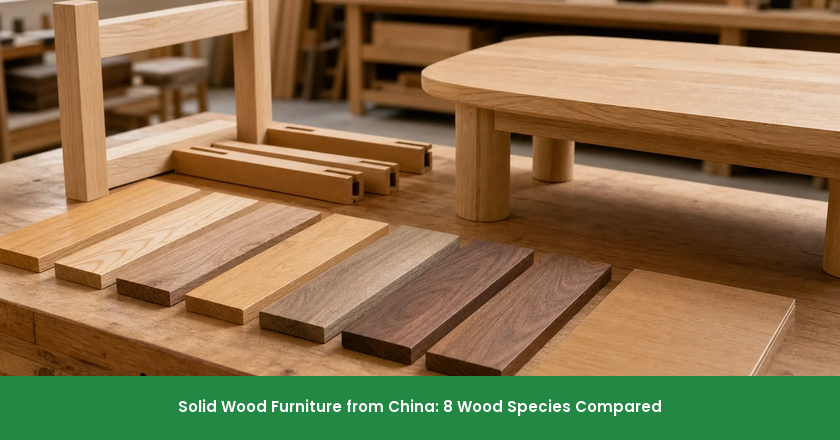
Solid wood furniture is not one uniform material decision. For a buyer, it means specifying which component uses which wood, what visible variation is acceptable, how the finish is referenced, and which production record ties the delivered piece back to that approval.
“Use oak” is a useful design direction, but it is not yet a furniture requirement. A dining table may have a visible tabletop, an apron, legs, drawer boxes, support blocks, and non-wood parts. Even when a product is marketed as solid wood, those components do not all need the same material, appearance, or release evidence. A factory can honestly quote the same species name while proposing a different grade, component allocation, finish route, or visual range.
That is why an eight-species comparison should not end with a hardness list. The buying decision is conditional: which part will the wood serve, what look must the buyer preserve, what finish will be approved, and how will production groups be checked against that reference? The sections below compare white oak, red oak, walnut, ash, beech, rubberwood, acacia, and pine through those questions. They are not a universal ranking or a substitute for engineering, testing, or destination-specific advice.
Choose Furniture Wood by Component, Not by Label
A component-level wood brief is a short buyer document that assigns material and acceptance requirements to each furniture component. A component-level wood brief is a practical buyer framework, not an industry standard. It starts with the species or material identity, then assigns that material to a stated component, an appearance range, a finish reference, and a lot record. Here, appearance range means the agreed visible variation in color, grain, knots, and figure for that component. Those five fields close different gaps that the phrase “solid oak” leaves open.
- Choose by furniture role. A prominent tabletop, a bent chair part, a hidden support block, and a drawer side may call for different material decisions.
- Approve a range, not a single board. A good-looking prototype is evidence of a direction; it is not proof that every production board will look identical.
- Keep the material identity readable. Ask the factory to name the proposed material in the quotation and production record, rather than treating a broad commercial label as enough detail.
- Keep evidence with the production group. A reference sample is more useful when it connects to the component, finish, and lot being released.
This approach changes the comparison question. Instead of asking, “Which wood is best?” ask, “Which wood can deliver the intended component, visual direction, finish, and approval route for this item?” A buyer may still prefer walnut for a dark premium table or pine for a knot-led collection. The point is to make the conditions visible before price, lead time, and sample decisions are treated as comparable.
Compare Eight Woods by Furniture Role and Approval Risk
The USDA Wood Handbook is a technical material reference, not a finished-furniture grade standard. That distinction matters: wood properties are useful inputs, but a furniture buyer also needs to decide how the material will be selected, joined, finished, packed, and accepted. The table therefore uses conditional commercial fit rather than declaring a single winner.
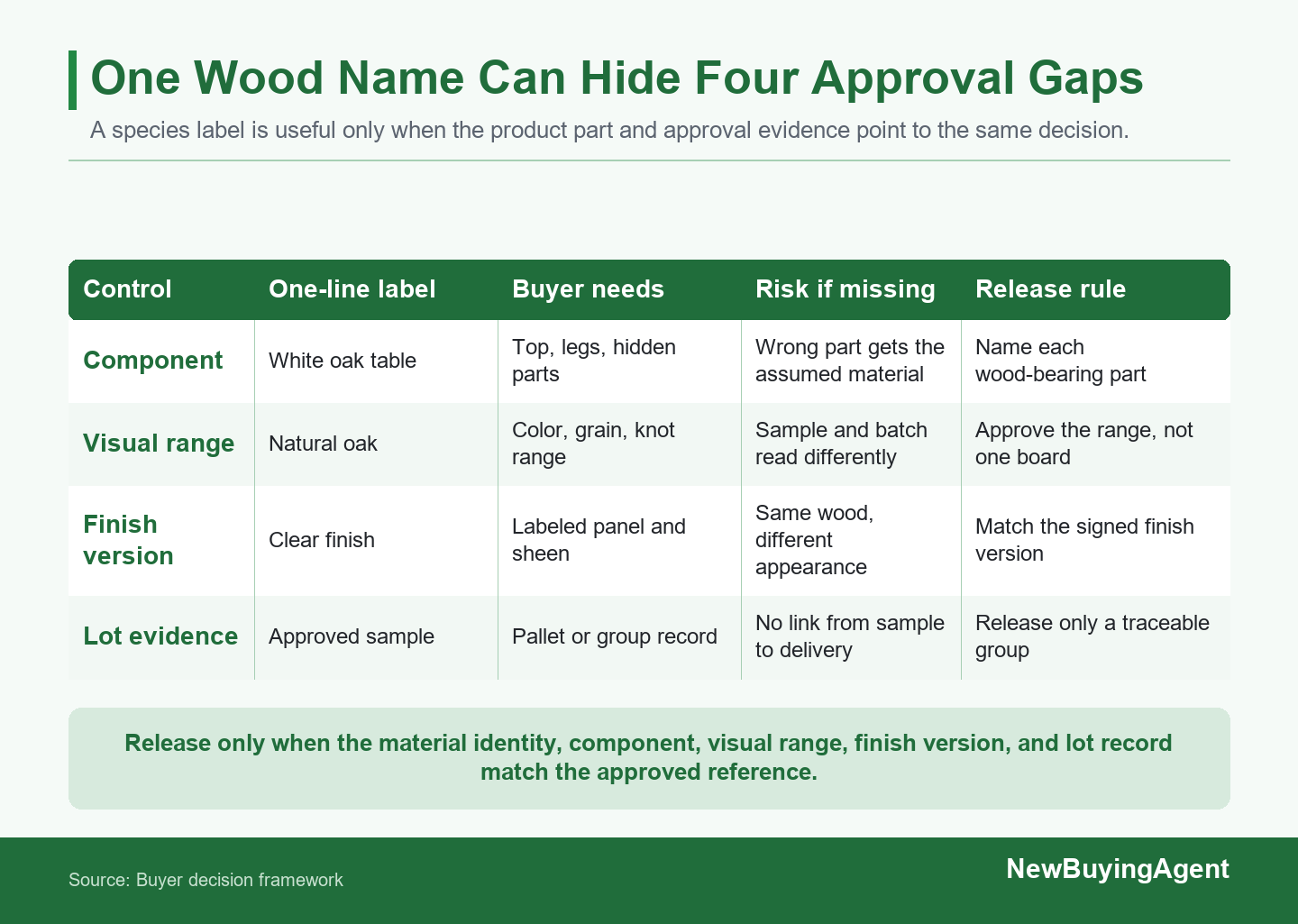
Use one release reference only when the component, visual range, finish version, and production group all match the buyer's approved material decision.
| Species | Often fits when | Visible direction | Briefing watch-out |
|---|---|---|---|
| White oak | Visible tables, storage, and frames need a versatile premium direction. | Pronounced grain with a light-to-warm range depending on finish. | State the approved grain and color range; do not assume every board will mirror one panel. |
| Red oak | The collection deliberately uses an open, expressive grain character. | More pronounced grain and a different color direction from white oak. | Do not substitute it for white oak on name similarity; approve the intended finish on the actual material. |
| Walnut | A dark, character-led premium surface is central to the product. | Rich brown variation that can become the visual feature. | Separate solid and veneer requirements, and approve the color range rather than requesting “dark walnut” alone. |
| Ash | A contemporary piece uses active grain under a clear or controlled finish. | Light, lively grain that can read differently after staining. | Use physical finish panels; stain response and grain should not be inferred from a photo. |
| Beech | Chairs or shaped parts need a fine, even visual direction with confirmed construction. | Generally calmer grain than open-grain options. | Confirm the actual part, joinery, and finish on a sample rather than assuming a generic species outcome. |
| Rubberwood | A defined component and finish programme make practical sense for the product position. | Can be directed through an agreed finish route. | It is not an automatic substitute for another named species; require buyer approval before any change. |
| Acacia | A collection wants strong natural character in tables or storage surfaces. | Distinct color and grain movement can be part of the appeal. | Commercial naming can cover variation; define the acceptable appearance and the material record. |
| Pine | A lighter, knot-led style is intentional rather than a defect to be hidden. | Light tone with visible knots and character when selected that way. | Write the knot and clear-grade expectation; a clear premium look cannot be assumed from the word pine. |
A published species guide can give useful context for color, grain, and character, but it cannot approve a production batch for the buyer. A guide tells you why ash and walnut may read differently in a collection. The buyer still has to decide which boards, range, sheen, and construction are acceptable for the actual SKU.
Use the table to create a provisional shortlist for a single product role, not to authorize a material change across a catalogue. For example, white oak may suit a visible tabletop while beech may be explored for a shaped chair component; that does not make them interchangeable. Compare the available sample, the intended finish, the component drawing, and the factory's proposed construction before the name moves into an order sheet. This is also the point at which NewBuyingAgent needs a buyer-defined purchase requirement, rather than a generic request for a wood recommendation.
A material decision also sits inside a broader product decision. If the collection direction is still open, buyers can review product-selection context before setting a material direction. That context should sharpen the product brief, not replace a component-level material approval.
Write the Wood Requirement at Component Level
The five-field list below is a practical buyer brief, not a mandatory standard. Its job is to stop one material phrase from carrying too many assumptions. Use it for every visible or structurally important wood component, then add drawings, hardware specifications, testing, packaging, and commercial terms where the product requires them.
Name the Material and the Part It Will Serve
First, state the proposed wood identity in the terms the buyer and factory can use consistently. Then name the exact component: tabletop face, tabletop underside, leg, chair rail, drawer front, internal runner, or another defined part. “White oak dining table” may be adequate for early discovery. “White oak for the visible tabletop face and legs; separately stated material for hidden supports” is a more useful quotation instruction.
Second, tell the factory whether a requested species is a visual requirement, a structural requirement, or both. A visible surface often needs an appearance approval route. A hidden part may need a construction and performance discussion instead. Keeping those roles separate avoids a common failure: paying for a named show surface where it is not visible, while leaving the critical visible component too loosely described.
Set the Appearance, Finish, Condition, and Lot Evidence
Third, attach an approved visual panel set. It can show the intended degree of color, grain, knots, and figure. Fourth, name the finish reference: a physical panel, a finish code, a sheen direction, or a signed sample with version control. A photo by itself is vulnerable to light, screen, and editing differences.
Fifth, state the wood condition or handling question that is relevant to the product and destination, and identify the record expected from production. Where a timber due-diligence route applies, the UK government's timber guidance illustrates why fields such as species and country of harvest may need to remain available; the actual record and responsible party depend on the route. The article does not set a universal moisture value or movement tolerance; those belong to the actual product design, factory process, and specialist review. The practical buyer question is simpler: can the factory connect the delivered component to the approved material, finish, and production group?
These fields make competing factory answers comparable. One factory may propose a solid walnut tabletop with a clear finish and a specified visible range. Another may propose a different construction or a different visible material. The buyer can then compare the actual offer rather than treating two uses of the word “walnut” as the same promise.
Approve a Range, Not a Single Lucky Board
The buyer and factory must agree the actual acceptable range. Published species information helps a buyer understand broad material character, but it is not a signed acceptance range for a live order. The visible approval should be tied to the product component, the intended finish, and a date or version that the buyer and factory can identify later.
The American Hardwood Export Council's species guide is useful context for color, grain, and character, but it cannot approve a production batch for the buyer. It provides broad material context; the buyer and factory still need to define the acceptable boards, range, sheen, and construction for the SKU.
A good material review separates three questions. First: does this species and construction direction fit the product? Second: what natural variation is intentional, permitted, or excluded on the visible face? Third: does the factory's finish process reproduce the approved direction under normal production conditions? Answering only the first question produces a visual surprise later, because the word “oak” or “walnut” has carried the other two questions without resolving them.
For a dining table, an approval set might show the tabletop face, edge treatment, legs, and a finished portion under the stated sheen. For a chair, it may show the shaped frame part, the join area, and the finish after assembly. The purpose is not to eliminate all natural variation. It is to decide which variation belongs to the collection and which variation falls outside the buyer's agreed range.
Keep the reference modest but traceable. Label it with the SKU, component, material description, finish version, and approval date. Ask how a production inspector will compare a later group to that reference. If the answer depends on memory, a screen photo, or an unlabeled sample board, the approval route is too weak for a visual material decision.
Keep Composite Components and Timber Records in Scope
Solid wood selection does not remove the need to assess covered composite products elsewhere in the furniture item. The EPA's consumer FAQ on formaldehyde standards describes the U.S. scope for hardwood plywood, MDF, particleboard, and finished goods containing covered products. Its separate stakeholder guidance addresses implementation questions. These are U.S.-framework sources, not a statement that every furniture item or destination is treated identically.
In practice, a table or cabinet can include solid wood, veneer, plywood, MDF, particleboard, adhesives, metal hardware, and packaging. A solid-wood species brief should therefore be one part of the product file. It does not answer whether a composite component is present, whether a destination standard applies, or which party is responsible for the related evidence. Keep the visible-material approval and the compliance route distinct, then connect them in the final product record.
Timber records are another separate route. The U.S. International Trade Administration's China standards guide gives broader context on China's standards and conformity-assessment landscape. It does not let a buyer infer an all-market answer from a wood label.
For a live transaction, confirm the current destination rule, the buyer's legal role, the product construction, and the record owner with the relevant responsible parties. Keep material identity and batch information after the sample is approved. Those records can still matter to commercial comparison, quality review, or a separate due-diligence process.
Illustrative Scenario: A Traceable White-Oak Appearance Gap
This is an illustrative buyer decision exercise, not a NewBuyingAgent client result or a universal procedure. An illustrative home-furniture buyer has ordered 480 white-oak dining tables from an already selected China factory. The tables are split across three production lots. The buyer approved a labeled finish panel and one reference table, but the purchase sheet describes the tabletop only as “white oak.”
During the final pallet review, 60 tabletops show a warmer, more open grain range than the approved reference. That difference does not prove that the wood is wrong. It does reveal that the original brief did not state the intended visible range. Crucially, pallet labels and finishing records identify those 60 tabletop blanks as one separable group. A mixed lot is a separable group of material parts that may not match the approval reference; it is not a claim that all other production is defective.
When the buyer keeps an existing factory, the immediate question can be China-side evidence coordination rather than a new factory search. In that situation, buyers can review China-side factory management for an existing furniture factory. The service discussion should begin with the complete purchase requirement and available records, not with a request to make a single wood species promise.
Hold the Traceable Group, Then Verify the Reference
Because the affected 60 tops are traceable, the buyer can hold that group, compare it with the signed reference, and document a group-level release decision. The remaining groups are not released merely because the held group is under review; they are checked against their own material, finish, and pallet records. This is a targeted containment decision, not a generic instruction to split every furniture order.
The illustrative buyer is purchasing 480 dining tables from one already selected China factory. The order has 3 production lots, and the affected scope is 60 traceable tabletops in 1 final pallet group. A labeled finish panel and reference table were approved, but the tabletop sheet named only white oak and omitted a visible appearance range.
The held tops are visibly warmer and more open-grained than the approved reference. Pallet labels and finishing records separate the 60 tops from the earlier groups. The decision is not whether oak can vary; it is whether this identified group fits the buyer's approved visual direction and whether the record trail supports a narrow disposition.
Hold the 60-tabletop group, compare it with the approved reference, and release only groups whose material, finish, label, and visual direction remain aligned. For the next run, add the component allocation, approved appearance range, finish version, and lot label to the production sheet. Release a group only after its component record, finish lot, pallet label, and visual comparison point to the same approved reference. This is an illustrative scenario, not a grade rule, client case, or guarantee that another buyer should make the same release decision.
When China-Side Furniture Support Fits
NewBuyingAgent is relevant when the buyer can state the product, component material, finish reference, quantity, timing, destination, and current factory status. That gives a China-side conversation enough commercial context to determine whether product supply or existing-factory coordination is useful. It does not make NewBuyingAgent a wood-science authority, nor does it replace furniture engineering, destination compliance review, or the buyer's final material decision.
For a new product request, the starting point is the complete purchase requirement: product drawings or references, component allocation, the intended material and finish, expected quantity, destination, packaging needs, and the evidence the buyer wants before release. Buyers with that level of definition can compare a defined solid-wood furniture request with NewBuyingAgent's product-supply service. If an existing factory is already retained, the material brief can instead frame the China-side follow-up required to keep the approved version visible.
Send a Component-Level Furniture Brief Before Requesting a Quote
The following packet is a starting point, not a substitute for product engineering, contract terms, or regulatory review. Its purpose is to give every factory the same material question, so a buyer can see what changes when a quotation, sample, or production proposal differs.
- Product and component list. Identify the SKU, each wood-bearing component, and whether it is visible, structural, or hidden.
- Proposed material identity. State the requested species or material for each relevant component and flag any substitution that requires written approval.
- Appearance and finish reference. Attach labeled photos, boards, panels, or samples; describe the intended color, grain, knot, and sheen direction.
- Construction and non-wood parts. List veneers, panels, hardware, adhesives, upholstery, and packaging that need their own product or destination review.
- Approval and lot evidence. Name the versioned sample, record owner, label or group identifier, comparison point, and release gate.
- Commercial context. Add quantity, destination, target timing, packaging expectations, current factory status, and the contact who can resolve an exception.
Use the same packet for every proposed material alternative. If one factory proposes white oak for the tabletop and another proposes an unnamed alternative, the buyer should be able to see that difference before an apparent price saving becomes a later sample dispute. If an answer leaves out the component, finish, or lot record, list it as an open decision instead of filling the gap with an assumption.
Public examples can help a buyer understand how a service partner describes sourcing context, but they do not validate a particular wood choice. If that perspective is useful after the request is complete, review NewBuyingAgent sourcing stories for buyer-context examples. Keep the decision on the live product brief, its evidence, and the parties responsible for it.
Once the packet is ready, a buyer can decide whether the remaining gap is product supply, existing-factory coordination, engineering review, or a destination-specific compliance check. When China-side product support is the remaining question, share a component-level furniture brief with NewBuyingAgent.
Frequently Asked Questions
These answers are general information and retain the same boundaries as the body: a material decision depends on component construction, and composite or timber obligations depend on the actual product, destination, and responsible parties.
Is oak always a better choice than rubberwood for solid wood furniture?
Oak is not always better than rubberwood, because each can fit a different component, finish, product position, and appearance brief. Oak may suit a particular visible direction, while rubberwood may be considered for a different defined component and finish programme. Compare the actual proposal, approved reference, construction, and substitution rules instead of treating the species name as a quality verdict.
Can a factory quote solid wood furniture from a species name alone?
A factory cannot reliably quote solid wood furniture from a species name alone, because the component, appearance, finish, and batch evidence can still differ. It should also disclose a different construction, veneer, composite panel, or proposed substitution where relevant. A short material line can begin the conversation, but it cannot make competing factory proposals equivalent by itself.
Does a solid wood specification cover MDF or plywood parts in the same furniture item?
A solid wood specification does not settle the composite-panel, adhesive, or destination documentation questions for other components in the item. List the bill of materials clearly, then have the responsible buyer, factory, and specialist confirm the requirements that apply to the construction and market. Do not use a solid-wood marketing description as a compliance conclusion.
What should be approved before production starts?
Approve a labeled reference that shows the agreed appearance range, construction details, finish, component allocation, and records that will connect the approval to production lots. Then make sure the factory can identify which group, label, or document will be compared with that reference before release. The exact approval set depends on the product, but it should be specific enough that the parties do not rely on memory alone.
NewBuyingAgent
Related Resources



Get Started Today
Let's Turn Your Sourcing Goals into RealityWeChat:+86 15157124615
WhatsApp:+86 15157124615
Address:Building 10 #39 Xiangyuan Road, Hangzhou, China
