


A physical sample is not a production reference until its version and production permission can be traced. A sample approval becomes risky when it travels through email, chat, and a courier label without carrying a version number and written production permission. The physical item may be correct, yet the carton, insert, or material released to the factory may describe a different configuration. Treat the sample as a controlled release: identify it, state what it represents, close the changes, and say precisely what may proceed.
A Sample Approval Is a Release Decision, Not a Courier Update
Sample management through a China sourcing agent is useful when the agent can keep one review trail intact across the buyer, factory, and production contacts. Delivery proves that an object arrived; it does not prove that everyone is working from the same product version. The release decision needs a named reference, a current specification, a record of what changed, and an explicit instruction about whether materials or production may be released.
That distinction matters most after a revision. A buyer may approve the body of a product while packaging artwork, an insert, a label, or a component remains open. Calling the whole order “approved” turns a limited review result into an unclear production instruction. A better record names the approved scope and the unresolved scope separately.
What Sample Control Changes Before Production
Sample control is a four-record decision, not an approval emoji or a courier update. Before a sourcing route releases work, a buyer should be able to answer four narrow questions.
- Reference identity: Which physical sample and version are under review?
- Review baseline: Which product, packaging, destination, and quality requirements were used to judge it?
- Change closure: Which comments were corrected, evidenced, accepted, or still open?
- Production permission: May the factory proceed now, and if so, with which configuration?
When any answer points to a different version, hold the affected scope rather than arguing over whether an earlier approval was “close enough.” This is an operational method, not a universal legal rule. The actual test, documentation, and release requirements still depend on the product and destination market.
Treat the Sample as a Controlled Reference, Not a Courier Event
A controlled reference requires the same version to appear in the sample record, specification, change log, and production permission. An approved reference sample is a named physical item and its linked documents, used as the agreed product reference. This four-record pack is deliberately simple: it gives the buyer a way to spot a break before the factory turns a partial approval into production work.
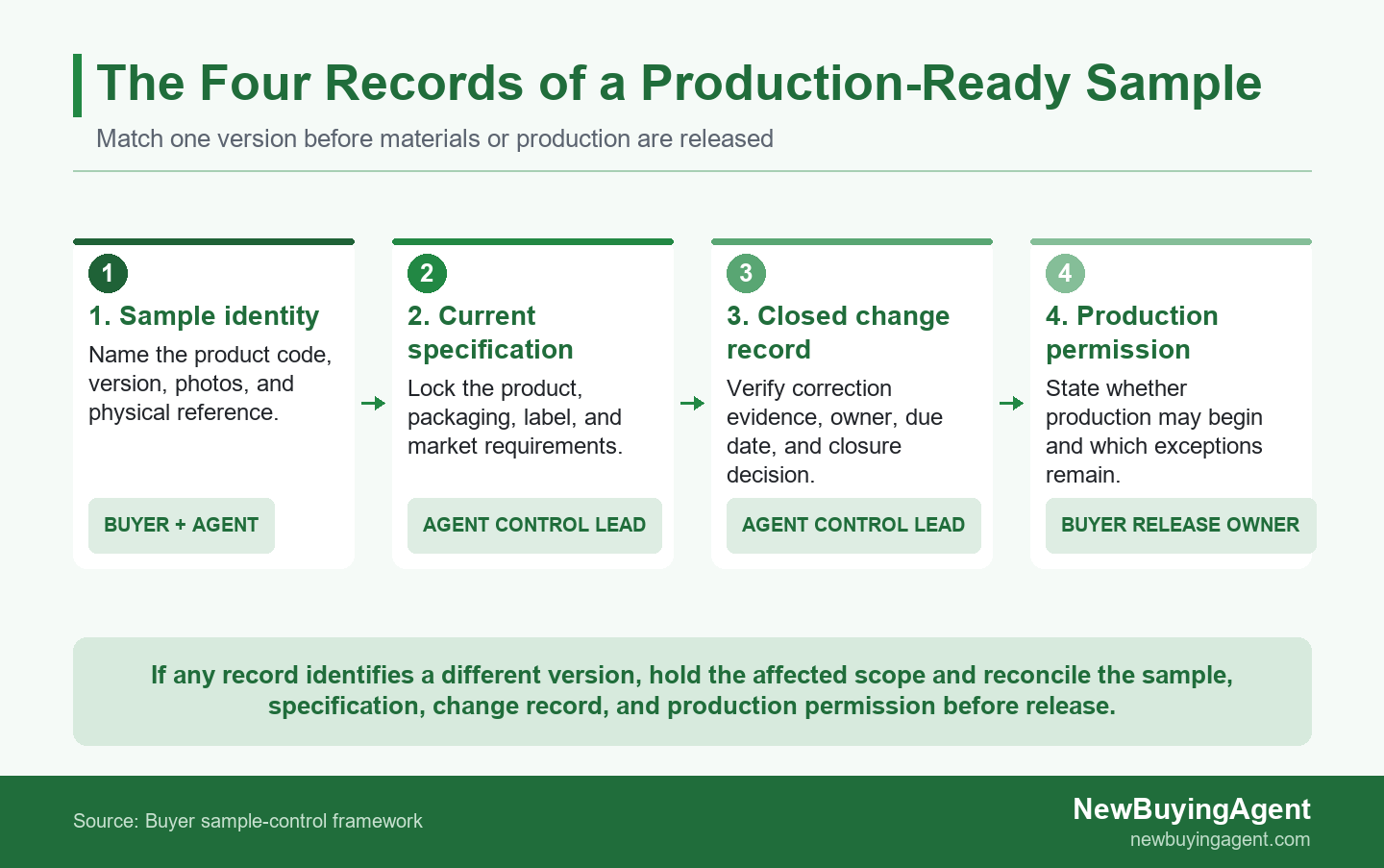
A sample becomes production-ready only when these four records identify the same version. If one record changes, hold the affected scope until the reference pack is reconciled.
Keep the physical reference in a protected location, photograph the relevant surfaces and packaging, and make the digital record easy to find. The specification should state the features being reviewed instead of relying on memory or a message such as “same as sample.” The change record captures feedback and proof of correction. The production permission then ties those records to a clear scope: for example, product body V3 and carton V3 may proceed, while a revised insert remains on hold.
Build the Request Pack Before the Sample Leaves China
A sample cannot be approved against a general impression; it needs an agreed review baseline. Put the product code, drawings or reference images, material and color requirements, critical dimensions where relevant, packaging details, label copy, target market, and review criteria in one request pack. The pack should also say what the sample is meant to decide: concept direction, function, pre-production readiness, or a packaging change.
For a new product route, NewBuyingAgent can use the buyer's documented purchasing needs and current sample evidence to discuss a China-supplied product path. A buyer who has organized the required configuration, quantity, destination, and current sample evidence can see how NewBuyingAgent supplies products from China around a complete purchasing brief. The service link is most useful here because the buyer has a documented product need, not merely an unstructured request for supplier names.
Decide the acceptance points before the sample ships. A short list may include appearance, assembly, function, safety-related observations, packaging fit, label accuracy, and any market-specific evidence the buyer expects. That does not mean every item needs the same checklist. It means the reviewer should know which differences would require a new sample, additional proof, or a hold.
Give Each Physical Sample a Traceable Identity
Give each physical sample a product code, version, and photo record before asking for approval. A practical label might combine a product code, revision, sample type, and date, such as HG-417 / V3 / pre-production / 2026-08-09. The format is less important than using it on the sample, in the files, and in the approval message. Reference photos should show the whole item plus the details that are likely to change.
Identity protects against a common quiet failure: feedback is sent on a photo of one item, the buyer receives another, and a third file is attached to a production order. If a courier label is the only identifier, the reviewer cannot tell whether a later correction belongs to the same version. Record the receiving date, reviewer, and intended use, then archive obsolete versions instead of overwriting them.
Convert Feedback Into a Versioned Change Record
For covered children's-product routes, retain a record that identifies the configuration connected to the relevant testing and certification evidence; do not leave the change only in a message thread. Feedback becomes production-ready only when each change says what must be corrected, who owns it, what evidence will close it, and whether the buyer accepts the result. A message saying “please improve the finish” leaves too much room for interpretation. A useful entry names the affected version, the issue, the required outcome, an owner, a due date, and a closure decision such as accepted, rejected, or requires another sample.
Keep high-risk changes visible until they are closed. For covered U.S. children’s-product routes, 16 CFR 1107.26 requires specified testing and certification records to be retained for 5 years. That is not a rule for every imported product, but it illustrates why the evidence tied to a regulated configuration cannot remain buried in a message thread. Confirm the product-specific route with qualified compliance support when it applies.
Use an Approval Status That Separates Review from Production Permission
Use an approval status that names both the sample decision and whether production is permitted. The supplier should not have to infer whether “looks good” means start production, make a small correction first, or wait for a revised packaging sample. A short status table gives every party the same instruction.
| Status | What the buyer accepts | What remains open | Production instruction |
|---|---|---|---|
| Approved | The named version and stated scope | Nothing that changes the released configuration | May proceed within the written scope |
| Approved with conditions | The listed features only | Named corrections or evidence | Hold the affected scope until conditions close |
| Revise and resubmit | No production reference yet | Material, function, fit, appearance, or packaging issue | Do not release the affected configuration |
| Rejected | No part of the sample | Fundamental mismatch or unacceptable risk | Stop and agree a new route before more work |
Acceptance sampling evaluates a sample selected from a lot under a stated plan; it does not turn an earlier approved sample into proof that the entire finished lot is acceptable. In plain terms, it uses a lot sample to accept or reject that lot under a stated plan. Approval status answers whether a known reference is ready to guide the next step. NIST defines a single sampling plan by sample size and an acceptance number, while its explanation of acceptance sampling says a random sample from the lot informs that lot’s disposition. Keep the two gates separate.
The wider NIST product and process monitoring reference places this logic in a finished-product control context. The practical implication is straightforward: preserve the approved sample as a reference, then create a separate inspection and release plan for the actual production lot.
Use Samples as Proof Inputs, Not as Proof of Every Finished Unit
In covered U.S. children's-product routes, the certificate framework is based on testing and remains separate from a generic sample approval. A sample can demonstrate a particular configuration, but it cannot by itself prove every finished unit matches it or that every destination-market obligation has been met. A Children's Product Certificate is a U.S. certification record for applicable children's-product rules; 16 CFR part 1110 sets a certificate framework based on testing or a reasonable testing program. The exact certificate and testing route depends on the product; do not use an approved sample as a substitute for the required evidence.
For an EU-bound product within GPSR scope, product documentation and traceability information remain separate from a physical sample approval. The same boundary applies in other markets. The European Union’s General Product Safety Regulation summary describes technical documentation, product-safety information, and traceability responsibilities. A buyer should map the current version to the evidence required for the intended market, then keep that route separate from the visual or functional sample sign-off. This is not legal advice; category-specific rules may apply in addition.
When V2 and V3 Records Diverge, Hold the Changed Scope
When product, insert, and carton records identify different versions, hold the changed scope until the evidence is reconciled. Consider this illustrative example: a 2,400-unit home-goods order with one product body, a printed instruction insert, and a retail carton. The buyer has accepted V2 for appearance and function. After that approval, the factory discusses an insert-material substitute and issues carton artwork V3. This is an example, not a client case or a conformity conclusion.
The physical sample still says V2, the carton artwork says V3, and the issue log does not show a closure for the insert material. The product body may be unchanged, yet the buyer cannot show that the new insert and carton were included in the original approval. The problem is not that V3 is automatically unacceptable. The problem is that the records no longer describe one confirmed configuration.
Hold production only for the affected configuration. Request a controlled V3 pack that identifies the physical sample, current insert material, carton artwork, unresolved items, and release scope. Production can proceed when the reference, specification revision, change closures, and written permission all name V3 and the same affected components. Because this is an illustrative example rather than a client case or conformity conclusion, actual product and market requirements may differ. The trade-off is a short decision delay now versus discovering after production that packaging or instructions followed an unreviewed version.
Choose the China-Side Support Route That Matches the Order
When a factory is already named, NewBuyingAgent's factory-management path can connect sample evidence to production progress and quality-control context. In that situation, a buyer can use China-side factory management when an existing supplier needs sample-to-production follow-up. The useful deliverable is not a vague approval message; it is a visible connection between the approved reference, progress updates, quality checks, and the written release scope.
NewBuyingAgent is positioned as a one-stop China sourcing agent for global buyers, so the route should follow the buyer’s actual factory status. Use the product-supply discussion when the request pack still needs to become a China-supplied product route. Use factory-management support when an existing production relationship needs China-side coordination. Neither route guarantees a price, supplier choice, test result, or delivery date; the sample-control pack makes the next conversation more specific.
Send One Handoff Before Materials or Production Are Released
Send one controlled handoff before materials or production are released. The handoff should include the sample ID and photographs, the current specification and packaging files, the change record with open and closed items, the approval status, the allowed production scope, and the purchasing context such as quantity, destination, timing, and any inspection criteria. A folder full of files is not enough if the recipient cannot tell which version governs.
Name the recipient who must acknowledge the handoff and preserve the decision in a place that survives staff changes. If a condition remains open, state whether it blocks all production or only a component, packaging run, or market configuration. That narrow instruction makes it possible to hold the real risk without stopping unaffected work.
When the pack is complete and the buyer needs a China-side product discussion, contact NewBuyingAgent with a complete sample control pack
Frequently Asked Questions
What Is the Difference Between a Prototype and an Approved Sample?
A prototype tests an idea, while an approved sample is a named version a buyer accepts as the production reference for a stated scope. Use the sample as a controlled reference, then apply the separate finished-lot and destination-market checks that the product route requires. A prototype may still invite broad changes to materials, shape, function, or packaging. An approved sample should point to the current specification, known exceptions, and a production instruction. If those records are missing, the item is closer to a review sample than a dependable production reference.
Can an Approved Sample Replace Final Inspection?
No, an approved sample cannot replace final inspection because it defines a reference rather than evaluating a finished lot. Final inspection evaluates the finished lot against the current specification and release criteria. The approval may help an inspector understand the intended appearance, construction, and packaging. It does not show whether the production lot contains the right quantity, workmanship level, packaging configuration, or defects. Keep final-lot inspection and market-specific evidence as separate controls.
When Should a Buyer Request Another Sample?
Request another sample when an open change affects safety, function, fit, material, critical appearance, packaging, or destination-market evidence. A new photo or document may be enough for a low-risk correction if the buyer can verify the same configuration. Ask for a physical resample when the change cannot be reliably judged from remote evidence, when it alters the reviewed product, or when the approval record would otherwise mix versions.
What Should the Production Team Receive After Sample Approval?
The production team should receive the approved sample identity, current specification, change log, approval status, packaging requirements, and stated production permission. The package should also identify open conditions, affected scope, and the person who can answer version questions. That is enough to turn review evidence into a usable instruction without pretending it replaces a contract, inspection plan, or destination-market compliance review.
NewBuyingAgent
Related Resources
Get Started Today
Let's Turn Your Sourcing Goals into RealityWeChat:+86 15157124615
WhatsApp:+86 15157124615
Address:Building 10 #39 Xiangyuan Road, Hangzhou, China
