

SVHC tracking is the process of mapping each component of a China-sourced product against the current EU REACH Candidate List, recording the evidence scope and date, and routing any finding to the correct compliance action (disclosure, notification, SCIP, or restrictions).
For China-made products entering the EU, the costly REACH mistake is rarely a missing generic statement. It is losing the link between a changing Candidate List, the exact item or component in the product, and the version of supplier evidence used for a release decision. A letter that says "REACH compliant" may still leave the buyer unable to tell which cable, coating, adhesive, or plastic part it covers. Treat tracking as controlled evidence for a dated product decision, not as a one-time document request.
That approach does not decide legal applicability for a particular product. It gives the sourcing and compliance owners a clearer handoff: identify the part, record the list revision, test whether the supplier material matches that scope, and route an unresolved result before production or repeat ordering moves ahead. It also prevents a China supplier from being treated as the party that certifies the EU importer's final legal position.
The Decisions Behind Reliable SVHC Tracking
An SVHC, or substance of very high concern, is a substance on the Candidate List that may later be considered for EU authorisation action. A useful tracking record connects one defined item or component, the Candidate List revision reviewed, the evidence scope, and the next recheck trigger. Those four fields let a buyer distinguish a controlled evidence file from a broad assurance that cannot be tied to the product now being ordered.
- Map the thing being assessed: a finished product name is often too broad when different components have different materials or suppliers.
- Lock the time reference: retain the Candidate List revision and the product revision together, rather than filing an undated declaration.
- Check what the evidence actually covers: ask whether the declaration names the component, material, supplier, and intended product configuration.
- Assign the next action: a finding may call for disclosure, a role and tonnage review, a relevant EU database route, a restrictions review, further investigation, or a targeted hold.
None of those actions is automatic from a spreadsheet cell alone. The discipline is to expose the missing field early enough that an EU compliance owner can make the product-specific decision with a real record in hand.
What REACH SVHC Tracking Must Actually Answer
REACH is the European Union's main law for chemical risks and industry information responsibilities. The European Commission's REACH overview provides that regulatory context. In practice, tracking needs a current Candidate List check connected to a defined article or component and a decision date. In REACH, an article is a manufactured object whose shape or design gives it its main function. That meaning matters because a lamp, a cable, a plug, and a plastic housing may need different evidence records even when a buyer purchases them as one finished product.
REACH is the European Union's main law for chemical risks and industry information responsibilities. The European Commission's REACH overview provides the regulatory context; it does not turn a sourcing file into legal advice. The practical sourcing question is whether the available evidence is specific enough for the product, supply-chain role, and decision date under review.
An identified SVHC is placed on the Candidate List for possible subsequent inclusion in the Authorisation List. As the European Commission explains in its authorisation guidance, that possible progression is not the same as an automatic import ban. The buyer should keep Candidate List tracking separate from the later question of whether a restriction, authorisation, notification, disclosure, or another product requirement applies.
Use the SVHC Evidence Ladder Before Product Approval
The Evidence Funnel is a four-step sourcing control: identify the item, map meaningful components, request scoped evidence, and recheck after change. Its purpose is simple: each rung narrows uncertainty. A product name identifies the commercial item, but it does not prove which component was reviewed. A dated, component-specific record can support a decision; a broad declaration with no clear scope creates an evidence gap that should be owned rather than ignored.
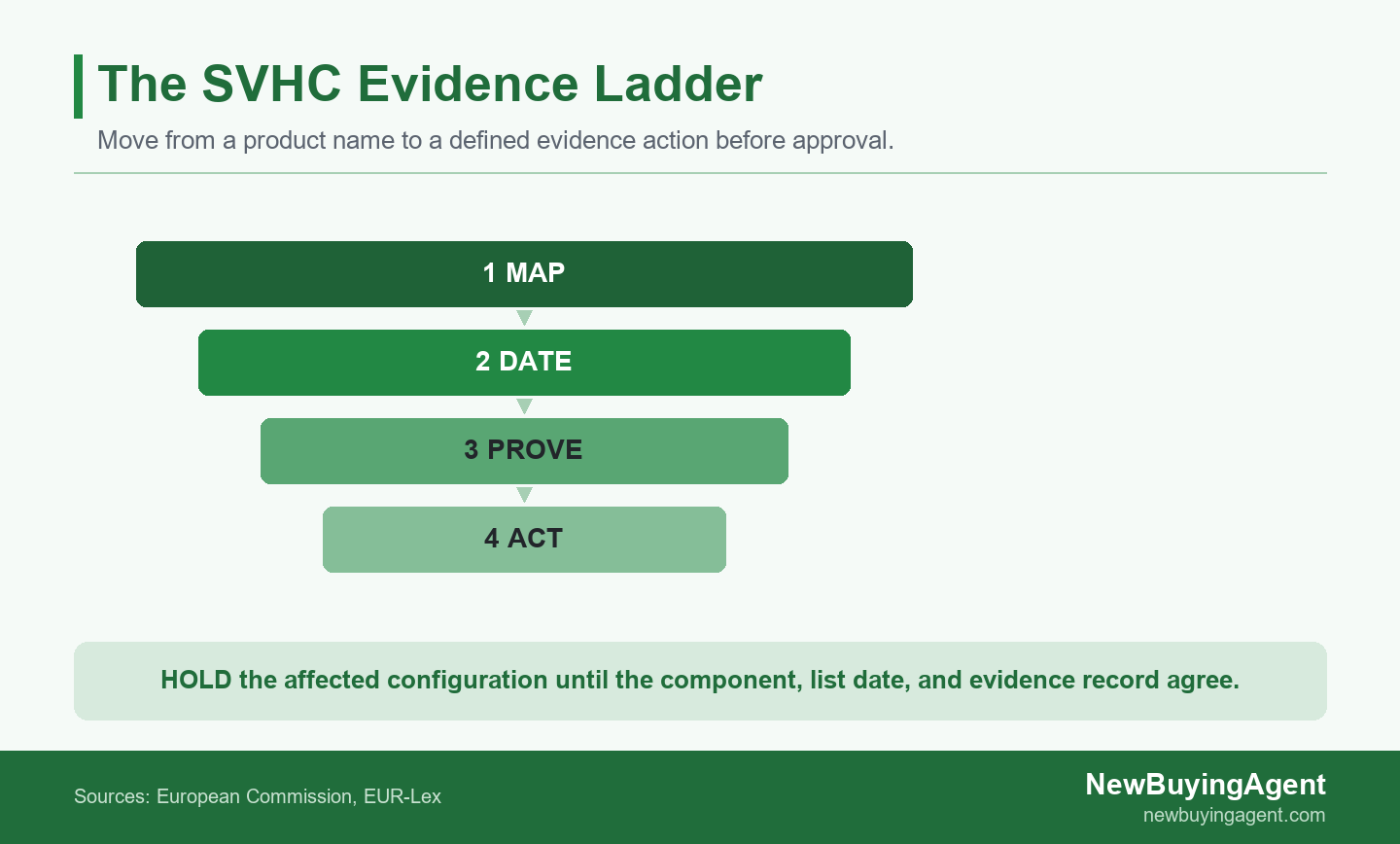
SVHC evidence ladder from component mapping to a defined EU compliance action
| Rung | Buyer record | Evidence gap that stops approval |
|---|---|---|
| Map | Product, article, component, supplier | The document names only a product family |
| Date | Candidate List revision and product version | The declaration predates a material or supplier change |
| Prove | Declaration scope and supporting material information | No link from the evidence to the affected component |
| Act | Named owner and decision route | No agreed disclosure, review, escalation, or hold action |
Before asking suppliers for documents, it can help to review the China manufacturing and product guide and settle the commercial product definition. That gives the evidence request a stable part number, drawing reference, component list, and change history instead of a vague request for a "REACH certificate."
First Map the Article and Its Meaningful Components
Article 33 can apply to constituent articles in a complex product where the substance exceeds 0.1% w/w of that article. The EU's guidance on substances in articles is why a broad finished-product average should not become the default evidence shortcut for a complex object.
A bill of materials is a structured list of the components and materials used in a product. For SVHC tracking, it should be useful to a person reviewing evidence, not just useful to an engineer ordering parts. Record the component name, internal or supplier part number, material or coating where relevant, supplier, product version, declaration reference, Candidate List revision used, and recheck trigger. A cable assembly, decorative coating, connector, battery pack, adhesive, or packaging component does not need the same depth in every product. It does need a clear reason for the scope chosen.
Start with the parts that can change the conclusion: a newly approved resin, a revised cable, a different plating source, an outsourced subassembly, or a component that moves between suppliers. If a supplier can only confirm a product family, log that as a scope limitation. Do not silently map the assurance onto every variant, colour, voltage, or revision. NewBuyingAgent can carry a defined product and evidence scope into a China sourcing brief; that is sourcing follow-through, not a legal-compliance determination.
Then Lock the Candidate List Date and Product Revision
Article 33 requires suppliers of qualifying articles to provide sufficient safe-use information, including at least the substance name. The EUR-Lex text of REACH Article 33 sets that information boundary. For a sourcing record, a declaration becomes decision-useful when it also identifies the covered component or product revision and the Candidate List date used for the review. Put those fields near the document reference, not in an email trail. Otherwise a buyer cannot tell whether a declaration still applies after a coating, cable, adhesive, or supplier substitution.
Set recheck triggers that match the buying cycle. Candidate List changes are one trigger. So are material substitutions, new sub-suppliers, revised drawings, a different manufacturing site, and a product version that changes the affected component. The point is not to impose a calendar ritual. It is to reopen the record when something changes that could make the prior evidence describe a different product.
Do Not Collapse Disclosure, Notification, SCIP, and Restrictions
Article 33 communication applies when a Candidate List substance is above 0.1% w/w in an article and includes safe-use information, at least the substance name. The EUR-Lex text of REACH Article 33 is the relevant legal wording. For a buyer, the important distinction is that evidence of a substance finding and the communication obligation are related questions, not a single pass-fail label.
Article 7(2) notification has both an above-0.1% w/w concentration condition and an annual total above one tonne, subject to the stated exemptions. The EUR-Lex text of REACH Article 7(2) makes the tonnage and role questions visible. A component finding should therefore be routed to the responsible compliance owner for a role, quantity, and exemption assessment rather than being announced as an automatic notification result.
SCIP is the EU database for information on certain substances of concern in articles and complex products. SCIP covers articles and complex objects containing Candidate List SVHCs above 0.1% w/w placed on the EU market, as summarised in the EU Publications Office's SCIP guidance. Keep SCIP as a distinct route in the action record; a supplier declaration is not a generic substitute for a submission decision.
REACH restrictions can limit manufacture, placing on the market, or use where an unacceptable risk is identified. The European Commission's restrictions guidance is a useful reminder that Candidate List tracking cannot replace a product-specific restrictions review. Treat the record as a routing tool: it shows what must be clarified next, not a universal clearance statement.
Why a Product Average Can Miss the Relevant Component
For the Article 7 purpose in Case C-106/14, the Court said an importer of a complex product must determine whether the 0.1% w/w threshold is met in each constituent article. The Court's decision in Case C-106/14 explains why a whole-product average can hide the component that needs attention.
This does not mean every product needs an identical component register or that a sourcing team should decide legal interpretation without specialist review. It means the review unit must fit the object. If a portable lamp has a cable, plug, battery pack, housing, coating, and packaging from different sources, ask where the article boundary and evidence boundary meet. A traceable component record lets the buyer and compliance owner discuss that question with a product drawing and supplier references, rather than with a generic finished-goods name.
An Illustrative China Sourcing Evidence Gap
Article 33 can apply to constituent articles in a complex product where the substance exceeds 0.1% w/w of that article. The guidance on substances in articles sets that component-level context. When a changed component lacks evidence that matches the current product revision and review date, a targeted hold is more defensible than a blanket approval. Consider an illustrative portable-lamp programme spanning 12 SKUs. The product register covers the metal housing, coated cable, plug assembly, battery pack, and retail packaging. Shortly before repeat production, the cable supplier changes and the new coating declaration names only the product family.
The immediate problem is not proof that the lamp contains an SVHC. It is that the buyer cannot connect the new cable and coating path to the current Candidate List check. Releasing every configuration would extend an unclear declaration beyond its stated scope. Holding the entire programme may be commercially unnecessary if the rest of the product record still matches. The decision can be narrower: isolate the configurations that use the revised cable while the evidence is corrected. Where an existing factory must provide that update during repeat production, review China factory-management support for existing suppliers.
Hold Only the Affected Configuration Until the Record Matches
The controlled response is to isolate the revised cable configuration, request a component-specific declaration tied to the current list date, and release only when the record matches the product revision. An EU-facing home-goods brand has an approved drawing and a 12 SKUs component register, but the declaration has no cable supplier, part number, or list revision. That is enough to identify a scoped evidence gap, even though it is not enough to state the product's final legal status.
Two observations drive the decision: the declaration predates the current Candidate List check, and the cable supplier changed after the original register was approved. Record the 2 components at issue - the cable and its coating declaration - alongside the supplier, part number, document date, list revision, and affected product configurations. This turns the problem from a broad compliance concern into a traceable correction task.
Hold the affected configurations, obtain a declaration that names the actual cable path, and route any confirmed finding to the EU compliance owner for the applicable action. Release only when the component record and evidence package name the same revision and no unresolved action remains. This is an illustrative sourcing-control example, not a customer case and not a determination that a substance is present or that a particular legal route applies.
Build a Supplier Request That Can Survive the Next List Change
REACH responsibilities depend on the actual product and the economic role in the EU supply chain. The European Commission's REACH sector overview is a useful role-context starting point. A useful China-side request then asks for SVHC information by component and product revision before the buyer closes the product decision. Ask for the product and component identification, supplier and manufacturing site where relevant, Candidate List revision checked, declaration date, scope statement, supporting material information, and a defined change trigger. The request should make it easy to see what the supplier knows and what still needs investigation.
Do not ask a factory to make a vague promise that it will "guarantee REACH." Ask it to return information that can be reviewed: the cable part number, resin grade, coating reference, adhesive identifier, declaration scope, and the product revision covered. Then give the internal compliance owner a simple exception rule: if the document does not match the component or decision date, the item stays open. That rule is more useful than collecting a folder of supplier letters with no comparison point.
The brief should state the product, destination market, known material questions, required evidence, decision owner, and the date by which the evidence must be resolved. NewBuyingAgent can help organise sourcing and supplier follow-through, but it does not provide legal certification or replace specialist EU compliance assessment.
Where China-Side Sourcing Evidence Changes the Product Decision
NewBuyingAgent's product-supply path can start from a buyer's defined product requirements and China sourcing brief. For a new supplier search, see how NewBuyingAgent supplies products from China. For EU-facing China product sourcing, compliance evidence should enter that product brief before quotation, approval, or repeat production decisions. It can affect material selection, supplier choice, sample approval, timing, and the cost of a late correction. Keeping the evidence request inside the product brief lets commercial and technical discussions use the same component references.
For a new product or a new supplier search, bring the evidence fields into the sourcing brief from the first quotation round. For an established supplier that needs a revised material record or repeat-production follow-through, state which product configurations are affected and who can close the exception. In either path, the sourcing task is to obtain and organise decision-useful supplier information; the importer and its advisers remain responsible for confirming the applicable legal route.
That division of work keeps a sourcing conversation practical. The buyer can ask for a defined material record and a change-response path, the supplier can return information at a traceable scope, and the EU compliance owner can decide what the information means for the actual product. It is a more reliable route than delaying every sourcing question until after a quotation, sample, or repeat-order choice has already narrowed the available options.
Use the sourcing brief as a decision record, not as a request for a blanket certificate. Name the product configuration, destination, component priorities, source documents, decision date, and the person who can resolve an exception. That leaves room to quote and develop the product while making an unresolved record visible before it becomes a repeat-production surprise.
Once those inputs are assembled, the conversation can start with the product configuration, China supplier path, evidence request, destination, and decision date, while the buyer keeps the legal-compliance conclusion with its responsible EU owner and advisers. To begin that sourcing conversation, contact NewBuyingAgent to discuss the EU product sourcing brief.
Frequently Asked Questions
Does an SVHC Declaration Prove Full REACH Compliance?
No, a supplier document can support a decision, but it does not by itself determine the product's final legal status. It may cover only named components, a stated Candidate List revision, or a particular product configuration. Check the scope, date, and product references, then have the responsible EU compliance owner decide whether further disclosure, notification, SCIP, restrictions, or other review is needed.
Do China Factories Have to Register Under REACH?
Not automatically for the China-based producer itself. The EU-based importer should confirm its own role for the actual product and transaction, while the China supplier can provide the component and material information needed for that review. The European Commission's REACH sector overview is a useful starting point for the role context, but a specific import structure may need specialist advice.
How Often Should a Buyer Update an SVHC Check?
Update the check whenever the Candidate List changes or the product changes in a way that could affect materials, components, coatings, adhesives, or supplier identity. A fixed annual reminder can be useful for file housekeeping, but it should not override a change-triggered review. The best cadence is the one that makes a new product revision or supplier substitution visible before an approval is treated as final.
Is Laboratory Testing Required for Every China Import?
No, laboratory testing is not automatically the right first response for every China import. Start with the applicable product requirements and credible component evidence, then escalate where the evidence, material risk, product design, or destination requirement warrants it. Testing can clarify a defined question; it does not replace the work of deciding which component, substance, legal route, and evidence gap are actually in scope.
How Often Is the EU SVHC Candidate List Updated?
The Candidate List is typically updated twice per year, usually around January and June, though the exact timing can vary by ECHA's review cycle. Each update may add new substances, revise existing entries, or clarify concentration limits. A sourcing record should note the Candidate List revision used for each approval so that a later update can be compared against the actual product configuration rather than assumed to still apply.
Do I Need to Submit to SCIP If My Product Is Below 0.1% w/w?
No. SCIP submission applies to articles and complex objects containing a Candidate List SVHC above 0.1% w/w placed on the EU market. If no constituent article exceeds that threshold, a SCIP submission is not triggered by SVHC content alone. However, a below-threshold result should still be recorded with the component, test or declaration basis, and review date, because a material or supplier change can alter the conclusion. Other product-specific obligations (such as restrictions or classification) may apply independently of SVHC concentration.
Can a China Supplier's REACH Declaration Be Used as Legal Proof in the EU?
A supplier declaration is evidence, not a legal determination. It can support the EU importer's compliance assessment by identifying which components, materials, and Candidate List revision were reviewed, but the importer remains responsible for confirming the applicable legal route for the actual product and transaction. A declaration that names only a product family, lacks a list revision date, or does not identify the affected component should be treated as a scope limitation, not as proof of compliance.
What Happens If a Substance Is Added to the Candidate List After My Product Is Already Shipping?
A newly listed substance does not automatically create a violation for products already placed on the market, but it does reopen the evidence question for current and future production. The practical steps are to identify which product configurations contain the newly listed substance or a material that could contain it, obtain a component-specific declaration or test result tied to the updated Candidate List revision, and route any above-0.1% finding to the EU compliance owner for disclosure, notification, SCIP, or restrictions review. Products already shipped may be subject to safe-use communication obligations if the substance is present above the threshold in an article; the importer should confirm this with its compliance adviser.
NewBuyingAgent
Related Resources

Get Started Today
Let's Turn Your Sourcing Goals into RealityWeChat:+86 15157124615
WhatsApp:+86 15157124615
Address:Building 10 #39 Xiangyuan Road, Hangzhou, China
