

A defect can be reported and still return on the next order. A customer photo and a return count tell the factory that something failed. They do not tell it which production lot failed, which process or component changed, or what test would prove a correction. Without that evidence the factory can only apologise and promise to improve, and the buyer pays for the same fault again on the repeat order. Closing the loop with a China factory is not a complaint process. It is an evidence and control process.
Post-launch defect feedback is the structured path that turns field failures, customer complaints and return data into a factory-verified root cause and a controlled product or process change. It ties each failure to a production lot and a test method, and it holds the next order until the correction is verified. In China sourcing, that path connects the buyer's defect record to factory traceability, a shared cause test, and a corrective action that survives the next production run.
The decision is not whether to escalate. It is what the factory must see before it can confirm the defect, and what must change before the next lot is released.
What a Closed Defect Loop Must Produce
A defect signal only closes when it becomes a verified root cause and a controlled change. If it stays at the level of "the product is failing", the factory can acknowledge it and still ship the same fault on the next order, and the buyer repays the cost in returns, rework and reviews. A closed loop produces four things: a measurable signal, lot-linked evidence, a verified cause, and a recorded correction with an effective date. Anything less is a conversation, not a fix.
- Best for: product-development, quality and sourcing teams handling field failures, complaints or returns on a China-made consumer product that will be reordered.
- How it works: measure the defect rate with its denominator, tie the affected units to a production lot and a named test method, test candidate causes with the factory, and record the surviving cause as a controlled change.
- Key advantage: the next order is released against a settled specification and inspection point rather than a verbal promise to improve.
- Decision: release the repeat order only after the corrective change is verified on the first units of the new lot; otherwise hold and test again.
- Risk: a defect that traces to a shared component reaches every variant and lot that uses it, even when only one unit was examined.
What Post-Launch Defect Feedback Means for a China-Sourced Product
A post-launch defect loop is a structured path, not a single complaint. It turns field failures, customer complaints and return data into a factory-verified root cause and a controlled product or process change, tied to a production lot and a test method rather than to an opinion. For a China-sourced product, the loop has to survive sampling, production, shipping and a reorder, so it cannot end at the first reply from the factory. It is wider than a complaint and narrower than a full redesign.
The discipline behind a closed loop sits inside quality management rather than beside it. ISO 9001:2015 is the quality management system standard published by ISO/TC 176, Quality management and quality assurance. Its logic of identifying nonconformity, correcting it and checking the correction is the same logic a buyer applies to a field failure. The standard does not set the buyer's defect definition or acceptance criteria. The buyer's own specification and market position do.
Because the fault sits inside a manufacturing route, it helps to see how design, tooling, production and inspection stages connect before the factory is asked to investigate. The China manufacturing and product guide explains how those stages relate.
Two limits matter from the start. A defect claim governs only what the specification and the test method cover, so a buyer who never defined the acceptance criteria cannot enforce a correction. The loop also manages the quality of a product the buyer has already chosen. It does not decide whether that product should have been launched, which remains the buyer's market decision.
Turn Field Failures and Returns Into a Defect Signal
A usable defect signal combines a failure mode, an observed rate, the affected quantity or lot, and the conditions of use, so a scattered set of complaints becomes one measurable problem the factory can investigate. "The product is failing" is not a signal. "The pump seal on 12 of 1,000 units from lot 2 leaks after two weeks of daily use" is a signal. The difference is the denominator, the lot and the condition, and those three details are what let a factory reproduce the failure instead of guessing at it.
Returns are a large and measured part of the retail picture, which is why a raw return count is tempting to use as the signal. The National Retail Federation and Happy Returns publish an annual Consumer Returns in the Retail Industry report that examines the scale of U.S. retail returns and retailer and consumer priorities for the returns experience. The report treats returns as a category with many causes, including fit, preference and damage, so a return count alone does not separate a defect from a change of mind. The transferable lesson is to break the returns into failure modes before treating any of them as a defect.
Building the signal is a short, repeatable exercise. List the failure modes that share a symptom. Count the affected units and the units exposed to the same condition. Record the lot, the date code and the conditions of use. The result is a one-line signal the factory can test, and it is the first cell of the loop that must be filled before anything else moves.
Triage the Signal Before You Contact the Factory
Triage separates safety, compliance and high-rate failures that need immediate containment from cosmetic or low-rate issues that can wait for the next quality review, so escalation matches the risk. A cosmetic scuff on one unit and a seal that fails under normal use do not deserve the same response. Sorting the signal first keeps the factory focused on the failures that carry real cost and real risk, and it stops a loud single complaint from setting the priority for the whole order.
| Signal type | Example trigger | Response | Evidence to start |
|---|---|---|---|
| Safety or compliance | A failure that could injure a user or breach a regulation | Contain immediately and check the reporting duty | Failed sample, lot code, conditions, photographs |
| High-rate or rising | A defect rate above the agreed limit, or climbing across lots | Open a factory investigation now | Rate with denominator, affected units, test method |
| Isolated functional | A single functional failure with no pattern | Retain the sample and watch the next lot | Sample, order details, customer report |
| Cosmetic or low-rate | A finish or appearance issue the customer notices but that does not affect use | Log for the next quality review | Photographs, quantity, lot code |
Read the table as an escalation rule. Contain anything that could injure a user or breach a rule, open an investigation as soon as a rate is measurable and above the agreed limit, and log the rest without spending the factory's attention on it. The escalation should follow the risk and the rate, not the loudest message.
Evidence the Factory Needs Before It Can Act
The factory needs the defect rate with its denominator, a retained failed sample, the lot or date code, the test method and conditions, and photographs or measurements of the failure before it can accept that a real defect exists. A factory is not being difficult when it asks for these. It is being asked to change a process on the basis of a claim it cannot examine. Evidence turns the claim into something the factory can reproduce, and a reproducible failure is what makes a correction possible.
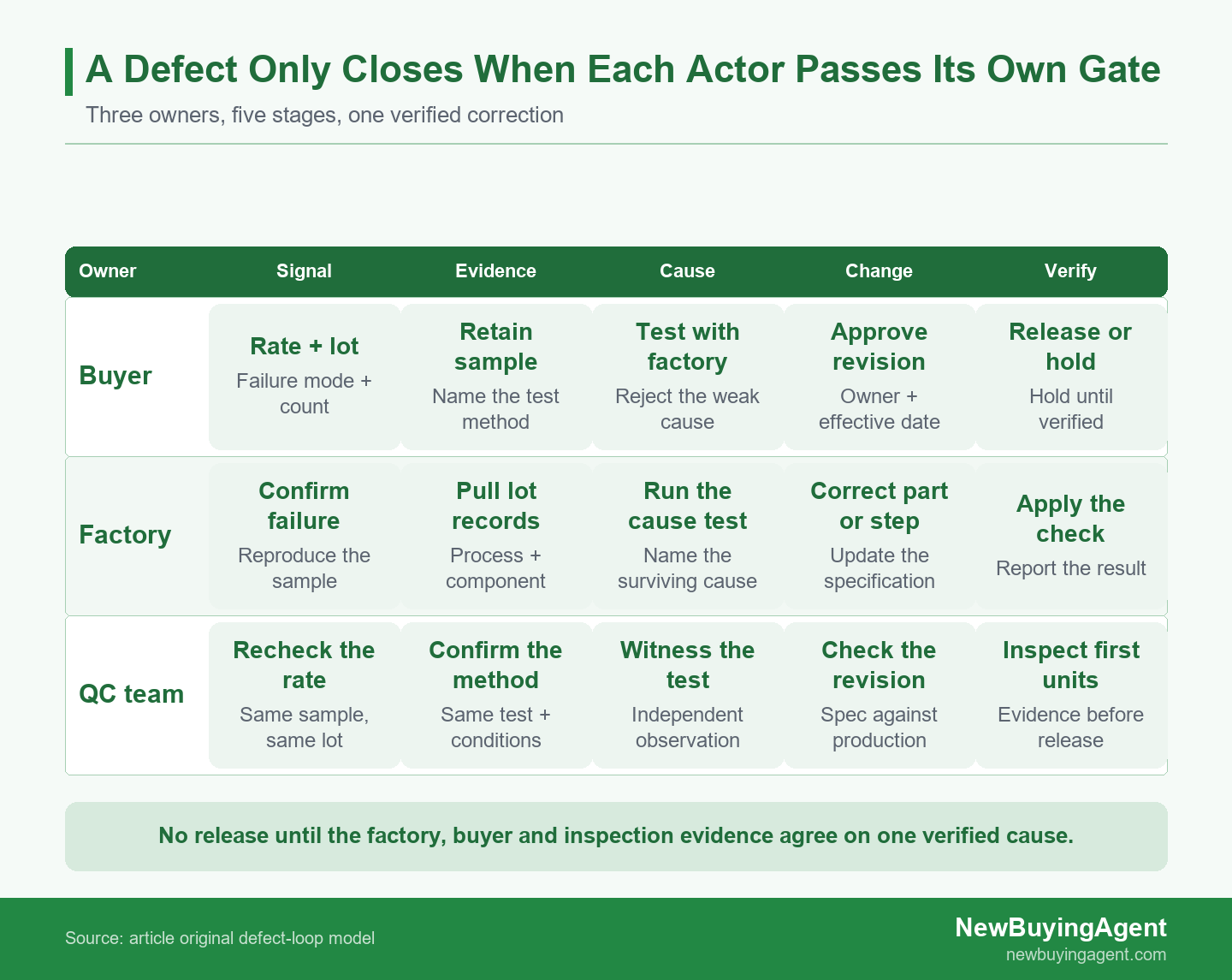
Buyer, factory and inspection partner each own a stage of the post-launch defect loop
It also helps to know whether the failure is real or a measurement effect before blaming a process. The NIST/SEMATECH e-Handbook of Statistical Methods is published by the U.S. National Institute of Standards and Technology and covers statistical methods including measurement-process characterization and design of experiments. That reference addresses measurement and experimentation rather than any single product, so the transferable lesson is narrow. Characterize how the failure was measured, and how much variation the measurement itself carries, before concluding that the process changed.
Collecting this evidence inside China is usually faster than assembling it from the buyer's side. A China-side partner with local factory access and product-development and quality-control capability, such as NewBuyingAgent, can turn a buyer's photos and order details into a factory-readable defect record, keep the retained sample with the lot code, and hold the evidence in the format the factory's quality team already uses.
Tie Every Defect to a Production Lot and a Test Method
Tying every defect to a production lot and a named test method lets the buyer and the factory decide whether the fault is confined to one run, shared across a component, or present in the process, instead of guessing from a single unit. A lot code answers "when and with what". A test method answers "how do we know". Together they turn a failure into a boundary: the units before the change behave one way, the units after behave another, and the difference points at what moved.
Traceability is an established supply-chain discipline rather than a buyer's invention. GS1 publishes the GS1 Global Traceability Standard, which describes how supply-chain parties identify products and share information so a product and its history can be traced through the supply chain. The standard does not dictate a consumer brand's lot scheme, so the transferable lesson is to give each production run an identity and to keep its component history. A defect with a lot code and a test method can be scoped; a defect without them can only be described.
Set the Test Method Before You Compare Results
A defect comparison only means something when the same test method, sample and conditions are used each time, so the buyer should record how the failure was measured before treating a later result as an improvement or a repeat. If the first check used a two-week soak and the second used a two-hour check, the second result is not comparable. Fixing the method early is what allows a buyer to say, later, that the corrected lot actually passed the same test the failed lot failed.
In practice the method record is short: the test or observation, the sample it was applied to, the conditions, the pass limit, and who performed it. Any change to that record is itself a change that the factory and the buyer should agree on, because a moved test method can hide an unchanged defect.
Run Root Cause Analysis With the Factory, Not At It
Root cause analysis works when the buyer and the factory examine the same evidence together, test candidate causes against the lot data, and record the cause that survives, rather than when the buyer sends a complaint and waits for a written apology. The factory holds the process records, the operator history and the component sources. The buyer holds the field data and the customer expectation. Neither side can verify a cause alone, so the useful work is done in the same room, physical or virtual, against the same lot.
Treating a defect fix as an improvement project rather than an argument is a recognised practice. The NIST Manufacturing Extension Partnership is a program administered by the U.S. Department of Commerce's National Institute of Standards and Technology to strengthen small and medium-sized U.S. manufacturers through MEP Centers. The program supports U.S. manufacturers, so the transferable lesson is narrower. A correction is a readiness decision supported by documented process evidence and a named owner, wherever the factory is located.
For a buyer who already has a Chinese supplier, the cause test is mostly a follow-up problem rather than a sourcing problem. NewBuyingAgent's existing-factory management service connects local China follow-up and quality-control capability to the cause test and the corrective-action record, so the investigation runs against the factory's own process evidence instead of stopping at a written reply.
Convert the Root Cause Into a Controlled Change
A root cause only closes the loop when it becomes a controlled change: a corrected specification or process step, an updated inspection point, a documented revision, and a clear effective date, with any published performance claim still supportable. A verified cause that is not written down is a memory. The next lot may be produced by a different shift, a different line or a different component batch, and the fault returns because nothing in the paperwork changed. The change record is what makes the fix travel. A correction that lives only in a chat thread or a phone call is not a correction; it is an intention that the next production plan can quietly drop.
There is also a claims boundary to respect. The U.S. Federal Trade Commission's advertising guidance explains that advertising claims must be truthful and not misleading and that advertisers must be able to substantiate the claims they make. That requirement applies to advertising claims in its own jurisdiction. The transferable lesson is that a corrective change should not leave a published performance or quality claim without support. If a claim was based on the original component or process, the corrected version needs its own basis before the claim is repeated to customers.
For a product moving into the next production lot, NewBuyingAgent's product-supply service carries the corrected specification, the updated inspection point and the effective date into the next order, using local China factory resources and product-development and quality-control capability to connect the recorded change to the factory that must apply it.
A workable change record names four things: what changed, who owns it, where it is checked, and from which lot it applies. When any of those is missing, the loop is still open, even if the factory has agreed in principle.
Worked Example: A Return Spike That Looked Like a Factory Defect
Treat a return spike as a hypothesis to test against the lot and the test method before blaming the factory process, because a signal can point to a substituted component, a storage condition or a measurement gap rather than to the line that made the unit. The first explanation is rarely the verified cause. In a small reorder, the cost of testing the cause is far smaller than the cost of shipping the same fault twice, so the evidence step is worth the delay.
Illustrative Example: A Return Spike Traced to a Substituted Component
In this illustrative example, a consumer brand sells a small home appliance across 2 production lots totaling 8,000 units, and 1 of 2 color variants shows a 4% field return rate reported through marketplace messages and photos. A repeat order of 5,000 units is scheduled once the current stock sells through. The product has been on the market for one season, the factory has acknowledged the complaint informally, and the buyer has returns but no measured defect record and no retained failed sample.
The returns arrive as customer photos and messages rather than as a failure mode with a rate and a denominator. The first explanation blames the assembly line, but the returns cluster in the later production lot rather than the earlier one. The failed units share a sealing gasket from an unapproved second source that was introduced to cover a component shortage.
Without a lot code and a retained sample, the buyer could only forward photos, and the factory could only repeat the apology. Once the units were tied to a lot and a component history, the shared substituted gasket became a testable candidate cause instead of the assembly line, and the scope of the fault became the units that used that gasket rather than every unit ever shipped.
The decision is to contain the affected lot, pause shipment of the remaining units from that lot, and hold release of the repeat order until the corrected component is verified. The factory re-approves the gasket source with an incoming inspection point, records the corrected component and the inspection check with an effective date, and verifies the change on a sample from the new component before the repeat order is released.
Before release, the buyer confirms the incoming check and the component record; after the first repeat-lot units, the buyer confirms the inspection result against the corrected specification. This illustrative example invents no measured rate and no passed test, and a verified correction is not a guarantee for every later unit; the product's own records, test method and contract govern the real scope.
Put the Defect Loop Into Your China Supplier Agreement
Put the defect loop into the China supplier agreement: define what counts as a defect, require lot traceability and retained samples, set the response and containment timeline, name the corrective-action record, and state who pays for sorting, rework and replacement. Written as terms, the loop does not depend on goodwill or on the next negotiation. It gives both sides the same procedure and the same evidence list, and it makes a verified defect a contract event rather than a favour.
Import and standards documentation belongs in that agreement rather than at the end of the process. The U.S. International Trade Administration's China Country Commercial Guide covers customs, regulations and standards, including tariff and non-tariff barriers, import requirements and documentation, and product standards. Naming the applicable documentation in the defect terms keeps compliance evidence attached to the corrective action instead of surfacing at the port.
Some defects also trigger a reporting path outside the commercial agreement. The European Commission's Safety Gate is the EU rapid alert system for dangerous non-food products, through which national authorities exchange information and measures taken on products that pose a risk to consumers. That system operates in the EU and does not replace the buyer's own market rules, so the transferable lesson is to check whether a safety or compliance defect has a reporting duty separate from the supplier claim, and to route it accordingly.
For a product with an open defect, prepare the product and failure mode, the defect or return rate with the affected quantity, the production lot or date code and the retained sample, the test method and conditions, the destination and the next order timing. NewBuyingAgent can use its local China factory resources and product-development and quality-control capability to collect the evidence, run the root-cause follow-up with the factory, and track containment and corrective action into the next lot. With that record ready, send your defect record to NewBuyingAgent.
Frequently Asked Questions
Is a return rate the same as a defect rate?
No; a return rate counts units sent back for any reason, while a defect rate counts units that failed a named test or condition against the units exposed to it, so a return rate has to be broken down into failure modes before it can be investigated. A return can be a change of mind, a fit problem or a defect. Only the failure modes that fail a defined condition belong in the defect rate, and only that rate gives the factory something it can test.
How long should a buyer wait before escalating a defect to the factory?
Escalate a safety or compliance failure immediately and a high-rate or rising failure as soon as the rate is measurable; only cosmetic or clearly isolated issues can wait for the next scheduled quality review. Waiting does not reduce the defect, and a rising rate usually costs more the longer it runs. The useful question is not how long to wait but whether the signal is strong enough to open an investigation, which the triage rule answers.
Can a factory refuse a defect claim without a returned sample?
A factory can reasonably dispute a claim it cannot examine, so the buyer should keep a retained failed sample, the lot code and the test conditions; a contract that defines the defect and the evidence makes the claim a term rather than a request. The sample is what lets the factory reproduce the failure. Without it, the discussion stays at the level of description, and a description cannot be tested or corrected.
Who pays for sorting, rework and replacement after a defect?
That is a contract term, not a default: the supplier agreement should state who bears sorting, rework, replacement and freight for a verified defect, and how a charge-back is calculated, so the responsibility does not depend on the next negotiation. A verified defect and an unverified claim can carry different terms, which is one more reason to close the evidence loop before discussing cost. Leaving it unstated turns a quality problem into a pricing argument.
How do I stop the same defect on a repeat order?
Close the loop with a controlled change: correct the specification, component or process, add the check at a named inspection point, record a revision and an effective date, and verify the change on the first units of the repeat order. The record is what stops the defect from returning when the shift, the line or the component batch changes. A verified correction that was never written into the specification is the most common reason a fixed defect comes back.
NewBuyingAgent
Related Resources

Get Started Today
Let's Turn Your Sourcing Goals into RealityWeChat:+86 15157124615
WhatsApp:+86 15157124615
Address:Building 10 #39 Xiangyuan Road, Hangzhou, China
