

Payment terms in China sourcing are not just finance language. T/T 30/70, L/C, and O/A each move risk between buyer cash flow, factory cooperation, document discipline, and quality-release leverage.
Key Takeaways
- T/T 30/70 is common but needs release proof: the buyer should place QC, packing, and document evidence before the balance payment.
- L/C adds document discipline: it can protect payment mechanics, but it does not replace product inspection or sample control.
- O/A improves buyer cash flow: it usually requires strong trust, order volume, factory leverage, or financing support because the seller carries more risk.
Payment Terms Are a Risk Allocation Tool, Not a Courtesy Line
Trade.gov's international payment-method guidance compares common trade payment methods by risk and timing. For China sourcing buyers, the practical issue is not which term sounds best. It is whether the payment term matches trust level, order size, factory cooperation, product proof, and delivery risk.
T/T 30/70 is common because it is simple: a deposit starts the order and the balance is paid before or around shipment. L/C adds bank-document discipline. O/A improves buyer cash flow because payment is due after shipment, often in 30, 60, or 90 days. Each term solves one problem and creates another.
Based on our analysis, payment terms should be negotiated together with product version, QC evidence, packing status, Incoterm, and shipment documents. If payment is discussed alone, the buyer may win better cash flow but lose factory cooperation, or protect the seller but weaken release leverage.
A payment term should never outrun product evidence
The safest payment structure is the one that keeps money, proof, and risk moving in the right order. A deposit should follow a stable product specification. A balance payment should follow inspection, packing, and document evidence. A credit period should follow enough trust, order history, or payment support to make delayed collection acceptable to the factory.
Calculated from a three-gate order model, the buyer should place one evidence gate before each major payment exposure: product lock before deposit, release proof before balance, and delivery/document reconciliation before extended credit. If a term skips one of those gates, the buyer may improve cash flow on paper while increasing quality or shipment risk in the real order.
The payment-method sources point to one practical lesson: payment terms are not just finance terms. They depend on order proof, document discipline, risk transfer, and shipment control. A T/T 30/70 structure may be simple, an L/C may add bank discipline, and open account may help cash flow, but each option needs a different level of trust and evidence.
Import and release context also matters. CBP importing guidance reminds buyers that entry data and compliance responsibilities still sit with the importer, while the WTO trade facilitation material shows why release and clearance depend on usable information. Payment timing should not be separated from those realities.
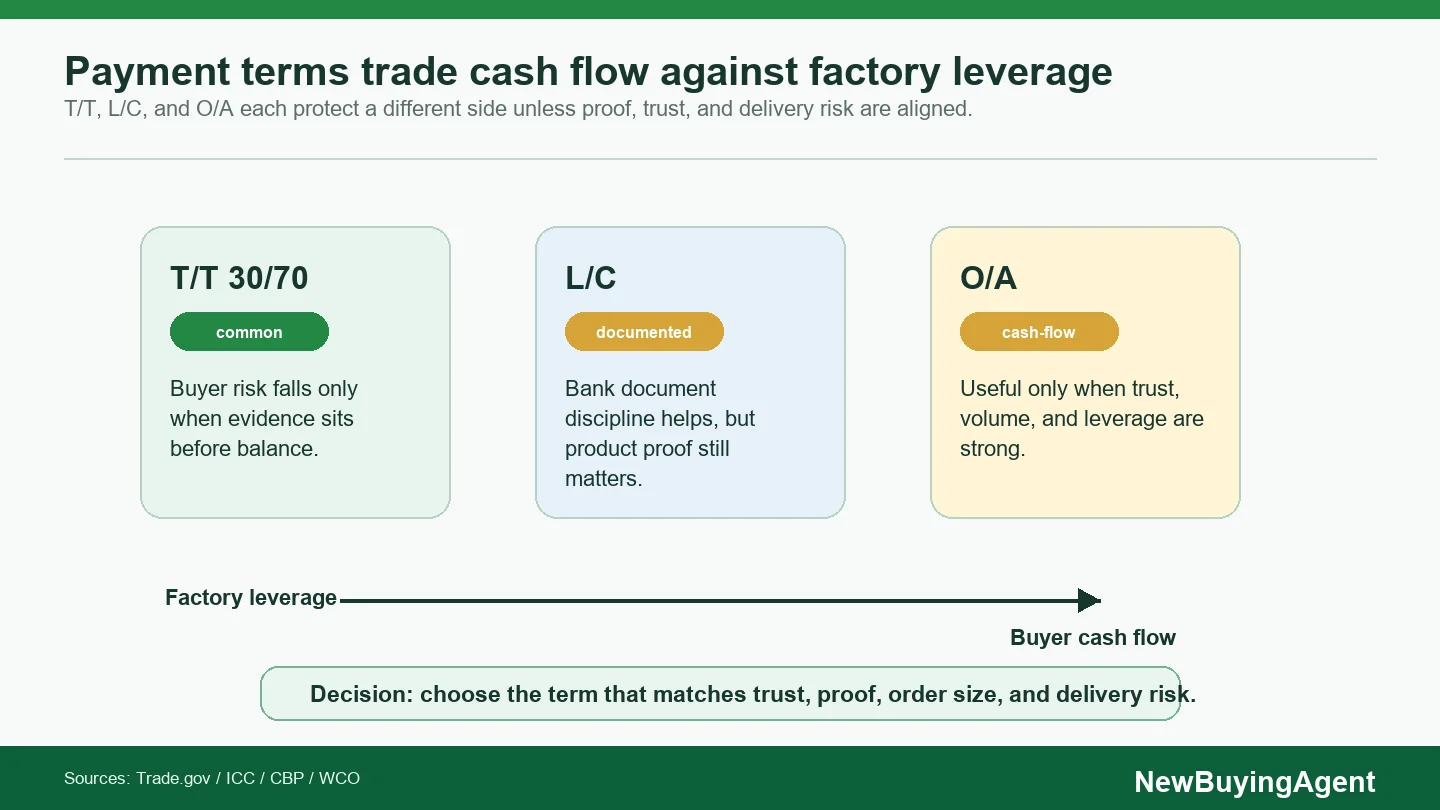
Payment terms should match proof, trust, order size, and delivery risk, not only buyer cash-flow preference.
T/T 30/70: Fast and Common, but Proof Must Sit Before Balance
T/T 30/70 is often the default for China sourcing because it is easy to understand and quick to execute. The buyer pays a deposit, production begins, and the balance is paid when goods are ready or before shipment. The simplicity is useful, but it also creates a critical release point.
The deposit protects the factory's production commitment
The deposit gives the factory confidence to buy materials, reserve capacity, and start production. The buyer should not treat the deposit as a casual placeholder. Once paid, the buyer has less leverage to change product version, packing, deadline, or cooperation terms unless those conditions were already written into the order.
The decision rule is to use the deposit only after the quote, specification, sample reference, packing expectation, and delivery term are clear. A low deposit may feel attractive, but unclear assumptions can make even a small deposit expensive if the order has to be reworked or restarted.
The balance payment should depend on release evidence
The buyer should make this rule visible in the purchase order or payment schedule. If the factory knows what evidence is required before balance, the release conversation becomes less emotional and more factual.
The balance payment is where T/T 30/70 succeeds or fails. If the buyer pays the balance based only on a factory message, the term becomes risky. The buyer should place final inspection, packed-goods photos, carton count, packing list, commercial invoice, and shipment plan before balance release.
Trade.gov's common export-document guidance shows why document readiness matters in cross-border trade. For payment decisions, the so what is practical: the buyer should not release final payment until the product evidence and shipment documents describe the same order.
L/C: Stronger Document Discipline, Higher Cost and Slower Setup
A letter of credit can be useful when order value, buyer-seller trust, or document discipline justifies the added bank process. It is not automatically better than T/T. It is better when the risk being controlled is payment against documents and when both sides can handle the process correctly.
L/C protects payment mechanics through documents
The buyer should therefore write L/C document requirements with operational reality in mind. Requirements that the factory, forwarder, or bank cannot produce consistently can create delay even when the goods are acceptable.
Trade.gov defines a letter of credit as a bank commitment to pay once required documents are presented after shipment. This can protect exporters and importers because payment depends on the document conditions written into the L/C.
The buyer should understand the limit: banks review documents, not the physical quality of the goods in the way a product inspector would. If the documents are compliant but the product was poorly specified or weakly inspected, the buyer may still have a commercial problem.
L/C terms must be operationally realistic
An L/C can fail operationally when document requirements are too strict, ambiguous, or disconnected from the real shipment. Small spelling differences, timing problems, document format issues, or inconsistent product descriptions can delay payment and create disputes. That cost may offset the protection the buyer wanted.
The WCO Data Model is a reminder that structured trade data matters across documents. In L/C sourcing, the product name, quantity, shipment data, invoice, packing list, and transport document should be planned early enough that the factory, freight side, and bank document requirements can align.
O/A: Better Cash Flow, but Only for Strong Relationships
Open account can be attractive because the buyer pays after shipment or after a credit period. It supports cash flow and inventory turnover, but it shifts more risk to the seller. Many factories will resist O/A unless the buyer has order volume, history, credit support, financing arrangement, or strategic value.
O/A is strongest when trust and volume are already proven
The buyer can also reduce resistance by tying O/A to repeat performance instead of demanding it immediately. A staged move from T/T to partial credit often protects cooperation better than a sudden full open-account request.
Trade.gov's Trade Finance Guide explains that open account normally means goods are shipped before payment is due, often after 30, 60, or 90 days. That is advantageous to importers for cash flow, but it is riskier for exporters.
The buyer should not treat O/A as a first-order entitlement. It is usually earned through repeat performance, clear payment behavior, larger order volume, strong buyer reputation, or support from a sourcing partner with factory relationships and payment flexibility.
O/A can weaken factory cooperation if negotiated too early
A factory may accept open account terms but recover risk through higher price, stricter MOQ, slower scheduling, reduced flexibility, or reluctance to handle changes. The buyer may gain cash flow while losing cooperation. That trade-off is easy to miss if payment is negotiated separately from product and delivery assumptions.
NewBuyingAgent's flexible payment support and local factory relationship base can be useful when buyers need better cash-flow terms, but the term must still fit the order. Payment flexibility works best when quality proof, delivery timing, and factory cooperation are protected rather than sacrificed.
Comparison Table: Where Each Term Fits
The table below compares payment terms by buyer cash flow, factory cooperation, use case, and control point. It is not a universal ranking. The best term is the one that matches risk.
| Term | Buyer cash-flow effect | Factory cooperation effect | Best use case | Main control point |
|---|---|---|---|---|
| T/T 30/70 | Moderate; deposit paid early and balance before/around shipment | Common and easy for many factories | Repeat or standard orders with clear sample and inspection evidence | Put QC, packing, and document proof before balance release |
| L/C | Moderate; payment depends on documents and bank process | Stronger document discipline but slower setup | Large or higher-risk orders where document control matters | Do not confuse bank documents with product quality proof |
| O/A | Strong for buyer cash flow because payment comes after shipment | Harder for factories unless trust, volume, or financing support exists | Established relationships or buyers with strong leverage | Use only when quality, delivery, and payment behavior are proven |
Trade.gov's documentary-collection guidance adds a useful middle-ground lesson even though documentary collection is not one of the three terms in the title: documents can control release mechanics, but they do not automatically prove product quality. The same logic applies to L/C and T/T release decisions.
How to Negotiate Terms Without Damaging Factory Cooperation
Payment negotiation is easier when the buyer can show order clarity. A factory is more likely to support better terms when product specs, quantity, repeat potential, inspection plan, delivery term, and document requirements are stable. Unclear orders are harder to finance and harder to trust.
Use order size and repeat potential as leverage
Factories usually care about predictable volume, stable specifications, and payment reliability. A buyer negotiating better terms should show expected repeat orders, launch timing, payment discipline, and what risk the factory is being asked to carry. A request for better terms without order clarity often sounds like pure risk transfer.
Based on our analysis, payment-term leverage rises when the buyer can prove three things: the product is stable, the order can repeat, and the release process is evidence-based. Those factors reduce uncertainty for the factory and make better terms easier to discuss.
Connect payment milestones to QC and shipment evidence
ICC Incoterms rules clarify responsibilities, costs, and risk transfer in the sale of goods. Payment terms should be connected to that same logic. If the buyer pays before risk transfer or before product evidence, the buyer carries more uncertainty. If the seller waits too long for payment without trust, cooperation may suffer.
The practical approach is to place evidence between money and risk. For T/T, balance follows inspection and packing evidence. For L/C, documents match actual shipment data. For O/A, the buyer's credit behavior and repeat volume justify the delayed payment.
Where NewBuyingAgent Fits in Payment-Term Strategy
NewBuyingAgent is relevant because payment terms are tied to sourcing execution, not just bank wording. Its local China factory resources, 30+ years of trade/manufacturing/QC experience, flexible payment support, and multi-industry cases can help buyers discuss terms in the context factories actually care about: product clarity, order stability, quality proof, and delivery confidence.
For a new sourcing order, buyers can use NewBuyingAgent's China product supply service when they need a quote that considers product, cost, payment, quality, and delivery together. For existing suppliers, the factory-management route is more relevant when payment release depends on staged QC, packing status, and shipment evidence.
What to Send Before Asking for Better Terms
Before asking for T/T adjustment, L/C, or O/A, prepare product specs, quantity, target price, repeat-order expectation, destination, delivery timing, payment target, quality requirements, and current supplier status. Also state what proof should appear before deposit, balance, shipment, or credit-period approval.
If payment terms are becoming the bottleneck, submit those details through NewBuyingAgent's purchasing inquiry channel. The useful next step is a quote-ready payment discussion that connects factory cooperation, product quality, shipment documents, and buyer cash-flow pressure instead of treating payment as a standalone request.
FAQ
Is T/T 30/70 safe for China sourcing?
T/T 30/70 can be safe enough when the buyer controls the release evidence. The deposit should follow clear specs and sample reference, while the balance should follow QC, packing, document, and shipment proof. Without those gates, T/T shifts too much risk to the buyer.
Is L/C better than T/T for China imports?
L/C is better when document discipline and bank-backed payment mechanics are the main concern. It is not automatically better for product quality. Buyers still need clear specs, sample control, inspection evidence, and shipment reconciliation because banks mainly review documents.
Why do factories resist open account terms?
Factories resist O/A because they ship goods before receiving payment, so they carry buyer credit risk and cash-flow pressure. They may accept O/A for trusted repeat buyers, larger volumes, strong buyer reputation, financing support, or relationships where payment behavior is already proven.
Which payment term is best for a first China order?
Many first orders use T/T with strong proof gates because it is simpler than L/C and more acceptable to factories than O/A. The buyer should not focus only on the term. The safer structure is clear specs, controlled sample approval, staged QC, and document checks before balance payment.
NewBuyingAgent
Related Resources
Get Started Today
Let's Turn Your Sourcing Goals into RealityWeChat:+86 15157124615
WhatsApp:+86 15157124615
Address:Building 10 #39 Xiangyuan Road, Hangzhou, China
