

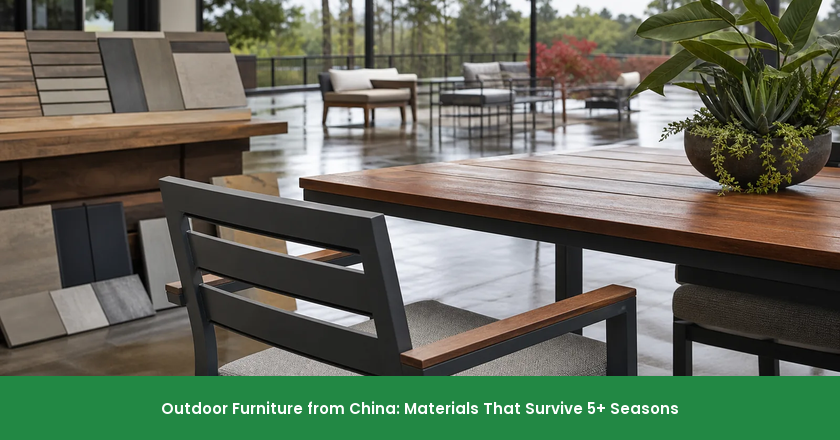
A five-season outcome is not a material label; it is a purchasing decision that has to survive the buyer's actual sun, rain, salt, temperature swings, handling, and maintenance reality. For outdoor furniture from China, the safer route is to choose a material system, then specify the protection, joints, hardware, cushions, and evidence that make that system credible. The Five-Season Material Matrix below is designed for that conversation, not as a warranty for every climate.
Five Seasons Begins With the Exposure Profile
A five-season target is credible only when material, exposure, construction, and evidence are specified together. Start with the exposure profile: direct sun hours, rain and standing water, salt or pool chemicals, freeze-thaw cycles, wind-blown grit, storage conditions, and the level of care the end user will realistically provide. Weathering is the material change caused by sunlight, moisture, temperature, and outdoor exposure; that is why a color sample or a frame label is not enough.
Expected service conditions should guide the treatment and protection requirements for outdoor wood components. The American Wood Protection Association's use-category guidance makes the same exposure-first distinction for treated wood: the expected conditions determine what protection is appropriate. A buyer requesting a covered balcony set therefore needs a different construction brief from a buyer placing the same design beside a salt-exposed pool deck.
Write the exposure profile before requesting prices. Then ask the factory to respond to it line by line: which substrate, which coating or finish, how water leaves the product, which metals touch, what soft goods are included, and what test or production evidence belongs to that exact configuration. If the wider product brief is still incomplete, use the China manufacturing and product guide to frame the factory brief before comparing quotations. That exposure-first input also gives NewBuyingAgent a concrete China-sourcing requirement rather than a generic request for weatherproof furniture.
What the Five-Season Material Matrix Means for Buyers
The best five-season option is the system with no unverified weak gate, not the material with the strongest marketing label. Use the Five-Season Material Matrix to compare every proposal against the same four gates: exposure fit, construction and water management, protective system, and configuration-linked evidence.
- Rank a material only after the destination conditions are defined.
- Buy the coating, finish, drainage, and hardware details with the frame rather than treating them as later choices.
- Ask for evidence that identifies the actual specimen and construction, not an unrelated material brochure.
- Keep a hold point for any mismatch between the approved brief and the physical product.
The Five-Season Material Ranking: Choose a System, Not a Label
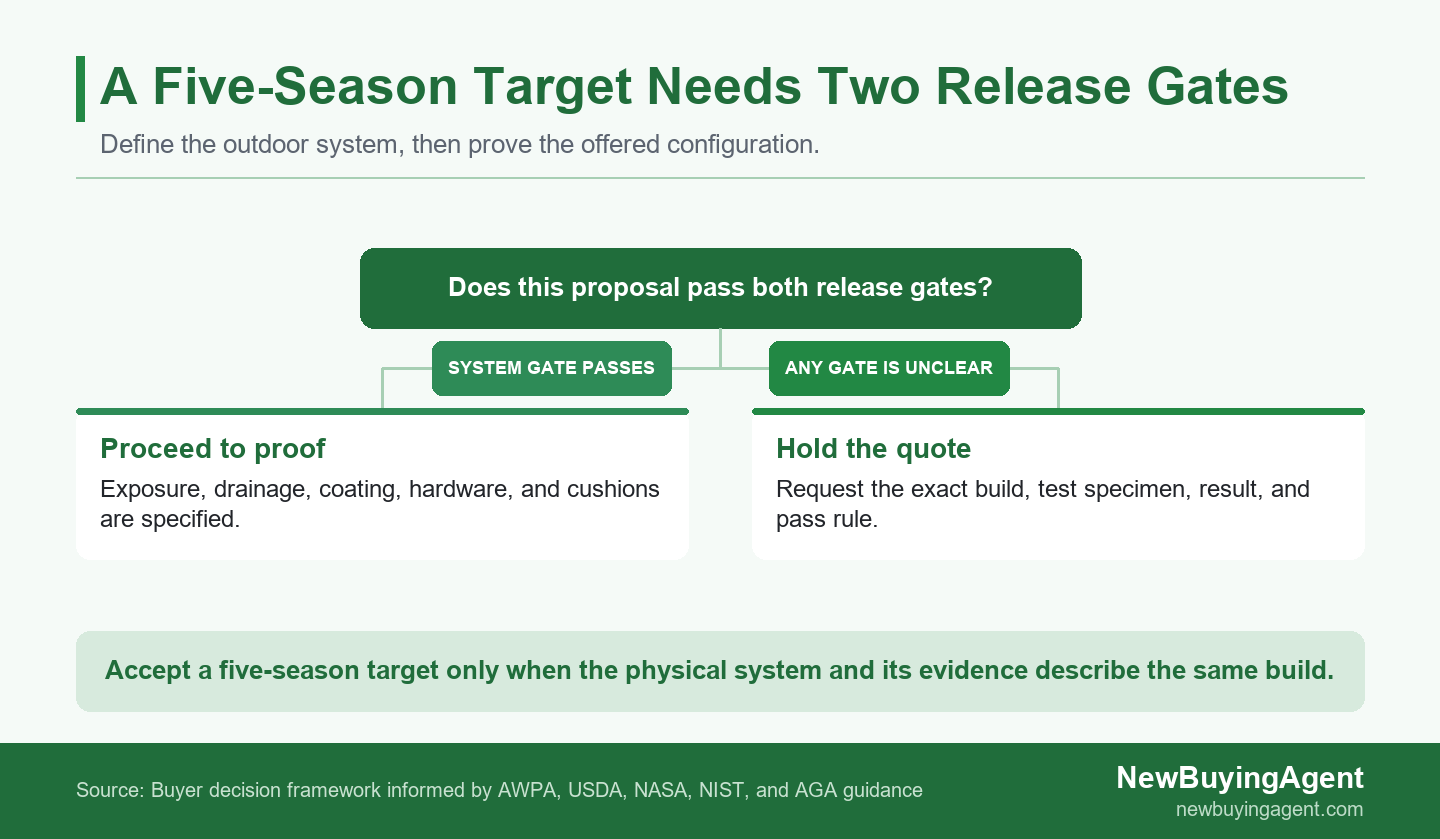
A five-season target is a release decision: first define the complete outdoor system, then verify evidence for that exact build.
The ranking compares material systems only after their climate, construction, protection, and evidence conditions are made visible. It is a practical ordering for a buyer who wants a durable collection, not a declaration that one material wins in every location, price band, or design.
| Rank | Material system | Best fit | Weak point to specify | Evidence to request |
|---|---|---|---|---|
| 1 | Powder-coated aluminum | Low-weight collections with disciplined coating and hardware choices | Coastal exposure, cut edges, dissimilar metals, drainage | Substrate, pretreatment, coating system, component records |
| 2 | Naturally durable hardwood | Premium collections where care and finish renewal are part of the offer | Water retention, end grain, finish schedule, verified species | Species identity, finish system, maintenance statement |
| 3 | HDPE | Heavy-use, easy-clean pieces with a verified resin and UV package | Color, formulation, load-bearing geometry, heat and UV exposure | Resin identity, weathering method, specimen and result |
| 4 | Hot-dip galvanized steel | Robust structures where coating thickness and atmosphere are visible | Coating process, drainage, welded areas, maintenance boundary | Galvanizing process and thickness evidence |
| 5 | WPC | Specified composite applications with clear formulation and water paths | Moisture, mold, formulation, cap layer, drainage | Construction details and weathering evidence |
Based on this comparison, powder-coated aluminum is often the most flexible first option for a broad outdoor range, but it only holds that position when the coating system and hardware are as clear as the frame. Hardwood can move ahead when a premium visual and planned care are central to the product. HDPE, galvanized steel, and WPC can be sensible choices when their specific weak points are visible and controlled.
1. Powder-Coated Aluminum for Low-Weight, Low-Maintenance Collections
Aluminum forms a protective oxide layer in common environments, but marine spray and dissimilar-metal coupling remain important corrosion boundaries. The NASA materials handbook describes both the protective oxide behavior and the need to consider marine and galvanic conditions. That boundary matters for chairs and tables because stainless fasteners, steel inserts, trapped water, and scratched coating can change the corrosion picture around an otherwise sound aluminum frame.
Specify the alloy or frame substrate, pretreatment, powder-coat system, coating thickness target, curing control, drainage holes, hardware material, and any isolation between unlike metals. For coastal or poolside use, ask the factory to explain what is different from its standard inland specification. A supplier's claim that a collection is "outdoor aluminum" is only a starting point; the accepted configuration should identify the parts that can collect water or expose bare metal.
2. Naturally Durable Hardwood When Care Is Part of the Product Position
For outdoor wood, protection from water, sunlight, and weathering is technically more important than appearance alone. The USDA Forest Service guidance on finishing wood emphasizes that outdoor protection is fundamentally about water, sunlight, and weathering control. A beautiful stain, smooth sanding, or premium species name therefore does not answer how joints dry, how end grain is protected, or how the finish is renewed.
Hardwood belongs near the top when the collection's design and price position can support care instructions, finish renewal, and verified species identity. Ask for the species name, source documentation where applicable, moisture approach, joint design, sealer or finish system, and a plain maintenance statement. If the buyer expects unattended furniture through wet winters, the decision should also address feet, contact with decking, covers, stacking, and drainage rather than only the wood species.
3. HDPE for Heavy-Use, Easy-Clean Pieces With Verified UV Performance
UV exposure and temperature can change HDPE behavior and can contribute to surface cracking in the conditions studied. A NIST study of polyethylene weathering reports that its tested UV and temperature conditions affected material behavior and could lead to rapid surface crack propagation. The buyer implication is not that HDPE is unsuitable; it is that the resin, pigment, stabilizer package, thickness, and geometry should not be assumed from the label alone.
HDPE can be a strong fit for easy-clean dining, poolside, and high-touch furniture where heavy pieces and a solid-color look work commercially. Request the resin identity, recycled-content statement if claimed, color system, UV exposure method, specimen identity, duration, observed result, and pass rule. Also separate surface durability from structural performance: a stable-looking seat still needs an appropriate load-bearing design and connection method.
4. Galvanized Steel When Structure and Coating Thickness Are Visible
For hot-dip galvanized steel, time to first maintenance is related to zinc-coating thickness and atmospheric conditions. Hot-dip galvanizing is a zinc coating applied to steel for corrosion protection, not a universal lifetime claim. The American Galvanizers Association explains the link between coating thickness, atmosphere, and time to first maintenance, so the supplier needs to name the process and provide coating evidence rather than simply write "galvanized steel" on the quotation.
Steel may suit substantial tables, benches, and commercial-looking lines when the weight and visual language are intentional. Check whether the frame is actually hot-dip galvanized or uses another zinc process; review weld treatment, venting and drainage, threaded areas, cut edges, and touch-up procedure. For a powder-coated galvanized frame, ask how the two layers are sequenced and what production record confirms the offered lot matches the submitted sample.
5. WPC Only When the Formulation and Drainage Story Are Clear
Outdoor wood-plastic composites can still face moisture, mold, decay, and polymer-degradation issues. USDA Forest Service research on WPC durability identifies those outdoor exposure concerns after extended use. That makes WPC a formulation-and-construction decision, not an automatic upgrade over wood or plastic.
Use WPC only when the project can identify the product's wood-plastic ratio or formulation information that is available, cap layer where used, wall thickness, water paths, fastening method, color behavior, and cleaning guidance. It can be appropriate for specified slats or surfaces, but a buyer should not infer five-season performance from the word composite. The factory should show how water leaves the assembly and which sample or test result relates to the same configuration.
Why the Frame Is Only Half the Durability System
The practical durability limit is often a joint, fastener, coating edge, drainage path, or cushion rather than the advertised frame material. This is why the Five-Season Material Matrix uses four gates rather than a single material score: a strong frame does not rescue a fabric that stays wet, a powder coat that ends at a cut edge, or a mixed-metal joint that traps water.
Turn the system into a bill-of-materials question. For every product, identify the frame, all visible and hidden fasteners, glides, inserts, arm caps, mesh or slats, cushion construction, and packaging that can hold moisture during shipment or storage. The aim is not to demand a perfect product. It is to find the first component that would undermine the intended use, then decide whether it needs a different specification, an evidence request, a maintenance boundary, or a different collection position.
Drainage, Joints, and Hardware Need Their Own Line Items
Drainage, joint design, and hardware pairing need their own line items because they can create failure conditions outside the advertised frame material. Ask where water enters, where it can remain, how it exits, whether fasteners sit in a wet pocket, and whether two unlike metals touch without separation. These questions are especially important at feet, arm connections, stackable interfaces, welded corners, and concealed brackets.
Make the answer purchasable. The product drawing or approved sample should identify drainage holes or weep paths, hardware grade and finish, isolation parts where needed, cap or plug details, and the treatment of cuts and welds. A buyer does not need to dictate the factory's engineering; the buyer does need a record that shows which construction features were approved and which changes trigger a new review.
Cushions Are a Separate Weathering Program
Cushions should be specified separately because their fabric, foam, thread, zippers, liners, and drainage can weather on a different schedule from the frame. A comfortable cushion can be the first element to fade, retain water, stain, or lose shape even when the chair structure remains usable.
Specify the fabric construction and color, thread, zipper type, foam or filling, liner, seam treatment, drain path, cover-removal requirement, and care instructions. If a weathering report is supplied, verify that it matches the offered textile and colorway rather than a generic swatch. This creates an honest product position: the buyer can sell the frame and soft goods as a coordinated outdoor system while still stating the care each part needs.
Turn the Durability Goal Into Evidence a Factory Can Show
A weathering report is useful only when its method, specimen, exposure conditions, results, and pass criteria can be tied to the offered configuration. Treat the report as a matching exercise: the named substrate, coating, fabric, color, thickness, and construction must correspond to the product on the purchase-order appendix. If the report cannot establish that connection, it may still be background information, but it is not proof for the exact furniture offer.
A useful weathering report should name its exposure method and conditions rather than rely on a generic UV-resistant label. If a supplier refers to xenon-arc exposure, define it plainly as a laboratory light-and-moisture test used to simulate weathering, then ask what specimen was exposed, for how long, under which conditions, what changed, and what result counted as a pass. The report should also show whether it covers the surface layer, the full component, or only a raw material.
Outdoor furniture safety evidence should distinguish general, seating, and table mechanical requirements from material weathering evidence. The EU listing for the EN 581 family separates general requirements from seating and table mechanical test methods. That distinction prevents one weathering document from being treated as a complete performance file; destination requirements and product type still determine what evidence is relevant.
- Match the report's specimen identification to the approved material and color construction.
- Record the method, exposure conditions, duration, measured result, and pass rule.
- Keep mechanical and safety evidence separate from weathering evidence.
- Set a hold point if production changes the substrate, coating, fabric, or hardware after approval.
Illustrative Release Decision: When the Frame Does Not Match the Brief
When the physical frame and the approved material brief do not match, the affected configuration should be held until its identity and evidence are verified. The following is an illustrative procurement decision, not a customer case: it shows why a finish sheet alone cannot establish what the underlying frame is or whether the approved system is still being produced. Buyers who already work with a China furniture supplier can review China-side factory management for an existing outdoor-furniture factory when local follow-up is needed.
The Corrective Gate Is Configuration Identity, Not a New Promise
The corrective gate is configuration identity: the physical product, revised documents, lot records, and acceptance decision must point to the same build. That is more useful than requesting a new marketing assurance because it gives the buyer a clear release condition.
An outdoor-living retailer is preparing a premium dining set for a humid, coastal-adjacent market where salt-laden air and frequent rain make coating and drainage more consequential than a showroom sample suggests. The order covers 480 dining sets for a spring launch. The approved brief calls for a powder-coated aluminum frame, weather-resistant cushions, and hardware suited to the agreed exposure profile. The purchase order includes the Five-Season Material Matrix, but the pre-shipment review plan has not yet linked the approved frame substrate to checks on representative production pieces.
During a review, a magnet adheres to several frame tubes. That observation does not establish the complete construction by itself, but it creates a material-identity question that the documents must resolve. The factory's coating sheet names a finish color, yet it does not identify the substrate, the coating system on the production lot, or whether the sample in the file represents the furniture now being prepared. The approved matrix and the physical product cannot be treated as the same configuration. The issue is not simply whether the frame is heavier than expected; a different substrate can change the corrosion boundary, hardware interaction, transport handling, and the evidence the buyer needs.
The buyer places 100% of the planned 480-set shipment on hold while the factory identifies the substrate, coating system, affected components, and production records. The cost is a possible launch delay, but releasing an unverified system would shift the replacement and reputation risk downstream. The corrective request is a revised bill of materials, a component list tied to the order, specimen-linked coating evidence, and a sample cut or another agreed non-destructive verification on representative frames. The buyer also asks whether any hardware or cushion detail changed with the frame. Release occurs only after the verified frame, finish, hardware, and cushion configuration matches the revised purchase-order appendix and the buyer accepts any changed commercial position. If the factory cannot create that match, the configuration remains outside the approved five-season brief. This is an illustrative decision model, not a claim about any NewBuyingAgent customer, factory, or material substitution rate.
Where China-Side Sourcing Support Fits the Material Decision
For a new outdoor-furniture requirement, NewBuyingAgent can use its China factory resources and product development and quality-control capability to support China product supply. The useful starting input is not a broad request for weatherproof furniture; it is a brief that identifies the product, exposure profile, preferred material system, commercial target, and evidence required before approval.
For an existing China furniture factory, NewBuyingAgent's factory-management service is relevant when production progress and quality evidence need China-side follow-up. The service path is different from a new-source request: the buyer can focus the conversation on whether the current factory's materials, documents, samples, and release evidence remain aligned. For a new requirement, buyers can compare a defined outdoor-furniture brief with NewBuyingAgent's product-supply service.
The Outdoor-Furniture Brief That Prevents a Vague Durability Claim
A durable outdoor-furniture quotation needs the product, exposure profile, material construction, evidence request, quantity, target price, destination, and timing in one brief. Include photos or drawings, proposed dimensions, the intended customer segment, any target color or finish, and a list of parts that cannot change without written approval. This lets factories respond to the same physical and commercial problem rather than send incomparable material labels.
- Describe the destination exposure and expected care level.
- Name the preferred material system and the acceptable alternatives.
- List coating, finish, drainage, hardware, and cushion requirements.
- Ask for configuration-linked evidence and state the review hold point.
- Provide quantity, target price, destination, packaging needs, and timing.
- Compare quotations only after each factory identifies assumptions and exceptions.
Once the brief is complete, buyers can review NewBuyingAgent sourcing stories for buyer-context examples and, when China-side product-supply support is the remaining decision, share a climate-and-material outdoor-furniture brief with NewBuyingAgent.
Frequently Asked Questions
Material names should be treated as starting points for a verified outdoor-furniture system, not as standalone durability guarantees. These questions address common boundaries that remain after the material, construction, and evidence review.
Is Teak Always the Best Outdoor Furniture Material?
No. Teak can be a strong premium option when verified species identity, joinery, water management, finish expectations, and care instructions fit the project. It is not automatically the best choice for a collection that will receive little maintenance, remain covered in wet storage, or compete primarily on low cost. Compare the wood system with aluminum or HDPE against the real destination conditions, not only the initial visual appeal.
Can Powder-Coated Aluminum Be Used Near the Coast?
Yes, but coastal suitability depends on the alloy, pretreatment, coating system, drainage, hardware pairing, and severity of salt exposure. Ask the factory what changes from its standard specification, how it handles cut edges and mixed-metal contact, and what evidence belongs to the offered configuration. A broad coastal claim without those answers does not tell a buyer how the furniture will behave at the intended site.
What Should a Factory Weathering Test Report Identify?
A useful report identifies the specimen, material construction, test method, exposure conditions, duration, results, and pass criteria tied to the purchase order. It should make clear whether the tested item is the same substrate, coating, fabric, color, or component that the factory proposes to supply. If a report only names a generic material family, use it as background rather than as final approval evidence for a specific furniture configuration.
Should Cushions Be Specified Separately From the Frame?
Yes. Cushions need their own fabric, foam, thread, zipper, liner, drainage, and care specifications because they can fade, retain water, stain, or lose shape on a different schedule from the frame. The brief should state whether covers must be removable, how water drains, which colors are approved, and which soft-goods sample or evidence record applies. That prevents a durable-frame claim from hiding a shorter-lived comfort package.
NewBuyingAgent
Related Resources



Get Started Today
Let's Turn Your Sourcing Goals into RealityWeChat:+86 15157124615
WhatsApp:+86 15157124615
Address:Building 10 #39 Xiangyuan Road, Hangzhou, China
