

Maintaining brand quality across 10+ product categories means using one shared brand standard while adapting material, function, defect, packaging, and release rules to each product type.
Multi-category growth can quietly damage a brand. A buyer may begin with one successful product, then add furniture, pet accessories, outdoor goods, storage, hardware, textiles, electronics, packaging items, and seasonal products. The product range expands, but the brand promise must still feel consistent to customers. That consistency does not happen by asking every product to pass the same generic inspection.
The challenge is that brand quality has two layers. The first layer is shared: logo, color, packaging tone, finish level, customer experience, documentation discipline, and defect tolerance. The second layer is category-specific: a chair has stability risk, a pet leash has force risk, a silicone bowl has contact risk, an outdoor rack has corrosion risk, and a textile bag has stitching risk. Strong quality management protects both layers at once.
NewBuyingAgent fits this problem because multi-category buyers often need one procurement process that can still respect product differences. Buyers share product specs, volume, target price, destination, and timing. NewBuyingAgent prepares a quote and manages product selection, cost negotiation, quality management, production follow-up, and logistics through final delivery.
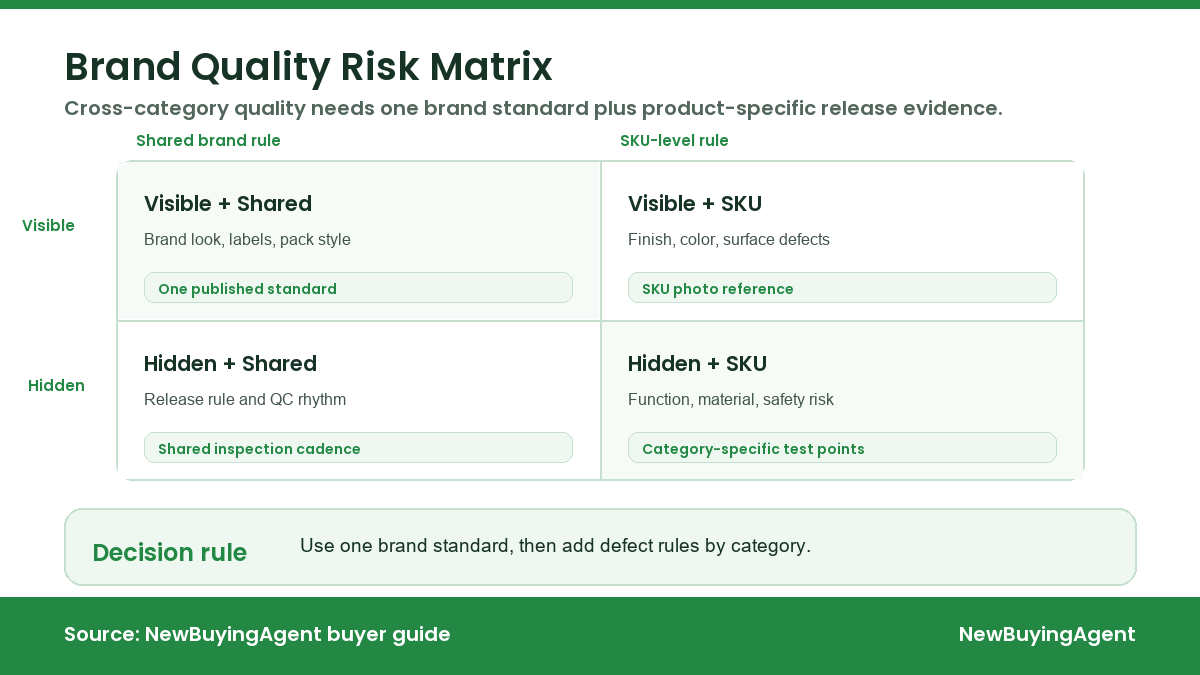
Brand quality across 10+ categories requires shared brand rules plus category-specific checks before shipment release.
Why Brand Quality Breaks When Categories Multiply
Brand quality breaks when each category is managed as a separate product experiment. One factory interprets the logo color differently. Another packs accessories in a cheap bag. Another accepts a scratch as minor when the buyer's retail channel would reject it. Another changes carton marks. Another uses a different finish standard. The customer does not see the sourcing complexity. The customer sees one brand behaving inconsistently.
Buyers often respond by writing longer checklists, but long checklists alone do not solve the problem. If the same checklist is applied to every category, it becomes too vague for real quality control. If every category has a completely different checklist, the brand loses consistency. The solution is a two-level quality system: a brand standard that never changes, and a category standard that changes according to product risk.
The ISO 9001:2015 page identifies ISO 9001 as a quality management system standard. Buyers do not need to turn a sourcing project into a certification exercise, but the management lesson is useful: quality should be built into a system, not rescued at the end by final inspection.
Change control is the part buyers often forget. As categories multiply, small changes start to appear: a new zipper, a slightly different carton, a different coating, a revised logo file, a cheaper insert, a changed screw, a new color batch, or a different fabric handfeel. None of these changes may look dramatic alone, but together they can weaken the brand. Buyers should define which changes require approval before production, which can be accepted by the sourcing team, and which must trigger a new sample.
Build a Brand Quality Standard First
A brand quality standard defines what customers should experience no matter which product they buy. It should be short enough to use and specific enough to enforce. The standard should cover visual identity, packaging quality, finish level, instruction clarity, defect tolerance, customer-use expectations, and release evidence.
Visual and Packaging Consistency
Visual consistency is the easiest to notice and the easiest to lose. Buyers should define logo size, logo placement, brand color, packaging material, barcode position, warning placement, carton mark format, instruction style, and photography expectations. A product may pass function checks and still feel off-brand if packaging and surface finish look cheaper than the rest of the line.
For multi-category buyers, a packaging master file is often more useful than scattered notes. It can include approved colors, fonts, icon style, carton marks, label hierarchy, and required inserts. The sourcing partner can then use that file during quote, sample, production, and release checks.
Customer Experience Consistency
Customer experience consistency means the product should feel like it belongs to the same brand promise. A premium home brand may care about finish, quiet function, and clean packaging. A value brand may care about simple assembly, clear instructions, and reliable function. A pet brand may care about material feel, odor, durability, and safety language. A travel brand may care about weight, compactness, and rugged packaging.
The buyer should define the experience standard in plain language. What should customers notice first? What defect would create a return? What detail would make the product feel below the brand's level? These answers help the sourcing partner decide which sample corrections matter most.
Release Evidence Consistency
Release evidence should be consistent even when product checks differ. Every category should have a record of approved sample, production status, packaging proof, QC result, carton marks, and shipment handoff. This shared evidence rhythm helps the buyer avoid a situation where one product has complete records and another product ships based only on trust.
The ISO 2859-1:2026 page describes AQL-indexed sampling plans for inspection by attributes. AQL can help structure lot inspection, but the buyer still needs category-specific defect definitions. The shared rule is the inspection rhythm; the category rule is what counts as a serious defect.
Add Category-Specific Quality Rules
Category-specific rules turn a general brand standard into product-level control. The buyer should decide which risks matter by category, then build defect lists around those risks.
| Category | Brand Rule | Category-Specific Check | Release Evidence |
|---|---|---|---|
| Furniture | Premium finish and stable assembly | Dimensions, hardware, finish, packaging | Sample photos, assembly check, carton proof |
| Pet products | Safe feel and durable use | Material, seams, small parts, odor, force points | Material notes, stress-point photos, QC report |
| Outdoor goods | Reliable use in real environments | UV, corrosion, load, water, abrasion | Exposure-related checks and packaging proof |
| Textiles | Consistent handfeel and color | Fabric weight, stitching, colorfastness, shrinkage | Approved swatch, sample, defect photos |
| Hardware | Functional durability and clean finish | Material grade, coating, fit, edge, fasteners | Material confirmation and function checks |
Use One Quality Calendar Across All Categories
A shared quality calendar helps the buyer manage 10+ categories without losing track. The calendar should include brief completion, quote approval, sample approval, packaging approval, production start, mid-production check, final QC, release decision, and shipment handoff. Each product may move at a different speed, but the buyer should see all products through the same decision rhythm.
This matters because quality failures often come from timing pressure. A late sample may skip packaging review. A delayed production run may rush QC. A carton mark may be approved after goods are packed. A multi-category calendar makes these risks visible early enough to act.
An illustrative scenario shows the problem. If a buyer manages 12 categories and each category has only three quality decision points, that is 36 decisions before shipment. If the buyer misses 10% of them, three or four products can ship with unresolved assumptions. The issue is not that the buyer lacks standards. The issue is that the standards are not attached to a calendar.
Repeat orders need the same discipline. Many quality problems appear not on the first order but on the third or fourth order, when everyone assumes the product is already understood. A factory-facing team may change a subcomponent, packaging supplier, coating batch, or worker process to save time or cost. The buyer should keep the approved sample, defect history, and previous QC evidence available for every repeat order, so the new order is checked against the brand standard rather than against memory.
Keep the Defect Language Clear
Defect language should be simple enough for everyone to use. Critical defects affect safety, legality, or product usability. Major defects affect saleability, function, appearance, packaging, or customer satisfaction. Minor defects are small issues that do not affect function or normal customer acceptance. These categories should then be adapted to each product type.
For example, a loose screw on a decorative display item may be major; a loose screw on a load-bearing chair may be critical. A small fabric shade difference may be minor for an inner lining and major for a visible set of cushions. A scratch inside a storage box may be minor, while a scratch across a retail logo may be major. Buyers should not let factories, agents, or internal teams guess these distinctions at the final inspection stage.
Destination-market safety expectations also matter. The CPSC business education page encourages businesses to identify requirements that apply to consumer products sold in the U.S., while the European Commission product safety page connects EU product safety rules to dangerous-product alerts. Buyers should keep compliance-related defects separate from ordinary cosmetic complaints.
Where NewBuyingAgent Fits in Cross-Category Quality Control
Cross-category quality is difficult because the buyer needs both consistency and adaptation. NewBuyingAgent can manage this as part of a full procurement process after the buyer shares product specs, volume, target price, destination, and timing. It can help keep product selection, cost negotiation, quality management, production follow-up, and logistics tied to one buyer-facing quality expectation.
The buyer should still provide the brand standard. NewBuyingAgent can manage China-side execution, but the buyer owns the customer promise. The strongest handoff is a clear brand quality sheet, product-level specs, sample approval notes, packaging files, and release priorities. With those inputs, NewBuyingAgent can help turn quality expectations into sample checks, production follow-up, QC evidence, and delivery decisions.
Buyers ready to organize a multi-category program can ask NewBuyingAgent to review their purchasing needs. Buyers still defining the broader procurement model can read NewBuyingAgent's product sourcing service overview before preparing the quality brief.
Quality Governance for Repeat Orders
Brand quality across many categories often weakens during repeat orders, not first orders. The first order receives attention because everyone knows it is new. Later orders may be treated as routine, and that is when small changes slip in: a new accessory, a changed carton, a slightly different fabric batch, a different coating, a revised label, or a cheaper internal packing method.
Repeat order governance means every reorder should be checked against the approved brand standard, not against memory. The buyer should keep the approved sample record, packaging file, defect history, QC photos, carton marks, and previous release notes. NewBuyingAgent can then manage production follow-up and quality management with a clearer reference point.
Change Approval Should Be Explicit
Changes should not be judged only by whether they save money or keep the order moving. The buyer should decide which changes require approval: material substitutions, visible color shifts, packaging changes, logo placement, hardware, accessory count, carton marks, instruction sheets, and any customer-facing surface. If a change affects the brand promise, it should not be treated as a factory-side detail.
NewBuyingAgent can manage the procurement process more effectively when these approval rules are known. It can handle cost negotiation, production follow-up, QC evidence, and logistics while bringing buyer decisions back at the points that protect brand quality.
A Repeat-Order Drift Scenario
Imagine a buyer has 10 product categories and each category has two repeat orders per year. That creates 20 repeat-order moments where a small change can slip in. If only three of those orders use a changed material, packaging insert, or finish without approval, the brand may still feel inconsistent across the range. The issue is not one dramatic failure; it is slow drift.
The practical answer is a repeat-order release file. Before shipment, each product should be checked against the previous approved version, current packaging proof, known defect history, and current QC evidence. This keeps brand quality from depending on memory, habit, or rushed final inspection.
What to Send Before Asking for Cross-Category Support
Buyers should prepare a brand quality sheet, product list, target quantities, target prices, destination market, packaging rules, sample status, known defect history, delivery timing, and category priorities. The brand quality sheet should explain what must stay consistent across all products and what can vary by category.
The most useful input is a simple red-line list: what defects are never acceptable, what defects may be reworked, what defects are tolerable within limits, and what changes require buyer approval. This list helps the sourcing partner manage cost negotiation without sacrificing the brand promise.
It also keeps approval decisions consistent when the product list keeps growing.
Who Is NewBuyingAgent?
NewBuyingAgent is a one-stop China sourcing agent for global buyers that want to source products from China. Backed by 30 years of trade, manufacturing, and quality-control experience, NewBuyingAgent prepares quotes for products that match the buyer's purchasing needs. Buyers share product specs, volume, target price, destination, and timing; NewBuyingAgent manages product selection, cost negotiation, quality management, production follow-up, and logistics.
Its sourcing network includes 50,000+ partner factories and 20,000+ product development & QC experts. For multi-category buyers, the value is keeping brand standards visible while each product receives category-specific quality checks.
Frequently Asked Questions
How do brands keep quality consistent across many categories?
Brands keep quality consistent by separating shared brand rules from category-specific checks. Shared rules cover logo, packaging, finish level, customer experience, and release evidence. Category rules cover product-specific risks such as load, material, stitching, food contact, corrosion, electronics, or packaging protection.
Why is one inspection checklist not enough?
One inspection checklist is not enough because different products fail in different ways. Furniture, pet accessories, outdoor goods, textiles, hardware, and electronics need different defect definitions. A shared quality rhythm is useful, but each category needs its own material, function, safety, packaging, and release checks.
What should a cross-category quality brief include?
A cross-category quality brief should include brand rules, product specs, packaging files, target quantities, destination market, sample status, known defect history, category risks, delivery timing, and release priorities. It should also list defects that are unacceptable, reworkable, or tolerable within limits.
When should buyers use managed procurement for brand quality?
Buyers should use managed procurement when the brand is sourcing many categories, launching seasonal products, handling private-label packaging, or struggling with inconsistent samples and QC evidence. Managed procurement helps connect product selection, cost negotiation, production follow-up, quality management, and logistics under one brand quality standard.
NewBuyingAgent
Related Resources



Get Started Today
Let's Turn Your Sourcing Goals into RealityWeChat:+86 15157124615
WhatsApp:+86 15157124615
Address:Building 10 #39 Xiangyuan Road, Hangzhou, China
