
Localize a China-made product by defining the exact destination, intended customer and sales channel, then approving the physical product, claims, language and packaging for that combination. A translated label is only one part of the work. For a US, EU and Middle East launch, the purchasing team needs named country versions and evidence tied to the goods that will actually ship.
Localize the Saleable Version, Not Just the Label
A localized China-made product has an approved product configuration, claims, language, packaging and evidence for its stated destination, intended use and sales channel. Keep a common core where the requirements are compatible. Separate the parts that change, assign approval owners and hold any version with an unresolved requirement before ordering its dedicated materials or releasing finished stock.
- Best for: Category directors expanding a product line into multiple destinations or channels.
- Risk: A common factory model, English carton or conformity mark does not establish every market's readiness.
- Decision: Approve the product and market combination, then connect that approval to production, packing and shipment.
Define the Country, Customer and Channel Before Changing the Product
A usable market brief names the country, end user, intended use and channel for the requested product version. A saleable version is the product together with its pack, instructions and identifiers approved for one destination and channel. It may share a physical core with other versions, but the buyer must be able to identify which approved configuration reaches each customer.
For the EU, name the member states where the product will be offered. For the Middle East, list individual countries, starting with the actual launch markets. Saudi Arabia and the UAE are useful examples here; they do not represent every country in the region. A distributor's request for an Arabic pack also needs a destination and product scope before it becomes a manufacturing instruction.
Separate customer fit from mandatory requirements. Validate size, color, accessory choice and pack quantity against the intended use and channel evidence. Avoid assuming that every US buyer wants a larger pack or that one aesthetic preference represents the entire Middle East. Ask the target-market buyer to identify the customer task, competitive offer and acceptable retail price that justify each commercial change.
For regulated features, classification comes before artwork. EU CE-marking guidance says CE marking is required only for products covered by rules that mandate it and must not be used on other products. A mark is therefore a product-specific consequence of the applicable rules. It is not a generic decoration that turns every China-made item into an EU-ready item.
Market-fit work can help narrow the commercial hypothesis. NewBuyingAgent offers AI-assisted product analysis, a free Bestseller Market Analysis Report and design or style optimization. Use this input to refine the product and market opportunity before paying for dedicated variants. The report complements buyer evidence about customers and channels; it does not replace the product-specific regulatory assessment.
Keep a shared product core only where destination requirements and actual customer use permit. A common factory model is not proof that every market can use the same configuration. Record the common materials, dimensions and intended use, then name the features that require separate confirmation. If those assumptions change, review the affected evidence before treating the core as reusable.
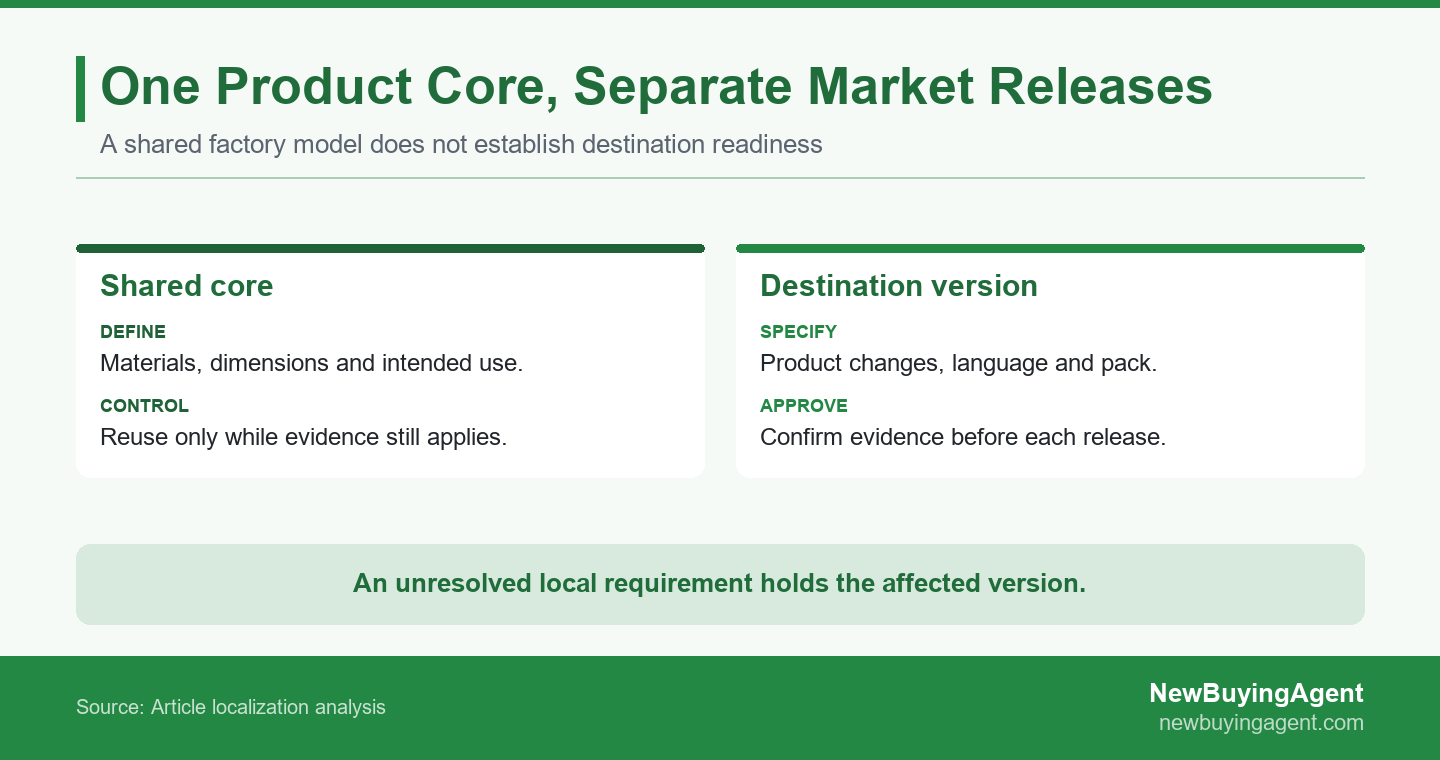
A shared product core needs destination-specific product, pack and evidence checks before each saleable version is released
Use Separate US, EU and Country-Specific Middle East Checks
A meaningful comparison of destination requirements uses the same base product and intended use, then identifies differences in specification, information and release evidence. The matrix below is a purchasing checklist, not a ranking of market difficulty or a complete legal schedule. An empty cell means someone must resolve the requirement; it does not mean the destination accepts an unchanged export product.
| Destination | Product scope | Label and language | Release evidence |
|---|---|---|---|
| US | Identify category and intended user | Origin and applicable product information | Product-specific requirements confirmed |
| EU: named member state | Check applicable EU product rules | Required local-language information | Matching product and responsible-party records |
| Saudi Arabia | Check applicable Saudi standards | Applicable Arabic warnings and instructions | Country-specific product and artwork approval |
| UAE | Check regulated-product status | Confirm applicable language and markings | UAE-specific conformity and channel checks |
Based on this comparison, share a version only after its product and information requirements are compatible across the named destinations. Separate incompatible changes, and hold the affected market when a requirement remains unresolved. The country name by itself does not determine a plug, label or certificate: the product category, intended use and route to market complete that decision.
US: Confirm Product Scope and Origin Information
NIST's packaging and labeling guidance explains that US labeling obligations depend on the product. It also describes the general country-of-origin marking requirement, including the English country name and applicable exceptions. For a China-made article, resolve the actual origin and marking method rather than replacing origin information with an American distributor address. Product-specific obligations still need their own review.
Give the reviewer the actual product composition, user group, claims and pack format. A general household organizer and an item marketed for children can raise different questions even when the factory considers them the same shape. Treat performance, safety, food-contact or environmental claims as review inputs. Do not let a marketplace listing introduce a use or promise that the technical product file never considered.
EU: Name the Member State and Required Information
EU general product compliance guidance requires relevant instructions and safety information, if required, in a language easily understood by consumers and end-users according to the importing country's rules. Name the member state before approving the language set. An English-only export leaflet cannot be accepted merely because the commercial buyer can read English.
Confirm who performs the applicable manufacturer, importer or other responsible-party obligations for the product. Match their information to the physical pack and online offer where required. Keep the product description, intended use and technical evidence consistent with the approved version. A document for a similar model should be examined for coverage, rather than filed as proof based on its title or conformity logo alone.
Middle East: Keep Saudi Arabia and UAE Reviews Separate
The US International Trade Administration's Saudi labeling guide directs buyers to the applicable product standards and says warnings and safety instructions must be in Arabic or Arabic and English. Confirm the exact standard, required content and permitted marking method for the actual item before printing. A translated marketing slogan does not satisfy a missing safety instruction.
The same agency's UAE standards guide identifies MoIAT conformity assessment and regulated-product requirements. Use the relevant UAE route for the product; Saudi-market paperwork is not evidence of UAE conformity. Shared regional standards may be relevant inputs, but the buyer still needs confirmation of the country-specific application and release documents.
Ask the local commercial contact to review units, terminology, product presentation and channel expectations alongside the regulatory reviewer. For Arabic artwork, check the final laid-out proof, including reading direction, numbers, symbols and warnings. Approval of a translated text file does not show that the printer preserved it correctly on the finished package. Retain the approved file and a physical or production-representative proof.
Turn Market Requirements Into Controlled Product Versions
A controlled destination version links the physical specification, approved artwork, instructions, identifiers and case packing. Review product changes before reusing existing evidence. Purchasing should be able to trace a finished unit back to the relevant specification and pack revision, while the warehouse can distinguish destinations without opening every carton. This requires a version record that describes actual differences, rather than four country names attached to one vague SKU.
Build the record in layers. The common specification fixes material, dimensions, construction and intended use. The destination sheet adds changed features, required wording and named approval references. The channel sheet fixes the selling unit, case quantity, listing data and fulfillment labels. Keep artwork separate from changeable shipping labels so an address update cannot accidentally overwrite mandatory product information.
Identifiers support this control but do not create regulatory approval. GS1 explains that a product can use the same GTIN in a different country. Geography alone is not a reason to invent a new number. For changed products or pack configurations, have the identifier owner assess the relevant allocation rules and channel requirements before assigning or reusing a code.
Consider a plug-in desk lamp as a second application. Review electrical configuration, components, supplied accessories, intended use and supporting evidence before approving destination artwork. A travel adapter or translated leaflet cannot be assumed to resolve an incompatible product configuration. The product reviewer should define the necessary changes; the factory then samples that exact configuration, and the evidence review follows the changed design.
A non-electrical organizer may allow more common physical parts, but its materials, user claims, dimensions and packaging still need confirmation. If the same pack is intended for several destinations, check that all required content fits legibly and remains accurate. A multilingual approach is an option to assess, not a requirement to multiply packs or an excuse to compress essential information beyond usability.
Test a Mixed-Market Order Before Releasing Every Version
A mixed-market order tests whether the version record can isolate unresolved approvals before all printed packs are released. Start from a clearly stated assumption about which product and market approvals already exist, then introduce a missing approval and identify the physical quantity it affects. The following hypothetical organizer order illustrates release control; its assumed approvals are not a claim that organizers automatically meet any destination's rules.
A hypothetical order has 1000 organizers split into US 400, Germany 300, Saudi Arabia 200 and UAE 100; the Saudi artwork proof is unapproved while the other versions and shared base are assumed verified.
| Destination version | Units | Assumed approval state | Order action |
|---|---|---|---|
| US | 400 | Base and local version verified | Release approved configuration |
| Germany | 300 | Base and local version verified | Release approved configuration |
| Saudi Arabia | 200 | Final artwork proof unapproved | Hold local pack release |
| UAE | 100 | Base and local version verified | Release approved configuration |
Based on this comparison, the unresolved Saudi artwork holds that version while the independently approved versions can proceed on the stated assumptions. Separate the held materials and stock, identify the exact proof revision needed and assign the person who can approve it. A delivery deadline cannot substitute for that missing approval.
Hold the Saudi version for artwork approval and release the other versions only if their approvals remain independent and the shared product has no unresolved defect. Do not redirect held stock to another market without review. A carton relabeling decision must account for the product inside, the instructions, identifiers and destination evidence, not just the freight booking.
Now change the facts: the factory substitutes a material in the shared core before packing. The issue can affect every version using that material, so expand the hold to all affected stock until the product and evidence review resolves it. Conversely, a corrected Saudi print proof can close the original local hold without reopening unchanged, independently valid approvals. The scope follows the actual change.
Before committing, quote the version mix rather than only the aggregate quantity. Ask about separate artwork setup, packaging minimums, extra handling, sampling and the time needed for approvals. Unused printed cartons are a commitment even if the finished product can be repacked later. If the variant overhead defeats the expected margin, test a smaller market rollout or a compatible shared pack instead of hiding those costs in the base unit price.
Send a Market-Specific Product Brief to China
A localization brief should state destination country, intended user, product specification, quantity by version, channel, target price, approved claims and required receipt, with named approval owners. Include the current sourcing situation and the product changes already agreed. This gives China-side execution a concrete supplied-product scope and allows the buyer to see which inputs remain unconfirmed before dedicated production or packaging is approved.
| Brief item | What to specify | What closes the decision |
|---|---|---|
| Market and channel | Country, customer and intended use | Buyer confirms launch scope |
| Product version | Common core and changed features | Approved sample and specification |
| Pack and instructions | Artwork, language, identifiers, case quantity | Final proof and packing reference |
| Required evidence | Applicable requirements and responsible parties | Qualified reviewer confirms scope |
| Commercial release | Version quantities, target price and receipt | Buyer approves scoped purchase |
NewBuyingAgent is relevant when these differences affect the products a buyer needs supplied from China. Its China product sourcing combines local factory resources with product development and quality-control capability, cost negotiation and delivery coordination. Those resources help turn agreed market requirements into an executable product offer; they do not make every requested product category or destination automatically approved.
For example, a retailer expanding a common storage range can request the shared construction and separate approved retail packs. A brand changing an electrical accessory needs a defined physical configuration and evidence scope before product and packaging commitments. In both situations, the useful sourcing outcome is the right product version at an acceptable price and receipt time, backed by the agreed product and quality requirements.
To submit the localization brief, provide the product and specification, destination countries, intended users, sales channels, quantity by version, target price and delivery timing. Attach the approved claim and artwork references, and identify unresolved requirements. NewBuyingAgent can use its China factory and product resources to prepare a scoped supply proposal, while the buyer assigns qualified approval owners for market-specific obligations and final commercial release.
Frequently Asked Questions
Can I localize a product by translating its existing label?
A translated label works only when the underlying product and supporting evidence already fit the destination; translation alone does not establish market readiness. Check whether the intended user, claims, materials or configuration changed before copying the original label. If they did, review the affected requirements and evidence first. Then approve both the language and the final printed layout, so the pack accurately describes the product supplied.
Can one multilingual pack serve several markets?
One multilingual pack can serve several markets when required information, legibility, product configuration and channel conditions are compatible. Confirm that the named parties and claims are correct in every destination and that the pack remains understandable after all languages are added. Compare the resulting setup and inventory savings with any larger pack or handling costs. Keep a record of the markets covered instead of treating the pack as universally usable.
Does a small component change need another review?
A component change needs review when it can affect product safety, performance, claims or the evidence supporting the approved version. Ask the product reviewer to identify which requirements and tests are affected, then determine whether existing evidence remains applicable. The review may be narrow for an equivalent cosmetic part or broader for a material or electrical change. Retain the decision with the revised specification before production continues.
Who should approve a translated instruction manual?
The buyer should assign language approval to a qualified target-market reviewer and keep a separate technical review for accurate product meaning. A fluent translation can still describe the wrong assembly step, unit or warning. Have the reviewers examine the final layout against the approved product and source instructions. Record their names, revisions and unresolved questions so a later artwork change does not silently bypass the approval.
NewBuyingAgent
Related Resources



Get Started Today
Let's Turn Your Sourcing Goals into RealityWeChat:+86 15157124615
WhatsApp:+86 15157124615
Address:Building 10 #39 Xiangyuan Road, Hangzhou, China