

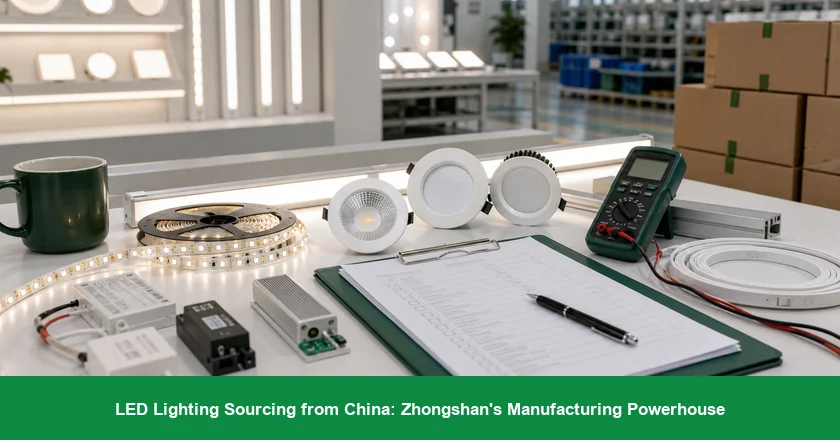
LED lighting sourcing from Zhongshan works best when buyers treat the cluster as a manufacturing advantage, not a shortcut around specification, compliance, and quality control. Guzhen can help buyers find range and cost leverage, but the winning order is the one that locks the exact product version before price pressure starts changing components.
Key Takeaways
- Zhongshan is useful because of cluster depth: buyers can compare lighting styles, component options, and production paths in one concentrated region.
- LED sourcing is a specification problem: wattage, driver, LED chip, housing, finish, test evidence, energy rules, packing, and repeat-batch control determine the real value.
- NewBuyingAgent fits when buyers need a supplied outcome: its local factory resources and product/QC capability help turn a lighting requirement into a quoted China-sourced product path.
Zhongshan Is Strong Because Lighting Is a Cluster Business
Zhongshan, especially the Guzhen lighting ecosystem, matters because lighting sourcing is rarely a single-factory decision. A buyer may need lamp bodies, drivers, chips, housings, finishes, packaging, labels, and spare parts to align. Cluster depth can make that easier because related suppliers, showrooms, workshops, and exporters are concentrated near each other.
According to SouthCN's regional coverage, Guzhen in Zhongshan is a major lighting-production and trade base. The sourcing lesson is practical: the cluster can widen product choice and bargaining leverage, but it also creates variation. Two suppliers may both say "LED downlight," while quoting different drivers, lumen output, heat management, certification assumptions, and cartons.
According to Guzhen lighting fair information, many buyers use the region for discovery and category comparison. The useful buyer action is not to choose by showroom appearance alone. Buyers should turn a sample into a version file: application, wattage, color temperature, CRI, beam angle, housing, driver, dimming, finish, packing, label, market, and delivery term.
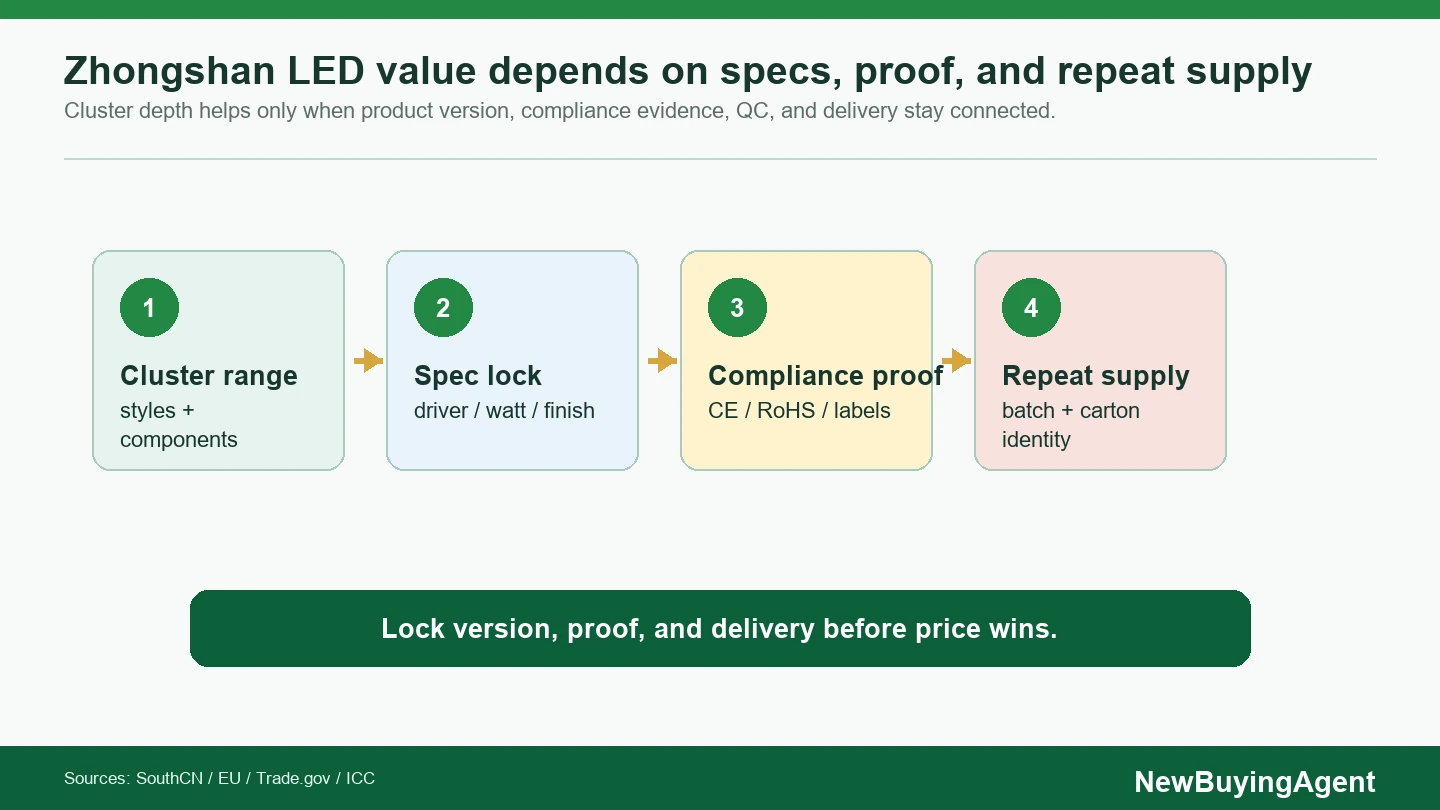
Zhongshan's lighting cluster helps only when product version, compliance, QC, and repeat supply are locked together.
What LED Buyers Should Define Before Asking for Quotes
A lighting quote is meaningful only when the technical and market assumptions are visible. For LED products, the same housing can hide different drivers, chips, heat sinks, optics, dimming methods, lifetimes, and safety margins. If the buyer gives only a photo and target price, the factory has too much room to change the version.
Product use comes before product appearance
A decorative lamp, outdoor fixture, retail display light, industrial high bay, and plug-in desk light create different risks. The buyer should define where the product will be used, how long it will run, what environment it faces, whether dimming is needed, and which destination market will receive it. That information controls the component path more than the product photo does.
According to European Commission light-source rules, light sources can connect to ecodesign and energy-labelling expectations. Even buyers outside the EU can learn from the rule: lighting is judged by measurable performance, not only by appearance. Lumen output, efficiency, product data, and label assumptions should be checked before the order becomes expensive to change.
The driver and thermal design are margin decisions
LED buyers often focus on unit price, but the driver and heat management determine failure risk. A cheaper driver can make a quote look attractive while increasing returns, warranty pressure, or customer complaints. Heat sinks, housing material, PCB quality, and ventilation should be part of the quote, because they decide whether the light performs after the first inspection photo.
According to the European Commission RoHS page, the EU restricts certain hazardous substances in electrical and electronic equipment. For sourcing buyers, the broader decision is to connect material and component evidence to the exact LED version being purchased. A generic compliance statement does not protect a batch if the driver, cable, solder, or accessory changes.
How to Compare Zhongshan LED Quotes Without Getting Misled
Cluster competition can reduce price, but it can also encourage suppliers to quote different versions. A buyer comparing LED lighting quotes should normalize product version, certification assumptions, packaging, sample approval, payment term, freight boundary, and replacement responsibility before choosing the lowest offer.
| Buyer decision | Zhongshan / Guzhen strength | Risk if ignored | What to lock |
|---|---|---|---|
| Product range | Indoor, outdoor, decorative, commercial, and component paths | A beautiful sample may not fit the sales channel | Use case, wattage, driver, finish, and packing |
| Compliance | Electrical and light-source categories need early rule checks | Late testing can force redesign or relabeling | CE/RoHS/energy label assumptions by market |
| Quote quality | Cluster competition can sharpen price | Low price may hide weak driver or packaging | Same specs, same term, same delivery boundary |
| Repeat supply | Large cluster gives options for style and batch continuity | Second batch can drift from approved version | Sample file, batch rule, carton identity |
The key insight is that Zhongshan's advantage is not the cheapest first number. It is the ability to find a product path that balances style, components, compliance evidence, packing, and repeat supply. If those factors are not locked, the low quote may simply be a different product.
Normalize quotes by the same delivery term
A factory quote can change dramatically depending on whether it is EXW, FOB, CIF, or DDP. Lighting buyers should not compare a low ex-factory price with a quote that includes export handling, freight, duty, or destination delivery. Heavy cartons, fragile shades, and multiple SKUs can make the delivery boundary as important as the unit price.
According to ICC Incoterms rules, cost and risk responsibilities move under different trade terms. That matters for LED sourcing because the buyer must know who pays for inland freight, export handoff, insurance, and delivery problems before comparing suppliers or sourcing agents.
Do not let packaging become an afterthought
LED products are vulnerable to carton crush, missing accessories, bent shades, broken glass, label mistakes, and mixed cartons. The packaging file should include inner box, master carton, drop-risk assumptions, barcode, manual, accessory bag, carton mark, and pallet method. If the buyer waits until production is finished to discuss packing, the cost and delay are already harder to control.
According to US trade shipping guidance from Trade.gov shipping guidance, shipping choices affect both cost and timing. For lighting buyers, the so-what is clear: carton size, packing strength, SKU mix, and freight mode should be priced before deposit, not discovered after production.
Compliance Evidence Should Be Attached to the Exact Product
LED lighting orders can involve electrical safety, EMC, RoHS, energy efficiency, labelling, and destination-specific documentation. The buyer does not need to become a certification engineer, but the buyer does need to ask whether evidence belongs to the same model, component set, and destination market.
CE and related claims need product identity
According to European Commission CE marking guidance, CE marking represents a declaration that the product meets applicable EU requirements. The practical sourcing rule is that a CE claim is useful only when the model, components, test records, manual, label, and supplier responsibility are connected to the order being shipped.
According to US trade market guidance from Trade.gov's EU CE marking guide, CE marking is a market-entry issue, not a decorative logo. LED buyers selling into Europe should ask whether the quoted product version is the same version covered by available documents. If the buyer changes driver, cable, housing, or dimmer after quotation, the evidence may no longer match.
Document discipline protects repeat orders
Lighting buyers often reorder successful SKUs. Repeat supply fails when model names stay the same but internal components change. The release file should keep the approved sample, bill of materials summary, driver reference, label file, instruction sheet, carton photo, and inspection criteria connected. This protects the buyer from receiving a cheaper-looking second batch that performs differently.
NewBuyingAgent is relevant here because lighting risk is not only factory contact. Buyers tell NewBuyingAgent the lighting product need, target price, market, quantity, and timing; NewBuyingAgent uses local China factory resources and product/QC capability to quote and supply China-sourced lighting products with a clearer version, quality, and delivery path.
When Zhongshan Is the Right Starting Point
Zhongshan is a strong starting point when the buyer needs LED lighting range, design comparison, component choices, cost competitiveness, and category-specific factory cooperation. It is especially useful when the buyer is still shaping a product line, comparing styles, or trying to improve cost without losing performance.
It fits product lines that need range and refresh speed
Retailers, project buyers, and ecommerce teams often need a family of lighting products rather than a single lamp. Zhongshan's cluster structure can help buyers compare related styles, finishes, and components more quickly. The buyer should still avoid adding too many SKUs before the first batch is proven. Range is useful only when version control and packing can keep up.
For market-fit lighting ideas, NewBuyingAgent's AI-driven hot-product analysis can help buyers avoid sourcing only what looks interesting in a showroom. The useful question is whether a lighting style fits the buyer's target customer, price band, sales channel, and delivery promise, not whether the sample wall looks impressive.
It works best when the buyer can describe the channel
The same LED product may need different priorities for a hotel project, hardware retailer, Amazon listing, or wholesale distributor. The buyer should state whether the order will be judged by installation speed, carton durability, product photo appeal, electrical compliance, replacement rate, or repeat-order stability. That channel context changes the sourcing decision.
If the buyer already has a China supplier but struggles with production follow-up or quality release, NewBuyingAgent's factory-management service may fit better than a new sourcing request. In that case, the buyer's problem is not category discovery or a standalone inspection. It is China-side supplier management that keeps communication, staged evidence, delivery execution, and the final lighting product outcome connected.
What to Send Before Requesting a Zhongshan LED Quote
Before requesting a quote, prepare product photos or drawings, target wattage, voltage, lumen expectation, color temperature, CRI, material, finish, plug or installation method, destination market, order quantity, target price, packaging needs, delivery timing, and any compliance expectations. If the product is a family, list which features must stay common across SKUs.
If those details are ready, the next step is to use NewBuyingAgent's China product supply service for a lighting quote-to-supply path. If the product direction is still unclear, buyers can also review NewBuyingAgent's market-fit product analysis before locking the assortment.
The strongest brief is not the longest brief. It is the brief that prevents hidden version changes. For LED lighting, that means naming the performance target, compliance boundary, component assumptions, packing method, and delivery term before price pressure begins.
For LED lighting, the final pre-order check should be a release package rather than a chat history. The buyer should be able to point to the approved sample, the quoted driver and component assumptions, the compliance evidence expected for the destination, the packing file, the carton data, and the delivery term. If any one of those items is missing, Zhongshan's cluster advantage is still useful, but the order is not yet controlled.
The safest sourcing decision is to treat every saving as conditional. A lower price is attractive only if the light still meets the same performance target, uses the same component path, ships in the same carton plan, and arrives under the same responsibility boundary. That is where local category resources and China-side follow-up become practical, because the buyer needs the order details held together while factories, components, and freight choices move quickly.
Frequently Asked Questions
Is Zhongshan good for LED lighting sourcing?
Zhongshan is a strong LED lighting sourcing base when buyers need product range, category depth, component options, and cost competition. Buyers should still lock the exact product version, driver, performance target, compliance evidence, packing method, and delivery term before choosing a quote.
What is the biggest risk when buying LED lights from China?
The biggest risk is version drift hidden behind a similar-looking sample. A supplier may change driver, chip, housing, cable, packaging, or document assumptions to meet a target price. Buyers should compare the same technical version before judging which quote is cheaper.
Do LED lights need CE or RoHS documents for Europe?
Many LED lighting products sold into Europe may involve CE-related requirements, RoHS restrictions, energy rules, or other product-specific documentation. Buyers should verify the applicable rules for the exact product and destination market instead of relying on a generic logo or verbal claim.
When should buyers use a sourcing agent for LED lighting?
A sourcing agent is useful when the buyer needs local factory resources, category-fit product selection, cost negotiation, quality evidence, packaging control, and delivery coordination from China. The value is strongest when the buyer wants a supplied lighting outcome, not scattered factory communication.
NewBuyingAgent
Related Resources
Get Started Today
Let's Turn Your Sourcing Goals into RealityWeChat:+86 15157124615
WhatsApp:+86 15157124615
Address:Building 10 #39 Xiangyuan Road, Hangzhou, China
