

A Chinese factory can have available machines, enough operators, and a full order book, yet struggle to restart your approved product when one technician is absent. Buyers should assess the specific tasks that depend on that person, the evidence that a backup can perform them, and the time needed to recover. The useful question is whether the order can continue at the agreed quality and timing, rather than whether the factory has a reassuring headcount.
What Buyers Should Verify Before Relying on One Person
A personnel dependency becomes a purchasing concern when an essential product task lacks a workable substitute. Check competence, current product knowledge, access, permission to act, and recovery timing together. A deputy’s name or a training record answers only part of that question; the strength of the order decision should follow the evidence for the affected task.
- Risk: Spare machines cannot replace missing setup knowledge or an unavailable quality decision.
- Common mistake: Treating general experience as proof that a backup can reproduce your approved product.
- Decision: Separate verified product scope from work that still needs corrective evidence.
- Timeline: Include qualification and any backlog when assessing recovery, rather than counting restart alone.
When a Skilled Employee Becomes a Production Bottleneck
Key-person dependency means a critical task cannot recover adequately while one particular individual is unavailable. Specialization is normal in Chinese factories, as it is elsewhere; the problem arises when an absence blocks the approved product longer than the order can tolerate. A competent backup, usable product records, and a tested recovery route distinguish ordinary specialization from an unresolved continuity risk.
A molding technician may know the settings that control a difficult finish. A maintenance specialist may be the only person who can diagnose a particular fault. A quality manager may hold the practical knowledge needed to interpret borderline results. The dependence can also sit outside production: an owner’s approval might be needed to authorize urgent materials, or a subcontractor may rely on one specialist for a special process.
Apply this check to the factory making the product and any critical outside process. Within broader supplier preparation, the China sourcing guide helps buyers connect such production questions with the overall sourcing decision. A personnel check adds a particular continuity question; it does not replace capacity, quality, or product-compliance review.
The UK business continuity toolkit connects key products and services with critical activities, disruption impacts, recovery timing, and necessary resources. Its voluntary UK planning context is different from a Chinese supplier approval. The transferable lesson is to start with the output you need and work backward to the people and resources that keep it available, rather than impose a universal recovery deadline.
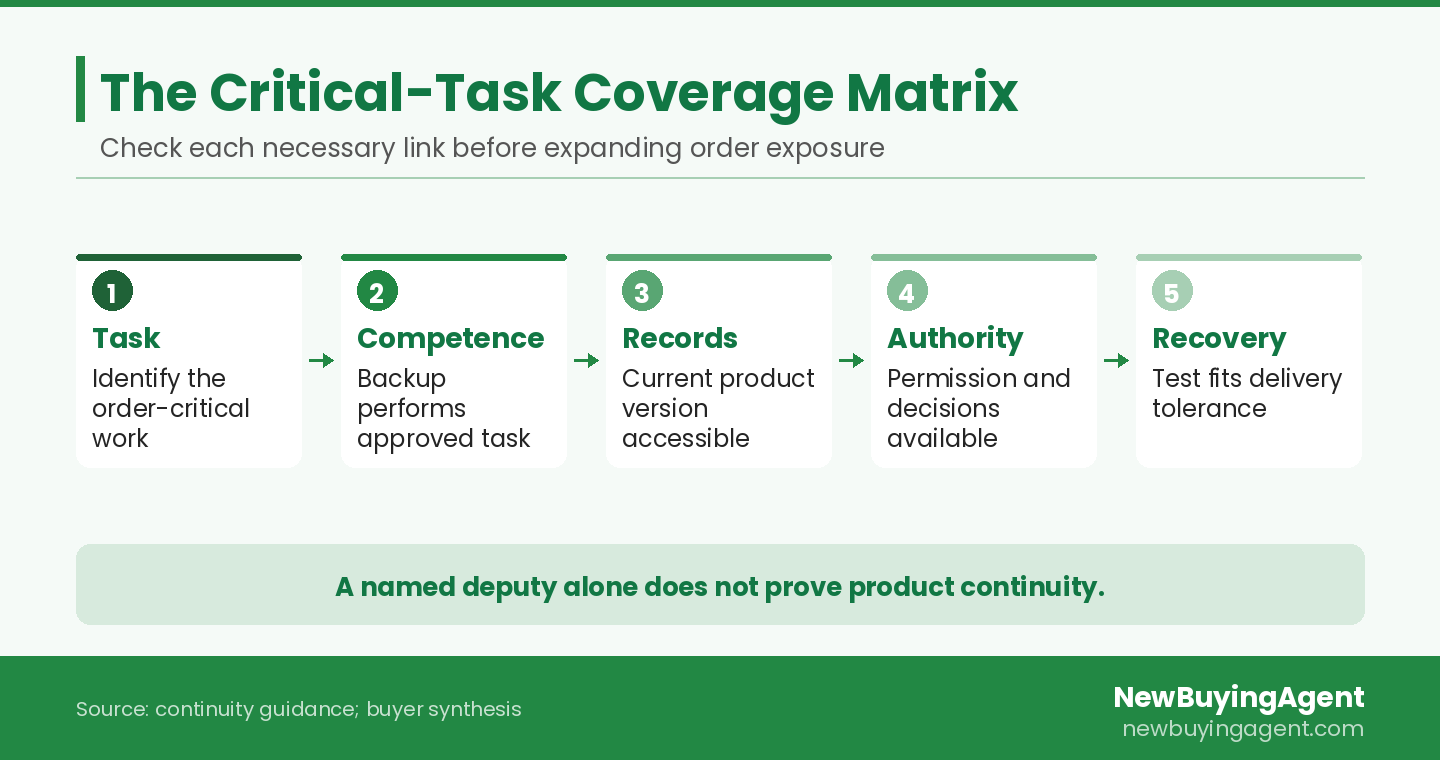
Factory backup readiness connects task competence, current records, authority, and demonstrated recovery
The Critical-Task Coverage Matrix
Map the people behind the critical tasks needed to make your specific product, then examine the backup evidence for each task. The Critical-Task Coverage Matrix below is a practical buyer synthesis, not a certification standard or a factory-wide score. Its purpose is to show where another person can continue the work and where a purchasing condition remains unresolved.
NIST’s manufacturing workforce guidance recommends identifying key positions, developing successors through cross-training, and keeping process documentation and work instructions current. This supports task-level questioning. It does not establish how common personnel dependencies are in China or prescribe a fixed number of backups for every factory.
| Coverage dimension | Evidence to examine | Remaining gap | Buyer response |
|---|---|---|---|
| Critical task | Product route and failure impact | Dependency hidden outside assembly | Extend the check to the actual process |
| Backup competence | Relevant observed task and accepted output | Training only, or different product | Request a scoped demonstration |
| Current knowledge | Approved revision and usable instructions | Old settings or personal-only records | Correct handover and test retrieval |
| Access and authority | Role permissions and escalation limits | Deputy cannot act without absent person | Define the authorized route |
| Recovery timing | Tested restoration and qualification time | Restart misses order tolerance | Revise commitment or supply option |
Identify the Task That Can Stop the Order
Follow the product route from setup through outside processing, inspection, and release. Identify the task whose interruption would prevent completion even if other operations remained available. Ask the production manager to show what happens when its usual operator is unavailable, including the equipment and support needed by a substitute.
Keep the task precise. “Tooling knowledge” is too broad; locating the correct mold, setting the approved process window, and recognizing an unacceptable finish are different abilities. Likewise, an inspection backup may know how to measure a dimension but lack authority to decide what happens to a nonconforming lot. Record these separately so the corrective action addresses the actual bottleneck.
Check Whether the Backup Can Reproduce the Approved Product
A credible backup can perform the relevant task under the conditions needed for your product. A course certificate, a job title, or years at the factory may help explain experience, but none shows by itself that the person can make the approved finish or judge the required result. Examine the task performed and the output accepted.
The ISO 9001 Auditing Practices Group’s educational competence guidance asks auditors to consider capable substitutes when usual duty-holders are absent and to evaluate applied competence. The paper is non-binding auditing guidance, not a universal requirement for a buyer’s absence test. Its useful distinction is between recording training and seeing that learning applied.
For a specialist process, agree what evidence is feasible and safe. A supervised product trial, an existing accepted production record attributable to the backup, or a demonstration on suitable equipment can provide different levels of assurance. Do not request unqualified operation simply to create a test. If formal qualifications apply to the task, have the appropriate specialist verify them before treating the substitute as available.
Make the Approved Product Knowledge Usable
Ask the backup to retrieve and use the current approved product information. Depending on the process, this may include specifications, setup limits, acceptance references, change history, or troubleshooting instructions. The buyer need not receive all factory know-how; the continuity question is whether the authorized person inside the factory can access the information needed for the agreed product.
The ISO 9001 Auditing Practices Group’s educational organizational-knowledge guidance explains that possessing documents does not necessarily demonstrate usable organizational knowledge. This matters when a folder exists but the backup cannot tell which revision governs the order. Check retrieval and interpretation together, while protecting proprietary information and retaining the agreed confidentiality boundaries.
Separate Technical Skill from Permission to Act
A technically competent backup may still be unable to obtain materials, approve a schedule, or escalate a deviation while the usual decision-maker is absent. Ask which decisions the substitute can make, which remain reserved, and how escalation works. Keep product acceptance and change approval intact; continuity does not justify quietly loosening the buyer’s specification.
FEMA’s emergency succession checklist identifies activation conditions and limits on delegated authority. Its setting is emergency-management succession, not commercial factory regulation. The transferable lesson is narrower: a deputy needs clear triggering conditions and defined powers, rather than an informal promise that someone will take over.
NIST’s federal information-system contingency guide includes personnel, software, data files, and vital records among recovery resources. For this factory assessment, that is an IT-scoped reminder to check whether product information remains available to authorized users. Restoring a system alone does not prove that the product can be manufactured or released.
Confirm role-appropriate access and the escalation route through the factory’s approved arrangements. A password copied from the absent employee is not useful evidence of a properly supported backup. Record a blocked retrieval as a specific access gap, then have the factory correct it and demonstrate the intended route without exposing credentials to the buyer.
Set a Product-Specific Recovery Limit
Compare recovery with the order’s actual delivery tolerance. Count the time needed to retrieve records, arrange an authorized substitute, restore the process, check product conformity, and deal with any backlog. A machine running again is an intermediate milestone; the buyer needs acceptable goods available on a credible schedule.
The acceptable interval changes with the product and commitment. A replenishment order with usable inventory may allow more time than a launch with a fixed shipment date. Discuss that constraint before the test and avoid an arbitrary factory score. If the substitute is shared across several lines, include competing demand: being trained does not make the person available everywhere at once.
Test an Absence Without Disrupting Production
Use a limited, authorized exercise to see whether the backup can complete the critical task without relying on the person supposedly unavailable. Agree the product, evidence, timing, and safe stop conditions beforehand. The Critical-Task Coverage Matrix then becomes an observation record: which links worked, which failed, and which affected orders still need corrective proof.
UK Cabinet Office continuity guidance recommends exercising plans to demonstrate that they work and maintaining them as staff or arrangements change. The factory demonstration described here adapts that principle to a specific product. It is a buyer recommendation, not a prescribed UK or Chinese audit procedure, and its frequency should follow relevant changes and risk.
Skill transfer can require preparatory work by the expert as well as the backup. A NIST report about a single US manufacturer describes its primary dimensional-inspection person receiving training to prepare to cross-train colleagues. This is an attributed example of developing transferable competence, not evidence that an absence test passed or that Chinese factories will achieve the same results.
Start with a walk-through if a live trial could create safety, quality, or delivery problems. Then move to a suitable controlled demonstration where justified. Record the actual help given: a trial that requires the usual technician to resolve every difficult step has exposed a gap, even if its output eventually passes. Correct the gap and test the affected step again.
For a buyer with an existing Chinese supplier, arranging product-specific follow-up remotely can be difficult. NewBuyingAgent’s factory-management service combines local supplier communication, production progress, and product quality follow-up. Its China-side operating support and product/QC capability are relevant to checking agreed corrective evidence; the buyer should define the task and acceptance criteria rather than assume a general factory visit proves continuity.
Match the Purchase Decision to the Unresolved Dependency
Make the order decision at the affected product and task level. Demonstrated backup coverage can support proceeding with agreed checks, while an unresolved gap can justify limiting a new commitment until corrective evidence is available. If recovery cannot meet the delivery need, compare a revised schedule or qualified supply option rather than assign an unsupported whole-factory risk label.
The Critical-Task Coverage Matrix helps make that condition explicit. Replace “improve continuity” with a named task, responsible factory role, required evidence, and the commitment that depends on it. A missing document may be corrected quickly; a specialist capability may require training and qualification. Those are different remedies with different timing.
A replacement factory is also a project, not an instant escape. It may need product development, sampling, tooling access, or process approval before usable goods are available. Compare its demonstrated readiness with the current supplier’s corrective plan. Keep commercial remedies and employment or legal questions with the relevant qualified advisers; the operational assessment supplies evidence for the purchase decision.
A Backup Technician Who Cannot Find the Current Settings
Illustrative example, with assumed quantities: an importer orders 6,000 storage components made by molding, including 2,000 with a particular texture and 4,000 with a routine finish. Only the lead setup technician has completed the current textured-product setup. During an agreed backup check, another technician runs the routine product successfully but cannot locate the approved textured-product settings. The observed competence covers the routine work; it does not yet establish recovery of the textured product.
Procurement keeps the 4,000 routine components on their verified path and does not expand the textured-product commitment while the gap remains. That decision distinguishes the observation from its implication: missing settings have not proved that the backup is incapable, but they prevent the buyer from relying on the claimed readiness. The supplier is asked for a product-specific correction, rather than rejected solely for having a specialist.
The factory prepares controlled current settings and acceptance references, trains the backup, and schedules an authorized trial. The backup then retrieves the approved revision and performs the textured-product setup; the quality lead checks the resulting texture and dimensions against the agreed requirements. Preparing records and training are the correction. The observed conforming trial is the verification, after which procurement reviews the remaining production schedule before expanding the affected commitment.
This illustrative example is not a NewBuyingAgent customer case or a measured factory outcome. A successful trial supports the demonstrated product and conditions, not every finish, machine, or future absence. It also leaves a practical maintenance question: who updates the backup’s information when the next approved product change occurs?
Carry the Findings into the Next Order and Supply Route
Keep the task finding connected to the next purchasing commitment. Record the affected product, corrective owner, evidence due point, and recheck trigger so procurement can see what remains conditional. Quality should verify the relevant output, while the factory owns its personnel, knowledge, and authority arrangements. A clear record prevents a reassuring follow-up message from replacing the agreed demonstration.
Recheck when the product or process changes, a relevant person leaves or changes roles, record access is altered, or a critical subcontractor changes. Ask whether the previous evidence still covers the current task. Do not automatically restart an entire factory audit when only one product revision changed; focus the follow-up on the competence, information, permission, and timing affected by that change.
For a new or replacement purchasing requirement, specialist dependence may mean the buyer needs a complete product-supply option with suitable technical capability. NewBuyingAgent’s product-supply service uses local China factory resources and product-development and quality-control capability to turn purchasing needs into quoted China-sourced products. Include the critical process and approved-product constraints so the supply proposal addresses the actual price, quality, and delivery need.
Prepare product specifications, quantity, target price, destination, and delivery timing, together with the specialist process, approved references, and known continuity constraint. Buyers can send purchasing requirements to NewBuyingAgent for a product-supply inquiry. The useful outcome is a quote and agreed production, quality, and delivery requirements for the China-sourced products; any specific backup demonstration should be defined within that agreed scope.
Frequently Asked Questions
Is an owner-led factory automatically too risky?
An owner-led factory is not automatically too risky; assess which order-critical decisions depend on the owner and whether another authorized person can keep them moving. Ownership structure alone does not show production recovery capability. Where authority remains concentrated, ask how routine decisions proceed during an absence and which exceptional decisions would wait or follow an agreed escalation route.
Should buyers request individual employee records?
Buyers generally need task-coverage and competence evidence, not unrestricted personal employee records. Ask for the relevant role, authorized responsibility, and demonstration or appropriately limited training evidence. Agree confidentiality and any necessary redaction with the supplier. If personal information is genuinely necessary, obtain advice on applicable privacy requirements and define the permitted purpose and recipients before collecting it.
Does key-person insurance solve production continuity?
Insurance may address some financial consequences under its policy, but it does not itself transfer technical knowledge or demonstrate that the approved product can restart. Separate any insurance assessment from the operational backup check. Have a qualified adviser examine the actual cover, exclusions, and beneficiary if it matters to the commercial decision; do not treat a policy’s existence as proof of task readiness.
What if the key person works for a subcontractor?
Follow the critical task to the subcontractor and check the approved recovery option rather than limiting the assessment to final assembly. The main factory’s workforce may not cover that outside capability. Any substitute process or subcontractor should preserve the buyer’s agreed product, quality, and approval requirements. Ask who coordinates the handover and what evidence would be needed before relying on a different route.
NewBuyingAgent
Related Resources


Get Started Today
Let's Turn Your Sourcing Goals into RealityWeChat:+86 15157124615
WhatsApp:+86 15157124615
Address:Building 10 #39 Xiangyuan Road, Hangzhou, China
