

A Chinese supplier can send a correct-looking invoice and still ask you to pay into an account that is not in its name. A bank account belongs to the legal entity named on it, so the question is not whether the invoice looks right but whether the beneficiary name matches the supplier's registered legal name and the official record behind it. That single check takes minutes, and it decides whether a deposit should move at all.
Bank account ownership means the account is held in the name of the supplier's registered legal entity, so the beneficiary name — the name of the account holder a payment is sent to — must match the supplier's legal name, the full registered name shown on its business license and in the public record. A document proves only what it says; the name match is what links the account to the entity you contracted with.
What Buyers Should Confirm Before Paying a Chinese Supplier
A bank account belongs to the legal entity named on it, so before any payment the buyer confirms that the beneficiary name matches the supplier's registered legal name and that the entity appears in the official enterprise record. A correct-looking invoice proves that a payment was requested, not who owns the account it points to.
- Best for: importers, brands and sourcing teams about to pay a deposit or act on a change of bank details for a Chinese supplier.
- How it works: confirm the legal entity and its unified social credit code from the official record, match the beneficiary name to the registered legal name, and confirm any change through a channel you already hold.
- Key advantage: the payment is tied to the entity that can legally hold the account, so a diverted instruction is caught before the money moves.
- Decision: hold a mismatched or unexpectedly changed account, verify it independently, and release only against the verified account and inspection evidence.
- Risk: a mismatch can be legitimate in narrow cases, so it should trigger verification rather than end the order by itself.
What It Means for a Bank Account to Belong to a Supplier
A bank account belongs to the legal entity named on it, so ownership is the match between the beneficiary name and the supplier's registered legal name rather than the presence of a document. A payment instruction names one account holder; the contract names one legal entity. When those two names are the same, the money goes to the party you contracted with. When they differ, the money goes to someone else, however familiar the quotation looks.
The name is not a trading label. The Company Law of the People's Republic of China, revised in December 2023, requires a company to have a name that complies with the state rules and requires the company's registration items, including the name, to be publicised through the national enterprise credit information publicity system. The registered name is the identifier the law fixes for the entity, which is why it, and not the brand on a quotation, is the name to match.
Because the account name describes the entity rather than its production, it helps to see how a Chinese manufacturer is organised before reading its record. The China manufacturing and product guide explains how product development, tooling and production stages relate.
How a Payment Gets Diverted on a China Order
Payment diversion works by breaking the link between the supplier and the account. Someone impersonates the supplier or takes over a real email account, then sends a new set of bank details, often timed to a deposit or a balance payment so the buyer is already expecting to move money. The instruction looks ordinary because it arrives on a thread the buyer recognises, and the account it names is held by someone else.
This pattern has a name and a standard control. The FBI Internet Crime Complaint Center describes business email compromise as a scam targeting transfers of funds and advises verifying requests for changes in account information through secondary channels or two-factor authentication. The control is not a better spam filter; it is confirming the change on a channel the attacker does not control, such as a phone number you already held before the message arrived.
The Evidence That Proves Who Owns the Account
Ownership is supported by three linked items: the supplier's registered legal name, the official enterprise record behind that name, and the account name on the payment instruction. Read as separate documents they can all look fine; read as a chain, a single mismatch shows exactly where the instruction diverges from the entity you contracted with. The two sections below take the name match first, then the independent record.
Match the Beneficiary Name to the Registered Legal Entity
The beneficiary name on the payment instruction must match the supplier's registered legal name exactly. A near-match, a shortened trading name or an account held in a director's personal name is a different account holder, not a spelling variation, and each of those is a hold condition rather than a detail to smooth over. Exactness is the point: the name is the only part of the instruction that ties the money to the entity.
When two suppliers share a similar name, an identifier removes the ambiguity. The State Administration for Market Regulation explains the unified social credit code as the code that identifies a market entity. Match that code rather than the name alone, so you confirm the entity you contracted with and not a similarly named company that shares part of the name.
Read the Official Enterprise Record, Not Just the License
The supplier's registration is published by the market regulator in the National Enterprise Credit Information Publicity System, so the buyer reads the record directly instead of trusting a scan. The system is free and official, and a search by the legal name or the unified social credit code returns the registration the supplier cannot edit. A licence image is a copy; the record is the source.
The record exists because disclosure is required rather than voluntary. The Interim Regulations on Enterprise Information Disclosure require market regulators to publicise registration and filing information through the National Enterprise Credit Information Publicity System, and companies must file annual reports that include their shareholder and contribution information.
The authority behind the record is the market regulator itself. The Credit Supervision Department of the State Administration for Market Regulation states that it builds and manages the National Enterprise Credit Information Publicity System. That is why the record is the reference for registration data, and why a document sent by the supplier is supporting material rather than proof.
A Six-Step Verification Process Before Any Payment
Verification is a repeatable sequence rather than one check, and the same six steps apply to a first order and to any later change. Confirm the legal entity and its unified social credit code; read the official enterprise record; match the beneficiary name to the registered legal name; confirm any account change through a callback on a number you already hold, which is the simplest secondary channel; run a small test payment where the amount and the bank allow it; and record the result before the main payment. Done in order, the sequence closes the gap that a single document leaves open.
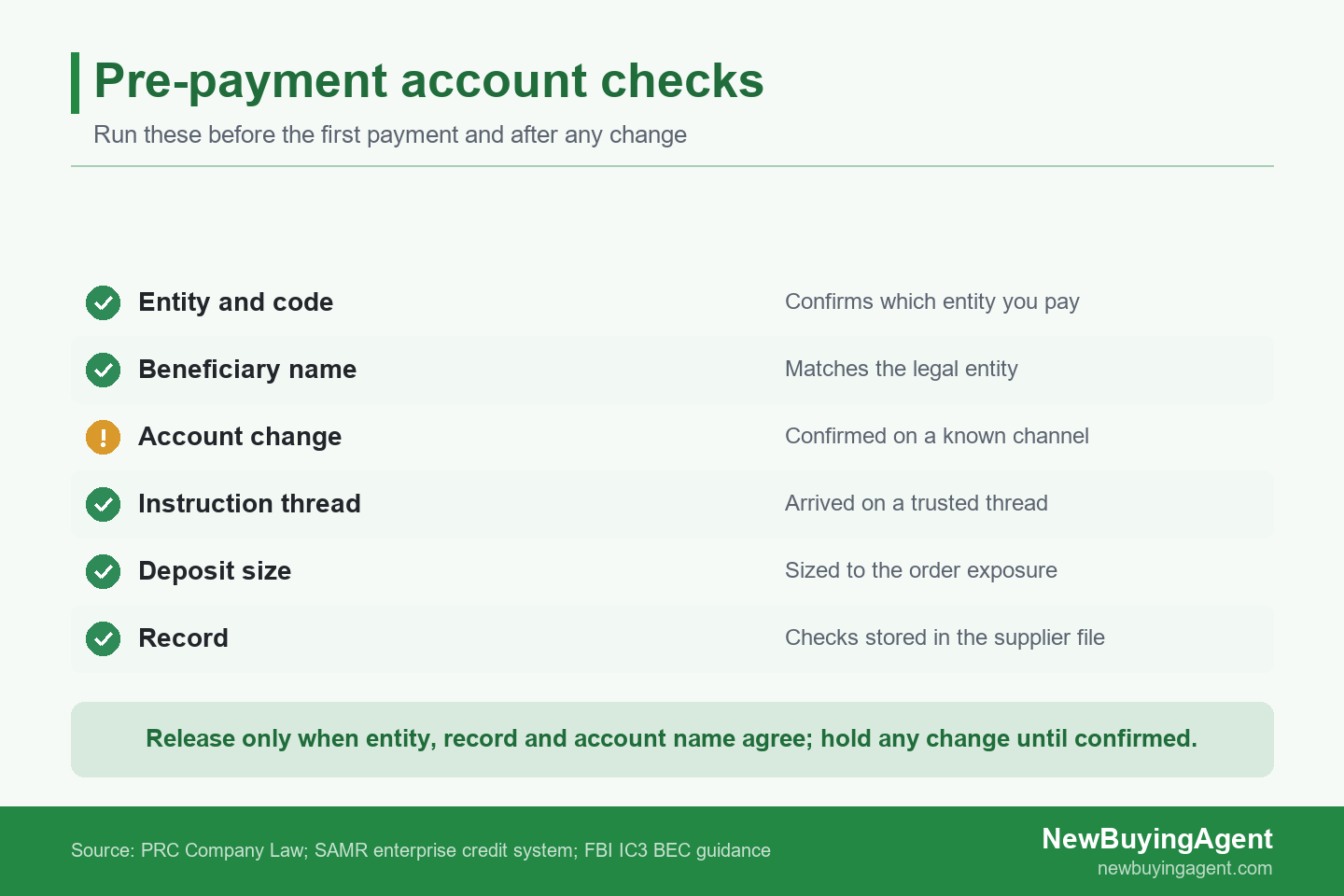
Checklist scorecard of six pre-payment account checks for a Chinese supplier, each with the confirmation it provides and a status mark
Treating the account name as a control is not an unusual precaution, and the lesson is separate from the context of the rule. Regulation (EU) 2024/886 requires EU payment service providers to verify the payee's name against the account before executing a transfer. The beneficiary name is a genuine check point a buyer can apply manually rather than a formality.
The EU rule does not apply to Chinese banks, and nothing here treats it as one. It is cited only to show that beneficiary-name verification is a recognised control a buyer can run manually on a China payment.
Part of this sequence can be run from the China side before a deposit moves. NewBuyingAgent's product-supply and factory pre-vetting service uses local China factory resources to pre-vet factories for price, quality and qualifications, so the entity behind the account is confirmed alongside the commercial terms.
Red Flags That Should Stop a Payment
A name mismatch, an unexpected account change, a changed email domain or a request for urgency are hold conditions because each one breaks the link between the supplier and the account. None of them proves fraud on its own, and none of them is a reason to cancel the order. Each one is a reason to pause the payment until the link is confirmed through a channel you control.
| Signal | Why it breaks the link | Action |
|---|---|---|
| Beneficiary name does not match the registered legal name | The account holder is a different party from the entity | Hold and verify the entity |
| Account change arrives by email only | The instruction came on a channel an attacker can control | Hold and confirm on a known number |
| Email domain or reply-to address changed | The thread may be impersonated | Stop replying and call the known contact |
| Same-day deadline and secrecy pressure | Urgency is meant to prevent the independent check | Slow down and verify first |
| Account is personal or in a different country | The payee does not match the contracting entity | Hold and request an entity account |
One red flag on its own is a prompt to check rather than a verdict, and two or more together should end the payment conversation until the account is confirmed. Keep the message, the account details, the request timeline and the sender address, because they are the evidence your bank and the receiving bank need if a transfer is already in motion. A supplier with nothing to hide will answer a confirmation call; a diverted instruction usually cannot.
Messages are engineered to extract exactly this kind of detail. The UK National Cyber Security Centre states that phishing uses scam emails, text messages or phone calls to trick victims, often to steal bank details or other personal information. A message that carries bank details is therefore a reason to verify the details, not a reason to trust them.
Illustrative Example: A Changed Account Before the Deposit
Test an account-change request against the verified record and the order exposure before it is acted on, because a correct-looking instruction can still be fraudulent. The example below is illustrative, and it shows the checks changing a deposit that was about to move.
How the Buyer Confirmed the Account and Reset the Payment
In this illustrative example, a consumer-goods brand is placing a first order with a new Chinese supplier that quoted a competitive price and asked for a 30% deposit before production. The order is 12,000 units at a USD 4.00 target unit price, about USD 48,000 of goods value, with a requested deposit of about USD 14,400. The supplier has sent a business license and a quotation; two days before the deposit is due, an email asks the buyer to pay into a new bank account, and the buyer has not yet checked the official record.
The business license shows a legal name that does not match the beneficiary name on the new account details. The account-change request arrived only by email, on a thread the buyer did not start, and asked for same-day payment. The mismatch between the beneficiary name and the legal name is the decisive signal: the account holder and the contracting entity are different parties, and the instruction arrived through a channel the buyer does not control. The deposit is also a large share of the order, so the money at risk before any production evidence is high.
The decision is to hold the deposit, confirm the account through the phone number and contact the buyer already holds, and release only against the verified account and the inspection evidence. The corrective action is to verify the legal name and the unified social credit code against the official enterprise record, call the supplier's known contact to confirm the correct account, and reset the deposit to a smaller first tranche tied to sample and pre-production evidence.
Before the balance is released, the buyer confirms the inspection evidence against the approved sample and confirms the account details again on the verified channel. This illustrative example invents no measured value and no passed test. A verified account reduces payment-diversion risk; it is not a guarantee of delivery or quality.
Decision Rules: Hold, Verify Further, or Release
The payment decision depends on whether the account name matches, how the change arrived, and how much the buyer funds before delivery, so the same facts produce a hold, a smaller first tranche, or a release. The rule is not a fixed percentage of the order; it is a comparison between how confident you are in the account and how much money moves before you can inspect anything.
Speed after a transfer is not a substitute for the check before it. The FBI Internet Crime Complaint Center advises contacting the originating financial institution as soon as fraud is recognised to request a recall, and states that acting quickly may reduce or eliminate losses. That is a reason to act fast if something goes wrong, not a reason to skip verification before the payment.
Three settings follow from the same evidence. When the beneficiary name matches the registered legal name and the instruction arrived on a channel you already hold, a standard deposit and balance schedule is reasonable. When the name matches but the amount is large, keep the first tranche modest and release the balance against inspection evidence. When the name does not match or the account changed unexpectedly, hold the payment, confirm the account independently, and do not release any tranche until the account is verified.
For a supplier already in use, the same rule applies to every payment, not only the first. NewBuyingAgent's existing-factory management service keeps China-side communication, production follow-up and quality checks on the supplier while payment and release stay tied to the verified account and the evidence.
Put the Verified Account Into the Supplier File
Put the verified legal name, the unified social credit code, the beneficiary account name and the payment condition into the supplier file, so a repeat order and any later change start from a verified record. The file should record what was checked, when, and the release condition for each payment. When a change request later arrives, it is compared against the recorded account rather than against the message.
For a supplier about to receive a deposit, prepare the supplier's legal name or unified social credit code, the beneficiary account name, bank name and account number as provided, the product and specification, the order quantity, target unit price, destination and delivery timing, and the payment schedule. NewBuyingAgent can use its local China factory resources and factory pre-vetting for price, quality and qualifications to confirm the supplier's legal identity and read its official record, then quote and follow the order against the agreed payment and release conditions. With those details ready, send the supplier name and order details to NewBuyingAgent.
Frequently Asked Questions
How can I tell if a supplier's bank account is genuine?
Match the beneficiary account name to the supplier's registered legal name, read the entity's official record, and confirm the account details through a channel you already trust. Those three checks together are what make an account instruction defensible. The official record confirms the legal entity and its unified social credit code; the name match confirms the account holder is that entity; and the independent confirmation rules out an instruction that came from an impersonated thread. No single document does all three, so a licence scan alone is not enough.
The supplier's bank account is under a different name. Is that a red flag?
A beneficiary name that does not match the supplier's registered legal name is a hold condition, because the account holder and the contracting entity are then different parties. It is not automatically fraud, and there are narrow cases where a related entity holds the account, but the burden is on the supplier to explain the relationship in writing. Until that explanation is verified against the official record, the payment waits. A near-match, a trading name or a personal account should be treated the same way as an outright mismatch.
What if the supplier asks to change the bank account after the order starts?
Treat any mid-order account change as unverified until it is confirmed through a separate channel you already hold, and never by replying to the message that requested it. Call the contact you used before the change arrived, or confirm through your own China-side contact, and compare the new account name to the registered legal name. If the new name does not match the entity, hold the payment and ask the supplier to explain the relationship in writing. A legitimate change survives that check; a diverted instruction usually does not.
Can money sent to a fraudulent account be recovered?
Recovery is uncertain and depends on speed, so the reliable control is to verify before the transfer rather than to rely on a recall afterward. If a payment has already gone to the wrong account, contact your bank and the originating financial institution immediately and request a recall, because acting quickly may reduce or eliminate the loss. Report the incident as well, and keep every message and payment record. None of that replaces the pre-payment check, which is the only step fully within your control.
NewBuyingAgent
Related Resources


Get Started Today
Let's Turn Your Sourcing Goals into RealityWeChat:+86 15157124615
WhatsApp:+86 15157124615
Address:Building 10 #39 Xiangyuan Road, Hangzhou, China
