

Introduction
Every new importer runs into the same wall. You find a factory making exactly what you want at a price that makes your spreadsheet sing, and then you read the fine print: minimum order, five thousand units. Suddenly that dreamy price requires a bet most small businesses cannot afford to place on an unproven product. The wholesale price and the wholesale commitment arrive as a package, and the commitment is the part that hurts.
Sourcing from manufacturers in china wholesale without big minimums is possible, but it works differently than the simple cut-the-price fantasy suggests. MOQ (minimum order quantity, the smallest batch a factory will run) exists for real reasons, and getting around it means understanding those reasons and choosing the right route for your situation. Some paths trade a slightly higher unit price for a tiny order. Others unlock real factory pricing once you know how to ask.
This walks through why MOQs exist in the first place, the legitimate ways to source small without paying retail markups, the negotiation moves that move a minimum, and the trade-offs each route carries. The goal is a clear map so you can test products and grow without betting the business on a single oversized first order.
Key Takeaways
• Minimum order quantities exist because setup, tooling, and material runs cost factories real money regardless of order size, so understanding those fixed costs is the first step to negotiating a minimum down sensibly.
• Wholesale markets and stock products offer genuine factory-adjacent pricing at low or no minimums, since ready-made goods skip the setup costs that force factories to demand large custom runs in the first place.
• Negotiating a lower MOQ works best when you trade something the factory values, such as a higher unit price, a credible reorder plan, or simpler specs that reduce their setup burden on your batch.
• Consolidating several small orders through one channel gives you collective buying weight, letting a buyer who individually orders little still access pricing and minimums normally reserved for far larger accounts.
• Every low-minimum route carries a trade-off in price, customization, or choice, so the smart move is matching the route to your stage rather than chasing the lowest possible number in isolation.
Why Minimum Orders Exist at All
You cannot negotiate around a rule you do not understand. MOQs are not arbitrary greed. They reflect real costs a factory carries every time it runs a job, and seeing those costs clearly is what lets you work with them instead of against them.
The Fixed Costs Behind Every Run
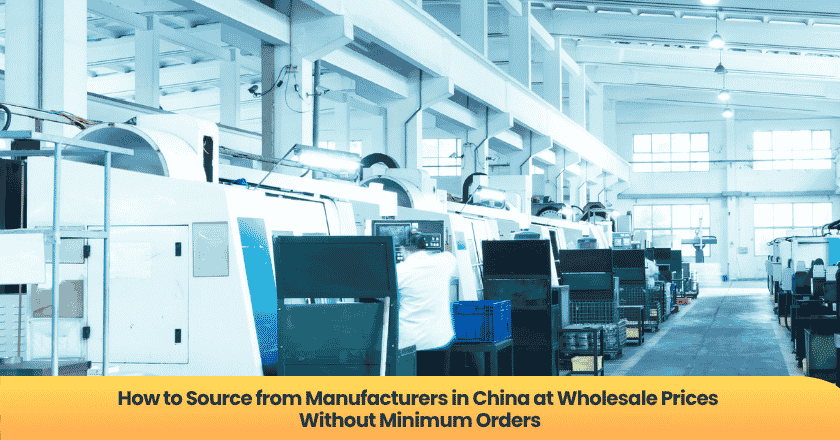
Setting up a production line costs the same whether a factory makes a hundred units or ten thousand. Machines get configured, materials get ordered in bulk, workers get assigned, and a sample gets approved. Those fixed costs have to be spread across the order. Spread them across a hundred units and each one carries a crushing share. Spread them across ten thousand and the cost per piece shrinks to the wholesale number you wanted.
Raw materials add another layer. Factories buy inputs in large lots, so a tiny order may not even cover a single material run. The short answer is that the MOQ is the factory protecting itself from losing money on a job too small to absorb its own setup. That is a problem you can solve, but only by addressing the cost, not by wishing it away.
There is a human cost too, and buyers rarely see it. A small custom order takes nearly as much of a sales rep's and a production manager's attention as a large one, from quoting to scheduling to follow-up. A factory swamped with big accounts simply has little incentive to spend that attention on a hundred-unit job. The MOQ is partly a filter, screening out orders that cost more in coordination than they return in profit.
Custom Versus Stock
The highest minimums attach to custom products. Anything built to your design needs tooling, a one-time mold or setup cost, plus a sample cycle and dedicated configuration. Stock products, the items a factory already makes and warehouses, skip all of that. They carry far lower minimums because the expensive setup already happened for someone else.
Expert Tip: Before you fight a custom MOQ, ask whether a stock product gets you ninety percent of the way there. Lightly customized packaging or branding on an existing item often delivers most of what you wanted at a fraction of the minimum a fully custom build demands.
The Routes to Low and No Minimums
Several legitimate paths get you wholesale or near-wholesale pricing without a giant order. Each suits a different stage and product type. Knowing the menu lets you pick deliberately instead of accepting the first MOQ you are quoted.
Wholesale Markets and Stock Goods
China's wholesale markets concentrate thousands of suppliers selling ready stock at low minimums, sometimes a single carton. For standard small-commodity items, these markets get you close to factory pricing without a custom run. The trade-off is choice. You buy what already exists rather than something built to your exact spec, and deep customization is off the table.
Buying stock from manufacturers directly works similarly. Many factories carry standard lines they will sell in smaller quantities than a custom job, because there is no setup to recover. Worth knowing: asking a factory what they already make, rather than what they could build for you, often surfaces a low-minimum option hiding in plain sight.
Agents, Consolidation, and Shared Weight
A sourcing agent or consolidation service can pool many buyers' small orders into volume the factory respects. Individually you order little. Collectively the channel orders a lot, and that combined weight unlocks pricing and minimums you could never reach alone. This is one of the most powerful routes for a small buyer who wants real factory pricing without a real factory order.
Consolidation also lets you mix products from several suppliers into one shipment, which keeps your freight cost per unit sane on small quantities. Splitting a container with other goods turns an uneconomical tiny shipment into a workable one. The math that kills small orders is often freight, not unit price, and consolidation is the fix.
Dropshipping and print-on-demand services sit at the far end of this spectrum, letting you sell with effectively no minimum at all because the supplier ships single units on your behalf. The pricing is the weakest of any route, since you are paying for that flexibility, but for validating whether a product sells before committing any inventory, it can be a sensible first step rather than a permanent home.
Expert Tip: Treat the no-minimum routes as a testing lab, not a business model. Use single-unit or tiny-batch sourcing to prove demand cheaply, then graduate to a real wholesale order the moment the data says a product works. The premium you pay early buys information, and information is what de-risks the bigger order.
Negotiating a Minimum Down
Sometimes the product you want is custom and the factory you want has a high MOQ. The minimum is not always final. Factories move on it when you give them a reason, and knowing what they value lets you trade for a smaller batch.
Trade Something for the Smaller Run
A factory lowers its minimum when the deal still makes sense for them. Offer a higher price per unit on a small batch and you help cover their fixed setup, which is often enough to open the door. Real talk: paying a bit more per piece on a test order is usually smarter than committing to a huge run of a product you have not proven yet.
A credible reorder plan is the other strong lever. A factory may run a small first batch at a workable price if they believe a larger, repeat order follows. Showing realistic growth, rather than vague promises, signals you are a relationship worth starting small for. Simpler specs help too, since anything that cuts their setup burden makes a smaller run easier to say yes to.
Common Mistake: Treating a quoted MOQ as a hard wall and walking away. The first minimum is often a starting position, especially for a buyer who shows a real plan. Failing to ask whether a smaller trial run is possible leaves an option on the table that many factories would have offered.
Off-Season and Slow Periods
Timing shifts what a factory will accept. During slow stretches between peak seasons, machines sit idle and managers would rather run a small job than none at all. A minimum that is firm during a busy period can soften when the floor is quiet. Asking when their next slow window falls can reveal a far more flexible answer than the one you got at peak.
Weighing the Trade-Offs by Stage
No low-minimum route is free. Each costs you something in price, customization, or selection. The right choice depends less on finding the absolute lowest minimum and more on matching the route to where your business actually is.
Match the Route to Your Risk
If you are testing an unproven product, a slightly higher unit price at a tiny minimum is cheap insurance against a warehouse of unsold inventory. Validate real demand first, then chase the lower wholesale price once volume justifies a bigger commitment. Paying a premium to stay small early is a feature, not a failure.
Once a product proves itself, the math flips. Now a larger order at a true wholesale price, with custom specs and your own branding, becomes worth the commitment. The route that served you at launch is rarely the one that serves you at scale. Reassess as you grow rather than locking into a single approach.
The 2026 Picture
Access keeps improving. Through 2026, digital sourcing platforms and AI-assisted supplier matching make it easier to find factories open to smaller runs and to compare their real minimums quickly, rather than emailing dozens of suppliers one at a time. The low-MOQ options that once took weeks to surface now appear in a far shorter search.
Flexibility is also spreading as more factories court smaller e-commerce buyers. By 2026, a growing share of manufacturers see low-minimum trial orders as the front of a funnel rather than a nuisance, because today's small buyer can become tomorrow's volume account. That shift quietly works in favor of anyone starting small and intending to grow.
How NewBuyingAgent Turns Small Orders Into Wholesale Pricing
The consolidation route works best when one partner can pool real volume across a deep factory base, which is exactly the position a long-established agent occupies. NewBuyingAgent is your perfect partner for global sourcing from China, backed by 30 years of expertise in trade, manufacturing and quality control. That standing is what gets a small order taken seriously at the factory level. It provides access to its 50,000+ cooperated partner factories—no language/region/time zone barriers. Its local reputation gets clients full factory cooperation. A network that wide means there is almost always a supplier willing to run clients' quantity at a sensible price. Its wide factory network lets it pick low-cost, high-cooperation suppliers. Even with its margin included, it cuts clients' costs by 5%-10%. And with the sourcing and coordination handled for clients, the time they would have spent chasing minimums stays theirs. The team handles all factory communication—perfect for multi-category buyers. It frees up clients' time to focus on expanding their local market sales.
Frequently Asked Questions
Can I really buy from Chinese manufacturers without a high minimum order?
Yes, through several routes. Wholesale markets and stock products offer low or single-carton minimums because they skip custom setup costs. Agents and consolidation services pool small orders into real volume. You can also negotiate a custom minimum down. Each path involves a trade-off, but none requires a giant first order to start sourcing.
Why do factories set minimum order quantities so high?
Setup, tooling, and bulk material purchases cost a factory the same whether the run is small or large, and those fixed costs must spread across the order. A tiny batch leaves each unit carrying a crushing share of setup. The MOQ protects the factory from losing money on a job too small to cover its own production costs.
How do I negotiate a lower MOQ with a manufacturer?
Give the factory a reason the smaller run still pays. Offer a higher unit price to help cover their setup, present a credible plan to reorder in volume, or simplify your specs to reduce their burden. Asking during a slow production season helps too, since an idle line makes a factory far more open to a small job.
Are wholesale market prices as low as factory-direct prices?
Usually close, but not identical. Wholesale markets sell ready stock at low minimums without the setup costs of a custom run, so pricing sits near factory levels for standard items. The trade-off is customization and choice, since you buy what already exists. For genuine custom goods at the lowest price, a larger direct order still wins.
What is the catch with low-minimum sourcing?
Every low-minimum route trades something away. You may pay a higher unit price, accept a stock design instead of full customization, or limit your selection to what already exists. None of these is a dealbreaker early on, but the cheapest true wholesale price still rewards larger, proven orders. Match the route to your stage.
How is low-MOQ sourcing changing in 2026?
Through 2026, digital platforms and AI-assisted supplier matching make factories open to small runs far easier to find and compare. More manufacturers also treat low-minimum trial orders as the start of a relationship rather than a nuisance, since a small buyer today can scale tomorrow. Both shifts favor anyone starting small with plans to grow.
Conclusion
Sourcing from manufacturers in china wholesale without a punishing minimum is not a trick or a loophole. It is a matter of understanding why MOQs exist and choosing the route that fits where your business stands today. Stock products and wholesale markets get you near-factory pricing on standard goods. Agents and consolidation pool your small order into volume the factory respects. Negotiation moves a custom minimum when you trade something the factory values. Each path is real, and each asks something modest in return.
The mistake is treating the lowest possible minimum as the only goal. The smarter aim is matching your sourcing route to your stage, paying a small premium to stay nimble while a product is unproven, then scaling into true wholesale pricing once demand is real. Start small on purpose, grow deliberately, and let the route evolve with you. Do that, and the wall that stops so many new importers becomes just another step you have already figured out how to clear.
NewBuyingAgent
Related Resources
Get Started Today
Let's Turn Your Sourcing Goals into RealityWeChat:+86 15157124615
WhatsApp:+86 15157124615
Address:Building 10 #39 Xiangyuan Road, Hangzhou, China
