

Introduction
A factory that pumps out millions of cheap consumer earbuds is the wrong place to build a thousand ruggedized industrial sensors — and vice versa. "Electronics factory" covers a span so wide that the term alone tells you almost nothing about whether a given factory fits your product. The buyer who finds the right one starts by understanding how consumer and B2B electronics manufacturing differ, because that difference points to entirely different kinds of factories.
Finding an electronics factory in China is less about searching harder and more about searching for the right profile. Consumer products live or die on cost at scale and time-to-market; B2B and industrial products demand reliability, certification depth, and often lower volumes with tighter tolerances. Match the factory's natural strength to your product's real demands, and most sourcing problems never start.
Key Takeaways
• Consumer and B2B electronics need different factories — match the factory profile to your product type.
• Consumer manufacturing optimizes cost and speed at scale; B2B optimizes reliability and certification.
• Verify real capability through certifications, testing systems, and traceability, not appearance or claims.
• The best-fit factory often isn't the one marketing hardest in English; reach matters.
• Compliance requirements differ sharply by product and market, so confirm them before committing.
Consumer vs. B2B: Two Different Factories
What consumer electronics manufacturing optimizes
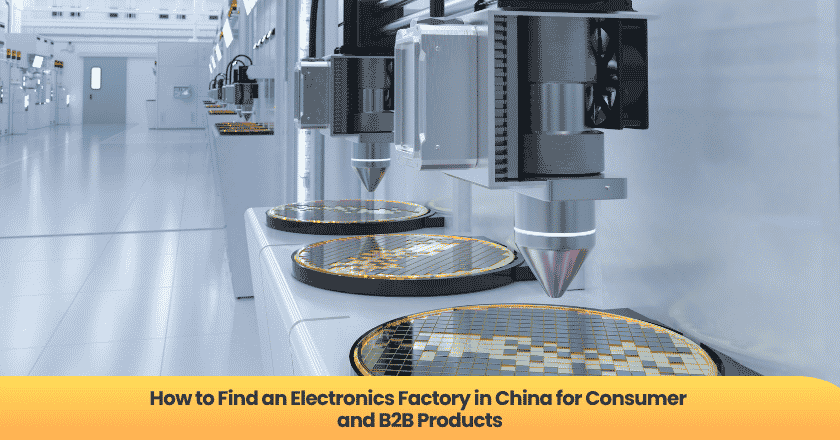
Consumer electronics — earbuds, chargers, smart-home gadgets, wearables — compete on price and speed. The factories that excel here are built for high volume, fast time-to-market, and aggressive cost engineering. They run efficient SMT (Surface-Mount Technology — the automated process of placing components onto circuit boards) lines at scale, manage consumer-grade component sourcing well, and understand the certifications consumer goods need for retail. Their sweet spot is volume; a small, complex order is a poor fit for their economics and attention.
For consumer products, the right factory is one whose normal business is your kind of product at a compatible volume. You want to be a meaningful client in the middle of their range, not their smallest account getting deprioritized behind million-unit runs.
Time-to-market pressure shapes consumer sourcing in a way B2B rarely faces. A consumer gadget often has a narrow window — a holiday season, a trend, a competitor's launch to beat — and a factory's speed through sampling, tooling, and ramp can decide whether you make that window. The best consumer-electronics factories are built for this, with fast prototyping and the component relationships to move quickly. Through 2026, with product cycles compressing further, this speed has become a sharper differentiator than raw unit price for many consumer buyers. The trade-off to watch is that speed-optimized factories sometimes cut corners on testing under deadline pressure, so pairing a fast factory with independent quality oversight keeps the rush from becoming a returns problem.
What B2B and industrial manufacturing demands
B2B and industrial electronics — sensors, control systems, medical or automotive components, industrial IoT — flip the priorities. Reliability, durability, traceability, and certification depth matter more than squeezing the last cent. These factories often run lower volumes with tighter tolerances, hold standards like IPC Class 3 (the highest reliability class for assembly) or industry-specific certifications, and maintain rigorous traceability because a field failure can be safety-critical or contractually severe. A consumer-volume factory is usually the wrong choice for this work, and vice versa.
The relationship dynamics differ too. B2B buyers typically build longer, deeper partnerships with their factories, because the cost of qualifying a new supplier for a reliability-critical product is high — requalification testing, audits, and the risk of a change in a proven process. Where a consumer buyer might switch factories between product generations to chase cost, a B2B buyer often stays with a qualified factory for years, valuing the consistency and the institutional knowledge that builds up around a complex product. That makes the initial selection even more consequential: you're not picking a vendor for one run, you're choosing a partner you may depend on for the product's whole lifecycle.
Expert Tip: Ask a factory what percentage of its output matches your product category and volume tier, then ask to see recent production of that type. A factory where most of the floor runs your kind of product — consumer wearables, or industrial controllers — has the right lines, component relationships, and engineering experience. One showing you a few relevant samples among mostly different work is learning your product on your money. Production mix, not a broad capability list, reveals true fit.
Finding the Right Factory
Reach beyond the visible suppliers
The strongest-fit electronics factory often isn't the one with the best English website or the highest platform ranking. Many capable factories fill their books through established relationships and don't market aggressively abroad, so the visible, English-facing suppliers are a self-selected fraction, not necessarily the best for your product. The factory truly built for your profile may never appear in a platform search at all.
The cost picture reinforces the case for reaching wider. A single buyer placing a modest electronics order has limited bargaining power on component pricing and little sway over a factory's standard terms. In electronics, where component pricing and allocation swing with market conditions and a wrong-fit factory can mean a failed production run, the ability to reach the right factory and verify it often matters more to the final cost than the headline quote does.
Factory or trading company?
Electronics listings are thick with trading companies presenting themselves as factories. A trading company resells from factories with a markup and no production control, which costs you price transparency and a direct line to fix technical issues. Verify by asking specific production questions — what SMT lines they run, what testing they do in-house — and requesting the business license, checking that the registered name matches the bank account you're asked to pay. A mismatch between the invoicing entity and the bank-account holder is the clearest sign of a middleman.
Common Mistake to Avoid: Picking an electronics factory by browsing platform listings and choosing the one with the most reviews and the lowest price. Platform visibility reflects marketing spend, and the lowest price often signals a trading company or a volume factory mismatched to your order. Buyers sign, then find their small B2B run deprioritized or their consumer product quoted by a reseller. Define your product profile and required volume first, then match a factory to it — don't let a listing's prominence choose for you.
Verifying Capability and Compliance
Capability you can check
Whatever the product, verify real capability rather than claims. For electronics that means: in-house SMT and assembly lines (not subcontracted to a workshop you haven't seen), testing systems appropriate to your product (automated optical inspection, functional testing, and for higher-reliability work, in-circuit testing), and traceability linking component lots to finished units. Request a factory walkthrough — live video works well — to confirm the lines and test stations exist and run. A factory that hesitates to show its floor is telling you something.
Independent quality oversight closes the gap, since a factory's own testing is reported by the party motivated to ship. An inspection layer answering to the buyer exists so electronics match spec and pass real testing across the run, rather than passing a sample check and failing in use.
Watch for subcontracting, too, which is common in electronics and easy to miss. A factory short on a particular capability — a specialized testing step, a certain assembly process — may quietly farm that work to a partner you never assessed, meaning your audit covered a facility that isn't doing all the work. Some subcontracting is legitimate and disclosed; the risk is the undisclosed kind. Ask plainly whether any part of production or testing happens off-site, and confirm that the testing your product needs actually runs in-house rather than being outsourced to whoever is cheapest that month. For higher-reliability B2B products especially, a clear chain of custody through the build matters as much as the headline capability list, because a single unverified step can undermine the reliability the whole product depends on.
Compliance differs sharply by product and market
Electronics compliance is unforgiving and varies by both product and destination. Consumer goods for the US and EU typically need certifications like FCC (US electromagnetic compliance), CE (EU conformity), and RoHS (restriction of hazardous substances), with wireless products needing additional radio approvals. B2B and industrial products may need sector-specific standards — medical, automotive, or industrial safety. A factory experienced in your target market can document the relevant certifications and design for them; one that hasn't may build a product that can't legally be sold where you intend. Confirm compliance experience before committing, not after a shipment is held at customs. Through 2026, tightening market-access and cybersecurity rules for connected devices have made this scrutiny even more important.
Expert Tip: Ask whether the factory has built a product for your exact target market and can share the certification path it followed. A factory that has shipped FCC- and CE-certified consumer electronics to the US and EU knows the testing labs, the documentation, and the design choices that pass — and saves you costly surprises. One vague about certification, or that treats it as your problem alone, may build a technically functional product you can't legally sell, turning a cheap quote into a stranded inventory.
How NewBuyingAgent Helps You Find the Right Electronics Factory
Electronics sourcing isn't about searching harder — it's about matching the factory to your product profile, since consumer goods chase scale and speed while B2B and industrial work demands reliability, certification, and tighter tolerances. Lining up that profile, capability, and compliance from a distance is hard to get right alone, which is why many buyers bring in a sourcing partner to help match it.
NewBuyingAgent is your perfect partner for global sourcing from China, backed by 30 years of expertise in trade, manufacturing and quality control.
Connecting your product profile to a factory that genuinely fits it — rather than the search-ranked, English-marketing few — is the starting point: with 100% Access to China's Factories, you use their 50,000+ cooperated partner factories—no language/region/time zone barriers. Their local reputation gets you full factory cooperation. A lone buyer has little say on component pricing, and a wrong-fit factory can mean an expensive failed production run, so a wider network leaves more room to choose well and to price keenly: with Lower Prices Than Direct Sourcing, our wide factory network lets us pick low-cost, high-cooperation suppliers.
Real capability in electronics is proven by testing and traceability, not a sample's appearance, and that line has to be held independently: NewBuyingAgent's 20,000+ product development & QC experts ensure your products match market needs and stay high-quality.
Frequently Asked Questions
Are consumer and B2B electronics made by the same factories?
Usually not. Consumer electronics factories optimize for high volume, low cost, and fast time-to-market; B2B and industrial factories optimize for reliability, tighter tolerances, certification depth, and traceability, often at lower volumes. Matching the factory's profile to your product type is the first and most important sourcing decision.
How do I find an electronics factory that fits my product?
Define your product category and required volume first, then match a factory whose normal business is that profile — confirmed by its production mix, not a broad capability list. Look beyond the highest-ranked platform listings, since the best-fit factory often doesn't market hardest in English, and verify it's a real factory, not a trading company.
How do I tell an electronics factory from a trading company?
Ask specific production questions — what SMT lines and testing they run in-house — and request the business license, confirming the registered name matches the bank account you'll pay. A real factory answers technical questions directly and can show its floor; a trading company hedges and a payment-name mismatch signals a middleman reselling with a markup.
What certifications do electronics from China need?
Requirements vary by product and market, but consumer goods for the US and EU commonly need FCC, CE, and RoHS, with wireless products requiring radio approvals. B2B and industrial products may need medical, automotive, or industrial safety standards. Confirm the factory has built for your target market and can document the certification path before ordering.
Can I verify an electronics factory without visiting China?
Yes. A live video walkthrough can confirm SMT lines, test stations, and workflow, and third-party audits and inspections verify the actual order. Pair a remote audit to qualify the factory with independent inspection during production, and you get most of the assurance of an in-person visit without the travel.
Conclusion
Finding an electronics factory in China starts with knowing which kind you need.
Consumer products point to high-volume, cost-and-speed factories; B2B and industrial products point to reliability-and-certification factories — and confusing the two is the most common early mistake.
Define your product profile and volume, match a factory built for it, verify capability through testing and traceability, and confirm the compliance your market demands before committing.
When identifying the right-fit factory and verifying it from a distance is more than you want to manage, it's worth having a partner match your product to the right electronics factory and verify its capability before you order.
NewBuyingAgent
Related Resources
Get Started Today
Let's Turn Your Sourcing Goals into RealityWeChat:+86 15157124615
WhatsApp:+86 15157124615
Address:Building 10 #39 Xiangyuan Road, Hangzhou, China
