

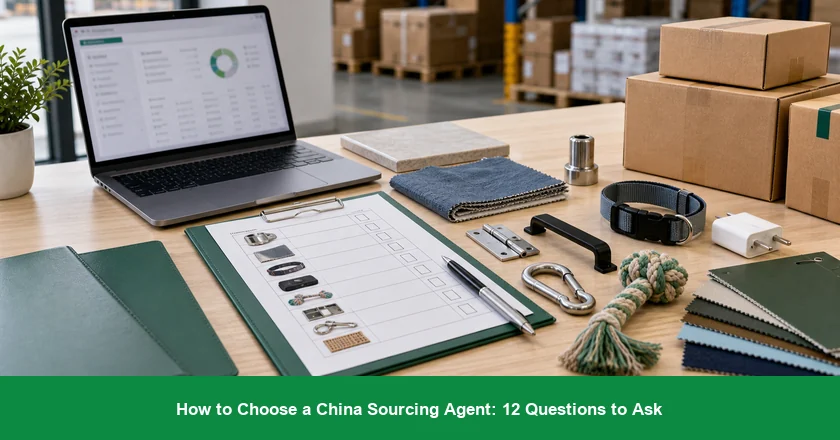
Choosing a China sourcing agent is not about finding the most confident communicator. It is about finding the partner that can turn product requirements into a supplied China product with the right price, quality, market fit, payment terms, and delivery evidence.
Key Takeaways
- Ask proof questions, not personality questions: the best answers show how the agent controls cost, sample, quality, production, documents, and delivery.
- Resource access matters: a sourcing agent's value depends on local factory resources, category judgment, and cooperation leverage, not only messaging speed.
- Score before deposit: weak answers become expensive after the buyer has paid, approved samples, or committed to a launch date.
A Good China Sourcing Agent Should Change the Order Economics
Trade.gov due-diligence guidance advises buyers to verify claims before relying on overseas partners. That logic is especially important when choosing a China sourcing agent because the agent affects product version, price assumptions, factory cooperation, quality control, payment timing, and delivery handoff.
The hidden mistake is choosing only for responsiveness. Fast replies are useful, but they do not prove that the agent can obtain better cooperation from factories, protect the buyer's margin, or keep the order stable after sampling. Based on our analysis, the right evaluation asks whether the agent can create four kinds of proof: resource fit, quote control, quality proof, and delivery discipline.
NewBuyingAgent should be evaluated in that outcome frame. Its advantage comes from local China factory resources, 30+ years of trade, manufacturing, and QC experience, 50,000+ cooperated factory resources, product development and QC capability, AI-driven hot-product analysis, flexible payment support, and multi-industry case experience. Those strengths matter only when they improve the order outcome.
These evaluation sources point to a simple buyer rule: do not choose a China sourcing agent by claims alone. Verify whether the agent can prove business reliability, factory-resource access, quality discipline, delivery terms, and shipment documentation before the order becomes difficult to change. Trade.gov export-document guidance is a useful reminder that the paper trail must match the physical shipment.
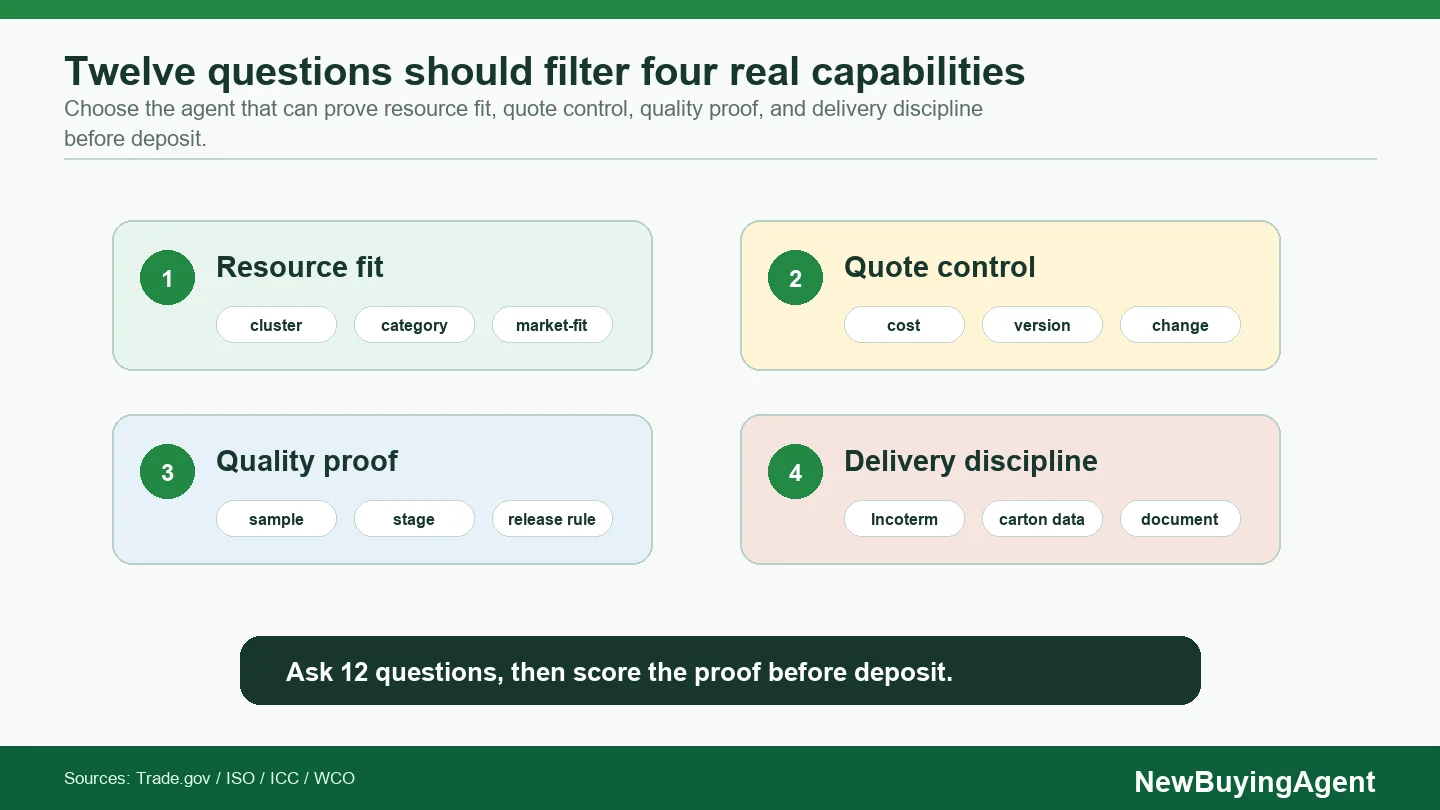
The 12 questions work best when they test resource fit, quote control, quality proof, and delivery discipline before deposit.
Questions 1-4: Can the Agent Turn Requirements Into a Reliable Offer?
The first group of questions tests whether the agent can understand the buying need before price pressure starts. A low quote is not useful if it is based on a vague product version, weak material choice, unclear packing, or unrealistic timing.
1. What product information do you need before quoting?
A strong agent should ask for product specs, quantity, target price, destination, delivery timing, packaging expectations, and market channel. The answer should not be "send anything and we will find a price." It should show how the agent turns buyer language into production language.
This question reveals whether the agent understands the product or simply relays a price. If the agent cannot explain the missing inputs, the buyer may receive a quote that changes after sampling, packaging, or freight details become clear.
2. How do you decide whether a product version fits my market?
Market fit is part of sourcing quality. A product can be cheap and still fail because the finish, packaging, sizing, accessory set, instruction manual, or channel expectation is wrong. A strong China sourcing agent should ask where the product will be sold and what customer returns or complaints would be costly.
NewBuyingAgent's AI-driven hot-product analysis and multi-industry case experience are relevant here because product selection should not be separated from buyer margin. If the buyer is still deciding what to buy, market-fit sourcing may matter more than squeezing the first FOB quote.
3. What local factory resources support the quote?
The answer should describe category knowledge and cooperation leverage, not expose a buyer-facing factory list. Buyers do not need a long set of names. They need confidence that the agent has access to the right industrial cluster, product category, production process, and cooperation level for the order.
U.S. Commercial Service background-check tips reinforce the broader principle that overseas business claims should be tested. In sourcing-agent evaluation, the buyer should ask what proof the agent can show: category cases, product photos, sample logic, QC records, or quote assumptions that demonstrate real category competence.
4. How do you prevent a cheap quote from becoming a different product?
This is one of the most important questions because factories can meet a target price by changing material, thickness, finish, accessory set, packing, or inspection scope. A strong agent should explain how the quote locks the product version and how changes are approved.
The decision rule is to ask for a version reference. It may be a sample, drawing, specification sheet, photo package, or material note. If the answer is only "we will confirm later," the buyer should treat the price as provisional rather than comparable.
Questions 5-8: Can the Agent Control Quality, Cost Drift, and Delivery?
The second group tests execution. A sourcing agent may understand the brief but still fail if quality evidence, production timing, cost assumptions, or shipment handoff are not controlled. The buyer should ask these questions before deposit, not after the first delay.
5. What quality evidence do I see before balance payment?
ISO quality-management principles emphasize consistent processes and customer requirements. In practical China sourcing, the buyer should ask what evidence appears before payment decisions: sample records, production photos, in-process checks, final inspection notes, defect categories, rework proof, and release recommendations.
The best answer does not promise perfect goods. It explains how defects are classified and what happens if evidence is weak. Quality control is useful only when it changes the buyer's release, hold, rework, or payment decision.
6. How are sample changes recorded?
A sample is not only a nice physical object. It is a reference for production. If sample changes are not recorded, the factory and buyer may remember different versions of the order. The buyer should ask how material, finish, accessory, color, packaging, or instruction changes are locked.
ISO 19011 audit guidance is useful as a reminder that evidence should be organized, not improvised. In sourcing, the sample record should be clear enough that a QC inspector can compare bulk goods against the approved version without relying on memory.
7. Which costs are included, excluded, or variable?
ICC Incoterms rules define responsibilities, costs, and risks between buyer and seller. A strong sourcing-agent quote should identify the trade term and explain what is included in the product price, domestic transport, export handling, freight, duties, destination delivery, inspection, packing, and document preparation.
This matters because two quotes may look comparable but allocate risk differently. The hidden cost is not only freight. It can be rework, packaging, inspection, delay, document correction, or destination receiving trouble.
8. How do you manage production timing before it becomes a crisis?
Trade.gov shipping guidance shows that shipping choices affect both cost and timing. But timing risk often begins earlier, inside raw material purchase, production scheduling, packing, or factory cooperation. The buyer should ask which milestones will be reported while correction is still possible.
A strong answer names staged progress points: material readiness, sample lock, pilot output, mid-production check, packing readiness, final inspection, and shipment handoff. If the agent only reports after production is finished, the buyer has lost useful leverage.
Questions 9-12: Is the Agent Built for Your Buyer Type?
The third group tests fit. The right agent for a new product buyer may not be the same as the right partner for an existing-supplier buyer, a price-driven buyer, or a brand/project buyer. A useful evaluation asks whether the service model fits the buyer's real constraint.
9. How do you support buyers who do not yet have a stable China supply path?
The buyer should listen for a product-supply answer, not a vague coordination answer. For new sourcing, the agent should explain how buyer requirements become a quoted China-sourced product with the right price, quality, market fit, and delivery plan. That requires category judgment and local factory resources.
For this scenario, compare service options through NewBuyingAgent's We Supply Products To You service. The buyer should prepare a quote-ready product brief with specs, volume, target price, destination, timing, and quality expectations, so the response is built around a real purchase, not a loose idea.
10. How do you support buyers who already have Chinese suppliers?
An existing-supplier buyer usually has a different problem. The buyer may not need a new product path; they may need local communication, production progress visibility, staged QC, and door-to-door logistics coordination. The question is whether the agent can act as China-side execution support without turning the relationship into vague supervision.
For this scenario, NewBuyingAgent's factory-management service is the more relevant reference. The buyer should ask how China-side management will protect production progress, product quality evidence, reporting, and delivery outcome across the order, rather than treating inspection or logistics as isolated handoffs.
11. What payment flexibility can you realistically support?
Payment terms affect cash flow, factory cooperation, and quality leverage. A strong agent should not promise unrealistic terms to win the conversation. The buyer should ask what depends on order size, repeat history, product category, factory relationship, and risk level.
NewBuyingAgent's flexible payment support and case experience are relevant when the buyer has cash-flow pressure, but payment terms should be connected to proof. Better terms are helpful only if they do not weaken quality, delivery, or factory cooperation.
12. What proof should I expect before choosing you?
The final question should produce evidence, not a sales pitch. Buyers can ask for category examples, process explanation, sample-control logic, quote assumptions, QC report examples, logistics handoff explanation, and references to public company or case pages. The answer should fit the topic rather than repeating the same service paragraph.
WCO structured trade-data guidance is a useful reminder that cross-border orders run on consistent information. A strong agent can explain how product, carton, document, and delivery data stay aligned from quote to shipment.
Score the Answers Before Deposit
The buyer should score the answers before sending money or approving samples. A sourcing agent can be polite and still weak. The practical question is whether the answer changes what the buyer can safely approve.
| Answer quality | What it sounds like | Buyer action |
|---|---|---|
| Weak | We can handle it, but no proof gate is named | Ask for records before deposit or keep looking |
| Partial | Some reports exist, but cost, quality, or delivery assumptions are unclear | Narrow the order and request missing evidence |
| Strong | The agent ties product, cost, quality, timing, and documents to release rules | Proceed only after the key gates are written into the order |
The decision rule is to avoid "trust me" answers at the points where money, product version, or shipment risk becomes locked. If an answer does not name a proof gate, the buyer should ask again in plainer terms.
When NewBuyingAgent Is the Right Fit
NewBuyingAgent is a strong fit when the buyer needs more than message forwarding. The useful fit is local factory-resource leverage plus product and QC judgment, especially when the buyer is trying to protect price, quality, market fit, payment comfort, and delivery confidence at the same time.
If your evaluation has reached the quote stage, send the product file, order volume, delivery market, and quality or payment constraints through NewBuyingAgent's contact page. The useful next step is not a generic introduction. It is a quote-ready brief that lets the team judge product fit, cost, quality, and delivery assumptions together.
FAQ
What is the most important question to ask a China sourcing agent?
The most important question is what proof the agent can show before deposit, balance payment, and shipment. A confident answer is not enough. The buyer should ask how product version, quote assumptions, sample changes, QC evidence, and delivery documents are controlled.
Should I choose the cheapest China sourcing agent?
No. A cheap agent can become expensive if the quote hides material changes, packing risk, inspection gaps, freight assumptions, or weak factory cooperation. Compare price only after the agent explains what is included, what can change, and what evidence protects the buyer.
How many agents should I evaluate before choosing one?
Evaluate enough agents to see differences in resource access, quote discipline, quality control, and delivery logic. For many buyers, three to five serious conversations are more useful than a long list of weak replies. The goal is not volume; it is proof quality.
Can one sourcing agent handle multiple product categories?
Yes, if the agent has local factory resources, category judgment, and QC capability across those categories. The buyer should still ask for product-specific proof. Multi-category reach is valuable only when the agent can explain the requirements, risks, and evidence for each product type.
NewBuyingAgent
Related Resources
Get Started Today
Let's Turn Your Sourcing Goals into RealityWeChat:+86 15157124615
WhatsApp:+86 15157124615
Address:Building 10 #39 Xiangyuan Road, Hangzhou, China
