Yiwu. For wholesale buyers worldwide, the name alone carries weight. Whether you're restocking a dollar store in Lagos, filling containers for a Dubai distributor, or building a private-label brand from scratch, the Yiwu International Trade City remains the single most accessible entry point into China's manufacturing supply chain — even in 2026, when cross-border e-commerce and AI-powered sourcing tools have reshaped how global trade works.
But the market has changed. Supplier strategies, payment infrastructure, customs procedures, and logistics options all look different today than they did five years ago. This guide breaks down exactly how to buy from Yiwu Market — practically, realistically, and with the hard-won details that most sourcing articles skip.
Key Takeaways
Before diving in, here's what you actually need to know:
- Yiwu MOQs are low by Chinese wholesale standards — most categories start at one carton, not a full pallet, making it genuinely accessible for small importers.
- Product quality varies enormously — Yiwu excels at price-to-availability ratio, not manufacturing precision. Sampling and pre-shipment inspection are non-negotiable.
- Language is a real barrier on the floor — basic translation apps help for browsing, but for customization or bulk negotiation, a professional sourcing agent or bilingual interpreter is a practical necessity, not a luxury.
- The Market Procurement Trade Method (Code 1039) is the standard export channel for Yiwu purchases — understanding this simplifies your customs paperwork significantly.
- Rail freight via the Yixinou line has become a genuinely competitive option for buyers shipping to Europe or Central Asia, cutting transit time compared to sea while costing far less than air.
- In 2026, live-stream wholesale sourcing from Yiwu is growing rapidly — remote buyers increasingly close deals through video-based supplier tours before committing to physical visits.
What Is Yiwu Market, and Why Does It Matter?
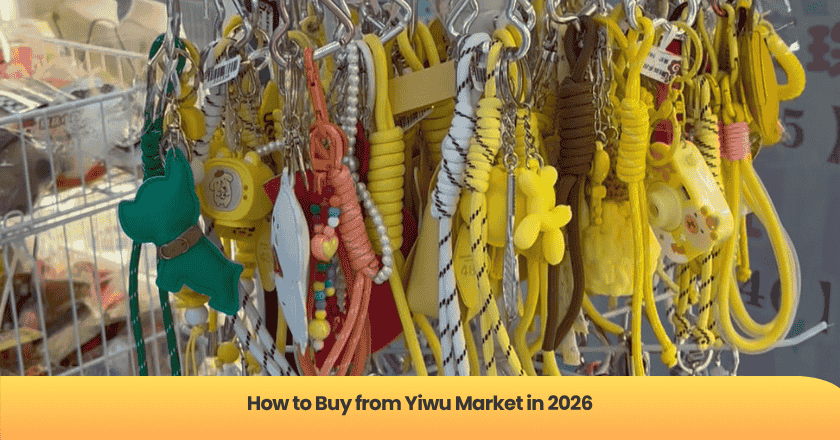
The Yiwu International Trade City — locally known as the Futian Market — is the world's largest wholesale market for small commodities. That's not marketing language; it's a UN-recognized designation. The complex spans over five districts across six floors, housing approximately 75,000 booths and more than 400,000 product types. On a busy trading day, foot traffic from international buyers alone runs into the thousands.
What makes Yiwu genuinely different from, say, sourcing on Alibaba or attending a Canton Fair is the tactile immediacy of it. You can walk between competing suppliers within minutes, handle samples in person, negotiate face-to-face, and consolidate shipments from fifty different stalls into a single outbound container — all within a few days.
What Products Can You Source at Yiwu?
The range is almost deliberately overwhelming. The market is structured so that similar product categories cluster in the same district and floor, which makes targeted sourcing more efficient than it looks from the outside. A simplified breakdown:
- District 1: Toys, artificial flowers, jewelry, arts and crafts
- District 2: Bags, hardware, locks, consumer electronics, watches
- District 3: Stationery, cosmetics, apparel accessories (buttons, zippers)
- District 4: Socks, shoes, underwear, textile accessories, hats
- District 5: Bedding, curtains, fabrics, automotive accessories, DIY products
- District 6: Imported goods, customized items, international trade services
One honest note: Yiwu is not the place to source precision electronics, high-end apparel, or products where technical specifications are tight. The market's competitive edge is price, variety, and speed — not engineering quality. Buyers who walk in expecting Apple-level finish on a $0.30 unit will be disappointed. Buyers who understand what they're buying will find genuine value.
Pros and Cons at a Glance
Why buyers choose Yiwu:
- Low minimum order quantities — one or two cartons is normal, not exceptional
- Enormous product variety under one roof
- Short lead times for in-stock items (days, not weeks)
- Low-pressure browsing environment compared to factory visits
Where Yiwu has real limitations:
- Niche or technical products are hard to find
- Quality consistency across production runs is unreliable
- Suppliers rarely speak functional English
- You are buying from traders, not manufacturers — traceability is limited
Expert Tip: Don't conflate "low price" with "low value." Yiwu's sweet spot is high-volume commodity goods — seasonal decorations, everyday accessories, promotional items, basic household products. If your margin model depends on that price point, Yiwu works. If you need documentation-heavy products (CE, FDA, REACH compliance), verify certifications before placing any order, not after.
Understanding MOQs and Pricing at Yiwu
Minimum order quantity — MOQ — is the minimum amount a supplier will sell you in a single transaction. At Yiwu, MOQs are expressed in cartons or dozens, not individual pieces. Real-world examples from the current market:
- Jewelry: Typically 10 dozen per design (120 pieces per SKU)
- Bags and luggage: Around 200 pieces
- Scarves: 300 pieces per colorway, subject to fabric availability
- Footwear: 200–300 pairs per style
- Small home accessories: Varies widely — chandelier-type items can start at 1 piece; small seasonal items like ornaments can require 5,000–10,000 pieces
On pricing, one thing surprises almost every first-time Yiwu buyer: bulk discounts are smaller than expected. Jumping from 1,000 to 10,000 units rarely moves the price more than 3–5%. Suppliers know that buyers inflate quantities during negotiation, and they've priced accordingly. Don't expect to unlock dramatic tiered pricing the way you might with a factory direct order.
Payment in Yiwu runs almost entirely in RMB (Chinese Yuan). Most stall-level suppliers don't accept USD, and card payments are uncommon at smaller booths. WeChat Pay and Alipay are universal on the floor. For foreign buyers without Chinese payment apps, working through an agent or bringing sufficient cash for sampling and small deposits is the practical approach.
Common Mistake to Avoid: Assuming the sample price reflects bulk production quality. Suppliers sometimes show better samples than what ships in volume. Always request a pre-production sample, confirm material specifications in writing, and conduct a pre-shipment inspection on your first order from any new supplier — regardless of how reassuring the booth presentation was.
How to Buy from Yiwu Market: Step by Step
Step 1 — Identify the Right Supplier Type
Two types of suppliers operate at Yiwu: specialist suppliers who focus on one product category, and multi-category traders who stock a broad mix. For buyers who need consistent quality and supplier accountability, specialist suppliers are generally the stronger choice. They maintain closer relationships with specific factories, have better visibility into production quality, and are more responsive to customization requests.
Multi-category traders are fine for spot-buying small mixed lots, but they're not who you want handling your private-label program.
Step 2 — Find Suppliers: Two Practical Channels
Option A — Visit the market in person:This is still the most efficient method for first-time buyers. Walk the relevant district, compare prices across five or six similar suppliers, handle samples, and note stall numbers. Most buyers find that physically seeing products next to each other reveals quality differences that photos completely hide.
Option B — Use the official online platforms:Two platforms list Yiwu suppliers digitally:
Yiwugo (yiwugo.com) — the market's primary online directory
Chinagoods (en.chinagoods.com) — the official government-backed platform
The honest assessment: both platforms are useful for initial research, but they lag behind the actual market. Yiwu's competitive edge is fast product turnover, and suppliers rarely update online listings in real time. Use them to shortlist — don't rely on them exclusively.
2026 update: A growing number of Yiwu sourcing agents now offer live-video market tours — they walk through booths on camera, hold up products, and negotiate in real time while the foreign buyer watches remotely. For buyers who can't justify a physical trip for a first order, this is a legitimate and increasingly professional option.
Step 3 — Verify Product Quality Before Committing
This is where most first-time buyers get burned. Quality at Yiwu is not uniform, even within a single supplier's stock. Before placing a bulk order:
Request physical samples and pay the sample cost — suppliers who refuse to provide paid samples are a yellow flag
Confirm material specs (fabric weight, metal grade, plastic type) in writing via WeChat or email
For orders above $3,000–5,000 USD, commission a third-party inspection agency to check goods before they leave the warehouse
Step 4 — Negotiate Prices (Realistically)
Negotiation at Yiwu is low-pressure by Chinese market standards, but it follows rules. Suppliers respond well to buyers who demonstrate real intent — showing you understand the product, know the category, and are comparing multiple booths. A 3–5% discount on larger orders is realistic. Dramatic cuts (10–20%) are essentially never going to happen at this market level.
Communicate simply: Basic English with a calculator works for price discussion. For anything involving customization — private labeling, color changes, packaging modifications — either bring a bilingual interpreter or work through a sourcing agent who can translate nuance accurately.
Step 5 — Arrange Warehousing and Consolidation
Because Yiwu buyers typically purchase from multiple suppliers across several days, a consolidation warehouse is an operational necessity. Goods from different stalls are delivered to a single warehouse, inspected, counted, packed, and then shipped as one outbound consignment. Without a consolidation point, managing multi-supplier logistics becomes chaotic quickly.
Expert Tip: Build your supplier list before you land in Yiwu, not while you're walking the market. Use Yiwugo and Chinagoods to pre-identify 8–10 target suppliers per category, map them by district and floor, then walk them in order. You'll cover more ground, feel less overwhelmed, and negotiate from a position of comparison rather than urgency.
Why Going Direct Doesn't Always Work Out
A common assumption among first-time importers is that cutting out intermediaries — going straight to the factory — automatically delivers better prices and more control. In practice, direct sourcing from China introduces a set of structural challenges that catch buyers off guard, often after money has already changed hands.
Price isn't actually lower without leverage. Without an established factory network, buyers have limited bargaining power. Language barriers, regional pricing norms, and the simple fact that a foreign buyer placing a one-off order holds little weight with a factory running full production schedules — all of these push prices up, not down. Buyers with access to a large, pre-negotiated factory network routinely secure better unit pricing than independent importers going direct.
Quality oversight breaks down quickly. A factory that passes your initial audit can still ship inconsistent product three months later if no one is monitoring the production line. Without dedicated quality control personnel stationed at or near the factory, defect rates tend to rise over time — particularly once the "new client" honeymoon period ends.
Payment terms are rigid by default. Most factories require substantial deposits upfront, with the balance due before shipment. For buyers managing cash flow across multiple SKUs or product categories, this structure creates pressure. Flexible credit terms are generally only available to buyers with an established relationship and volume history — which takes years to build independently.
Communication overhead is real. Coordinating across time zones, language gaps, and different production calendars is genuinely time-consuming. Buyers juggling five or more product categories across separate factories spend a disproportionate amount of time on operational coordination rather than market development.
Multi-factory management compounds the risk. Reliability varies significantly between factories. Managing supplier relationships across categories — each with its own production lead times, quality standards, and communication styles — creates compounding operational complexity that most importing businesses are not structured to absorb.
These are the structural reasons why professional sourcing intermediaries exist — not as a workaround, but as a purpose-built solution. NewBuyingAgent is one example of how the model has evolved. Rather than operating as a traditional commission-based agent (where buyers negotiate factory prices independently and then pay an additional service fee on top), NewBuyingAgent works on an order-driven model: buyers submit their requirements directly, and the company takes full procurement ownership across all product categories — covering supplier selection, quality management, and logistics, with no separate commission charges.
Backed by 30 years of trade and manufacturing experience since 1995, and drawing on a network of 50,000 partner factories and 20,000 product development and QC specialists across China, the platform positions itself as an operational extension of the buyer's team rather than a middleman layer. For buyers sourcing across multiple categories who want a single accountable point of contact, this model addresses most of the direct-sourcing pain points described above.
Expert Tip: Before committing to any sourcing model — direct factory, traditional agent, or full-service intermediary — map out your actual pain points. If your primary challenge is price, a large-network intermediary may outperform direct sourcing. If your challenge is quality consistency across multiple SKUs, on-the-ground QC coverage matters more than fee structure. The right model depends on what's actually costing you the most.
Working with a Yiwu Sourcing Agent
Unless you speak Mandarin, have a registered Chinese business entity, and have done this before, a Yiwu sourcing agent is not optional — it's practical infrastructure. Agents handle supplier communication, sample coordination, order payment, quality inspection, warehouse consolidation, and export documentation. For buyers outside China, they're the operational backbone of the entire transaction.
Agent fees typically range from 3–10% of order value, depending on service scope. Be immediately skeptical of agents quoting 1% or less — that rate doesn't cover operating costs, which means income is coming from somewhere else, usually supplier kickbacks or undisclosed margin.
Red Flags When Evaluating Yiwu Agents
- Constantly switching suppliers between orders to access cheaper pricing — product consistency collapses without you realizing it
- No physical warehouse address — consolidation without a real warehouse is a logistical liability
- Requesting all payment upfront before order confirmation — standard practice is a deposit structure
- Unable to provide inspection reports — a professional agent does not skip this step
Finding a reputable agent: Google search for "Yiwu sourcing agent" returns a long list. The most reliable screening method is requesting references from previous clients in your country or category, verifying they have a functioning warehouse, and confirming they can handle your specific export documentation requirements.
Common Mistake to Avoid: Treating your agent as just a translator. A good Yiwu agent acts as a procurement manager — they push back on poor-quality goods, flag supplier reliability issues, and protect your interests during inspection. Hire someone with that orientation, not just someone who can speak both languages.
Shipping from Yiwu: Your Options in 2026
Yiwu is well-connected logistically. Main export routes from Yiwu include:
- Ocean Freight (FCL/LCL): The dominant choice for volume buyers. Full container load (FCL) is cost-effective above roughly 15 CBM; less than container load (LCL) consolidation suits smaller shipments. Transit to major ports is 25–45 days depending on destination.
- Air Freight: Fast (3–7 days), but costs roughly 4–6x sea freight per kilogram. Viable for urgent reorders or high-value, low-weight goods.
- Rail Freight via Yixinou: The China–Europe rail corridor that originates in Yiwu and terminates in Madrid, passing through Kazakhstan, Russia, Belarus, Poland, France, and Germany. Transit time to European destinations runs roughly 18–22 days — significantly faster than sea, at roughly 40–60% of air freight cost. In 2026, this route has become a serious, mainstream option for European importers, not a niche experiment.
- Express Courier (DHL, FedEx, UPS): Practical only for samples or very small orders. Not cost-effective for commercial volumes.
The Market Procurement Trade Method (Code 1039)
For buyers sourcing from Yiwu, the standard export declaration channel is the Market Procurement Trade Method — Chinese Customs code 1039. This is a simplified export framework designed specifically for small-commodity wholesale markets like Yiwu.
Key features of Code 1039:
- Each customs declaration is capped at USD 150,000 per shipment
- Multiple suppliers' goods can be consolidated into one declaration
- Small purchase receipts from market stalls are processed through the Market Procurement Platform to generate a unified commercial invoice
- SOHO businesses and buyers without their own export license can still export legally through a registered agent
This matters because it simplifies the documentation burden significantly for small and medium importers. Rather than needing a full general trade export invoice from every supplier, the system consolidates everything through a single export agent.
Expert Tip: Always confirm with your freight forwarder or sourcing agent which trade code your shipment will use before goods reach the warehouse. Switching from 1039 to general trade (code 0110) midstream creates documentation complications that delay departure.
Yiwu Market in 2026: What's Changed
A few shifts worth noting for buyers planning a sourcing trip this year:
Digital integration is accelerating. Chinagoods has expanded its live-commerce features, and a growing number of suppliers now conduct remote negotiations via video. Not all of them are good at it yet, but the infrastructure is there.
Sustainability inquiries are increasing. European buyers in particular are arriving with ESG documentation requirements — material declarations, restricted substance lists, carbon footprint estimates. Most Yiwu suppliers are not prepared for this. Budget extra lead time if compliance documentation is part of your import requirements.
Geopolitical tariff exposure. Buyers importing into markets with elevated tariffs on Chinese goods (notably the United States) are increasingly using Yiwu as a sourcing discovery point but routing production through third-country factories. The market has adapted — District 6 now hosts a growing number of international trade intermediaries for exactly this purpose.
Payment infrastructure for foreign buyers has improved. RMB cash remains dominant on the floor, but the surrounding transaction ecosystem is more foreign-buyer-friendly than it was two years ago.
Frequently Asked Questions
Do I need a business license to buy from Yiwu Market?
No. Individual foreign buyers can walk the market and purchase goods. However, to export commercially, you need either your own export license or to work through a licensed export agent. The 1039 trade method was designed specifically to accommodate buyers without their own export entity.
Can I visit Yiwu Market without a sourcing agent?
Yes, for browsing and small spot purchases. For anything involving customization, bulk orders, consolidation, or export documentation, working without an agent is technically possible but operationally difficult — especially without Mandarin language capability.
How long should I plan for a Yiwu sourcing trip?
Most experienced buyers allocate 3–5 working days for a focused category sourcing trip. First-time visitors often need a full week to navigate the market layout, meet enough suppliers, and allow time for sample review before leaving.
What's the best time of year to visit Yiwu?
March–May and September–October are peak buying seasons and overlap with the Canton Fair calendar. January and February (around Chinese New Year) see the market largely closed. July–August is quieter and can be a good time for negotiation, though some suppliers are in their own slow season.
Are products at Yiwu Market covered by intellectual property protections?
This is a real concern. The market has improved on trademark enforcement in recent years, but counterfeit and IP-infringing products still exist. Do not purchase branded replicas — the legal and customs risk at the import end is the buyer's problem, not the supplier's.
How do I handle quality disputes after goods have shipped?
Prevention is the only reliable strategy — inspection before shipment is your best protection. Post-shipment disputes with Yiwu suppliers are difficult to resolve remotely and rarely result in refunds. This is why pre-shipment inspection is treated as standard practice, not optional insurance.
NewBuyingAgent
Related Resources
Get Started Today
Let's Turn Your Sourcing Goals into RealityWeChat:+86 15157124615
WhatsApp:+86 15157124615
Address:Building 10 #39 Xiangyuan Road, Hangzhou, China