


Ten factory updates can all look green while the launch is already late. The hidden constraint is usually a handoff: a component that cannot be packed until a revised finish is accepted, an insert that cannot print until artwork is frozen, or a finished carton that cannot join a booking until its documents and allocation agree. Coordinating a distributed launch is therefore a release-control job, not a larger version of supplier chasing.
A Brand Launch Needs One Release Date, Not Twelve Separate Updates
The last required handoff, not the average factory status, sets the sales-ready date. That handoff may sit between a finished-goods factory and a hardware supplier, between a packaging printer and a kitting partner, or between the brand decision and a consolidation cutoff. A shared release date makes that dependency visible before every factory starts reporting its own version of “complete.”
- Control the customer-ready SKU or kit, not each factory’s isolated completion percentage.
- Give every handoff one owner, one approved version, one due date, and one acceptance condition.
- Use a gate to decide whether a scope can move forward; do not let a status update stand in for evidence.
- When a late change is traceable, calculate the affected kit scope before deciding on a full hold or split release.
A useful launch record names the commercial promise first: the SKU family, quantity, destination, target ship window, channel or retailer constraint, and the person who can accept a trade-off. Only then can the team judge whether an upstream delay changes a customer commitment or merely consumes float inside one workstream.
Build the Launch Map Before Any Factory Starts
A launch map makes every cross-factory handoff visible before it becomes a late surprise. Start at the customer-ready unit and work backward: finished item, required component, packaging, insert, carton label, inspection evidence, kitting, allocation, and shipment. The purpose is not to expose every supplier’s commercial details. It is to identify what each downstream party must receive, in which approved version, before it can start or release its own work.
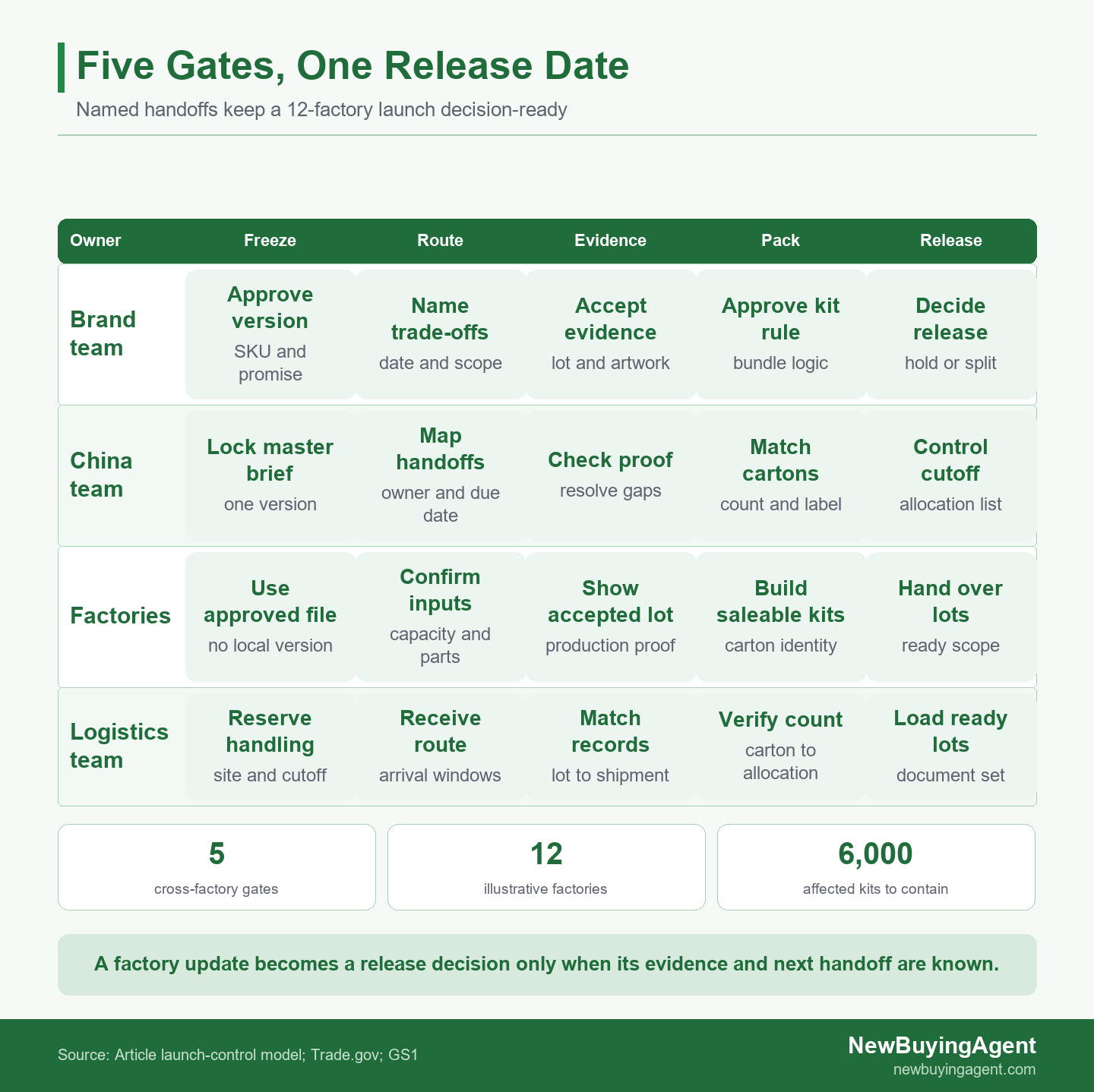
Swimlane diagram showing four launch actors moving through five gates from product freeze to shipment release
For a new multi-category launch, this map belongs in the purchasing brief rather than in a separate meeting deck. Buyers who need a China-side team to connect product, packaging, quality and delivery requirements can see how NewBuyingAgent can supply products from China against one complete launch brief. The useful input is a complete product and commercial requirement, not a request for a generic progress report.
Name the Interface, Not Only the Factory
Name the interface—not only the factory—when you control a multi-factory launch. “Hardware factory: delayed” is not a usable control item. “Matte finish sample from hardware factory to finished-goods factory; version F-03; owner named; accepted by Thursday; required before two kit families can close” is one.
For every interface, capture six fields: the sender, recipient, required input, version or lot, latest acceptable date, and acceptance evidence. Add a seventh field when needed: the release scope that the handoff blocks. This small discipline prevents a familiar failure mode in which the component factory says it shipped, the assembler says it has not received the correct version, and the coordinator has no agreed condition for resolving the gap.
The record should sit with the product-family plan, not with a long chat history. That lets the brand see which handoffs share a carton, a booking, a retailer promise, or a compliance boundary. It also makes escalation proportionate: a missing swatch for a non-critical accessory differs from a missing approved label file for every unit in the launch.
Then Mark the Handoff That Sets the Sales-Ready Date
Track the predecessor that sets the downstream start date, not the factory that writes the longest update. A critical path is simply the chain of dependent work that determines the earliest sales-ready date. In a launch with multiple factories, the critical item can move as samples are approved, materials arrive, cartons are confirmed, and consolidation capacity is reserved.
Ask one question at every review: “If this handoff is not accepted by its last acceptable date, what can no longer start?” The answer identifies the real escalation point. A coordinator can then request evidence that changes the decision—an approved sample, a production-lot record, a carton count, or a booking confirmation—instead of collecting more optimistic dates.
Do not confuse a critical handoff with the most expensive component. A low-cost insert can block a regulated retail bundle; a short packaging delay can prevent container loading even when all finished goods are ready. The control priority follows the downstream consequence, not the apparent importance of the sending factory.
Run Five Gates Against the Same Critical Path
A factory status is not a release condition until the responsible party, evidence, and next handoff are defined. A release gate is the named check that confirms those conditions before dependent work moves forward. A practical gate answers three questions: what must be true, who can confirm it, and which downstream work may start once it is true. The same map should carry five gates from version freeze to shipment release.
| Gate | Release condition | Evidence to retain | What it protects |
|---|---|---|---|
| 1. Product freeze | One approved product, artwork and specification version | Dated approval and revision log | Uncontrolled production changes |
| 2. Capacity and materials | Each critical input has a route and last acceptable date | Confirmed capacity, material and handoff dates | Hidden predecessor delays |
| 3. Production evidence | Required lot or sample checks are accepted | Inspection or acceptance record | “Finished” goods that are not accepted |
| 4. Kit and carton readiness | Correct components, pack data and labels match the approved scope | Carton count, label and kit record | Mixed versions or incomplete bundles |
| 5. Allocation and shipment | Released scope, documents and booking match | Allocation list and shipment document set | Loading the wrong or incomplete scope |
Incoterms clarify who carries named shipment, documentation, insurance, and clearance tasks. Trade.gov’s Incoterms guidance makes that boundary explicit. The final gate should name the party responsible for each task rather than assume that a factory’s readiness note settles it.
Freeze Versions Before Dependencies Multiply
For applicable U.S. children's products, a material change can turn a component update into a compliance review. Under 16 CFR part 1107, applicable changes in product design, manufacturing process, or component sourcing that can affect compliance have testing and certification consequences. This is a narrow U.S. example, not a universal rule, but it shows why a revised component cannot always be managed as a harmless schedule update.
At the freeze gate, record the approved master version and list the files that must match it: product specification, artwork, label data, packing instructions, inspection criteria, and any destination-specific documents. A change request should state the affected SKU families, inventory or lots, factories, carton files, customer promise, and decision owner. “Use the latest file” is not control unless everyone can identify which file is latest and whether any earlier production must be contained.
Release Only the Kits Whose Evidence Still Matches
Release only the kits whose accepted lot, carton identity, documents, and shipment allocation still match the approved version. The rule is deliberately narrower than “release every completed factory order.” It keeps a changed or missing input from being hidden inside a consolidated shipment where it is much harder to sort, rework, or explain to a channel partner.
At this point, test the agreed product, packing, evidence, and shipment inputs together, rather than accepting a factory-complete status as a release decision.
For release control, treat each carton, pallet, or other shipped handling item as a distinct traceable package. A unique logistic-unit identifier can connect physical movement to electronic records. The GS1 Logistic Label Guideline describes the SSCC as a unique identifier for logistic units and as a link between physical movement and electronic messages. Where a buyer’s process uses this kind of identity control, it gives the consolidation team a practical way to match a pallet or carton scope to the release record.
A packing list records what is inside each package, with weights and measurements. Trade.gov’s packing-list guidance sets that package-level boundary. Compare the record with the approved kit and allocation list before loading; otherwise a correct quantity total can still conceal a wrong label version, incomplete bundle, or customer-channel mix.
Applicable U.S.-bound ocean ISF data is due no later than 24 hours before vessel loading. CBP’s filing guidance limits this to the specified route and condition. Treat it as a route-specific deadline in the critical path, not as a generic export rule for all destinations or transport modes.
For applicable U.S. imports, the importer is the finished-product certifier. 16 CFR part 1110 sets that limited boundary. A factory document can be an essential input, but it does not automatically transfer an applicable finished-product responsibility.
Worked Scenario: A Late Change Across Twelve Factories
Calculate the affected customer-ready kits before choosing a full hold or a split release. The calculation does not make the decision by itself; it gives the decision a defined commercial scope.
Identify destination document needs early; a packing list is not a commercial invoice. Trade.gov’s common export-document guidance supports that distinction. This matters when a team considers moving only part of a launch through a common consolidation plan.
The 6,000-Kit Decision Is a Scope Test, Not a Factory Vote
The affected kit count is the first scope test before a hold-or-split decision.
Consider an illustrative home-organization launch with four coordinated SKU families and one retail date. 12 China-side factories and partners contribute finished goods, components, packaging, inserts, hardware, kitting, and consolidation. Each family has 3000 planned units. Two weeks before final carton completion, the hardware finisher reports that a revised matte coating needs five more production days for the hardware used by two families.
Two observations change the discussion. First, the late hardware belongs in two customer-ready families, so the exposed scope is 2 × 3000 = 6000 kits—not the entire 12000-unit program. Second, the other two families have passed product and packing checks, but all four families share a consolidation booking. The team must therefore separate product readiness from booking convenience.
The analysis is not “the hardware factory is five days late.” It is whether the revised finish changes required evidence, whether the two affected families can remain traceable through packing, and whether releasing the other families would alter the retailer offer or customer promise. The appropriate provisional decision is a scoped hold on the two affected families while the unaffected families proceed through final verification and a split-booking option is kept open.
The coordinator obtains revised finish samples and a dated completion confirmation, rechecks the affected product and supporting evidence, then updates kit and carton allocation before the consolidation cutoff. A family may release only when its approved version, accepted lot, carton and label data, supporting destination evidence, and assigned shipment allocation agree. This is an illustrative calculation, not a forecast or a claim that a split release will meet any retailer, contract, certification, or destination requirement.
Where a Sourcing Agent Fits in a Multi-Factory Launch
Multi-factory coordination belongs inside the supplied-product or existing-factory execution route. The China-side work affects the delivered product: it connects specifications, development, quality checks, carton readiness, consolidation, and the released shipment scope. It is not a stand-alone dashboard service.
When a buyer is launching new product families, a sourcing agent can help turn one commercial brief into a China-supplied execution plan. When the buyer already has factories, the more relevant route is to use China-side factory management when the launch uses existing suppliers. In either case, the starting point is the same: name the product promise, the interfaces that decide it, and the evidence required to release it.
NewBuyingAgent can support global buyers with local China industrial-cluster access, product development and quality-control coordination, and execution across supplied products or existing factory relationships. The practical boundary matters: a coordinator can make ownership and evidence clearer, but cannot honestly guarantee that every factory, route, or launch date will remain feasible after a change.
Prepare the Launch Brief Before the Factories Quote
The launch brief must name both the buying requirement and the cross-factory dependencies that decide release. Put the following in one buyer-owned document: product families and specifications; quantity and target price; destination and target ship window; required packaging, labels, and inserts; factory or component dependencies; the last known approval version; and the person who can decide a hold, substitute, or split.
That brief gives a China-side team enough information to test the real control problem instead of simply forwarding a request. If the launch is active, include the current lot status, carton readiness, booked consolidation window, and unresolved change.
It should also state the last decision that is still open: a product approval, a carton-file change, a split-shipment choice, or a destination-document question. Naming that decision keeps the first discussion focused on release scope and evidence rather than a generic progress update. That clarity limits needless back-and-forth in the first review. Buyers ready to scope either a supplied-product or existing-factory route can send NewBuyingAgent the launch brief for a China sourcing discussion.
Frequently Asked Questions
How many factories can one sourcing agent coordinate?
There is no reliable factory-count ceiling. Practical capacity depends on how many handoffs are critical, how often versions change, whether lots and cartons are traceable, and whether the brand gives one person authority to make release decisions. Ten independent items with no shared packaging may be easier than four SKU families that depend on common hardware, inserts, a booking, and a retailer set date. Evaluate the control system, not headcount alone. Ask how the team controls interfaces, escalation, evidence, and release scope before asking for a headline factory number.
Does every factory need to see every other factory’s schedule?
No. Each factory needs the dates, approved versions, and acceptance conditions that affect its own input or next handoff. A packaging supplier may need the final carton file and receipt date, while a hardware supplier does not need the finished-goods factory’s full commercial schedule. Share enough information to protect the dependency, while keeping pricing, supplier relationships, and unrelated production details appropriately controlled. The coordinator should maintain the full dependency view and distribute only the actionable slice to each party.
What should be frozen before multi-factory production begins?
Freeze the product version, approved materials, artwork, carton and label data, inspection criteria, target ship window, and change-decision owner before dependent production begins. Also record the customer-ready bundle logic: which components, inserts, finishes, or documents are required for each SKU family. This does not prevent later changes, but it makes the affected scope and the approval route clear when a change arrives. The later check then confirms that those agreed inputs are still suitable before the family moves forward.
When should a commercial invoice be ready for a split release?
A commercial invoice is required for export and import clearance. Trade.gov’s commercial-invoice guidance describes that document boundary. Confirm the destination-specific requirements and the party responsible for the document before finalizing a split release. The broader launch lesson is that document deadlines and approvals belong on the dependency map before loading, not after a booking is fixed.
NewBuyingAgent
Related Resources


Get Started Today
Let's Turn Your Sourcing Goals into RealityWeChat:+86 15157124615
WhatsApp:+86 15157124615
Address:Building 10 #39 Xiangyuan Road, Hangzhou, China
