


A China sourcing agent is not adding value merely by obtaining a lower factory number. The useful result is a commercial path the buyer can still recognize: the same product version, a stated packing basis, agreed payment exposure, named delivery responsibility, and a record of what changed. That is why the buyer should issue a negotiation mandate before requesting a counteroffer. It tells the agent which requirements are fixed, which terms may move, and when a changed offer must return to the buyer for approval.
A Better Negotiation Is a Protected Trade-Off, Not a Lower Number
A lower quote is meaningful only when its product and commercial basis are visible. A sourcing negotiation works when it protects the buyer's intended outcome while making any concession legible. In practice, the buyer needs the agreed product version and commercial assumptions behind a stated price: materials, features, quantity, packing, delivery term, payment milestone, and timing. If one of those moves without a written label, the buyer is not comparing a concession with the same order. The agent's role is to expose that change early enough for the buyer to choose it, reject it, or request another alternative.
Trade.gov links accurate export pricing with terms of sale and payment method choices. Its guidance on negotiating an export sale places pricing beside those commercial choices. For the buyer, that means a counteroffer should show which inputs moved with the number, rather than inviting a decision from a unit price alone.
- Protect the fixed scope. State which product, packing, compliance, and timing requirements cannot be exchanged for a lower price.
- Make alternatives explicit. Ask for a same-scope offer and a separately labeled conditional offer when the factory proposes a change.
- Keep authority visible. Let the agent negotiate within agreed ranges, but route buyer-only decisions back to the named owner.
- Release only the chosen path. Put the selected price, scope, term, and approval condition into the order record before production instructions move forward.
Give the Agent a Negotiation Mandate Before Asking for Price
Give the agent a negotiation mandate before asking for price. A negotiation mandate is a short written boundary for the conversation, not a script that pretends every factory will respond in the same way. The quote basis is the defined product version and commercial terms behind the number the buyer is asking the agent to negotiate. The mandate should name the product reference, expected volume or volume range, destination and timing, required quality or performance points, target commercial term, payment guardrails, and approval limit. It should also say whether the agent may test alternatives such as a different order quantity, packing configuration, lead time, or payment milestone.
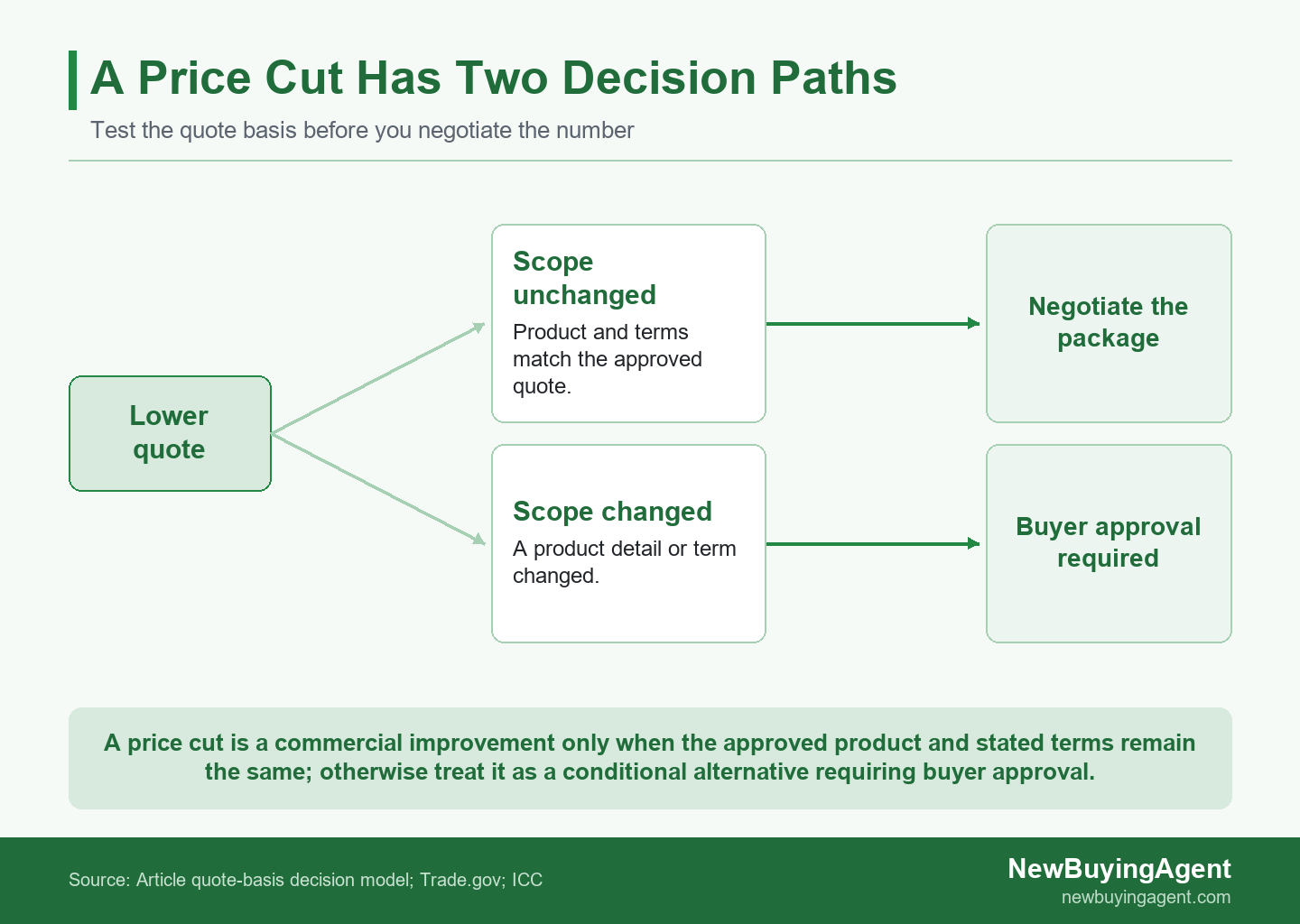
Split-path diagram showing a lower China quote branching into same-scope negotiation or a conditional alternative requiring buyer approval
A conditional alternative is an option that changes a named part of the requested order in exchange for a stated price, timing, or term effect. With that boundary, the agent can ask a factory for meaningful options without treating an unapproved substitution as a saving. For a buyer using NewBuyingAgent, the same written boundary gives local China-side coordination a clear instruction and keeps the buyer's approval point visible.
- Fixed: the product version, buyer-critical requirements, and any non-negotiable timing or destination constraint.
- Open for testing: the limited levers the buyer is willing to evaluate, with their acceptable range.
- Approval trigger: the changes that require the buyer's written decision before an offer is accepted.
- Record: the fields that must appear in the factory's revised quotation and eventual order confirmation.
Lock the Buying Brief Before the Price Conversation
A pro forma invoice is a detailed quote in invoice form that sets out a proposed commercial deal before shipment. Trade.gov lists price, terms of sale, payment terms, estimated shipping date, and validity date among the information to include in a pro forma invoice. Trade.gov's pro forma invoice guidance makes those fields a practical briefing checklist: when one is missing, the agent should ask whether it is unchanged, proposed, or still open, instead of allowing the conversation to collapse into a price-only exchange.
For example, “same product” should point to an identifiable sample, drawing, approved version, or written description. “Same packing” should state the export-carton basis where it affects protection, cube, or handling. The buyer can then authorize the agent to explore a price reduction without authorizing an undefined reduction in the order itself.
Negotiate the Levers in an Order That Preserves Meaning
Negotiate the levers in an order that preserves the meaning of the quote. A useful sequence starts with what must remain unchanged, then tests the least disruptive commercial lever, and only then presents a conditional product or packing alternative. That order lets the buyer see whether a lower number came from volume, timing, payment, delivery responsibility, or a changed product assumption. It also avoids a common trap: debating a price reduction for several days before learning that the underlying quotation no longer represents the required order.
The agent does not need to promise a concession. Its practical contribution is to convert an informal factory response into options with a visible scope and consequence. A factory may decline, offer a different lead time, or require a different minimum quantity; each outcome is still useful when it is recorded in comparable terms.
Make Every Counteroffer Comparable to the Same Product
Trade.gov describes the pro forma invoice as a negotiating tool that records product details, quantity, price, and specifications. Its common export-documents guidance describes that record in the context of an export transaction. The agent can use the same discipline to place the original quote and the proposed revision side by side before asking the buyer to choose.
State any material or export-carton change as a separate conditional alternative. Material, finish, hardware, testing, packing, and delivery assumptions should not be hidden inside a revised description. Then identify the price effect, timing effect, and decision owner. This is especially important when a commercial shorthand such as “lighter build,” “standard carton,” or “usual finish” could describe several possible outcomes. The buyer does not need every factory detail in the mandate; the buyer does need the detail that changes whether the offer is truly the same order.
| Comparison field | Same-scope counteroffer | Conditional alternative |
|---|---|---|
| Product reference | Matches the approved version | Names the proposed material, feature, or construction change |
| Packing basis | Matches the agreed carton and protection method | States the revised packing and its handling or timing effect |
| Commercial term | Uses the requested delivery and payment basis | Names the changed term or milestone with the price effect |
| Buyer action | May proceed within the mandate | Requires the buyer's explicit choice before release |
When the factory cannot keep the same scope at the requested price, that is not a negotiation failure. It is a decision point. The buyer can accept the original scope at the original price, approve a defined alternative, change the order conditions, or stop the conversation before an unclear quote becomes an unclear commitment.
Treat Price, Payment, and Delivery Responsibility as One Commercial Conversation
Incoterms clarify the tasks, costs, and risks carried by buyers and sellers in international goods transactions. Trade.gov explains that the rules also identify the point at which risk of loss or damage passes. The agent should therefore ask for the exact named term and location, then present it with the quote rather than treating logistics responsibility as a later detail.
Trade.gov advises parties to consider payment method during or before contract negotiations. Its payment guidance describes different timing and risk positions for importer and exporter. A sourcing agent can make the trade-off visible by showing the payment milestone beside the price, but the buyer should decide what level of payment, credit, or financing risk is acceptable for the transaction.
ICC describes Incoterms 2020 as rules for allocating delivery responsibilities, costs, and risks between parties. The ICC publishes 11 rules in that framework. It also describes the rules as determining important buyer and seller responsibilities and cost and risk allocation in sales contracts. The ICC's Incoterms 2020 description provides the rule-publisher context. That is why an agent should not report “delivery included” as if it settled responsibility. The counteroffer needs the named rule, named place, and any buyer decision that remains open.
A practical written release line might combine the selected product version, price currency and unit, quantity, named delivery term and location, payment milestones, expected readiness date, and the buyer's approval reference. It is not a substitute for transaction-specific legal, customs, credit, or regulatory review. It is a commercial control that makes the negotiated path easier to recognize when the order passes from quotation to execution.
Illustrative: Turn an Ambiguous Price Cut Into Two Clear Choices
The lower number is not comparable until the material and carton basis are stated. A buyer may reasonably seek a cost reduction, but a factory response that says “lighter cabinet build” and “revised carton” leaves the buyer unable to tell what was exchanged for the saving. The agent's immediate job is to make those conditions visible, not to turn the ambiguity into an assumed acceptance. Buyers who want examples of decisions that benefit from a clear brief and documented follow-through can review NewBuyingAgent success stories.
The Agent's Value Is the Clear Choice, Not a Secret Discount
An outdoor-living retailer is preparing a China-sourced steel storage cabinet in two colorways for a seasonal launch. This illustrative 4,800-unit order receives a lower counteroffer after the buyer asks for a cost reduction before placement. The buyer has a target price and date, but the revised product description does not say whether the original steel gauge, coating standard, hinge specification, and export-carton basis remain in place.
The counteroffer contains a lower unit price, a vague note about a lighter cabinet build, and a revised carton reference. The buyer's launch date makes a late packing correction consequential: even a small change in protection or carton dimensions could surface only when it is difficult to change the release plan. The observable problem is not that the factory made an alternative proposal; it is that the proposal cannot yet be compared to the requested order.
The agent asks for two paths. Path one preserves the approved product and carton basis, with its corresponding price and commercial terms. Path two names every proposed material or packing change, its price effect, timing effect, and the approval needed. The buyer can now use the mandate: approve path one if the original scope matters more, approve path two if the defined trade-off is acceptable, or request another alternative.
The agent's value is the clear choice, not a secret discount. The corrective action is the two-option quote. Before production or packing instructions are released, the selected path is verified against the written material, packing, price, commercial term, and buyer approval reference. This is an illustrative commercial scenario, not a customer case or product-safety, legal, customs, or financial advice; a product-specific requirement still needs the appropriate technical and transaction review.
Where a China Sourcing Agent Adds Leverage Without Taking the Buyer's Decision
NewBuyingAgent can turn a complete purchasing need into a commercially aligned China product-supply discussion. Its local industrial-cluster access and cooperated factory resources can help bring a brief to the right production conversation, while product development and quality-control capability help keep agreed requirements visible. When the buyer is seeking a new China product route, it is useful to use NewBuyingAgent's product-supply service with a complete brief rather than starting with an unbounded request for “the lowest price.”
The buyer still owns the commercial decision. A productive mandate tells the agent what may be explored and what needs escalation; it does not transfer the buyer's market, margin, product-positioning, or risk decision to a third party. The agent can develop a clearer commercial picture through product selection, cost negotiation, production follow-up, quality control, and logistics coordination, but the chosen trade-off should remain recognizable to the person responsible for the order.
That record also makes escalation more useful. Instead of asking whether a factory “can do better,” the buyer can ask for a defined same-scope counteroffer, or for a named alternative with the consequence attached. The agent can return with the information needed to choose: what remains fixed, what moves, which commercial term applies, and which point needs approval. That approach does not remove the need for product-specific review; it makes the buyer's next review more focused.
A compact request also improves the response time of the conversation. It gives the factory a reference point, gives the agent a boundary for follow-up questions, and gives the buyer a test for deciding whether a revised offer is ready. The result may still be an unchanged price, a revised lead time, or a different quantity requirement. Those outcomes are more useful than an unexplained number because they can be accepted, declined, or returned for another defined option.
Before sending the next negotiation request, collect the approved product reference, the current quotation, the changes the buyer is willing to consider, the required decision date, and the person authorized to approve a conditional offer. If local China-side coordination would help turn those limits into a clear factory conversation, share the project brief with NewBuyingAgent.
Use a Different Boundary When the Factory Is Already Chosen
With an existing factory, begin by separating what is already committed from what can still be discussed. The team may need to gather a production-status update, confirm the currently approved product record, reconcile an open quality observation, or establish the facts behind a timing concern. Those tasks can support a later buyer decision, but they do not by themselves authorize a revision to price, scope, or payment. A clear handoff identifies the open question, the documents that answer it, the China-side person who can obtain those documents, and the buyer authority required if the facts call for a commercial decision. This is particularly helpful when multiple messages, samples, and packing instructions have accumulated over the life of an order.
Existing China supplier issues need a different service boundary from a new product-supply quote. The boundary changes when the buyer already has a China factory relationship and needs execution support instead of a new product-supply conversation. In that situation, the negotiation context may be tied to existing specifications, open production issues, quality follow-up, shipment timing, or factory communication. The buyer should identify which open factory facts are already documented, which instructions have been released, and who may approve a commercial change. This helps distinguish a request for clearer execution from a request to reopen the original buying decision. It also gives the China-side team a workable scope for communication, production follow-up, quality checks, and logistics coordination. When that is the needed boundary, buyers can use NewBuyingAgent's factory-management service for an existing China supplier.
That distinction keeps expectations honest. A factory-management assignment can help surface the production and commercial facts needed for a buyer decision, but it should not imply that every historical price, relationship term, or product change can be reopened at will. The useful question is whether the buyer needs a new sourcing path, or stronger execution and communication around the factory already selected.
Frequently Asked Questions
Can a China sourcing agent negotiate a lower factory price?
A China sourcing agent can negotiate price, but the result is useful only when the agreed product, packing, payment basis, and delivery responsibility remain visible. A lower number may be a genuine same-scope concession, or it may describe a different commercial path that needs the buyer's approval. Ask the agent to return a stated quote basis and a written description of every condition attached to the reduction.
What should buyers give an agent before negotiation starts?
Give the agent the product reference, expected volume, destination, timing, fixed requirements, commercial target, and clear authority for the trade-offs it may test. Add an approval trigger for anything that changes the intended product, risk position, or delivery commitment. If a product sample, drawing, or packing standard is already approved, identify that record so the factory's counteroffer can be compared to the same version.
Are payment terms part of sourcing negotiation?
Yes. Payment terms affect cash-flow timing and the risk carried by each party, so they should be evaluated beside the price and delivery term. The appropriate choice depends on the specific transaction and the buyer's own risk assessment. A revised payment milestone can change the value of a lower unit price, which is why it belongs in the same counteroffer rather than in a separate informal message.
When should a buyer reject a lower China quote?
Reject or reframe a lower quote when it quietly changes the required material, packaging, payment milestone, delivery responsibility, or documented product version. Ask for a same-scope offer and a clearly labeled conditional alternative, then approve only the path that matches the buying decision. If the factory cannot state the changed condition and its effect, the buyer has not yet received an offer that can be evaluated responsibly.
NewBuyingAgent
Related Resources

Get Started Today
Let's Turn Your Sourcing Goals into RealityWeChat:+86 15157124615
WhatsApp:+86 15157124615
Address:Building 10 #39 Xiangyuan Road, Hangzhou, China
