

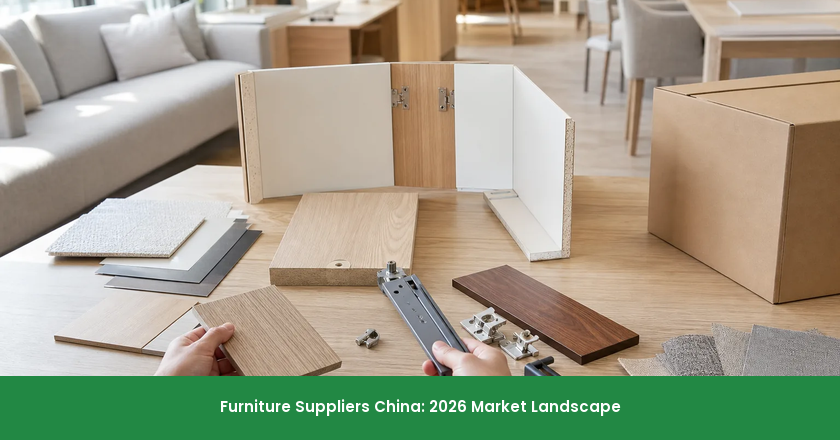
A broad China furniture search can produce hundreds of credible-looking offers while leaving the purchase decision undefined. The difficult part is not finding product photos or a familiar region; it is making sure the sample, materials, destination evidence, packaging, and delivery records all describe the same furniture version. Treat the 2026 market landscape as a way to build that decision, not as a ranking of factories.
What needs to line up before a furniture quotation is useful?
- Market scale is context, not proof. A large export category says nothing about whether two offers use the same panel construction, finish, cartons, or release records.
- Construction comes before a location label. A bedroom chest, upholstered lounge chair, flat-pack cabinet, and hospitality table create different material, hardware, packing, and destination questions.
- Destination evidence belongs to the item. Composite panels, clothing storage units, wood-origin claims, and general product-safety obligations each have a different scope.
- Release needs a document trail. A signed brief, approved sample, component revision, and carton identifier should point to one controlled product version.
A market landscape is a decision map, not a supplier ranking
A market landscape is useful when it turns a category into a product decision, not a ranking. For furniture suppliers in China, the useful first question is not “Which name is best?” It is “What exact item am I asking the market to make and deliver?” That shift matters because furniture combines visible materials, hidden substrates, hardware, dimensional tolerances, protective packing, and a destination-specific selling context.
That does not mean every project needs a long technical dossier on day one. It means the buyer should decide which facts cannot be left as assumptions: product use, construction, finish, visible and hidden materials, pack format, destination, quantity, and timing. Those fields create a fair basis for discussing price and lead time later.
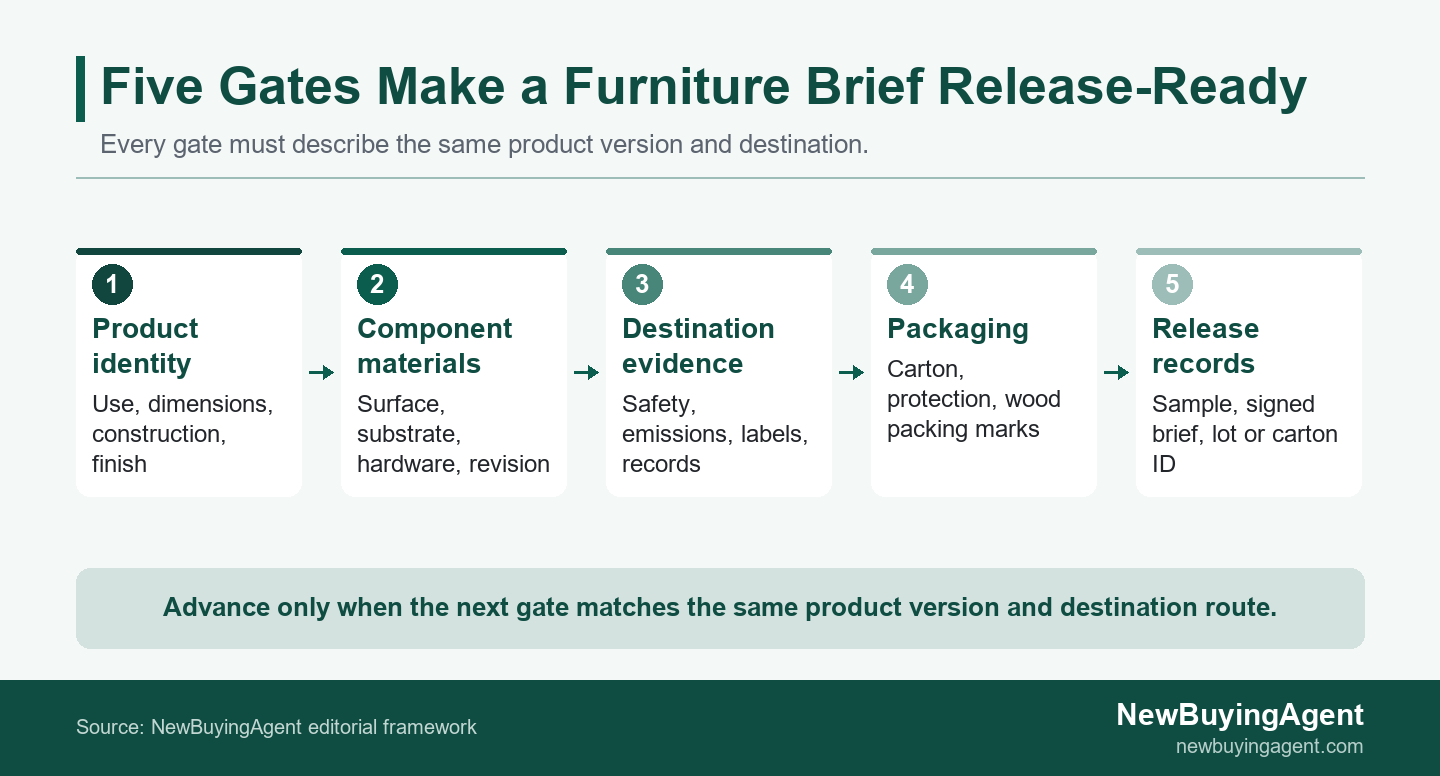
Advance only when each gate still describes the same product version and destination route.
What China's furniture supply landscape means in 2026
WITS reports China HS 9403 exports to the world at USD 36,437,902.45 thousand in 2024. China remains a major furniture export base, but HS 9403 is a customs category for furniture and parts not elsewhere specified. The figure is a scale signal—not a statement about total market value, one product class, or one factory’s capability.
A trade category cannot prove that two products share the same construction, evidence, pack method, or delivery condition. Trade categories group unlike products together; they cannot show whether a quotation for a veneered chest uses the same drawer substrate, hardware grade, carton protection, or compliance assumptions as another quotation. Use market scale to justify a disciplined brief, then use the brief to narrow the actual buying decision.
At this early stage, buyers who are still deciding between a furniture category, finish direction, or market position can add market-fit product research before asking for a detailed offer. The goal is to prevent a decorative trend decision from being separated from construction and delivery realities.
Start with the product family, not a city name
A buyer can make a market search usable by defining product family, construction, channel, and pack configuration first. Furniture clusters and showroom districts can be valuable research routes, but they are not a substitute for that definition. A flat-pack retail cabinet, a hospitality bedside table, and a direct-to-consumer dining table may share a silhouette while needing very different assembly, durability, carton, and documentation decisions.
Furniture quotations become comparable when material allocation, dimensions, finish, hardware, packaging, quantity, and destination assumptions share one brief. Ask every offer to identify those fields and the commercial handoff. A price is only comparable when those assumptions are comparable.
Trade.gov describes China's standards and conformity-assessment landscape as involving multiple authorities. That is a useful reminder that a general China-side certificate is not automatically the evidence needed for the destination where the item will be sold.
| Product family | Decision that changes the brief | Evidence to request before comparison |
|---|---|---|
| Flat-pack storage | Panel construction, assembly, edge treatment, carton load | Component sheet, assembly version, carton drawing and drop-risk assumptions |
| Upholstered seating | Frame, foam, fabric, cover method, dimensional tolerance | Material allocation, cover reference, hardware list and pack method |
| Bedroom storage | Drawer construction, tip-over route, load-bearing hardware | Product-use scope, component revision, applicable destination evidence |
Use the Furniture Procurement Readiness Framework
The Furniture Procurement Readiness Framework uses five gates: product identity, component materials, destination evidence, packaging, and release records. It is a simple editorial method for turning market research into a request that can be checked, not a certificate. Its value is that each gate asks whether the next record still refers to the same product version and the same selling destination.
Start with product identity: item use, dimensions, construction, finish, and channel. Then allocate the component materials instead of relying on one broad phrase such as “solid wood” or “veneer.” Add the destination evidence question before sampling, not after a carton is ready. Finally, specify the packing route and the records that connect the approved sample to production. A missing field is not automatically a failure, but it is a reason not to treat two offers as equivalent.
A buyer-defined furniture brief is the practical starting point for NewBuyingAgent product-supply support in China. When that brief is defined, a buyer can turn a defined furniture brief into a China-supplied offer. The useful handoff is a concrete product request and its evidence questions—not a request for a generic market list.
Translate materials and destination rules into evidence
EPA identifies hardwood plywood, MDF, particleboard, and finished goods containing them in the TSCA Title VI composite-wood framework. A material label may describe the visible surface while saying little about the inside of the item. Here, composite wood means wood-based panels such as MDF, particleboard, or plywood used as parts of a finished item. The EPA guidance means the buyer needs component allocation, not merely a reassuring furniture description, before deciding what evidence to request.
The NIST record identifies a safety standard for clothing storage units under 16 CFR part 1261. Product use therefore changes the question: that route is not a universal rule for chairs, tables, or all cabinets. It is a prompt to identify when a drawer chest or similar item is within a product-specific route and to confirm the current requirements with the responsible compliance party.
The European Commission lists wood and derived products including furniture in EUDR scope, with application dates varying by operator category. For an EU-bound wood product, the destination question can include traceability and deforestation-related scope. The Commission’s EUDR guidance does not make every furniture item automatically identical; it tells the buyer to establish the actual product, operator role, and route before treating an origin claim as complete.
The European Commission states that Regulation (EU) 2023/988 has applied since 13 December 2024. The same discipline applies to broader EU product safety. Its general product-safety standards guidance is a reason to verify the item-level standard, warnings, instructions, and economic-operator responsibilities that apply to the actual furniture product; do not treat a generic “EU compliant” statement as an answer.
A worked furniture brief conflict: drawers, panels, and documents
The worked drawer-chest conflict is illustrative, not a client result or product test. This example shows why the document version matters as much as the attractive exterior sample when the destination route depends on hidden construction.
When a declaration and the product construction point in different directions
A buyer that already works with a China factory may need quality and delivery coordination once a controlled product brief exists. The buyer can coordinate quality and delivery with an existing China factory through NewBuyingAgent once the record is controlled; that support does not replace the buyer’s responsibility to define the intended item and market.
An illustrative home-furniture buyer is preparing a 720-unit bedroom-storage order with an existing China factory for a U.S. retail launch. The order covers 720 drawer chests in 2 finish colors, packed in 360 export cartons across 4 planned shipment groups. The quote names a veneer exterior, but the construction sheet does not allocate composite panels to drawer parts or identify the document version for those components.
The draft declaration refers broadly to the item while the bill of materials shows MDF-backed drawer components. The sample’s drawer interior and the current component sheet use different revision dates, so the buyer cannot tie the evidence to the production construction. The buyer has a document-product conflict: the component record and the physical construction do not point to one controlled version for the destination route.
Hold release of the affected construction version until the bill of materials, destination documentation, and sample reference identify the same drawer components and revision. Create a component allocation sheet that names visible surface, substrate, drawer parts, document owner, and revision date; attach it to the sample and packing release record. Release only after the signed component sheet, applicable destination evidence, approved sample, and carton-level product identifier agree. This illustrative example is not a NewBuyingAgent client result, a product test, or legal advice. Applicable requirements depend on the product and destination.
Packaging and handoff belong in the product decision
ISPM 15 describes treatment and marking measures for covered wood packaging material in international trade. Furniture wood and export wood packaging are related but not interchangeable questions. If an order uses wooden pallets, crates, or dunnage, capture that packing route separately from the construction description for the table, chest, or chair inside the carton.
FSC describes chain of custody as a material-verification route across sourcing, production, and distribution. It can support a defined material claim, but it does not replace finished-product safety, emissions, performance, labels, or packaging checks. State the claim, the material scope, and the record owner so a carton mark does not become a substitute for product evidence.
Before production release, ask one handoff question: can a third party identify the intended product version from the signed brief, the approved sample, the carton label, and the packing list without reconstructing the decision from emails? If not, the order is still relying on memory rather than a controlled record.
Turn the landscape into a usable purchase brief
A concise furniture purchase brief is an editorial tool for turning market research into a quote-and-release request. It is more useful than a broad request for “furniture suppliers in China.” Include the product family and selling channel; drawings or reference photos; dimensions and construction; materials by component; finish and hardware; required destination evidence; quantity and target timing; carton and pallet expectations; and the approval and release record expected before shipment.
Use the framework as a gap check, not a paperwork exercise. If the buyer cannot yet name a component material or destination route, flag it as open rather than allowing it to disappear in the quotation. If packing changes, ask whether the carton identifier and release record still point to the same product version. This is how market research stays connected to a shipment decision.
When the brief is ready, buyers can send a furniture purchase brief to NewBuyingAgent.
Frequently asked questions
Furniture procurement answers remain conditional to product construction and destination route. These short answers clarify where the framework changes, not a universal rule for every furniture item.
Which Chinese furniture region should buyers start with?
Start with the product family and construction you need, then use a region as a research route rather than proof that a particular item is ready to buy. A location can help organize factory visits, showroom research, or product references, but it cannot confirm that the quoted item uses the required materials, hardware, packing, or destination evidence. Use the same written brief wherever the search begins.
Does FSC certification prove every furniture component is compliant?
No, FSC certification alone does not prove that every component and finished-product obligation is satisfied for the intended destination. Chain-of-custody evidence can support a specific material claim, but it does not replace destination-specific safety, emissions, construction, or labeling checks. The buyer should ask which components carry the claim, which record supports it, and which separate product requirements apply in the intended market.
What should a furniture quotation include before sampling begins?
A usable quotation should identify the product version, materials by component, dimensions, finish, hardware, test or document needs, packing assumption, quantity, destination, and commercial handoff. Add a clear sample reference and revision date when a visible finish, drawer construction, or panel allocation matters. That does not remove negotiation, but it exposes whether two offers are describing the same item before sampling consumes time.
Are wood pallets and wooden furniture regulated in the same way?
No, wood pallets and wooden furniture are not regulated in the same way because transport packaging and the product follow different scopes. Document product construction and the export-packing route separately. A wood table, a pallet, a crate, and dunnage may each call for different records or treatment questions. Confirm the applicable destination requirements for the actual shipment.
NewBuyingAgent
Related Resources



Get Started Today
Let's Turn Your Sourcing Goals into RealityWeChat:+86 15157124615
WhatsApp:+86 15157124615
Address:Building 10 #39 Xiangyuan Road, Hangzhou, China
